
From Fox News Latino:
WASHINGTON – For the first time, racial and ethnic minorities make up more than half the children born in the U.S., but demographers believe the Latino population boom may have peaked thanks to a longer-term decline in immigration.
The growth is rooted in large part to decades of heady immigration growth that is now slowing. New 2011 Census estimates highlight sweeping changes in the nation's racial makeup and the prolonged impact of a weak economy, which is now resulting in fewer Hispanics entering the U.S.

As a whole, the nation's minority population continues to rise, following a higher-than-expected Hispanic count in the 2010 Census. Minorities increased 1.9 percent to 114.1 million, or 36.6 percent of the total U.S. population, lifted by prior waves of immigration that brought in young families and boosted the number of Hispanic women in their prime childbearing years.
But a recent slowdown in the growth of the Hispanic and Asian populations is shifting notions on when the tipping point in U.S. diversity will come — the time when non-Hispanic whites become a minority. After 2010 census results suggested a crossover as early as 2040, demographers now believe the pivotal moment may be pushed back several years when new projections are released in December.
There are larger implications as the population mix changes. The largest implication is what happens when the U.S. no longer has a well-informed electorate?
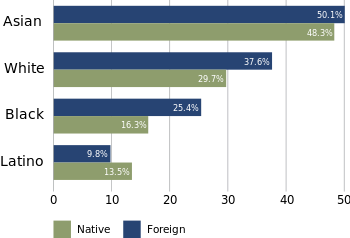
The difference among races and cultures, both native and foreign born, in regard to those who have earned a Bachelor's degree or higher.
[source]
If the Latino population increase has been propelled by immigration... legal or otherwise... something will have to change in their cultural attitudes toward education if they are to be more than serfs or political pawns to the promise of government goodies.
The last thing America needs for its economic future is a growing "victim" minority relying on the government for its daily needs.

[source]
Fortunately, Latino families seem to have a much stronger family network than blacks. Still, not being an economic drain is not quite the same as being a strong contributor to economic growth. Generally, Latinos have shown a strong sense of community and work ethic. Sure, there are gang problems in large cities, but there is not the underlying malaise seen in the black communities.
While the economic implications of the U.S. becoming a nation of minorities are uncertain, there are bound to be significant cultural and political issues in the next several decades. The large question is whether the "American dream" becomes another "Balkan Nightmare."
Nothing lasts forever, but let's hope that our children's grandchildren can still feel America is a great nation.