READ ABOUT DETROIT AND SOLUTIONS TO ITS PROBLEMS. CLICK HERE.
Showing posts sorted by relevance for query "oil prices". Sort by date Show all posts

Wednesday, May 14, 2008

Increasing Supply Of Oil Rejected

SEARCH BLOG: OIL and POLITICS

The following email and news article may give you an idea of what we are facing when politicians decide that the government should fiddle with the economic law of supply and demand.

From Sen. Carl Levin:

I want to share with you a speech I gave in the Senate today regarding soaring energy prices. Record high gas and diesel prices have reverberated throughout our economy, hitting the pocketbooks of ordinary Americans and inflating the price of everything from food to manufactured goods. Action is clearly needed to combat these skyrocketing energy prices which are a threat to our economic and national security.

During the past few years, both as Chairman and as Ranking Member and of the Senate Permanent Subcommittee on Investigations (PSI), I have led a number of investigations examining U.S. energy markets and rapidly rising oil and gasoline prices. As a result of these investigations, I have been advocating a number of measures to address the rampant speculation and lack of regulation of energy markets, which have greatly contributed to the recent run-up in fuel prices.
Four specific policies should be immediately adopted to combat the absurd prices Americans are paying at the pump. These policies are contained in the Consumer-First Energy Act of 2008 (S.2991), which was introduced by Senator Harry Reid (D-NV) on May 7, 2008. I am an original cosponsor of this important legislation.

First, we need to put a cop back on the beat in all energy markets that affect the U.S. in order to prevent the excessive speculation and price manipulation that drives up the price of a barrel of oil. The trading of contracts for the future delivery of oil and gas has increased six-fold since 2001. Much of this increase can be attributed to speculators, who buy and sell futures contracts for crude oil and leverage them just to make a profit, creating an artificial “paper demand” that does not accurately reflect actual market conditions. While the Commodity Futures Trading Commission (CFTC), the main federal regulator charged with policing U.S. energy commodity markets, has the authority to regulate certain commodity markets, it cannot police one of the biggest energy markets due to the “Enron loophole,” a provision in law that exempts electronic energy exchanges from government oversight. In September 2007, I introduced legislation (S.2058) that would close the Enron loophole and regulate electronic energy markets. In December 2007, I was able to successfully work with my colleagues to insert language from S.2058 into the Farm Bill that was passed by the Senate on December 14, 2007 (H.R.2419). Last week, the House and Senate conferees on the Farm Bill reached agreement to include our legislation in the final Farm Bill. I am hopeful that Congress will finally pass this important legislation – and the President will sign it – shortly.

The Consumer-First Energy Act contains a provision to close another loophole in the regulation of our energy markets. One of the key energy commodity markets for U.S. crude oil, gasoline, and heating oil is now located in London, outside the reach of U.S. regulators. This means that traders can avoid our government’s limits on speculation and reporting requirements by using the London exchange. The Consumer-First Energy Act includes a provision to stop rampant speculation and increase our access to timely and important trading information and ensure that there is adequate market oversight of the trading of U.S. energy commodities no matter where the trading occurs. This provision is so important that I have introduced this provision as a separate bill, S. 2995.

Another policy that should be implemented to help alleviate some of the upward pressure on oil prices is
the suspension of the filling of the Strategic Petroleum Reserve (SPR). In 2003, the Permanent Subcommittee on Investigations released a report showing that the Bush Administration’s policy of placing large deposits of oil into the SPR was increasing prices but not overall U.S. energy security. For the past few years, over repeated objections from its own experts at the Department of Energy (DOE), the Administration has continued to fill the SPR regardless of the price of oil or market conditions. Given the fact that the SPR is more than 95 percent full, it makes little sense to be filling the SPR when the price of a barrel of oil is hitting record highs on a daily basis. That is why I have co-sponsored a bill (S.2598) to suspend the SPR fill for one year, or until prices fall to more acceptable levels, whichever comes first. Passing this legislation will save the taxpayers money and relieve some of the pressure on the oil markets that is driving prices relentlessly higher.

While closing the Enron loophole and temporarily stopping the filling of the SPR will help lower energy prices in the near-term, we need to develop a long-term, comprehensive energy plan to decrease our reliance on oil. By
investing in new technologies and alternative energy sources, we will significantly reduce our dependence on foreign oil. I have long been a supporter of advanced automotive technologies such as hybrid electric, advanced batteries, hydrogen and fuel cells and promoted development of these technologies through federal research and development and through joint government-industry partnerships. The federal government must do its part first to develop these technologies so that they will then in turn be within reach of the American public.

Finally, while the American consumer is increasingly burdened by record prices at the pump, major oil companies have been reporting record-breaking profits. Instead of utilizing these windfall profits to develop new technologies or boost production, these companies have been buying back shares to inflate their earnings and reap further profits.
I have supported windfall profits taxes in the past, and I will continue to support them in order to encourage the sensible use of oil company resources.

These four common sense policies could do a great deal to lower energy prices and alleviate some of the pressure the average American is feeling in this difficult economy. If you would like to learn more about the Consumer-First Energy Act, or view my statement on actions we should take to lower oil and gas prices, I encourage you to click on the following link <http://levin.senate.gov/newsroom/release.cfm?id=297663>.

Sincerely,
Carl Levin

Let me summarize the four policy points proposed by the senator:
  1. Increase regulation on oil trading
  2. Suspend filling the Strategic Petroleum Reserve
  3. Focus on alternative energy
  4. Implement a windfall profits tax
Now let's look at a UPI article:
WASHINGTON, May 13 (UPI) -- The U.S. Senate Tuesday rejected an attempt to expand offshore oil and gas drilling to allow the states to generate revenue.

The Republican-backed proposal would have allowed states to drill off their coasts and share revenues with the federal government, the (Newport News, Va.) Daily Press reported.

The amendment would have amended a federal ban prohibiting offshore drilling along most coastal states, the newspaper said.

The state proposal was packaged with other controversial measures, including drilling in the Arctic National Wildlife Refuge.

The amendment was rejected on a mostly party-line vote of 42 to 56.

Sen. David Vitter, R-La., urged his colleagues to support the measure, noting that his home state of Louisiana has profited from offshore drilling in the Gulf of Mexico.

"We need to expand on that policy to dramatically increase our domestic energy production," he said.

But Democrats said an expansion of offshore drilling would do little to reduce Americans' dependence on foreign oil.

"We can't drill our way out of this problem," said Sen. Richard Durbin, D-Ill. "We can't drill our way to lower gas prices."

[HT Redneck's Revenge]

Let me summarize that for you:
  1. A proposal to increase the supply of domestic oil and allowing states to benefit from that was rejected along political party lines.
  2. Democrats view increasing the supply of oil as irrelevant to the price of gasoline.
Now, let me interpret that for you:
  1. The government must rigidly control the actions of the marketplace
  2. The government must rigidly control supply
I seem to recall a similar statement of political philosophy from the past.


..

Thursday, January 10, 2013

Gasoline Prices To Go Down... Up... Down... Up

SEARCH BLOG: GASOLINE.

It's interesting to follow the "experts" when it comes to gasoline price predictions.  One gets the feeling that an expert is only such in forecasting the past.

The government is quite optimistic that gasoline prices will fall.  That's because the economies of the world are improving which will lead to greater demand which will lead to falling prices.  Perhaps there is a supposition that there will be even greater supply... something that "peak oilers" have denied... to offset the greater demand.

In its monthly Short-Term Energy Outlook released today, the U.S. Energy Information Administration (EIA) has for the first time forecast crude oil prices for 2014 to go along with forecasts for this year. A more dramatic difference, though, comes in the expected differential between WTI crude prices and the price for Brent crude.
The EIA reported that the price of Brent crude in 2012 averaged $112 a barrel and expects that to fall to an average of $105 a barrel in 2013 and to $99 a barrel in 2014. The differential between Brent crude and WTI crude averaged $18 a barrel in 2012, and the differential is expected to fall to $16 a barrel this year and to $8 a barrel in 2004.
Based on the EIA’s figures, WTI crude will average about $89 a barrel in 2013 and $91 a barrel in 2014, compared with $94 a barrel last year. WTI crude is trading at around $93 a barrel today.  ]Read more: Gasoline, Oil Prices to Fall Further — EIA - 24/7 Wall St.
On the other hand...
The current national average for a gallon of regular gasoline is $3.30. Drivers shouldn’t expect prices to get cheaper at any point in 2013.
That’s according to the analysts at GasBuddy, who have just released a forecast for gas prices throughout 2013, which include month-by-month projections. The predictions call for an average price of $3.29 throughout January, followed by a gradual run-up to the year’s highest prices come springtime. Prices are expected to retreat in fall and early winter, though the lows reached in December 2012—average of $3.25 per gallon nationwide—aren’t likely to be repeated.  [Read more: http://business.time.com/2013/01/09/2013-gas-price-forecast-around-4-per-gallon-by-spring/#ixzz2HaGDEnLy]
On the third hand...
Increased domestic oil production and lower demand will push gas prices lower in 2013, AAA said.
The national average price of gasoline should peak at $3.60-$3.80 per gallon barring any significant unanticipated events, which compares to a peak of $3.94 a gallon in 2012.
Wednesday's national average price of gasoline was $3.30 per gallon, which is 7 cents less than last year and 4 cents less than a month ago.
Florida’s price per gallon now averages $3.41 — up 5 cents over last week, AAA Auto Club South said. Gas prices in Jacksonville averaged $3.45 a gallon on Thursday, up 7 cents from a week ago. [source]
On the fourth hand...
But oil prices should dictate what happens next with pump prices. The economies in the U.S. and China are showing improvement, while Europe remains in recession. 

"They set it down and raise it back up whenever they want to; right before Christmas it seemed to go down quite a bit and the right back up after Christmas it seems to jump right back up again," said Jackson resident, Tim Caldwell.

Energy experts said the wild card in prices is the Middle East.  In the past two years, threats to shipments of oil form the region drove crude prices during the winter, which led to a surge in prices. [source]
So there you have it... forecasted gasoline prices for 2013 will be either up or down.
..

Sunday, April 20, 2008

Reply From Senator Levin Regarding Oil and Gasoline Prices

SEARCH BLOG: OIL and POLITICS

On March 30, I wrote to the two U.S. senators from Michigan regarding the present situation of oil and gasoline prices, as well as related energy policies. This site contains other posts regarding U.S. energy policies. If you haven't done so, you may want to read Friday's post and follow some of the links.

While the following email from Sen. Carl Levin's office may not represent the whole picture... especially the government's part in restricting supply... the issues raised in this response need to be evaluated, especially in the area of market speculation abuses [does that remind you of the recent sub-prime and hedge fund fiascoes?]. In evaluating what should or can be done, keep in mind that some of the aspects are global and some are purely national.

This is, most likely, a standard response to this issue, but it is worth reading to understand some of the politics involved:

Dear Mr. Hall:

Thank you for contacting me with your concerns about the price of gasoline. I appreciate hearing from you on this matter.

For most Americans driving is not a matter of choice. In many areas, people cannot drive less to get to work, school, medical care, or to buy groceries. Therefore, they are forced to pay whatever the oil companies charge for gasoline. During my time in the Senate, I have worked to protect consumers, farmers, and small businesses from potentially overwhelming price hikes in oil and gas prices. When prices spiked after Hurricane Katrina, I introduced a bill to give the President the authority to temporarily freeze gasoline and petroleum product prices until supplies were restored to pre-hurricane levels. I also have supported measures to impose temporary windfall profit taxes on oil and gas companies found to be guilty of price gouging.

Even when our refineries have been operating at full capacity, I have been concerned about the manipulation of the price of oil, gasoline, diesel and other refined products, such as home heating oil and jet fuel. Over the past several years, both as Chairman and Ranking Member of the Senate Permanent Subcommittee on Investigations, I have conducted investigations into the reasons for these rising prices. In 2002, I led an investigation which found that increasing concentration in the refining industry was contributing to price spikes. In 2003, I led an investigation which found that the Department of Energy’s (DOE) purchases of oil for the Strategic Petroleum Reserve (SPR) were pushing up oil prices. Under my leadership, the Subcommittee is currently conducting an investigation into energy trading and the manipulation of energy prices.

At the same time that gas prices have been rising, often seemingly contrary to the laws of supply and demand, there has been a dramatic increase in oil and gas trading by market speculators. Energy trading can be a very complicated matter, but the basics are straightforward: energy traders buy and sell contracts for the future delivery of oil and gas on futures exchanges such as the New York Mercantile Exchange (NYMEX) and the Intercontinental Exchange (ICE). Some of these traders are oil companies and refineries buying or selling oil and gas contracts, while others are speculators who bet on energy prices either increasing or decreasing before final delivery of these commodities.

The Commodity Futures Trading Commission (CFTC), the main federal regulator charged with policing U.S. energy commodity markets, is supposed to ensure that buyers and sellers in energy futures markets are not engaging in excessive speculation or illegally manipulating oil and gas prices. While the CFTC is able to regulate exchanges such as the NYMEX, it cannot police all U.S. energy commodities markets due to the “Enron loophole,” a provision in law that exempts electronic energy exchanges from government oversight. This provision has enabled companies like Enron to trade on electronic markets without any oversight from the CFTC. Traders on unregulated markets are able to buy massive stakes in energy commodities, possibly manipulating or distorting energy prices. In 2006, my investigation found that experts estimated market speculation could account for more than 25% of the cost of a barrel of oil. In 2007, my investigation found that large trades by a single hedge fund named Amaranth had pushed up natural gas prices during the winter of 2006-07. We need to put a “cop” back on the beat to protect American consumers from the price manipulation and excessive speculation that can occur on these unregulated electronic markets.

On September 17, 2007, I introduced the Close the Enron Loophole Act (S.2058). This legislation would help to prevent price manipulation by directing the CFTC and electronic exchanges to police energy commodity trading. This bill would help prevent excessive speculation and price manipulation by providing the CFTC with the authority needed to monitor and regulate electronic exchanges, something it already does with futures exchanges like the NYMEX. I worked to insert language from the Close the Enron Loophole Act into the Farm Bill that was passed by the Senate on December 14, 2007 (H.R.2419). Before it can be signed into law, the Farm Bill must be reconciled with similar legislation passed by the House of Representatives. If this measure were to be enacted by Congress and signed into law, it would significantly strengthen the federal government’s ability to police our energy markets.

We need to continue to develop a long-term, comprehensive plan that will conserve energy, increase our domestic energy supplies in a responsible manner, and increase the use of alternative fuels in order to enhance our nation’s energy independence. I believe we should invest in leap-ahead technologies like hybrid and hydrogen vehicles. By working with industry leaders to achieve new technological breakthroughs, we will help create jobs and spur our economy. With significant investments in research and development, public-private partnerships and incentives for manufacturers to invest in new technologies, we can make great strides in hybrid and alternative fuel vehicle technologies and dramatically reduce our dependence on gasoline. This type of comprehensive approach will reduce the cost of gas in the long run and enhance our national security by allowing for greater energy independence. As the Senate continues to debate our national energy policy, I will continue to work toward this goal.

Thank you again for writing.

Sincerely,
Carl Levin
ADDENDUM:
Further reading: United States Senate PERMANENT SUBCOMMITTEE ON INVESTIGATIONS...THE ROLE OF MARKET SPECULATION IN RISING OIL AND GAS PRICES: A NEED TO PUT THE COP BACK ON THE BEAT

..

Sunday, February 26, 2012

Oil Production Increased During Obama's Administration

SEARCH BLOG: OBAMA and OIL

President Obama recently pointed out that domestic oil production has increased during his administration.  True.  But he is taking credit for those increases which occurred because they were outside of federal jurisdiction.

The increase in domestic drilling was almost entirely in areas for which the Obama administration exercised no authority, as oil production on federal land declined by 11 percent in fiscal year 2011, according to a study by the Institute on Energy Research (IER), a free-market energy think tank. But oil production on state lands increased that year by 14 percent and increased by 12 percent on private lands.

Increases? Yes.  His doing? No.

About a year ago, the headlines read:
U.S. approves first deepwater oil drilling permit since BP spill 
Published: Monday, February 28, 2011, 9:05 PM 
You should remember that during the time when the Obama administration was dragging its collective feet, China and Cuba were doing the drilling dance not far from U.S. shores.

But, you say, the Obama administration was simply being responsible.  When the time was right, the Obama administration acted decisively to ensure a new flow of oil for the country.

Eh, not exactly....  From one week earlier:
Court orders Obama to act on drilling permits

February 21, 2011: 11:14 AM ET 
NEW YORK (CNNMoney) -- A federal court ordered the Obama administration Thursday to act on five deep water drilling permits in the Gulf of Mexico within 30 days, calling the delays in issuing new decisions "unreasonable, unacceptable, and unjustified."


Still, with environmental concerns, President Obama was completely justified in stopping oil exploration.
Bill Clinton: Drilling delays 'ridiculous' 
Bill Clinton reportedly criticized delays in oil drilling permits since last year's spill in the Gulf. | AP Photo
CloseBy DARREN GOODE | 3/11/11 4:55 PM EDT 
Former President Bill Clinton said Friday that delays in offshore oil and gas drilling permits are “ridiculous” at a time when the economy is still rebuilding, according to attendees at the IHS CERAWeek conference.
Oh, but that was so last year!


True, Obama has had a chance to change directions and make the U.S. less dependent on oil from OPEC.
Obama’s Keystone pipeline rejection is hard to accept
January 18, 2012 
But one has to admire Obama for being consistent about his anti-oil policies.

Besides, the economy is recovering.  What's the big deal? Well, oil prices are up from $33.07 in January 2009 when Obama took office to...


That more than tripled ... and that's just the start.  The story, of course, is that starting expansion of drilling would take 3-4 years to influence oil supply.  Uh, help me with the calculations here, but isn't it three years since 2009?

Gas prices high? No magic bullet, Obama says. 
Gas prices rise to average $3.65 a gallon, a record for this time of year. Obama dismisses GOP plans to lower gas prices as 'bumper sticker' answer.  
Oil prices are approaching last year's highs as tensions increase over Iran's nuclear program. The rise pushed gasoline prices Friday to a national average of $3.65 a gallon, the highest ever for this time of year.
The most recent innovation of the Obama administration to ensure no lessening of foreign oil dependency is aggressive regulation.


Now we understand.  It is not necessary for the U.S. to increase its own supply of oil because those are "bumper stick" solutions to high gasoline costs in the U.S. which is the result of the fear of not having enough oil because of actions by countries like Iran on whom the West is dependent for some of its oil.  

In other words, being less dependent on unreliable sources of foreign oil would not make any difference regarding the impact of being dependent on foreign oil... so we're just not going to do anything about it.  Same story 100th verse; a little louder, a little worse.

MONDAY, FEBRUARY 20, 2012

Energy - Obstructionism As Policy

SUNDAY, FEBRUARY 26, 2012


2012 IS HERE

..

Wednesday, April 11, 2012

Evil Oil Companies?

SEARCH BLOG: OIL and ENERGY

I get emails from various politicians.  They have issues.  They have plans.  They want to know your opinion... or maybe just want you to think they want your opinions... hard to say.  This one was just received and elicited a response.  I'll not embarrass the sender by including a name.

April 11, 2012 
Dear Friends,
While oil companies are making record profits – the five biggest took home more than $137 billion in profits last year – the rest of us are paying more at the pump.  
It doesn’t make sense. We’re at an eight-year high in domestic oil production, and domestic demand for oil and oil products is down. That means supply is high, demand is low, but we’re still stuck with high prices at the pump. So what do we do?  
I’ve got some ideas, and I want to hear yours. Like many Ohioans, I’m tired of the stranglehold oil companies have on our national energy policy. And like many Ohioans, I believe we need to take a “do it all” approach to reducing gas prices. 
Please tell me which of these actions you support to reduce gas prices: 


Your Priorities: Gas Prices


Do you feel that these actions are important?

Yes

No
1. Crack Down on Speculation: Prevent Wall Street speculators from driving up the price at the pump. A recent report found that excessive speculation adds $0.56 to every gallon of gas you put in your car.

2. Drill it Here, Keep it Here: If oil companies produce oil on public lands in the U.S., then it should stay here. No longer should oil companies export our own oil overseas, when we need it here at home.

3. Cut Wasteful Subsidies for Big Oil: End wasteful tax giveaways for Big Oil and use the savings to break the stranglehold Big Oil has on consumers by investing in clean energy.

4. Improve Fuel Efficiency of Cars and Trucks: Increase fuel-efficiency standards for vehicles so that consumers get more miles per gallon and spend less on gasoline

5. End Oil Cartels: Give the U.S. the authority to go after oil-producing nations, like the members of OPEC, that band together to drive up the price of oil.

6. Tap America’s Oil Reserve: Open the Strategic Petroleum reserve to increase domestic oil supply and lower prices.

My response:

Dear -----: 
No one likes to see $4 per gallon oil.  Well, almost no one.  But this is an energy policy issue, not an issue about oil companies profits. 
http://hallofrecord.blogspot.com/2012/04/obama-gets-wish-canada-to-focus-oil.html
  
Mark J. Perry, University of Michigan - Flint economist asks: 
http://mjperry.blogspot.com/2011/05/will-apples-profits-be-investigated.html
  
The U.S. has the wherewithal to affect the worldwide price of oil as shown by the mere threat of releasing some of its oil reserves.  But that is and always has been a temporary measure.  A longer term solution is an energy policy, along with supporting legislation, that allows expansion of the supply side.  I'm sure you are well aware of the impact that shale natural gas has had on worldwide supplies and prices... and where is "speculation" regarding natural gas?  Often our laws have just the opposite impact and increase the cost of petroleum products.  Here is something you can actually do to impact the cost of gasoline... and food on our tables: 
http://www.forbes.com/sites/christopherhelman/2012/04/03/ethanol-minus-the-corn-it-could-fuel-america-if-it-werent-illegal/
   
Sabre rattling at strawmen... or oil companies... is just counter-productive. 
Sincerely, 
Bruce Hall

I really liked the one about End Oil Cartels.


Okay, do that.

2012 IS HERE

..

Thursday, January 15, 2009

Gasoline Prices ... Try Another Explanation

SEARCH BLOG: GASOLINE

From the U.S. Department of Energy and parroted by the American Petroleum Institute [or is it the other way around?]:

Why do gasoline prices differ according to region?

Although price levels vary over time, Energy Information Administration (EIA) data indicate that average retail gasoline prices tend to typically be higher in certain States or regions than in others (Figure 2). Aside from taxes, there are other factors that contribute to regional and even local differences in gasoline prices:

Proximity of supply - Areas farthest from the Gulf Coast (the source of nearly half of the gasoline produced in the United States and, thus, a major supplier to the rest of the country), tend to have higher prices. The proximity of refineries to crude oil supplies can even be a factor, as well as shipping costs (pipeline or waterborne) from refinery to market.

Supply disruptions - Any event which slows or stops production of gasoline for a short time, such as planned or unplanned refinery maintenance, can prompt bidding for available supplies. If the transportation system cannot support the flow of surplus supplies from one region to another, prices will remain comparatively high.

Competition in the local market - Competitive differences can be substantial between a locality with only one or a few gasoline suppliers versus one with a large number of competitors in close proximity. Con-sumers in remote locations may face a trade-off between higher local prices and the inconvenience of driving some distance to a lower- priced alternative.

Environmental programs - Some areas of the country are required to use special gasolines. Environmental programs, aimed at reducing carbon monoxide, smog, and air toxics, include the Federal and/or State-required oxygenated, reformulated, and low-volatility (evaporates more slowly) gasolines. Other environmental programs put restrictions on transportation and storage. The reformulated gasolines required in some urban areas and in California cost more to produce than conventional gasoline served elsewhere, increasing the price paid at the pump.
Now look at the present GasBuddy.com map of U.S. prices:

The relative pricing has changed dramatically. The Midwest and Northeast consumers are being "pumped" for more money. Yet, demand is dramatically down and so are oil prices.
Do we have our own "Putin" controlling things? The Midwest and Northeast are beginning to feel like Europe does about natural gas.
Or is it just history repeating?
Published: June 28, 2000
Energy Secretary Bill Richardson said today that Midwest gasoline prices were still too high and that the Clinton administration was working to alleviate refinery problems and investigating oil companies for ''potential price fixing.'' Gasoline at the pump has fallen 7 to 12 cents a gallon in the Midwest the last week. Before last week, gasoline prices had surged for eight straight weeks.
Midwest gasoline prices continue to defy the market economics... just as they did 8-1/2 years ago... explanations and excuses notwithstanding.

In western New York, a state legislator wanted to have consumers boycott Sunoco which is the dominant player in an area of especially high relative gasoline prices:
Updated: 12/17/08 02:41 PM
NIAGARA COUNTY
Boycott of Sunoco urged by legislator

LOCKPORT — Niagara County Legislature Vice Chairman Clyde L. Burmaster called Tuesday for a boycott of Sunoco gasoline by local governments and citizens to protest high local gasoline prices.

Burmaster, R-Ransomville, sponsored a resolution that passed two weeks ago to ask for a state investigation of local gasoline price gouging. Sunday, The Buffalo News revealed that prices here are high because Sunoco, the dominant gasoline supplier in the region, is trying to make up for profits lost when crude oil prices were at record highs earlier this year.

In a speech at Tuesday’s Legislature meeting, Burmaster said, “As in the Old West, it is time for the vigilantes to ride. . . . Why don’t people want to move to Western New York or Niagara County? Is it too expensive to live here? Go ask Sunoco.”

He said residents should call Sunoco at (800) 786-6261 to protest prices and should call Gov. David A. Paterson’s local office at 716-847-7968 to ask him to respond to Burmaster’s resolution asking for an investigation.

The real problem is identifying which companies are the dominant players because of the variety of independents that get their gasoline from the majors.
I suspect, however, that in the Detroit area, Marathon sets the pace because they have a local refinery. Tough to verify, however. It could be argued that Marathon's refinery expansion is affecting this area's pricing [cover costs, etc. etc.]... but that would be tough to verify, too.
Perhaps this is a case of not having a local refinery increases gasoline prices and having a local refinery increases gasoline prices. Heads, I win; Tails, you lose.

..

Wednesday, September 10, 2008

Commodity Speculation

SEARCH BLOG: SPECULATION

One part of the cost of oil... and other commodities... is speculation. There are several posts on this blog about this practice, including a letter from Sen. Carl Levin which you can find doing a search on this blog.

In May, the U.S. Senate heard testimony from Michael Masters, of Masters Capital Management regarding the impact of speculation.

What we are experiencing is a demand shock coming from a new category of participant in the commodities futures markets: Institutional Investors. Specifically, these are Corporate and Government Pension Funds, Sovereign Wealth Funds, University Endowments and other Institutional Investors. Collectively, these investors now account on average for a larger share of outstanding commodities futures contracts than any other market participant.

These parties, who I call Index Speculators, allocate a portion of their portfolios to “investments” in the commodities futures market, and behave very differently from the traditional speculators that have always existed in this marketplace. I refer to them as “Index” Speculators because of their investing strategy: they distribute their allocation of dollars across the 25 key commodities futures according to the popular indices – the Standard & Poors - Goldman Sachs Commodity Index and the Dow Jones - AIG Commodity Index.
As a follow-up, this appeared in today's news:
Study links oil prices to speculation

By H. JOSEF HEBERT – 1 hour ago

WASHINGTON (AP) — An independent study of oil markets concludes that speculation by large investors was a primary reason for the surge in oil prices during the first half of the year and for the more recent price declines.

It said investors poured $60 billion into oil futures markets during the first six months of the year as oil prices soared from $95 to $145 a barrel and since then have withdrawn $39 billion from those same markets as prices have retreated.

Michael Masters of Masters Capital Management, which did the study, said the flow of money — not major changes in supply and demand — caused the volatile movement of oil prices. The report was released Wednesday by Senate and House sponsors of bills to put additional curbs on oil market speculation.
So, if you happen to have oil stocks or pension funds [including government pension funds] or perhaps just a mutual fund heavily invested in oil, you probably did pretty well during the run-up in oil prices. But now, $39 billion has been "withdrawn" from those markets.

What's another word for "withdrawn?" "Lost?"
If you make money by speculating when the price of something goes up, what happens to your gains when it goes down?

And will the government cover those losses?
If speculators are positive feedback during a shortage, are speculators negative feedback during a glut... or even adequate supply? Should we look for $20 per barrel oil again? Or are these speculators simply riding the coattails of the marketplace... and taking a substantial risk if their $146 per barrel investment becomes $103 per barrel in the marketplace?

..

Tuesday, September 09, 2008

Gas Prices Holding Steady While Oil Prices Drop

SEARCH BLOG: OIL

Watch the pendulum and repeat this phrase: "You have gotten used to high gasoline prices. You have gotten used to high gasoline prices. You better have gotten used to high gasoline prices."

Prices normally peak in summer and then decline after Labor Day. Around here, you could have purchase gasoline for about $4.10 per gallon in early summer. Now it is about $3.70.

That's roughly a 10% drop. It saves you about $6 on a 15-gallon fill.
Oil prices peaked at around $146 a barrel in early summer and have declined to under $103 today.
That's about a 30% decline. Are you being gouged by the oil companies?
On the surface, the answer is obviously yes. That's the problem with surface or superficial answers. Like oil, sometimes you have to dig a little deeper to find the real answers.

The real answer is as the price of oil rose to its peak, gasoline prices did not increase proportionally. There was too much resistance and refiners had to eat the costs. In some cases, that might have been one division of a company losing money or not earning much while another division earned a lot. In some cases, the refiners were independent of the oil sources.

So, why haven't gasoline prices gone down? Because refiners are now able to charge a normal mark-up for their product versus their costs.
Remember, you have gotten used to higher gasoline prices. So the refiners don't feel as much pressure to reduce gasoline prices more.
..

Thursday, October 20, 2005

Excessive Spending - No, That's Bad News, Too

Oil prices went up and that led to accelerated inflation... you know, things cost more. That's bad news.

Well, now oil prices have dropped a little so oil companies won't earn as much money from you and me. No, that's bad news because the stock market likes higher earnings and is reacting negatively so your investments are tanking (no pun?).

Of course, that means gas prices and other prices should come down because oil prices are coming down. No, that's bad news because oil prices went up before and the Federal Reserve is looking at that as it ponders raising interest rates even higher which will offset any cost reductions from lower oil prices.

That doesn't make sense! Yes, that's also bad news.

Sunday, September 04, 2005

Excessive Spending - Killing the Golden Goose

Let's hope that $3.30/gallon regular gasoline is an indication of a "bubble" that will burst. The economy is already beginning to tighten its collective belt and people are "just saying no" to travel. Airlines and the tourist industry are getting hurt. Now hurricane Katrina has thrown another wrench into the gears. Will oil prices fall back?

Some, such as Irwin Kellner

Output from the Organization of Petroleum Exporting Countries alone exceeds 30 million barrels per day, and is still rising.

Why, then, are crude oil prices going up? Speculation, that's why.

Lured by rising prices, speculators have been pouring tons of money into the spot and futures markets, betting that prices will go even higher. They're forgetting one thing: the law of supply and demand.

The higher oil prices go, the more likely it is they'll fall. Either demand will drop off or new supplies will come onstream.

This could well result in speculators leaving the oil market as quickly as they came in, thus driving prices down even more.

Dr. Irwin Kellner is chief economist for MarketWatch. He also is the Weller professor of economics at Hofstra University and chief economist for North Fork Bank.

and David Nassar,
As crude retraces on each report that hinders higher prices, we begin to sense the market better suggesting the fear premium priced into oil is "priced to perfection" -- meaning that in the absence of sensational news, oil's correction seems ever closer.

Certainly unfortunate and substantial news could move prices higher, but fear is factored into the market and this leaves room for the oil bears to step in.

Editor's note: David Nassar is chairman and chief executive of MarketWise.com.

think so.

Let's hope they are right or it could be a very long economic winter.

Tuesday, October 21, 2008

Have Oil Prices Corrected Yet

SEARCH BLOG: OIL

Last year when oil prices were on the way up and had reached $90 per barrel, I wrote that I could see a correction in the future... not immediately, but it would happen. My envisioned "corrected" point was $51 per barrel. That was obviously crazy given the peak oil forecasts of $200+ for 2009.

Now read what the Herald Sun in Australia wrote.
Not there yet, but maybe soon. After all, its only $25 away and has fallen over $70 already from the peak oil panic prices. Maybe it won't reach $51, but there is still a strong possibility.

How could I have made such an audacious prediction and how could it have the possibility of being correct when the world's experts all pointed in the opposite direction? If oil were a commodity or product upon which little else depended and for which there were no substitutes, then its scarcity could certainly drive up its prices... presuming there was a steady market that wasn't that price sensitive. I'm not sure what kind of product that could be.

But oil is a basic commodity upon which nearly all economies depend. There was never a real scarcity... just the potential of demand outstripping supply. So when prices doubled and tripled, it was pretty obvious what the result was going to be... dramatic economic pullback... followed by a dramatic price reduction for oil back to a more "balanced" level. This happened in 1973 and 1980 so why is anybody surprised the third time? Maybe they didn't study history. Of course, the credit debacle has pushed the price decline fairly more rapidly than even I might have anticipated.

As economies begin to recover, there will be repeated efforts to push oil prices back up over $100, but it becomes self-defeating if pushed too far. It was obvious last November that it was being pushed too far. I'm not sure what is "the right price" for oil, but we can all tell what is "the wrong price" when we experience it.

Maybe OPEC and speculators will learn something this time. Maybe our politicians will also learn that grandiose alternative energies available in 20, 30 or 50 years from now, don't take the place of real energy produced now in our own back yard guaranteeing sufficient supply at non-extortion rates. Or maybe we just have to go through this a 4th time... or more.

..

Wednesday, March 07, 2012

Political Spin 2012 Elections

SEARCH BLOG: POLITICS

It's interesting how both political parties blame each other for economic troubles.  For over 3 years it has been Bush's fault.  Now with oil and gasoline prices riding high, it is the Democrats and Republicans blaming each other.


The Democrats are protesting the so-called "cheering" by the Republicans over the rapid increase in prices of almost everything consumable, but particularly gasoline.  From The Huffington Post:

Who is really to blame for higher gas prices?
  • The big oil companies that are doing everything they can to keep oil scarce and the price high;
  • Speculators that drive up the price in the short run;
  • Foreign conflicts, dictators and cartels -- that have been important in driving up prices particularly in the last two months;
  •  The Republicans who prevent the development of the clean, domestic sources of energy that are necessary to allow America to free itself from the stranglehold of foreign oil -- all in order to benefit speculators and oil companies.
There is not much truth to point one: oil production on state and private lands have increased by 14% since Obama came into office... but have declined by 11% on Federal lands due to Obama's anti-fossil fuel administration.

There is partial truth to point two: speculators do buy and sell based on anticipated market conditions.  When they perceive an improvement in demand, they will buy more contracts and the prices will rise.  But they can't rise forever and speculators can get burned in panic selling that allows the price of oil to drop precipitously.

Point three: Iran certainly has been a source of concern in the world's oil markets.  But that's another reason to question why Obama has allowed oil production on Federal lands to decline by 11%.

Point four: Obama has shown great willingness to "invest" taxpayer money into unproven and noncompetitive "alternative energy" companies that simply drain money from the government before they go belly up.  To succeed as alternatives to oil without significantly damaging the economy, alternatives should produce energy at the same cost or less than fossil fuel sources.  Right now that can't be done... even at current oil prices.  Until then, "alternative energy" will be the plaything of the wealthy or fanatical... just as large, flat-screen TVs were when 42" models ran about $8,000-10,000.  It isn't the stuff of mass consumption by any stretch now... it's the stuff of mass depletion of wealth.

RELATED:
MONDAY, FEBRUARY 20, 2012Energy - Obstructionism As PolicyTHURSDAY, FEBRUARY 16, 2012Energy Shortages Are Not RealTHURSDAY, JANUARY 12, 2012Home Grown Energy

2012 IS HERE

..

Wednesday, September 10, 2008

The Special Law Of Oil Economics Equation

SEARCH BLOG: OIL

Oil economics seems to defy general economics in the minds of some. They will readily agree that the price of oil will increase if demand exceeds supply. So when the threat of hurricanes or an OPEC announcement of reduced output is announced, they are perfectly comfortable with the market reaction to that news: oil prices increase.

On the other hand, these same special-oil-law-of-economics adherents will vociferously argue that increasing supply will have no effect on oil prices... that the only counter to increasing prices is decreasing demand.

The general law of supply and demand is superseded by the special law of oil economics: demand or less demand.
They are partially correct. During the past few months, oil prices have declined as demand was reduced. The special law of oil economics was proven to hold true.
All that was necessary were massive economic problems around the world triggered by insufficient supply.
So, when Obama and Pelosi and Reid tell you that "drill, baby, drill" is stupid, they are correct. You don't need more oil.
All you have to do is give up your standard of living and rely on hot air power... until some good alternatives are found.
But don't be discouraged, their new regime will come up with a program to make it all better... that's a promise we can just add to the list.

..

Wednesday, December 17, 2008

OPEC and Russia Attempt To Raise Oil Prices

SEARCH BLOG: OIL

When the world perceived that the economy was growing, it was an easy task to get oil prices to increase on a daily basis. OPEC and Russia are pining for those days and hope to have them return by cutting oil production... you know reduce supply to increase demand... or something like that.

That's the corollary to the Democratic Party's policy on energy: prices go up because there is a dwindling supply; prices can't go down when there is an increased supply... so increasing supply is a waste of time.
Of course, the whole pricing based on the supply and demand relationship depends on a reasonably "normal" situation. In a severely damaged economy, the impact of decreasing oil supply is going to be similar to cutting interest rates from 1% to 0.25%... similar to pushing a rope. Growth pulls prices; contraction allows pricing freefall.

So, while reducing interests rates may have a temporary, nominal, positive effect on the economy, reducing oil supply will only countervail that impact and extend the economic malaise.
OPEC and Russia would be wise to wait this troubled period out rather than helping to extend it... unless, of course, that is their intention.
The Federal Reserve missed the opportunity to ameliorate the recession when it raised interest rates on the unfounded fear of inflation... large and rapid price increases were a function of oil costs which were self-limiting and self-defeating. The political process missed the opportunity to work with oil companies during the time of high prices to move toward greater U.S. supplies which has left the door open for more of this OPEC-Russia b.s.
Now we have a screwed up economy with the possibility of deflation and no additional control of our energy supplies... but we do have change blowing in the wind as we begin the journey to stop global warming which isn't occurring.
The political process is so good. It's all the fault of the automobile CEOs.

..

Can"t Find It?

Use the SEARCH BLOG feature at the upper left. For example, try "Global Warming".

You can also use the "LABELS" below or at the end of each post to find related posts.

Blog Archive

Cost of Gasoline - Enter Your Zipcode or Click on Map

CO2 Cap and Trade

There is always an easy solution to every human problem—neat, plausible, and wrong.
Henry Louis Mencken (1880–1956)
“The Divine Afflatus,” A Mencken Chrestomathy, chapter 25, p. 443 (1949)
... and one could add "not all human problems really are."
It was beautiful and simple, as truly great swindles are.
- O. Henry
... The Government is on course for an embarrassing showdown with the European Union, business groups and environmental charities after refusing to guarantee that billions of pounds of revenue it stands to earn from carbon-permit trading will be spent on combating climate change.
The Independent (UK)

Tracking Interest Rates

Tracking Interest Rates

FEDERAL RESERVE & HOUSING

SEARCH BLOG: FEDERAL RESERVE for full versions... or use the Blog Archive pulldown menu.

February 3, 2006
Go back to 1999-2000 and see what the Fed did. They are following the same pattern for 2005-06. If it ain't broke, the Fed will fix it... and good!
August 29, 2006 The Federal Reserve always acts on old information... and is the only cause of U.S. recessions.
December 5, 2006 Last spring I wrote about what I saw to be a sharp downturn in the economy in the "rustbelt" states, particularly Michigan.
March 28, 2007
The Federal Reserve sees no need to cut interest rates in the light of adverse recent economic data, Ben Bernanke said on Wednesday.
The Fed chairman said ”to date, the incoming data have supported the view that the current stance of policy is likely to foster sustainable economic growth and a gradual ebbing in core inflation”.

July 21, 2007 My guess is that if there is an interest rate change, a cut is more likely than an increase. The key variables to be watching at this point are real estate prices and the inventory of unsold homes.
August 11, 2007 I suspect that within 6 months the Federal Reserve will be forced to lower interest rates before housing becomes a black hole.
September 11, 2007 It only means that the overall process has flaws guaranteeing it will be slow in responding to changes in the economy... and tend to over-react as a result.
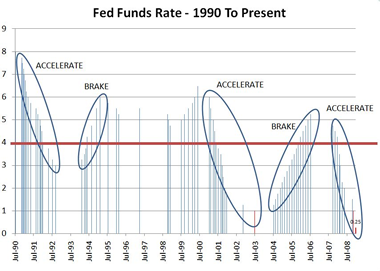
September 18, 2007 I think a 4% rate is really what is needed to turn the economy back on the right course. The rate may not get there, but more cuts will be needed with employment rates down and foreclosure rates up.
October 25, 2007 How long will it be before I will be able to write: "The Federal Reserve lowered its lending rate to 4% in response to the collapse of the U.S. housing market and massive numbers of foreclosures that threaten the banking and mortgage sectors."
November 28, 2007 FED VICE CHAIRMAN DONALD KOHN
"Should the elevated turbulence persist, it would increase the possibility of further tightening in financial conditions for households and businesses," he said.

"Uncertainties about the economic outlook are unusually high right now," he said. "These uncertainties require flexible and pragmatic policymaking -- nimble is the adjective I used a few weeks ago."
http://www.reuters.com/

December 11, 2007 Somehow the Fed misses the obvious.
fed_rate_moves_425_small.gif
[Image from: CNNMoney.com]
December 13, 2007 [from The Christian Science Monitor]
"The odds of a recession are now above 50 percent," says Mark Zandi, chief economist at Moody's Economy.com. "We are right on the edge of a recession in part because of the Fed's reluctance to reduce interest rates more aggressively." [see my comments of September 11]
January 7, 2008 The real problem now is that consumers can't rescue the economy and manufacturing, which is already weakening, will continue to weaken. We've gutted the forces that could avoid a downturn. The question is not whether there will be a recession, but can it be dampened sufficiently so that it is very short.
January 11, 2008 This is death by a thousand cuts.
January 13, 2008 [N.Y. Times]
“The question is not whether we will have a recession, but how deep and prolonged it will be,” said David Rosenberg, the chief North American economist at Merrill Lynch. “Even if the Fed’s moves are going to work, it will not show up until the later part of 2008 or 2009.
January 17, 2008 A few days ago, Anna Schwartz, nonagenarian economist, implicated the Federal Reserve as the cause of the present lending crisis [from the Telegraph - UK]:
The high priestess of US monetarism - a revered figure at the Fed - says the central bank is itself the chief cause of the credit bubble, and now seems stunned as the consequences of its own actions engulf the financial system. "The new group at the Fed is not equal to the problem that faces it," she says, daring to utter a thought that fellow critics mostly utter sotto voce.
January 22, 2008 The cut has become infected and a limb is in danger. Ben Bernanke is panicking and the Fed has its emergency triage team cutting rates... this time by 3/4%. ...

What should the Federal Reserve do now? Step back... and don't be so anxious to raise rates at the first sign of economic improvement.
Individuals and businesses need stability in their financial cost structures so that they can plan effectively and keep their ships afloat. Wildly fluctuating rates... regardless of what the absolute levels are... create problems. Either too much spending or too much fear. It's just not that difficult to comprehend. Why has it been so difficult for the Fed?

About Me

My photo
Michigan, United States
Air Force (SAC) captain 1968-72. Retired after 35 years of business and logistical planning, including running a small business. Two sons with advanced degrees; one with a business and pre-law degree. Beautiful wife who has put up with me for 4 decades. Education: B.A. (Sociology major; minors in philosopy, English literature, and German) M.S. Operations Management (like a mixture of an MBA with logistical planning)