READ ABOUT DETROIT AND SOLUTIONS TO ITS PROBLEMS. CLICK HERE.
Showing posts with label Oil. Show all posts

Monday, July 02, 2012

Obama: $2 Billion For Brazil To Develop Offshore Oil Fields; Moratorium On U.S. Development

SEARCH BLOG: OBAMA, ENERGY, and OIL

The Energy-Starvationist In Chief, Barack Obama, has openly declared war on coal and now is surreptitiously attacking oil.

Via All American Blogger:

WASHINGTON, D.C. — IER Senior Vice President Dan Kish released today the following statement about the Obama administration’s proposed final plan for development of energy resources on the Outer Continental Shelf: 
“President Obama’s offshore charade continues today with the formal announcement of the 2012-2017 leasing plan for the outer continental shelf. With this plan, the administration reinstates the 27 year moratorium that was lifted in 2008, and turns its back on potentially enormous energy resources that could provide jobs and energy security for America. For more than three years, the Obama administration has consistently reversed bipartisan efforts to open America’s vast offshore resources for energy development. 
“The president has cancelled lease sales, delayed others, and imposed a unilateral executive embargo on the oil resources that our most promising public lands could provide. With 98 percent of the U.S. offshore currently unleased for energy exploration, Secretary Salazar has finalized this plan to continue the administration’s war against affordable energy. In the end, Americans will pay more for the energy they need. 
“While President Obama and Interior Secretary Salazar claim an ‘all of the above’ energy strategy, today’s announced plan continues to give the American people access to a mere fraction of the offshore resources they own. If not for this president and his policies, Americans could access more than 200 years of oil supply under our feet and off our shores. 
“Millions of Americans are still looking for jobs. The Gulf Coast economy has yet to recover from President Obama’s moratorium on offshore drilling. President Obama has signaled today that he has no regard for our energy future, nor the jobs that a sensible, long-term plan for offshore development would create.” [source]
That's the same President Obama that arranged for $2 billion of U.S. taxpayer dollars to guarantee loans for Brazil to develop their offshore oil deposits... which ultimately was sold to the Chinese.

2012 IS HERE

..

Thursday, June 28, 2012

Brazil 2 Obama 0

SEARCH BLOG: OBAMA

It would be laughable if it were not so pathetic.  Our lightweight President once again demonstrates why he should spend more time on the golf course and less in his official capacity.


OBAMA’S BRAZILIAN OIL DISASTER


It's almost painful to read it, but go ahead.


Ohhhh!  It was sooooo close.

2012 IS HERE

..

Wednesday, May 30, 2012

Oil Signals Economic Slowdown

SEARCH BLOG: ECONOMY and OIL

Perhaps all of those all-electric cars are driving down the price of oil.  Perhaps not.

The recent price drop in oil suggests that confidence in the global economies is slipping badly.  Keynesian economics say this is the time for governments to spend more money.

That was tried in Greece.  Fail.
Perhaps it is time to re-visit some economic assumptions about government spending and debt... although those who claim that spending and inflation are the keys to success probably want to double down on that bet.


FT [Financial Times] has an interesting interactive graphic.  Check it out here.


Damn, those Austrians might have been right.

2012 IS HERE

..

Monday, May 14, 2012

U.S.: Too Many Assets; Too Little Cash

SEARCH BLOG: GOVERNMENT

Most people think about the Federal government in terms of legislation, regulation, military, and debt.  Seldom does the issue of Federal government assets arise.  If people were told that the U.S. government owns 20% of all U.S. land, many would be greatly surprised.


A portion of that land falls under the Bureau of Indian Affairs and more under the Forest Service and National Park Service.  But then there is a wide area [yellow above] under the Bureau of Land Management.

While some of this land can be considered "national treasures"... unique, scenic, pristine, fragile... a lot of it is generally nondescript.  And some of it is valuable for what lies below the surface.

From Astute Bloggers:
GAO: America has 2.5 TRILLION barrels of recoverable oil on federal lands in Colorado, Utah and Wyoming
That's roughly 15 or 16 times the national debt in today's price of the oil.  Even if only 25% were recoverable, that oil is still fairly valuable.
“The Rand Corporation, a nonprofit research organization, estimates that 30 to 60 percent of the oil shale in the Green River Formation can be recovered,” [Anu K.] Mittal  [GAO’s director of natural resources and environment] told the [House Science] subcommittee [on Energy and Environment]."
 

So, the question that begs to be asked is: why is the Federal government sucking the wealth out of the private sector in the form of taxes when it is sitting on so much wealth itself?  That's sort of like an individual being on welfare while owning a safe full of gold.  You try getting away with that.

The positive economic impact of shale oil extraction has been shown in North Dakota.

North Dakota Sets New Records in February for Both Crude Oil Production and Oil Employment

2012 IS HERE

..

Friday, May 11, 2012

A Funny Thing Happened On The Way To The Oil Forum

SEARCH BLOG: OIL and GASOLINE

A few people may have noticed that oil and gas prices have been falling during a time of the year when they normally rise.  This, of course, was due to President Obama's great leadership when he said, "High gasoline prices are a bad, bad thing."

Mark J. Perry, economist and blogger, asks:

Oil Prices Are Falling, Do Speculators Get Credit?
A lot of things affect the price of oil and gasoline.

  • demand
  • demand
  • demand
  • supply
  • supply
  • supply
Of course, there is the anticipation of demand and the anticipation of supply.  That's when "speculators" will buy and sell future contract based on their best guesses of what is going to happen. It appears there is a "consensus" that supply will be plentiful and demand will be low.

Funny how a "consensus" can change with new information.  Apologies to Zero Mostel and Phil Silvers and thanks to all you speculators out there.


2012 IS HERE

..

Thursday, April 19, 2012

Oil And Natural Gas Prices And Predictions

SEARCH BLOG: OIL and NATURAL GAS

It has been obvious that something is wrong.  Oil prices stay high; natural gas prices plummet.


[image source] Significant shale gas reserves exist in Poland and France. With new and clear guidelines, development could be rapid and sharply reduce Europe’s import needs. At the same time, the US is beginning to plan for exports of gas. This is the context behind last week’s remarkable comment by Vladimir Putin, who warned Gazprom it would have to rise to the challenge of a transformed market. 
But shale gas is not the full story. US production of tight oil, which is produced from shale and other rocks, has tripled in the past three years to almost 900,000 b/d. Predictions that the US could become self-sufficient in hydrocarbons in the next two decades no longer look absurd. [source]
Well, in the U.S., natural gas is abundantly available; oil isn't.  Natural gas production is either unprofitable or getting there.  There is enough market tension for oil that $100 oil looks to stay around for awhile... and oil profitability as well.

Except, of course, the producers respond to the market.  From economist Mark Perry:


This is to be expected.  Fracking and shale are relatively new sources with chaotic growth.  There will be corrections and adjustments.  The chart above says we should expect a rise in the price of natural gas and, possibly, a decline in the price of oil as their relative abundance changes.  Unless, of course, we don't.

2012 IS HERE

..

Wednesday, April 11, 2012

Evil Oil Companies?

SEARCH BLOG: OIL and ENERGY

I get emails from various politicians.  They have issues.  They have plans.  They want to know your opinion... or maybe just want you to think they want your opinions... hard to say.  This one was just received and elicited a response.  I'll not embarrass the sender by including a name.

April 11, 2012 
Dear Friends,
While oil companies are making record profits – the five biggest took home more than $137 billion in profits last year – the rest of us are paying more at the pump.  
It doesn’t make sense. We’re at an eight-year high in domestic oil production, and domestic demand for oil and oil products is down. That means supply is high, demand is low, but we’re still stuck with high prices at the pump. So what do we do?  
I’ve got some ideas, and I want to hear yours. Like many Ohioans, I’m tired of the stranglehold oil companies have on our national energy policy. And like many Ohioans, I believe we need to take a “do it all” approach to reducing gas prices. 
Please tell me which of these actions you support to reduce gas prices: 


Your Priorities: Gas Prices


Do you feel that these actions are important?

Yes

No
1. Crack Down on Speculation: Prevent Wall Street speculators from driving up the price at the pump. A recent report found that excessive speculation adds $0.56 to every gallon of gas you put in your car.

2. Drill it Here, Keep it Here: If oil companies produce oil on public lands in the U.S., then it should stay here. No longer should oil companies export our own oil overseas, when we need it here at home.

3. Cut Wasteful Subsidies for Big Oil: End wasteful tax giveaways for Big Oil and use the savings to break the stranglehold Big Oil has on consumers by investing in clean energy.

4. Improve Fuel Efficiency of Cars and Trucks: Increase fuel-efficiency standards for vehicles so that consumers get more miles per gallon and spend less on gasoline

5. End Oil Cartels: Give the U.S. the authority to go after oil-producing nations, like the members of OPEC, that band together to drive up the price of oil.

6. Tap America’s Oil Reserve: Open the Strategic Petroleum reserve to increase domestic oil supply and lower prices.

My response:

Dear -----: 
No one likes to see $4 per gallon oil.  Well, almost no one.  But this is an energy policy issue, not an issue about oil companies profits. 
http://hallofrecord.blogspot.com/2012/04/obama-gets-wish-canada-to-focus-oil.html
  
Mark J. Perry, University of Michigan - Flint economist asks: 
http://mjperry.blogspot.com/2011/05/will-apples-profits-be-investigated.html
  
The U.S. has the wherewithal to affect the worldwide price of oil as shown by the mere threat of releasing some of its oil reserves.  But that is and always has been a temporary measure.  A longer term solution is an energy policy, along with supporting legislation, that allows expansion of the supply side.  I'm sure you are well aware of the impact that shale natural gas has had on worldwide supplies and prices... and where is "speculation" regarding natural gas?  Often our laws have just the opposite impact and increase the cost of petroleum products.  Here is something you can actually do to impact the cost of gasoline... and food on our tables: 
http://www.forbes.com/sites/christopherhelman/2012/04/03/ethanol-minus-the-corn-it-could-fuel-america-if-it-werent-illegal/
   
Sabre rattling at strawmen... or oil companies... is just counter-productive. 
Sincerely, 
Bruce Hall

I really liked the one about End Oil Cartels.


Okay, do that.

2012 IS HERE

..

Monday, April 09, 2012

Argentina Wants To Be Like Venezuela

SEARCH BLOG: OIL and NATURAL GAS and VENEZUELA

From Seeking Alpha:

Since writing my article Argentina on the Brink: What is the Real Investment Risk?, events in Argentina over the last week have moved even more rapidly towards what I believe is the impending nationalization of the Argentine oil and gas industry. These events also indicate that the Argentine government is targeting foreign companies not only operating in the oil and gas sector but across the Argentine business sector. These recent events have escalated the degree of investment risk for foreign investors who hold investments in Argentine companies or foreign companies operating in Argentina. It has also significantly increased the risk for non-Argentine companies operating in the oil and gas sector, because I believe that these companies will eventually lose their oil and gas concessions.
In case you forgot what happened in Venezuela:

Venezuela Decrees Nationalization of Last Foreign Controlled Oil Fields 
By GREGORY WILPERT – VENEZUELANALYSIS.COMCaracas, February 27, 2007 (venezuelanalysis.com)— Venezuela’s President Chavez announced a new law-decree, which will nationalize the last remaining oil production sites that are under foreign company control. The nationalizations, which affect oil production in the Orinoco Oil Belt, will take effect on May 1st of this year, until which time companies may negotiate the terms of the nationalization.
How has that worked out?


... and Venezuela's economy?
Venezuela’s economic freedom score is 38.1, making its economy the 174th freest in the 2012 Index. Its score increased by 0.5 point since last year, with a modest gain in labor freedom partly offset by a drop in trade freedom. Venezuela is ranked 28th out of 29 countries in the South and Central America/Caribbean region, and its overall score is much lower than the world average. 
Venezuela continues to be mired in a climate of economic repression. Severely hampered by state interference, the formal economy is increasingly stagnant, and informal economic activity is expanding. Monetary stability is particularly weak, and there are extensive price controls on almost all goods and services. Government interference in the financial sector further distorts price levels and constrains private-sector growth by allocating credit on non-market terms. [source]

I won't say that Argentinians are being stupid, but actions speak louder than words... and stupidity has its own rewards.

2012 IS HERE

..

Wednesday, April 04, 2012

Obama Wants To Protect Investments That Make Our Economy Grow

SEARCH BLOG: OBAMA and ECONOMY

From CNNMoney:

Obama criticized the Ryan budget for cutting too deeply into non-security discretionary spending, an area of the budget that funds education, research and development and most government agencies.
"You can be sure that with cuts this deep, there is no secret plan or formula that will be able to protect the investments we need to help our economy grow," Obama said.
*****

That's an interesting choice of words... particularly "investments we need to help our economy grow."

What "investments" is the government making?  Perhaps the President is referring to his obsession with alternative energy companies.  That has been a resounding success.  As his regulators go about dismantling a significant portion of the U.S. energy capability, the President is "investing."
WEDNESDAY, MARCH 21, 2012U.S. Energy Policy
Perhaps he is talking about "investments" in expanding health care through mandatory requirements for insurance.  Well, that seems like more of a transfer of funds from one consumer expenditure to another. Besides, that's not really the "government's money."  Oh, I forgot about the penalties for not purchasing the insurance.  But that can't be in Obama's budget, can it?

And he wants to cut the military so that can't be an investment.

Opening up federal lands for energy exploration?  That has created a lot of jobs on state and private lands in the past few years.  No, I don't think his agencies are set up to do that.  Besides, would that be an "investment?"  Well, it's a moot point.

Perhaps he has some plan to provide subsidies for U.S. manufacturing, although he has spoken disdainfully about subsidies.

Maybe there are more shovel-ready jobs in his investment portfolio.  Wait, there weren't shovel-ready plans in his earlier "investments."

Well, we know he must have something in mind concerning his "investments."  Where do you suppose he plans to "invest" the money the government works so hard to get from taxpayers?  Maybe here...


Remember, it's never too early to think about investing.


Your government in action.  I really like the part about the new organizers.

2012 IS HERE

..

Tuesday, April 03, 2012

Obama Gets Wish - Canada To Focus Oil Exports On Asia

SEARCH BLOG: OIL

WASHINGTON—Prime Minister Stephen Harper upped the ante for the Alberta oilsands Monday, telling a Washington audience that Canadian oil will be heading for Asian markets regardless of whether the United States okays the controversial fuel.

Harper, speaking on the heels of a one-day North American Leaders Summit at the White House, said the mere fact that cancellation of the long-delayed Keystone XL pipeline is possible leaves Ottawa with no choice but to aggressively pursue other export markets to safeguard Canada’s economic future. [source]
Isn't it lovely to see a national leader who is looking out for the economic interests of his country?  Too bad it isn't the President of the United States.

RELATED:
MONDAY, FEBRUARY 20, 2012 Energy - Obstructionism As Policy 
THURSDAY, FEBRUARY 16, 2012 Energy Shortages Are Not Real 
MONDAY, JANUARY 23, 2012 Obama - Keystone Kop 
THURSDAY, JANUARY 12, 2012 Home Grown Energy

Thursday, March 29, 2012

Obama To Oil Companies: That Money Is Part Of My Stash

SEARCH BLOG: OIL and OBAMA

President Obama, referring to provisions in the Tax Code for write offs of exploration and other expenses as "subsidies," called for higher taxes on oil companies.
In his Feb. 13 budget, Obama said existing tax “loopholes and expenditures” for the oil and natural gas companies amount to an unwarranted “preference” of these industries over others. [source]
Ignoring that oil companies have spent billions of dollars expanding domestic oil and natural gas production that have saved consumers billions of dollars...
Obama ridiculed Republican presidential candidates as the “flat Earth crowd,” who’d “rather give $4 billion in taxpayer subsidies to oil companies this year than to invest in clean energy.”
So, on the one hand, the President chides U.S. consumers and the automobile industry for not being "green" enough and consuming too much fossil fuels while, on the other hand, sets up roadblocks to expansion of domestic oil exploration and production and demonizes oil companies for their profits... profit that is used for paying taxes, profit that creates new jobs, profit that enriches retirement funds, profit that could otherwise go to Iran or Venezuela or Saudi Arabia.
America's three biggest oil companies, ExxonMobil ( XOM - news -people ), Chevron ( CVX - news - people ) andConocoPhillips ( COP - news - people ), all endure income tax burdens of more than 40%--higher than the statutory U.S. rate of 35%. Exxon, with a 45% rate, tallied $21.6 billion in worldwide income taxes for 2010. [source]
Meanwhile, the President pushes investments in one "alternative" failure after another and thinks of himself as a visionary.  That would be a visionary through coke-bottle glasses.

The President has a way of lying through omission.  He tells one part of the story and conveniently omits the salient counter-points.  In this case, that's because he views profits from corporations as rightfully belonging in his stash.


SUNDAY, MARCH 18, 2012

Myth Of U.S. Oil Dependence


2012 IS HERE

..

Thursday, March 22, 2012

Obama Leading From Behind Again

SEARCH BLOG: OBAMA and OIL

From the Financial Times:


While Mitt Romney is presently being attacked as the "Etch-A-Sketch" candidate, it is obvious that Obama is the Etch-A-Sketch president.

President Obama re-iterated his boast that oil production has risen during his administration... a claim discussed here:
Myth Of U.S. Oil Dependence
and here:
U.S. Energy Policy
It appears that President Obama has once again wet his finger, stuck it in the air, and is trying to figure out which way the wind is blowing.  He is truly a man of great vision... hindsight.

As the National Review article states:

‘When it comes to American energy production, President Obama is like a rooster who crows at the sunrise, then imagines that he conjured up the morning,” jokes Ben Cole of the Institute for Energy Research. The White House has been taking credit for increased oil production, when it actually was taking place on state and private lands while output on federal lands was dropping. Now, the administration is touting the construction of the southern leg of the Keystone XL pipeline, though so far the process has been entirely outside federal jurisdiction.
It appears President Obama's re-election hope is to fool enough people all of the time.  No change there.

2012 IS HERE

..

Wednesday, March 21, 2012

U.S. Energy Policy

SEARCH BLOG: ENERGY

Our President made it clear before he became President that he was going to attack coal as the primary source of electrical energy in the U.S.  He has been successful as coal now accounts for less than 40% from nearly 50% a couple years ago.


Many will say, "that is a good thing" because coal is a dirty source of energy and we want a clean source such as solar or wind... even if the cost per kilowatt hour is many times that of coal.  The American people want to pay higher energy costs for the privilege of having clean energy.

Besides, we have many other sources such as natural gas that can economically substitute for coal for the time being, so we don't have to rely on unreliable sources such as wind and the sun.  Our President has even signed a rather long and mind-numbing National Defense Resources Preparedness Executive Order that has a provision regarding Energy. [h/t Bill]

Sec. 203.  Maximizing Domestic Energy Supplies.  The authorities of the President under section 101(c)(1) (2) of the Act, 50 U.S.C. App. 2071(c)(1) (2), are delegated to the Secretary of Commerce, with the exception that the authority to make findings that materials (including equipment), services, and facilities are critical and essential, as described in section 101(c)(2)(A) of the Act, 50 U.S.C. App. 2071(c)(2)(A), is delegated to the Secretary of Energy. 

However, the President's own policies have significantly hindered this Executive Order resulting in a net decline of electrical energy in the U.S.

Note that "Other" which includes wind/solar has not increased.
Total electricity generation was down 7% in December 2011 compared to December 2010 (see chart above). Despite this decline, generation from natural gas rose 12% to 86 terawatthours. Coal-fired generation, however, fell by 21% between December 2010 and December 2011, to 132 terawatthours. 
But the President has claimed that he is pro-energy and has pointed to an increase in oil and natural gas production to back up that claim.  That must be the where that Section 203 of the National Defense Resources Preparedness Executive Order fits in:
“Under my administration, America is producing more oil today than at any time in the last eight years,” Obama told the audience at the University of Miami. “That’s why we have a record number of oil rigs operating right now – more working oil and gas rigs than the rest of the world combined.” 
The increase in domestic drilling was almost entirely in areas for which the Obama administration exercised no authority, as oil production on federal land declined by 11 percent in fiscal year 2011, according to a study by the Institute on Energy Research (IER), a free-market energy think tank. But oil production on state lands increased that year by 14 percent and increased by 12 percent on private lands. [source]
And as the Speaker of the House, John Boehner, has pointed out, President Obama has been an energy obstructionist [h/t Anthony Watts]:

Running on Empty: New Chart Shows White House Plan for Higher Gas Prices & Fewer Jobs
Posted by Don Seymour on February 24, 2012

In yesterday’s speech defending his failed energy policies – under which gas prices have nearly doubled and are rising faster than ever – President Obama called for the kind of “all of the above” energy strategy long-championed by Republicans. But far from supporting “all of the above,” the Obama administration has spent more than three years blocking efforts to expand energy production and bring down gas prices, while pushing job-crushing tax hikes and taxpayer-backed loans to companies like Solyndra.
That leads to very interesting speculation: perhaps President Obama has issued this latest National Defense Resources Preparedness Executive Order as justification for expanded government funding of his favorite alternative charities such as Solyndra.

What might be Dr. Chu's vision as Secretary of Energy?


Chu: Solyndra Loan Was My Responsibility by associatedpress
Steven Chu Says Plants Might Be Ultimate Fuel...


After all, we can't rely on coal anymore... or oil... or nuclear power.  Going for the Sun or water... or going down the rabbit hole....  Perhaps a little realism mixed with idealism might be helpful.

RELATED:

Myth Of U.S. Oil Dependence 

2012 IS HERE

Sunday, March 18, 2012

Myth Of U.S. Oil Dependence

SEARCH BLOG: ENERGY

The decline of drilling for oil on U.S. Federal lands has declined, offsetting gains in oil production on private and state lands.  One might ask why?  One should ask the President of the United States.  But his answer will be that oil production has increased during his reign.  That, of course, is taking credit for outcomes that have defied his policies.

If oil production had risen 11% on Federal lands instead of falling by 11% the increased number of jobs and the amount of oil produced would be substantial.  Would it be enough to offset the world's jitters about an unstable Iran?  Not likely, but it would be a move in the right direction.  It would be sending a message to Iran and a hodge-podge of other anti-American states that their economic foundations are about to crumble as the post-9/11 speculative price of oil declines.

[Iran oil exports - source]

As it is, President Obama's current anti-energy policies allow hostile countries like Iran to finance their anti-American efforts.

The argument, of course, is that the U.S. has only 2% of the world's proven reserves.  This 2008 chart from Al Fin, says differently:


Image via Robert Rapier


Since then, the growth of shale oil in both the U.S. and Canada has made that conservative projection obsolete.  Economist Mark Perry from the University of Michigan, Flint, reported:

A New Age of Energy Abundance in the U.S.

Thanks to the shale revolution....
As reported in The Gateway Pundit:
Barack Obama continued to repeat the myth today that the US has only 2% of the world’s oil reserves. 
Not true. 
The AFP reported: 
Obama warned supporters that they would likely soon hear Republican calls of “drill, drill, drill” as election season heats up, and but warned that solely relying on new oil exploration would not solve America’s energy woes. 
“America uses more than 20 percent of the world’s oil. If we drilled every square inch of this country …. we would still have only two percent of the world’s known oil reserves.
“If you have got two and you have got 20, there is a gap.”
The "gap" is the amount of bureaucratic obstruction led by Barack Obama & Co.

2012 IS HERE

..

Can"t Find It?

Use the SEARCH BLOG feature at the upper left. For example, try "Global Warming".

You can also use the "LABELS" below or at the end of each post to find related posts.

Blog Archive

Cost of Gasoline - Enter Your Zipcode or Click on Map

CO2 Cap and Trade

There is always an easy solution to every human problem—neat, plausible, and wrong.
Henry Louis Mencken (1880–1956)
“The Divine Afflatus,” A Mencken Chrestomathy, chapter 25, p. 443 (1949)
... and one could add "not all human problems really are."
It was beautiful and simple, as truly great swindles are.
- O. Henry
... The Government is on course for an embarrassing showdown with the European Union, business groups and environmental charities after refusing to guarantee that billions of pounds of revenue it stands to earn from carbon-permit trading will be spent on combating climate change.
The Independent (UK)

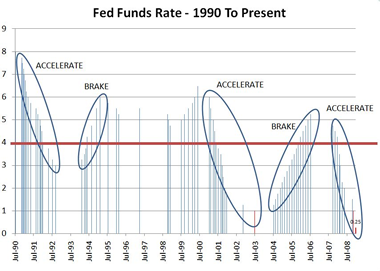
Tracking Interest Rates

Tracking Interest Rates

FEDERAL RESERVE & HOUSING

SEARCH BLOG: FEDERAL RESERVE for full versions... or use the Blog Archive pulldown menu.

February 3, 2006
Go back to 1999-2000 and see what the Fed did. They are following the same pattern for 2005-06. If it ain't broke, the Fed will fix it... and good!
August 29, 2006 The Federal Reserve always acts on old information... and is the only cause of U.S. recessions.
December 5, 2006 Last spring I wrote about what I saw to be a sharp downturn in the economy in the "rustbelt" states, particularly Michigan.
March 28, 2007
The Federal Reserve sees no need to cut interest rates in the light of adverse recent economic data, Ben Bernanke said on Wednesday.
The Fed chairman said ”to date, the incoming data have supported the view that the current stance of policy is likely to foster sustainable economic growth and a gradual ebbing in core inflation”.

July 21, 2007 My guess is that if there is an interest rate change, a cut is more likely than an increase. The key variables to be watching at this point are real estate prices and the inventory of unsold homes.
August 11, 2007 I suspect that within 6 months the Federal Reserve will be forced to lower interest rates before housing becomes a black hole.
September 11, 2007 It only means that the overall process has flaws guaranteeing it will be slow in responding to changes in the economy... and tend to over-react as a result.
September 18, 2007 I think a 4% rate is really what is needed to turn the economy back on the right course. The rate may not get there, but more cuts will be needed with employment rates down and foreclosure rates up.
October 25, 2007 How long will it be before I will be able to write: "The Federal Reserve lowered its lending rate to 4% in response to the collapse of the U.S. housing market and massive numbers of foreclosures that threaten the banking and mortgage sectors."
November 28, 2007 FED VICE CHAIRMAN DONALD KOHN
"Should the elevated turbulence persist, it would increase the possibility of further tightening in financial conditions for households and businesses," he said.

"Uncertainties about the economic outlook are unusually high right now," he said. "These uncertainties require flexible and pragmatic policymaking -- nimble is the adjective I used a few weeks ago."
http://www.reuters.com/

December 11, 2007 Somehow the Fed misses the obvious.
fed_rate_moves_425_small.gif
[Image from: CNNMoney.com]
December 13, 2007 [from The Christian Science Monitor]
"The odds of a recession are now above 50 percent," says Mark Zandi, chief economist at Moody's Economy.com. "We are right on the edge of a recession in part because of the Fed's reluctance to reduce interest rates more aggressively." [see my comments of September 11]
January 7, 2008 The real problem now is that consumers can't rescue the economy and manufacturing, which is already weakening, will continue to weaken. We've gutted the forces that could avoid a downturn. The question is not whether there will be a recession, but can it be dampened sufficiently so that it is very short.
January 11, 2008 This is death by a thousand cuts.
January 13, 2008 [N.Y. Times]
“The question is not whether we will have a recession, but how deep and prolonged it will be,” said David Rosenberg, the chief North American economist at Merrill Lynch. “Even if the Fed’s moves are going to work, it will not show up until the later part of 2008 or 2009.”
January 17, 2008 A few days ago, Anna Schwartz, nonagenarian economist, implicated the Federal Reserve as the cause of the present lending crisis [from the Telegraph - UK]:
The high priestess of US monetarism - a revered figure at the Fed - says the central bank is itself the chief cause of the credit bubble, and now seems stunned as the consequences of its own actions engulf the financial system. "The new group at the Fed is not equal to the problem that faces it," she says, daring to utter a thought that fellow critics mostly utter sotto voce.
January 22, 2008 The cut has become infected and a limb is in danger. Ben Bernanke is panicking and the Fed has its emergency triage team cutting rates... this time by 3/4%. ...

What should the Federal Reserve do now? Step back... and don't be so anxious to raise rates at the first sign of economic improvement.
Individuals and businesses need stability in their financial cost structures so that they can plan effectively and keep their ships afloat. Wildly fluctuating rates... regardless of what the absolute levels are... create problems. Either too much spending or too much fear. It's just not that difficult to comprehend. Why has it been so difficult for the Fed?

About Me

My photo
Michigan, United States
Air Force (SAC) captain 1968-72. Retired after 35 years of business and logistical planning, including running a small business. Two sons with advanced degrees; one with a business and pre-law degree. Beautiful wife who has put up with me for 4 decades. Education: B.A. (Sociology major; minors in philosopy, English literature, and German) M.S. Operations Management (like a mixture of an MBA with logistical planning)