READ ABOUT DETROIT AND SOLUTIONS TO ITS PROBLEMS. CLICK HERE.
Showing posts with label Outsourcing. Show all posts

Tuesday, October 20, 2009

Trading Places

SEARCH BLOG: ECONOMY and TRADE

I won't say "I told you so." Just read the articles linked below...

Hindsight is so 20-20. What could possibly go wrong with huge trade imbalances and loss of core manufacturing capability and jobs... as long as our government could get the money it wanted to spend on its social and economic experiments?

..

Saturday, January 17, 2009

Outsourcing In Review

SEARCH BLOG: OUTSOURCING

While I understand the short-term profit motivation for outsourcing, I have always believed that it was not necessarily in the long-term self-interest of corporations and the nation to go in that direction. More specifically, I hold that outsourcing is akin to "eating your young" to be competitive. While most economists argued that we were better off with this strategy [before the structural cracks appeared], I argued that this practice would lead us to a very vulnerable position when things turned bad. Note that I included energy "outsourcing" in this... outsourcing is not just limited to jobs.

So, if you are curious, click here to read a litany of posts mentioning outsourcing.

Below are some of my favorites that will be part of the above list [you would have to select "older posts" at the end of all of the selected posts to see some of these] if you don't want to go through all of them:

Happy reading.

..

Sunday, November 16, 2008

Old School Military Thinking

SEARCH BLOG: AUTOMOBILES

From The New York Times:

AMERICA’S automobile industry is in desperate trouble. Financial instability, the credit squeeze and closed capital markets are hurting domestic automakers, while decades of competition from foreign producers have eroded market share and consumer loyalty. Some economists question the wisdom of Washington’s intervening to help the Big Three, arguing that the automakers should pay the price for their own mistakes or that the market will correct itself. But we must act: aiding the American automobile industry is not only an economic imperative, but also a national security imperative.

When President Dwight Eisenhower observed that America’s greatest strength wasn’t its military, but its economy, he must have had companies like General Motors and Ford in mind. Sitting atop a vast pyramid of tool makers, steel producers, fabricators and component manufacturers, these companies not only produced the tanks and trucks that helped win World War II, but also lent their technology to aircraft and ship manufacturing. The United States truly became the arsenal of democracy.

During the 1950s, advances in aviation, missiles, satellites and electronics made Detroit seem a little old-fashioned in dealing with the threat of the Soviet Union. The Army’s requests for new trucks and other basic transportation usually came out a loser in budget battles against missile technology and new modifications for the latest supersonic jet fighter. Not only were airplanes far sexier but they also counted as part of our military “tooth,” while much of the land forces’ needs were “tail.” And in those days, “more teeth, less tail” had become a key concept in military spending.

But in 1991, the Persian Gulf war demonstrated the awesome utility of American land power, and the Humvee (and its civilian version, the Hummer) became a star. Likewise, the ubiquitous homemade bombs of the current Iraq insurgency have led to the development of innovative armor-protected wheeled vehicles for American forces, as well as improvements in our fleets of Humvees, tanks, armored fighting vehicles, trucks and cargo carriers.

In a little more than a year, the Army has procured and fielded in Iraq more than a thousand so-called mine-resistant ambush-protected vehicles. The lives of hundreds of soldiers and marines have been saved, and their tasks made more achievable, by the efforts of the American automotive industry. And unlike in World War II, America didn’t have to divert much civilian capacity to meet these military needs. Without a vigorous automotive sector, those needs could not have been quickly met.

More challenges lie ahead for our military, and to meet them we need a strong industrial base. For years the military has sought better sources of electric power in its vehicles — necessary to allow troops to monitor their radios with diesel engines off, to support increasingly high-powered communications technology, and eventually to support electric propulsion and innovative armaments like directed-energy weapons. In sum, this greater use of electricity will increase combat power while reducing our footprint. Much research and development spending has gone into these programs over the years, but nothing on the manufacturing scale we really need.

Now, though, as Detroit moves to plug-in hybrids and electric-drive technology, the scale problem can be remedied. Automakers are developing innovative electric motors, many with permanent magnet technology, that will have immediate military use. And only the auto industry, with its vast purchasing power, is able to establish a domestic advanced battery industry. Likewise, domestic fuel cell production — which will undoubtedly have many critical military applications — depends on a vibrant car industry.

To be sure, the public should demand transformation and new standards in the auto industry before paying to keep it alive. And we should insist that Detroit’s goals include putting America in first place in hybrid and electric automotive technology, reducing the emissions of the country’s transportation fleet, and strengthening our competitiveness abroad.

This should be no giveaway. Instead, it is a historic opportunity to get it right in Detroit for the good of the country. But Americans must bear in mind that any federal assistance plan would not be just an economic measure. This is, fundamentally, about national security.

Wesley K. Clark, a retired Army general and former supreme allied commander of NATO, is a senior fellow at the Burkle Center for International Relations at the University of California at Los Angeles.
What is wrong with this article? Several things.
  • Gen. Clark is retired and old and white... he doesn't have a functioning brain anymore.
  • The vast majority of U.S. voters [52%] elected a president who sees the military budget as bloated and is dedicated to peaceful, diplomatic resolution of any future disagreements.
  • We have shown that it is not necessary to actually produce anything in the U.S. in order to have a vibrant economy... further, we can outsource our military transportation needs to China which can produce cheap Hummer knockoffs for much less than GM.
Besides, just how far do you think an electric powered military vehicle could go before it ran out of a charge? Where would they plug in the damn things in the middle of a desert?

[HT George Lowe]
..

Monday, October 06, 2008

Dealing With China Is More Than Exporting Jobs

SEARCH BLOG: EDUCATION and CHINA

A Michigan company [check out their website] has recognized the growing importance of China in the world's economy in a slightly different way. Rather than outsourcing expertise, it is proposing that our next generation gain some expertise in dealing with Chinese firms and officials: Chinese language skills.

This is still new, but expect some big things soon. Many national chains are beginning to stock their books and I believe some schools are expressing interest. Obviously, these are meant as an introduction to Chinese.
But with the increasing importance of China as both an economic and military power, those in our next generation who have an understanding of that language will be in demand.
Think not? Then read this.

..

Friday, June 06, 2008

Filed Under Huh?

SEARCH BLOG: DUH

Filed under: we need to rethink our strategy.

"SAN FRANCISCO -- The nation's top nuclear weapons design lab has laid off hundreds of workers, raising concerns about a brain drain and stirring fears that some of these highly specialized scientists will sell their expertise to foreign governments, perhaps hostile ones.

Because of budget cuts and higher costs, Lawrence Livermore National Laboratory laid off 440 employees May 22-23. Over the past 2 1/2 years, attrition and layoffs have reduced the workforce of 8,000 by about 1,800 total."


What happened to the notion that the U.S. could outsource all of those old industrial jobs and focus on our future of being the intellectual leaders of the world... with all of the attendant scientific and engineering jobs?
File under: with friends like this, who needs enemies?
"Other Michiganders endorsing Obama were Detroit Mayor Kwame Kilpatrick, National Education Association board member Joyce Lalonde, Michigan AFL-CIO Secretary-Treasurer Tina Abbott and Michael Tardif, a Detroit political consultant with ties to Mayor Kilpatrick."

Hey, didn't Obama just get rid of Rev. Wright. Now he has picked up Mayor Wrong!
Filed under: I didn't know the world worked that way.
"Because if we are willing to work for it, and fight for it, and believe in it, then I am absolutely certain that generations from now, we will be able to look back and tell our children that this was the moment when we began to provide care for the sick and good jobs to the jobless; this was the moment when the rise of the oceans began to slow and our planet began to heal; this was the moment when we ended a war and secured our nation and restored our image as the last, best hope on Earth."

See, if you hope and work for change and provide universal health care and jobs to everyone, then global warming will stop and war will be over. Perhaps another clarification will follow... because I'm not sure what IT entails. But it sounds so nice.
..

Saturday, March 08, 2008

China Unethical? Surprise!

SEARCH BLOG: CHINA and UNETHICAL

Thursday, The Astute Bloggers [among others] posted an article about how China stole technology from Korea's LG Corporation so that they could compete with LG in the world market for plasma screens.

"Prosecutors in Seoul, Korea, indicted an ex-LG employee for spying for a Chinese company in a case they say cost the South Korean economy more than $1 billion. The Chinese company, Changhong-Orion PDP-Chaihong, reportedly paid the LG manager $300,000 per year, an apartment and a car (he was still collecting his LG salary) in exchange for copying 1,182 files from the LG network and giving it to the Chinese company...

The company then used that stolen data to copy LG's plasma display panel production technology. Changhong-Orion PDP-Chaihong plans to start making plasma panels with the stolen technology starting in December."
And we should be surprised... why?

Here are some posts about that subject going back awhile:
No need to say more.

,,

Sunday, February 10, 2008

Economic Fragmentation

SEARCH BLOG: ECONOMY

Two weeks ago, I wrote about the implications of state unemployment rates. There was the glaring disparity between states like Michigan and California versus Virgina.

The Economist has put that into the larger perspective of all states' unemployment and housing price changes on this map:

[click image for larger view]


Once again Virginia, which is closely aligned with the growth of the federal government, and western states with very small populations have been spared from economic downturn. As the article in the Economist states:

"So far, much of the misery has been concentrated in one sector—housing—and in two distinct sets of states: the industrial Midwest and those states that saw the biggest housing bubble, particularly California, Nevada, Arizona and Florida. These two groups are disproportionately important politically. They include many states that voted early in the primary races. Several of them (such as Michigan and Florida) are traditionally swing states in the general election.

The situation is still grimmest in Michigan, Ohio and other erstwhile manufacturing strongholds, where the subprime bust came on top of the secular loss of factory jobs. But the most dramatic weakening has been in bubble states. Economies that were buoyed by booming construction and soaring house prices are now being dragged down.

California's mighty economy is visibly wobbling. In some cities, house prices are falling at double-digit rates and the unemployment rate has jumped from 4.8% to 6.1% in the past year, an increase twice as steep as the national trend. In Los Angeles, the weak dollar and slower consumer spending have sharply cut import-traffic through the port. This downturn is not as gut-wrenching as those in the early 1990s or 2001, when core industries such as defence and technology suffered badly. But it is steep enough to have thrown the state's budget into disarray and derailed Governor Arnold Schwarzenegger's ambitious plans for health-care reform."

On the brighter side, the free-fall of the dollar [an adjustment to the current account deficit, the Federal Reserve's wildly fluctuating interest rates, unfettered greed and manipulation by the investment and banking sectors, and the massive increase in the federal budget deficit pushed farther by a stimulus package] will eventually lead to more manufacturing and export opportunities and a rebound in the overall economy.

However, there may be a longer road to recovery than usual according to the Economist:
"A downturn centred on housing will have pernicious effects, even on the regions it hits least. That is because it constrains one of the biggest safety valves in America's economy: people's ability to move. Previous downturns spawned sizeable migrations from recessionary states to booming ones. In the early 1990s, for instance, people flocked from New England to southern states. This time, that mobility is hampered by people's inability to sell their homes. Unemployment may go on rising in California, even though Montana cannot get the workers it needs."
So how do we avoid this unpleasantness? It appears we don't... unless we can get investors from China and Saudi Arabia to buy all of those unsalable homes. After all, they have all of our manufacturing and energy money and need to spend those dollars somewhere.
Tell me again why outsourcing [here, here, and here] leading to manufacturing collapse (let's blame the Republicans) and a restrictive energy policy leading to energy price inflation (let's blame the Democrats) are so good?
..

Wednesday, January 16, 2008

House Of Cards - Second Verse

SEARCH BLOG: ECONOMY

I've been having an ongoing email conversation with Bill who has pretty strong opinions about many of the issues which I post here.

Although I am a harsh critic about outsourcing, I believe it is partially a result of bad trade treaties and currency manipulation by major trading nations that literally force U.S. corporations into the practice of outsourcing. Bill is not quite as forgiving.

With regard to the Federal Reserve, I have been fairly unforgiving myself as shown in the summary of quotes in the column to the right.

And with regard to Wall Street and Big Banking, I wrote this a few days back:

"A few years ago, we saw cracks in the financial world with hedge fund scandals. Now we are seeing further cracks with the sub-prime scandal. It seems that the mundane world of banking and investing has gotten caught up in the "get rich quick," high-risk mindset that accepts manipulation of markets as preferred paths to wealth. While there may be big reward with big risk, there is the big downside as well."
All in all though, Bill and I have a pretty close alignment. So I wasn't too surprised when I got this link in an email from him.
I have to say that it was worth my while checking it out... and I believe it will be worth your time as well.
I guess there are others out there with whom I agree. But as I wrote back to Bill:
I'm not sure I picked up the specifics of his solution.
That's always the rub....

..

Sunday, January 13, 2008

House Of Cards

SEARCH BLOG: ECONOMY

Trying to figure out the economy? The most obvious changes have been in two sectors: industrial and financial.

In the industrial sector, the U.S. continues to dominate, but is not nearly as vertically integrated as decades ago when basic parts... that became basic components... that became basic assemblies... that became finished products were produced in the U.S. The industrial network was based in the U.S. and the jobs pyramid was based in the U.S.

Now, the lower layers of the pyramid have become porous and weak. Towns and cities and states that used to hum along with the machinery of our industries have become shells of their former selves. More and more, we are employed "servicing" each other... selling at Walmart instead of creating tools or parts or new products.
Much of this change has been associated with productivity gains rather than outsourcing to other countries. I suspect the argument for productivity is somewhat overstated, just as the blame placed on outsourcing is overstated. Regardless, the shift to service sector jobs results in wages that are, on average, 8% less than manufacturing job wages.
The average for services, $11.79, was about the same as the overall average and was 92 percent of the average for manufacturing. [source]
If you take 8% more per year from a large sector of employment and add that to the economy, you do get a significant bump.
But the process of moving from manufacturing to service jobs has been going on for awhile, so the economy has adjusted to that. So have individuals who have lost their manufacturing jobs. Less money coming in means less going out or saved... on average.
Of course, if you have adjusted to an economy based on many at the lower levels earning less, then there may be less opportunity for further adjustment when the economy is impacted by sudden problems... especially when those problems are caused at the top.
A few years ago, we saw cracks in the financial world with hedge fund scandals. Now we are seeing further cracks with the sub-prime scandal. It seems that the mundane world of banking and investing has gotten caught up in the "get rich quick," high-risk mindset that accepts manipulation of markets as preferred paths to wealth. While there may be big reward with big risk, there is the big downside as well.
“The question is not whether we will have a recession, but how deep and prolonged it will be,” said David Rosenberg, the chief North American economist at Merrill Lynch. “Even if the Fed’s moves are going to work, it will not show up until the later part of 2008 or 2009.” [N.Y. Times]
Is there a connection between lower paying service jobs, finance manipulation schemes, and the looming economic problems facing the U.S.?
Here are a couple of dots . . -- connect them.
..

Wednesday, December 26, 2007

Celebrating The Purchase Of America

SEARCH BLOG: CONTROL

There is increasing happiness on Wall Street as CNN reports:

In recent weeks, a number of big financial services companies - including Morgan Stanley (MS, Fortune 500), Citigroup Inc. (C, Fortune 500) and UBS AG (UBS) - have received capital infusions from foreign government investment entities to help offset subprime related losses.

"The big news of the day are these investments in investment banks by sovereign wealth funds," said Brian Gendreau, investment strategist at ING Investment Management.

Let's step back a little.
  • We don't allow development of our oil, natural gas, or other energy resources
  • We ship off jobs and manufacturing.
  • The people who previously earned good incomes from those manufacturing jobs now have no jobs or lower paying jobs.
  • They no longer purchase as much from local businesses who cut back on their staffs.
  • Homes that were being purchased by those people are being foreclosed.
  • The banks and financial institutions who wrote mortgages on those homes lost big time.
  • Countries from which we purchase our energy [oil] or now have our manufacturing and jobs, send back money to bail us out.
Sounds good... something for nothing! We're being "subsidized" again!
We haven't lost a thing! Have we?
A little less than a year ago I wrote:
As a nation, we have "chosen", increasingly, to not have control in two strategic areas:
  • Energy
  • Manufacturing
In the area of energy, we have chosen to stay wed to oil and natural gas as our mainstays for energy rather than nuclear power, coal or alternative fuels. As a result of that choice, we "outsource" a significant amount of our energy resources.

In the area of manufacturing, we have chosen to seek lowest cost labor as a panacea for remaining "competitive". Consequently, we have "outsourced" a significant portion of our manufacturing capacity to countries such as China.
As we move jobs, facilities, and... finally... ownership elsewhere, we lose control of our destiny. At what point do we decide that maybe there is a limit to this expedience?

..

Wednesday, November 28, 2007

We Outsource - They Insource

SEARCH BLOG: CHINA and ECONOMY

Which economy is producing the most new wealth, the most new jobs, and on the verge of becoming a leader in advanced technologies?

Is there a fundamental shift in thinking for the U.S. versus China? The U.S. seems to view growth as spending and debt growth; China seems to view growth as capability, resource, and wealth growth.
I wonder while approach is more viable in the long run?
Oh, that's too much to think about... let's just enjoy the being subsidized.

..

Thursday, July 19, 2007

What Goes Up....

SEARCH BLOG: ECONOMY

Just an observation.

The DOW is up
.


Housing is down
.


For some time, the explanation for the strong market performance was consumer spending. Now there appears to be a consumer "circling of the wagons," but the DOW keeps going up. The explanation I've heard is that U.S. businesses are doing very well... overseas. The dollar is down and U.S. business are making a lot of money overseas... and that translates [exchanges?] into lots of cheap dollars.

So, let me see how this works. American consumers buy goods from U.S. companies who outsource production overseas and lay off American workers who then cannot afford to keep buying things like homes but the workers overseas make money and buy goods from American companies that make loads of money in terms of dollars because the dollars is getting to be worth less and less because American companies import goods and services for sale in the U.S. to consumers who need to buy inexpensive products because they are strapped financially because their jobs have been sent overseas.

Tuesday, January 02, 2007

Bad Idea of the New Year

SEARCH BLOG: ECONOMY and ENVIRONMENT

From the Economist's View:

Almost everyone except the likes of ExxonMobil, US Vice President Dick Cheney, and their paid servants and deluded acolytes understands that when humans burn hydrocarbons, carbon dioxide goes into the atmosphere, where it acts like a giant blanket, absorbing infrared radiation coming up from below and warming the earth.

Likewise, almost everyone understands that while global warming might be a much smaller or larger problem than existing models suggest, this uncertainty is no excuse for inaction. ...

Finally, almost everyone agrees that governments, non-profit institutions and energy companies should be spending far more to develop technologies that generate non-carbon-emitting power, that remove it from the atmosphere to forests or oceans, and that cool the earth by reflecting more of the sunlight that lands on it.

Clearly, the world's rich countries should carry the burden of dealing with climate change. After all, they could take an easy, emissions-intensive path to industrialisation and wealth. Today, China, India and other developing countries cannot, and it would be unfair to penalise them for that. ...

Economists like to think of things in terms of prices. And when economists see behaviour that has destructive side effects, we like to tax it. Taxation makes individuals feel in their wallets the destruction they are causing. ...

But it has to be the right tax. An SUV going 10 miles in the city and burning a gallon of gasoline pumps about three kilograms of carbon into the atmosphere. Should the extra global warming tax be US$0.05 a gallon, US$0.50 a gallon, or US$1.50 a gallon? ...[T]he size of the tax hinges on a question of moral philosophy: How much do we believe we owe our distant descendants?
Wow. There are so many faulty assumptions, it should be apparent to almost everyone that this idea is unworkable. But just in case you don't see the problems, here is the short answer:
  • Almost everyone excludes a very significant portion of the scientific community that does not accept the notion of an anthropogenic climate change model
  • Almost everyone excludes a large portion of the economic community that believes taxation is not needed to cure a questionable problem.
  • Almost everyone excludes a large portion of the world that believes China and India don't require a free ride regarding any global actions that might be enacted.
  • Economists are generally not in the value judgment business regarding perceived destructive behavior and will often find that the law of unintended consequences rules over well-intentioned legislation and taxation (is outsourcing destructive behavior... ask those who lose their jobs?) Is hamstringing our economy going to solve a perceived global problem or only create a U.S. economic problem?
I suggest you check out the link in yesterday's post if you haven't done so already. That's the long answer.

Saturday, December 09, 2006

Economics Professors as Celebrities

SEARCH BLOG: ECONOMICS

Alana Semuels wrote in the L.A. Times:

Fame found Tyler Cowen on the back seat of an airport bus.

Travel-weary after a long flight back from a family vacation, the economics professor was returning to his car at Baltimore/Washington International Airport. Suddenly, a man leaned across the bus aisle to shake Cowen's hand, pronouncing himself a "huge fan" — not of Cowen's economics work, but of the Internet blog the George Mason University faculty member created three years ago... since he and colleague Alex Tabarrok started the blog Marginal Revolution, which has had more than 6 million visitors, Cowen has become something he didn't even know existed: an economics celebrity.
This and other blogs like Cafe Hayek, Econobrowser, and Economist's View among many others have opened up the arena of economics to the non-academia who flail away trying to comprehend the often counter-intuitive concepts espoused by economists... for example, losing your job to outsourcing is not a bad thing (from a national perspective, not your own).

They are enjoyable and challenging venues.

Friday, November 24, 2006

No Problems With The Economy

SEARCH BLOG: DEBT

The "no problem" crowd at Cafe Hayek insists that we are all benefiting from "free trade" with China... and anyone who thinks otherwise is a discredited "mercantilist".

Okay... here is the latest Debt Service Ratio from the Federal Reserve... the percentage of household disposable income required to cover debt (I've shown 2nd quarter by year for brevity). Remember that is a national average... so if 10-15% of the people are causing the increase... then the increase is magnified considerably for them. If everyone is sharing in that increase... then we are seeing a structural change in our economy.

Yr/Qtr Percent
80q2 11.16
81q2 10.73
82q2 10.75
83q2 10.57
84q2 10.76
85q2 11.38
86q2 11.95
87q2 12.27
88q2 11.92
89q2 11.90
90q2 11.96
91q2 11.80
92q2 11.12
93q2 10.83
94q2 10.95
95q2 11.60
96q2 11.94
97q2 12.12
98q2 12.04
99q2 12.29
00q2 12.51
01q2 13.19
02q2 13.29
03q2 13.55
04q2 13.46
05q2 14.07
06q2 14.40
Apparently, the "free traders" are not feeling your pain. Perhaps it is just a coincidence that as China increases its share of manufacturing for products consumed in the U.S., that consumers in the U.S. have had an increasing portion of their income going toward debt servicing? Well, maybe. Perhaps it is just that we've all become spendthrifts in past decade.... Or maybe our "disposable income" is not keeping up with the cost of living.

But things are going really well in China.

Hmmmm. Well, to be fair, let's admit that there is uncertainty about the statistical correlation between outsourcing jobs or simply importing more products that we used to produce. Data is hard to come by. Still, closing a factory in Kentucky or Ohio in order to produce the product in Mexico or China seems to have an intuitive correlation. Others say that there is a net increase in employment from not doing the work ourselves. Let's leave it there for now. But as Ben Benanke says:

"Quantitatively, outsourcing abroad simply cannot account for much of the recent weakness in the U.S. labor market and does not appear likely to be an important restraint to further recovery in employment," Fed Governor Ben Bernanke said in a speech Tuesday at Duke University's Fuqua School of Business.

But Bernanke added that the effects of outsourcing should not be ignored, saying job losses cause "significant hardships for affected workers." He agreed that jobless benefits and worker training were helpful, adding that policy makers should also try to get the economy growing faster and find ways to ease the sting of health-care costs.

"To say that the U.S. economy benefits from trade is not to say that every individual American worker or family benefits, or that the structural changes induced by trade are not disruptive," Bernanke said.

Saturday, November 18, 2006

The Economy - Federal Reserve Version

SEARCH BLOG: FEDERAL RESERVE

In summary, inflation spurred by strong economic growth has resulted in higher foreclosures which can be controlled by raising interest rates. While pockets of the economy are doing poorly, outsourcing design, engineering, and production overseas will bring recovery. All in all, we expect everything to be cushy (so enjoy your soft landings).

And, by the way, things are going just as well in Europe...
Somehow, the view from the top always looks better.
..

Thursday, October 19, 2006

China - The Replacement for the U.S.?

Oh, I'm not talking about the next big democracy.

Take a look at this article from Inc. Magazine... the entrepreneurial magazine.

It is an excellent presentation of many the facets of the emerging China. Back some time ago, I pondered how someone making 45-cents per hour could live so well in China. This article answered that and confirmed my position: it's funny money.

But that's not really the importance of this article. Take the time to read it. Then go to Cafe Hayek and read all of the comments about how U.S. business is so inefficient that it has to outsource to China and that it is so good for us to do so.

Then, if you still feel like going to Wal-Mart to by some "China-priced" goods... have at it.

Thursday, October 12, 2006

Excessive Spending - Keep Minimum Wages Down

Yes, keep minimum wages down. That's what is advocated in Cafe Hayek, a site moderated by two George Mason University professors.

As a direct response to that, I wrote the following comment on their site:

"Let them eat cake."

I believe that was spoken by a French economist who didn't understand the connection between economic theory and political reality.

Hmmm.

Then, Cafe Hayek had another post that expanded on the notion that raising minimum wages nationally makes companies uncompetitive and forces layoffs.

My response was:

If keeping wages low were the key to competing, then Costco would not be able to compete with Wal-Mart/Sam's Club. The fact that Costco not only competes, but pays significantly higher wages AND has higher customer satisfaction shows how spurious the argument against raising minimum wages is.

The number of employees affected would be a small fraction of total employment, but the positive impact to those employees would be significant.

Coffee shop tales notwithstanding, the fact is that minimum wage rates have never been the measure of any company's ability to compete.

They also quoted the "Coyote Blog" where the following was stated:

"In a number of locations, we have been forced by rising minimum wages and associated costs (particulalry workers comp.) to switch some of our cleaning and landscaping duties from our live on-site employees to local contractors. These contractors may pay their workers more than minimum wage, but the workers are often twice as productive as ours, yielding a cost savings for us. When minimum wages are $5.15 an hour, these contractors can't compete with our own workers, but when minimum wages rise over $7.00, as they are across the west coast, this option starts to become attractive."

My response to that post was:

Hmmm. As a small business owner, I would have to say that you are just making excuses for your own business inefficiency. After all, these contractors will have to pay the same minimum wages, so why can they do it and succeed when you do it and fail?

The argument about "affordability" is a red herring.

In an email to Prof. Russell of GMU, I wrote:
Perhaps, instead of railing against a few extra dollars an hour, you and your fellow economists can devise a workable roadmap from subsistence to success that can be taken to the single parents in the poor sections of Detroit and similar cities... one where money really doesn't matter. Of course, one could always say economics deals with the larger picture and creating workable "roadmaps" is not part of that process. Too many variables, etc. Yes, one could say that... and that increasing the minimum wage is a bad thing for the recipients... and it is okay to create a Catch-22, where you need a better education to get out of poverty, but it costs too much to get that education if you are earning "minimum wages"... and it's good for the poor to have competition between U.S. workers and Chinese workers for the entry-level jobs that are the path out of the minimum-wage trap.

One could say those things... and nothing is solved... but the macro numbers look good. At some point, there is a need for both business and government to recognized that leaving a permanent underclass to its own devices may be more expensive in the long run than creating and managing processes to address the situation. Lowering corporate taxes and outsourcing entry-level jobs has helped corporations, but not necessarily translated into opportunity for those on the lowest economic rung in the U.S. So, if increasing the minimum wage is too costly as a first step, what is the first step?
The U.S. has a healthy overall economy (despite pockets of recession like Michigan). Capitalism is the engine of the economy. But if capitalism has no room for compassion, then perhaps we must question its tenets. A system that care only for the winners does not necessarily reflect the founding principles of this country.

The pilgrims did not operate their settlements on the basis of "I got mine."


Friday, September 01, 2006

Greeks Can't Jump?

Cripes... now the U.S. is outsourcing championship teams!

Will it never end?

Can"t Find It?

Use the SEARCH BLOG feature at the upper left. For example, try "Global Warming".

You can also use the "LABELS" below or at the end of each post to find related posts.

Blog Archive

Cost of Gasoline - Enter Your Zipcode or Click on Map

CO2 Cap and Trade

There is always an easy solution to every human problem—neat, plausible, and wrong.
Henry Louis Mencken (1880–1956)
“The Divine Afflatus,” A Mencken Chrestomathy, chapter 25, p. 443 (1949)
... and one could add "not all human problems really are."
It was beautiful and simple, as truly great swindles are.
- O. Henry
... The Government is on course for an embarrassing showdown with the European Union, business groups and environmental charities after refusing to guarantee that billions of pounds of revenue it stands to earn from carbon-permit trading will be spent on combating climate change.
The Independent (UK)

Tracking Interest Rates

Tracking Interest Rates

FEDERAL RESERVE & HOUSING

SEARCH BLOG: FEDERAL RESERVE for full versions... or use the Blog Archive pulldown menu.

February 3, 2006
Go back to 1999-2000 and see what the Fed did. They are following the same pattern for 2005-06. If it ain't broke, the Fed will fix it... and good!
August 29, 2006 The Federal Reserve always acts on old information... and is the only cause of U.S. recessions.
December 5, 2006 Last spring I wrote about what I saw to be a sharp downturn in the economy in the "rustbelt" states, particularly Michigan.
March 28, 2007
The Federal Reserve sees no need to cut interest rates in the light of adverse recent economic data, Ben Bernanke said on Wednesday.
The Fed chairman said ”to date, the incoming data have supported the view that the current stance of policy is likely to foster sustainable economic growth and a gradual ebbing in core inflation”.

July 21, 2007 My guess is that if there is an interest rate change, a cut is more likely than an increase. The key variables to be watching at this point are real estate prices and the inventory of unsold homes.
August 11, 2007 I suspect that within 6 months the Federal Reserve will be forced to lower interest rates before housing becomes a black hole.
September 11, 2007 It only means that the overall process has flaws guaranteeing it will be slow in responding to changes in the economy... and tend to over-react as a result.
September 18, 2007 I think a 4% rate is really what is needed to turn the economy back on the right course. The rate may not get there, but more cuts will be needed with employment rates down and foreclosure rates up.
October 25, 2007 How long will it be before I will be able to write: "The Federal Reserve lowered its lending rate to 4% in response to the collapse of the U.S. housing market and massive numbers of foreclosures that threaten the banking and mortgage sectors."
November 28, 2007 FED VICE CHAIRMAN DONALD KOHN
"Should the elevated turbulence persist, it would increase the possibility of further tightening in financial conditions for households and businesses," he said.

"Uncertainties about the economic outlook are unusually high right now," he said. "These uncertainties require flexible and pragmatic policymaking -- nimble is the adjective I used a few weeks ago."
http://www.reuters.com/

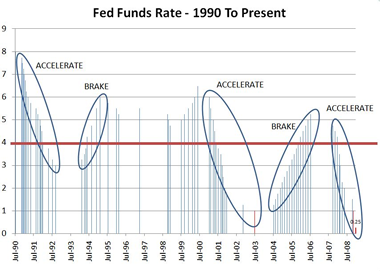
December 11, 2007 Somehow the Fed misses the obvious.
fed_rate_moves_425_small.gif
[Image from: CNNMoney.com]
December 13, 2007 [from The Christian Science Monitor]
"The odds of a recession are now above 50 percent," says Mark Zandi, chief economist at Moody's Economy.com. "We are right on the edge of a recession in part because of the Fed's reluctance to reduce interest rates more aggressively." [see my comments of September 11]
January 7, 2008 The real problem now is that consumers can't rescue the economy and manufacturing, which is already weakening, will continue to weaken. We've gutted the forces that could avoid a downturn. The question is not whether there will be a recession, but can it be dampened sufficiently so that it is very short.
January 11, 2008 This is death by a thousand cuts.
January 13, 2008 [N.Y. Times]
“The question is not whether we will have a recession, but how deep and prolonged it will be,” said David Rosenberg, the chief North American economist at Merrill Lynch. “Even if the Fed’s moves are going to work, it will not show up until the later part of 2008 or 2009.”
January 17, 2008 A few days ago, Anna Schwartz, nonagenarian economist, implicated the Federal Reserve as the cause of the present lending crisis [from the Telegraph - UK]:
The high priestess of US monetarism - a revered figure at the Fed - says the central bank is itself the chief cause of the credit bubble, and now seems stunned as the consequences of its own actions engulf the financial system. "The new group at the Fed is not equal to the problem that faces it," she says, daring to utter a thought that fellow critics mostly utter sotto voce.
January 22, 2008 The cut has become infected and a limb is in danger. Ben Bernanke is panicking and the Fed has its emergency triage team cutting rates... this time by 3/4%. ...

What should the Federal Reserve do now? Step back... and don't be so anxious to raise rates at the first sign of economic improvement.
Individuals and businesses need stability in their financial cost structures so that they can plan effectively and keep their ships afloat. Wildly fluctuating rates... regardless of what the absolute levels are... create problems. Either too much spending or too much fear. It's just not that difficult to comprehend. Why has it been so difficult for the Fed?

About Me

My photo
Michigan, United States
Air Force (SAC) captain 1968-72. Retired after 35 years of business and logistical planning, including running a small business. Two sons with advanced degrees; one with a business and pre-law degree. Beautiful wife who has put up with me for 4 decades. Education: B.A. (Sociology major; minors in philosopy, English literature, and German) M.S. Operations Management (like a mixture of an MBA with logistical planning)