READ ABOUT DETROIT AND SOLUTIONS TO ITS PROBLEMS. CLICK HERE.
Showing posts with label Federal Reserve. Show all posts

Friday, November 16, 2012

Federal Reserve To FHA: Don't Tell Anyone The Truth... They Can't Handle The Truth

SEARCH BLOG: ECONOMY and FEDERAL RESERVE.

You can't handle the truth!  So, don't be alarmed; you won't get it from the Obama administration.

The Federal Reserve's Big Ben Bernanke says...


The Federal Housing Authority says:


To recap: loose lending standards led to massive numbers of bad mortgages that were bundled and sold which led to... massive numbers of defaults and foreclosures and lost investments which led to... government bailouts of the banks which led to... demands for more responsible lending requirements which led to... difficulties getting new loans which led to... a continued depression of the housing market which led to... calls for loose lending standards which led to... authorizing loans for those who had borrowed money for homes that they could not afford which led to ... go back to the beginning of this sentence.


..

Monday, October 15, 2012

Federal Reserve: U.S. Inflation Not A Problem - Maybe

SEARCH BLOG: FEDERAL RESERVE.

From Reuters:

U.S. Fed officials offer divergent views on inflation risks
Federal Reserve officials offered divergent opinions on Monday about the correct stance for monetary policy, pitting a hawk against a dove over the inflation risk posed by the central bank's massive efforts to buoy U.S. growth.
The Fed, which meets to review policy next week, in September announced a third round of quantitative easing and pledged to keep interest rates near zero until mid-2015 in an effort to underwrite a durable economic upswing.
Anti-inflation hawks were outnumbered by the doves on the Fed's policy-setting committee, who view inflation as a distant threat in the face of tepid U.S. growth and high levels of joblessness, plus other gauges of economic slack. 
That's really quite interesting.  The top bankers in the U.S. are telling us that things are so bad that the risk of an economic death spiral is of more concern than the risk of an economic falling-off-the-debt-cliff... at least that's how I read these tea leaves.
Lacker said the Fed's guidance that it will keep rates low until at least mid-2015 could send the wrong message.
"It could be misinterpreted as meaning that the Committee believes the economy will be weaker than people had thought. By itself, that could have a dampening effect on current activity, which is not what was intended," he said.
Misinterpreted?  Hmmm.  How's that?
St. Louis Fed chief James Bullard raised his next year growth estimate to 3.5 percent, from a previous call of a pace above 3 percent. He told the Missouri Council on Economic Education that he saw unemployment dropping toward 7 percent over the course of the year, the St. Louis Fed said.
But U.S. growth has repeatedly undershot forecasts as it has gradually recovered from a severe recession in 2007-2009, and Dudley cited this experience for a reason why policy "needed to be still more aggressive," as well as to guard against shocks. [Full Article]
Got it!  They have no idea what is going to happen... but it won't be good if we keep doing what we've been doing.

2012 IS HERE

..

Wednesday, September 05, 2012

Peter Schiff Says Federal Reserve Policies Are Wrong

SEARCH BLOG: ECONOMY

Peter Schiff writes via Forbes:

Because the Fed has kept interest rates too low for too long, Americans have saved too little and borrowed too much; consumed too much and produced too little; and imported too much and exported too little. Too much of our labor is devoted to the service sectors and not enough to goods production. Too much capital goes to Wall Street speculators and not enough to Main Street entrepreneurs.  We built too many homes but not enough factories. We have developed too many shopping centers, and not enough natural resources. The list of Fed induced misallocations goes on. 
By trying to preserve the jobs associated with this old economy, the Fed prevents the market from creating the ones we actually need. Unfortunately no one seems to understand that, and we continue to chase blindly after failed economic models. Look for such misunderstanding to be on high display this week in Charlotte as Democrats gather to call for even greater intervention to perpetuate a failed economic model.
RELATED:

WEDNESDAY, JULY 11, 2012


2012 IS HERE

..

Wednesday, March 14, 2012

Can Obama Truly Be This Amoral?

SEARCH BLOG: OBAMA

A very disturbing series from The Ulsterman Report:

My God…My God…What Has Become Of America?

I'm not sure I can fully appreciate what is being discussed in these three interviews, but I get the distinct impression that I will if Obama is re-elected.  

Set aside part of an evening.  Take the time to read these interviews.  Then vote for ABO!

2012 IS HERE

..

Thursday, January 26, 2012

Hope, Change, Or Hope You Still Have Some Change

SEARCH BLOG: FEDERAL RESERVE

To support a stronger economic recovery and to help ensure that inflation, over time, is at levels consistent with the dual mandate, the Committee expects to maintain a highly accommodative stance for monetary policy. 
In particular, the Committee decided today to keep the target range for the federal funds rate at 0 to 1/4 percent and currently anticipates that economic conditions--including low rates of resource utilization and a subdued outlook for inflation over the medium run--are likely to warrant exceptionally low levels for the federal funds rate at least through late 2014. [SOURCE]
In other words, no hope for much change under the present administration.  We're going to give away money to say that the economy is moving.  Inflation?  Hah! Ever try inflating a lead ballon?


Now about your retirement plans....


RELATED READING:

Fed Signals That a Full Recovery Is Years Away
 

By BINYAMIN APPELBAUM
The Federal Reserve said it was not likely to raise interest rates until the end of 2014, adding 18 months to the expected duration of its response to the slump.

2012 IS HERE

..

Monday, May 03, 2010

Old News Is Still New

SEARCH BLOG: NEWS

Moving is interesting in many ways, not the least of which is what you find buried in the back of storage closets.  My wife found these [click images for larger views]:

Detroit Free Press; March 3, 1976
  • China and a U.S. president
  • Car sales recovering
  • Federal Reserve under fire
  • New cars coming


The Wall Street Journal; October 20, 1987
  • Stock Market crashes
  • Is a Depression coming?
  • U.S. and Iran in conflict

The Detroit News and Free Press; December 20, 1998

The Detroit News; November 8, 2000
  • Who will be the next president?

Aw, that's old news.

2012 IS GETTING CLOSER

..

Monday, January 04, 2010

Inflated Expectations

SEARCH BLOG: OIL and INFLATION

Some disturbing stories for those who feel that we may be on the brink of an inflationary episode:

It's a bit early to be yelling "buy copper" or "buy garlic," but it may be worth watching the signs more closely. The U.S. government continues to come up with more programs every day that will put inflationary pressures on our economy.

Right now, the ragged condition of the economy is an anchor against inflation, but that may be ending. And it is obvious that the price we pay for being "subsidized" by China and India, among others, is the risk of being whipsawed by incidents and disputes in places most of us can't find in an atlas.

2012 IS GETTING CLOSER

..

Tuesday, October 20, 2009

Trading Places

SEARCH BLOG: ECONOMY and TRADE

I won't say "I told you so." Just read the articles linked below...

Hindsight is so 20-20. What could possibly go wrong with huge trade imbalances and loss of core manufacturing capability and jobs... as long as our government could get the money it wanted to spend on its social and economic experiments?

..

Sunday, October 18, 2009

Raise Interest Rates

SEARCH BLOG: INTEREST RATES

I was surprised to see this cover on Barron's October 19 issue:

It's an interesting conundrum: should the Fed try to slow an economy that is dead in the water or try to prevent inflation caused by policies of the Obama administration? Apparently, there is no alternative such as "let the markets work."

Here's what is going on:

  • The federal government is flooding the world with dollars that have no real backing, thus diluting the value of the dollar against other currencies [inflation within the U.S.]
  • The Federal Reserve is trying to protect the banking system by keeping the cost of their money low while trying to figure out how to deal with insolvent banks
  • U.S. trade and tax policies encourage the gutting of U.S. manufacturing and the rise of U.S. unemployment creating a greater "dependency class"
  • U.S. unwillingness to enforce immigration laws is flooding our cities with uneducated, social services dependent masses that have strained cities' and states' budgets to their breaking points
  • Despite optimism in the stock markets, most investors have lost substantial amounts in the past three years leaving personal finances in a mess
  • Real estate is a cesspool and now Congress is trying to re-institute the very policies that caused the mess
  • On top of all of this, the Obama administration is trying to pass energy and health care legislation that will further cripple the economy and place inflationary pressures on the dollar
So, I guess it's time to raise interest rates.

Soon to come... big increases in taxes.
..

Wednesday, August 26, 2009

What Has Ben Bernanke Learned?


... New fashion statement... no ties?

Aug 13, 2009
..

Banks Are In Trouble

SEARCH BLOG: BAILOUT

It doesn't take more than a quick read of financial publications to realize just how much of the TARP iceberg is still below the water waiting for another Titanic experience.

In yesterday's The Wall Street Journal there was the headline "Fewer Catching Up On Lapsed Mortgages." In the article was the statement, "Barclays Capital projects the number of foreclosed homes for sale will peak at 1.15 million in mid-2010, up from an estimated 688,000 as of July 1."

There was also the editorial opinion titled "Private Equity and the Banks" that dealt with regulations by the FDIC for imposing bank-holding regulations if ownership exceeds 24.9%.

The private equity investors don't want the regulations, even if they exceed the 24.9% threshold. The Journal rightly muses: "The still weak U.S. banking system doesn't need investors looking mainly for a quick spinoff that could leave a bank in poor hands within a year or two." Yes, this is the time that the manipulators come out in force. [Note: for those of you who think the WSJ represents the interests of manipulators... have another think.]

Meanwhile, Bank of America "Denies Misleading Its Investors On Bonuses" ... "and it was "widely understood" that billions of dollars would be awarded for 2008 performance."

There was also an article about "Price for RBS Assets in Asia in Doubt" but the Royal Bank of Scotland is Great Britain's problem [I hope].

Skipping over to Monday's Barron's, a pithy paragraph on page 12... "Analyst Meredith Whitney said that U.S. bank failures will quadruple as a result of bad loans She told Bloomberg Television that she expects more than 300 closings."

But the final word goes to banking guru, former Federal Reserve Chairman, Alan Greenspan who was also quoted in Barron's: "We're OK for the next six months. We are getting a recovery... but the process doesn't have legs to it."

You can decide if the last part refers to the slowness of the recovery... or that the recovery doesn't have a leg to stand on.

The big question for most of us is: in which mattress do we keep our money?


..
Saturday, August 15, 2009

Economy Surges... Nowhere

SEARCH BLOG: ECONOMY

Three months ago, I wrote:

Just some observations:

  • Unemployment has not peaked and the "hunker down" mentality is increasing which will have a suppressing effect on the economy
  • The economy has yet to feel the impact of General Motors and Chrysler declaring bankruptcy... and the bankruptcy court decisions that will ripple through the supplier base and have a suppressing effect on the economy
  • Oil prices have gone up over $15 per barrel from their lows and that will have a suppressing effect on the economy
  • The federal government's deficit spending increases will lead to either or both tax increases and higher inflation which will prompt the Federal Reserve to raise interest rates... all of which will have a suppressing effect on the economy
  • Federal energy policies are being pushed by Energy and Commerce Chairman Henry Waxman that will dramatically increase the cost of energy and create burdens on domestic manufacturers which will have a suppressing effect on the economy
I'm still not sure what hope I am to have from all of this change. But don't worry; China will buy our debt and continue to subsidize us... or will they?
Now The New York Times writes:

Halfway through the back-to-school shopping season, retail professionals are predicting the worst performance for stores in more than a decade, yet another sign that consumers are clinging to every dollar. Fears about the job market have resulted in sluggish customer traffic over the last few weeks, spurring the gloomy sales projections. Parents who do shop are aggressively trading down, informing status-conscious teenagers that notebooks from the dollar store or shirts from Costco will have to do this year.
The stock market has been optimistic, but recovery may need more than hope and some pocket change. It looks as if the Federal government is the only source of spending these days. Oh, wait! Those are our dollars, aren't they?
..

Thursday, August 13, 2009

Watching The Federal Reserve

SEARCH BLOG: FEDERAL RESERVE

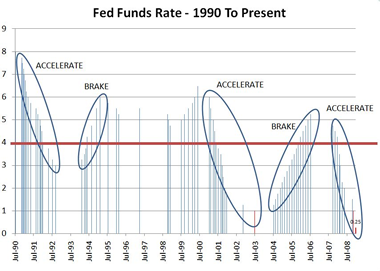
Ever since the Federal Reserve realized that the economy was tanking [a couple years too late] and dropped interest rates that they had just finished raising to fight inflation [when dropping prices portended possible deflation], the Fed has been sitting quietly in the background doing banking "stuff" with banks that were have problems doing their banking "stuff."

The Fed has seen itself as the guardian of our banking system, whereas the rest of the nation has thought of it as the stabilizer of our economy. Not so much. As long as banks were solid, the Fed's whipsawing of our economy [which increased in frequency after 2000] was seen as a necessary action to prevent our economy from overheating or freezing.

The reality was that the Fed was trying to protect banks from the dilution effects of inflation on their loans and assets whenever the economy was growing fast enough that demand caused price increases. On the flip side, if the economy was slowing and bank profits were thinning, then a bit of rate dropping was in order. If that benefitted the economy, that was a nice side effect.

It wasn't until the Fed's last series of interest rate hikes [on the erroneous fear of inflation] starting in 2004 exacerbated a developing financial crisis that people began to notice something amiss. With the housing market collapsing followed by energy prices crushing the economy, why was the Fed still focused on raising interest rates?

Certainly, interest rates were not high in absolute or historical terms, but they were increased so quickly that individuals and business were caught in a large relative increase in costs. Money borrowed on equity was subject to variable rates that followed the Fed's rates. Suddenly those home improvement loans because home wrecking loans. And small business owners that used their home equity for loans to increase their businesses found themselves in a cash flow crunch. The rush of loans being defaulted caught banks and the Fed by surprise. This was not supposed to happen just because of manipulations to protect banks against inflation.

In 2007, while the Fed funds rate was 5.25%, I thought that a quick, decisive cut to 4% might restore some confidence that the Fed was on top of the situation... with more cuts to follow as necessary. A few months later the Fed cut the rate to 4.75% which only triggered dismay. Another cut a month or so later to 4.25% was now too little too late. It triggered panic as people were convinced the Fed simply didn't understand the scope of the problem. From that point on, the Fed was in a canoe following the tidal wave of collapse. There was nothing it could do.

The best laid plans....

Now there are rumblings about possible Fed actions to raise the funds rates. Well, they are at 0% so it is difficult to lower them. The question is: when is it appropriate to return rates to a more "normal" level and how fast? The last part of the question is even more important than the first part. Given the huge value losses of real estate and investments, at what point do we say everything is "normal" again? When the DJIA reaches 10,000? When home foreclosures return to the average rate of the past 10 years? When unemployment falls below 6 percent?

That's the big question for the Fed: when and how fast should the economic brakes be applied? There is no more accelerator for the Fed to press, so all the Fed can do is apply the brakes. How much slower should the economy go from here?

Go to the very bottom of this column to read some excerpts from blog posts going back to the beginning of 2006. It explains much. You can also do a blog search on "Federal Reserve" using the search box at the top left.

..

Wednesday, May 20, 2009

Has The Federal Government Gone Too Far?

SEARCH BLOG: GOVERNMENT

It's a short, complicated, and fair question: has the federal government gone too far?

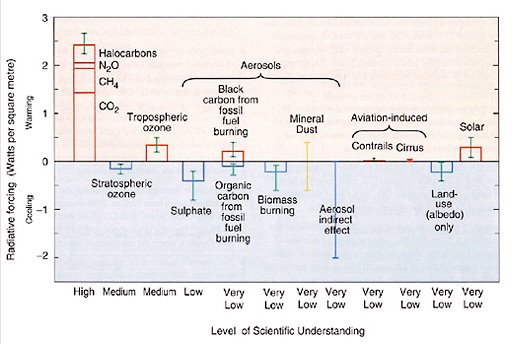
In the name of saving the planet from a natural, non-toxic, essential-to-life molecule, the federal government is enacting trillions of dollars in new regulations and laws that will result in economic hardship for hundreds of millions of people both in their day-to-day lives and in their attempts to save for their futures.

Federal spending is now so high that increased taxes are inevitable, as is a higher rate of inflation that will dramatically erode real buying power. Buyers of federal IOUs are increasingly reluctant to accept more. Higher inflation will inevitably lead the Federal Reserve to raising economy-suppressing interest rates.

Federal regulations are adding increasing costs to purchasing and operating automobiles. The next step will be energy regulations of buildings including retroactive standards. How long will it be before the trunk of every vehicle has an energy rating symbol... or the front door of every house?

Federal regulations are crippling the development of reliable energy sources for the 21st century in favor of niche energy sources that are subject to the whims of the weather and, in the case of wind turbines, the object of objections by those who are forced to live near those arrays.

Federal involvement in private enterprise has escalated to the point where the federal government now owns major players in finance and manufacturing and has an inherent conflict of interest between the economic role of such entities and the political aspirations of those running the federal government.

All of this is being done in the name of fairness and justice and the interest of the nation, but it is undermining the very economic foundations of this country. The federal government is practicing a form of economics that no economist can support. It is creating the basis for a long-term economic implosion by forcing economic decisions that are no longer based on market efficiency, but rather market manipulation.

..

Wednesday, March 04, 2009

Thaddeus McCotter And Gary Peters Write to Ben Bernanke and Timothy Geithner

SEARCH BLOG: AUTOMOBILES

Michigan Representatives Gary C. Peters and Thaddeus McCotter have written the following letters to Ben Bernanke and Timothy Geithner regarding the failure of TALF funding to enable automobile dealers to buy vehicles from manufacturers. If dealers can't get credit to buy vehicles, manufacturers can't sell the vehicles.

The government lends billions to keep GM and Chrysler operating and then their customers are unable to seal the deal.

Just a little detail someone forgot to address.

Use [CTRL -] to reduce image size

FOR IMMEDIATE RELEASE
March 4, 2009

CONTACT: Jameson Cunningham
Office: 202-225-8171
Cell: 202-288-2147

PETERS CONTACT: Cullen Schwarz

Office: 202-225-5802

Cell: 202-641-3781

PETERS AND MCCOTTER URGE ACTION TO PROVIDE GREATER LIQUIDITY IN AUTO MARKETS

Chairman Frank and other House Financial Services Members Join in Calling on Fed and Treasury to Provide Access to Credit for Auto Dealers

Washington, D.C. – Congressmen Gary Peters and Thaddeus McCotter today called on the Federal Reserve and U.S. Treasury to act further to provide enhanced liquidity to promote domestic auto sales. In a letter to Federal Reserve Chairman Ben Bernanke and Treasury Secretary Timothy Geithner, Peters and McCotter said that while the effort to promote liquidity in consumer markets through the Term Asset-Backed Securities Loan Facility (TALF) was welcome, providing greater access to domestic auto dealers is also needed. The letter, authored by Congressman Peters and McCotter, was also signed by House Financial Services Committee Chairman Barney Frank and other Committee Members.

“If auto dealers can’t get financing, they can’t sell cars and our auto industry cannot recover,” said Congressman Peters. “The international credit crisis has crippled all sectors of the auto industry around the world. To protect millions of American jobs, we need a comprehensive approach to help the industry weather the global credit crisis. That means not only providing support to the Big Three and their parts suppliers and allowing consumers access to car loans, but also providing credit for dealers to keep cars moving on and off showroom floors. Efforts to protect jobs by supporting parts of the domestic auto industry could prove unsuccessful if we do not address the challenges facing all sectors of the industry.”

“As our American auto industry’s working families continue to endure a painful and perilous restructuring process, we look forward to working with the Federal Reserve and Treasury Department to help these working families and our auto industry survive and, one day, thrive,” said Rep. McCotter. “If the American auto industry receives an enhanced bridge loan but cannot sell their cars, our communities will greatly suffer. I appreciate that Federal Reserve Chairman Bernanke is willing to revisit the issue and make sure our working families keep their jobs, their homes, and their dreams for their children. I hope both the Federal Reserve and Treasury Department speedily find a way to ensure adequate financing for auto dealers is available. We must forestall this credit crisis by keeping men and women working in the auto industry employed; thus, removing financing barriers for auto dealers is essential.”

Yesterday, the Treasury Department and Federal Reserve announced the implementation of the TALF, through which up to $200 billion would be loaned to eligible owners of AAA-rated securities backed by auto, credit card and student loans to allow lenders to make more of these loans. However, rating agencies appear reluctant to rate loans to auto dealers as AAA, shutting dealers out of the program.

Full text and signatories of the Peters/McCotter letters:


Thursday, February 26, 2009

You Can't Get There From Here

SEARCH BLOG: AUTOMOBILES

Michigan Rep. Thaddeus McCotter comes across more like a logic professor than a U.S. Congressman. A leads to B and B leads to C therefore A leads to C.

Unfortunately, the federal government doesn't necessarily use sound logic when establishing its programs and provisions. Let's look at the loans to General Motors and Chrysler as an example. The government is lending these manufacturers money to continue their operations. As part of the deal, they must jump through various restructuring hoops and come up with plans for producing and selling vehicles that will save our planet from the non-threat of CO2. These companies are doing just that. People are being laid off and engineering teams are whipping together fanciful vehicles that run on a variety of propulsion fuels that have no supporting infrastructure. Regardless, Congress can feel good about its efforts to "fix" these companies.

Here is where Rep. McCotter, the Diogenes of Congress, looks around and sees the hypocrisy and duplicity of the government and says [via Jameson Cunningham in McCotter's staff]:

“As our American auto industry’s working families continue to endure a painful and perilous restructuring process, the Federal Reserve must help – not hinder – these working families and our auto industry’s chance to survive and, one day, thrive.

Unfortunately, the Federal Reserve’s Term Asset-Backed Securities Loan Facility (TALF) may not include credit access relief for domestic auto dealers to purchase cars from manufacturers. This past Wednesday, in the House Financial Services Committee, I reaffirmed the Federal Reserve must help make TALF work for auto dealers, consumers, and every working family in the American auto industry.

“Bluntly: if the American auto industry receives an enhanced bridge loan and continues its painful restructuring on the path to viability, the Federal Reserve cannot put this immense road block in the way of working families’ efforts to keep their jobs, their homes, and their dreams for their children.”

What is he saying... for those who miss the obvious... is that the government can't offer money to the auto companies on the condition that they do what the government says and then make it impossible for these companies to sell their vehicles because the government fails to ensure that the dealers who buy these vehicles have access to the credit from the banks which received much more from the government... but are refusing to provide dealers with credit.

The left hand doesn't know what the left wing is doing.

..

Saturday, January 17, 2009

Outsourcing In Review

SEARCH BLOG: OUTSOURCING

While I understand the short-term profit motivation for outsourcing, I have always believed that it was not necessarily in the long-term self-interest of corporations and the nation to go in that direction. More specifically, I hold that outsourcing is akin to "eating your young" to be competitive. While most economists argued that we were better off with this strategy [before the structural cracks appeared], I argued that this practice would lead us to a very vulnerable position when things turned bad. Note that I included energy "outsourcing" in this... outsourcing is not just limited to jobs.

So, if you are curious, click here to read a litany of posts mentioning outsourcing.

Below are some of my favorites that will be part of the above list [you would have to select "older posts" at the end of all of the selected posts to see some of these] if you don't want to go through all of them:

Happy reading.

..

Thursday, December 18, 2008

Next Step Away From Prosperity

SEARCH BLOG: ECONOMY

Earlier in the month, I asked "Are We There Yet?"

Let's just say we are getting closer:

NEW YORK (CNNMoney.com) -- The U.S. dollar fell to a 13-year low against the yen and weakened against the euro Wednesday, a day after the Federal Reserve cut its key short-term interest rates to historic lows.

The Japanese currency reached a 13-year high against the dollar Wednesday, falling to ¥87.78 from ¥88.95 late Tuesday. The last time the yen was this strong was July 1995. Since mid-September, the yen has gained nearly 15% against the dollar.


For those with short memories, Japan experienced an economic "revolution" like this a decade ago. Their central bank went to 0% funds rates for years... and the economy did nothing in response. Here's the point: you don't manipulate your way out of a situation caused by long-term financial manipulations and disintegration of manufacturing. You get to bite the bullet.

Until federal, state, and local governments become unabashedly pro-business and anti-taxes the downward spiral from prosperity is just going to happen. Until our great politicians and economists realize that more programs and service jobs at McDonalds are not the recipe for prosperity, we are going down the road to being Great Britain, Jr.

This is not to argue for unethical business practices. Fraud is fraud. The Madoff's of the world need to be castrated and sent to prison (oh, I know that is too harsh).
But government can't hamstring business with onerous taxes, mandates, and incomprehensible regulations and red-tape... and then ask why a tax break here or there didn't work. Government can't try to micro-manage the economy the way the Federal Reserve does and wonder why the distortions appear in the economy.

Thursday, June 08, 2006
Recession

Okay, others are thinking it. I'm saying it. Michigan is in a recession. Housing markets elsewhere are tanking. Just talked with my wife's brother-in-law in Virginia. The spigot just got turned off there.

Ben Bernanke et al at the Federal Reserve has just cost the U.S. taxpayers billions of dollars and he feels good about it. [The Federal Reserve had just increased the funds rate to 5.25%]

That's what happens when the government tries to run the economy.
..

Wednesday, December 17, 2008

OPEC and Russia Attempt To Raise Oil Prices

SEARCH BLOG: OIL

When the world perceived that the economy was growing, it was an easy task to get oil prices to increase on a daily basis. OPEC and Russia are pining for those days and hope to have them return by cutting oil production... you know reduce supply to increase demand... or something like that.

That's the corollary to the Democratic Party's policy on energy: prices go up because there is a dwindling supply; prices can't go down when there is an increased supply... so increasing supply is a waste of time.
Of course, the whole pricing based on the supply and demand relationship depends on a reasonably "normal" situation. In a severely damaged economy, the impact of decreasing oil supply is going to be similar to cutting interest rates from 1% to 0.25%... similar to pushing a rope. Growth pulls prices; contraction allows pricing freefall.

So, while reducing interests rates may have a temporary, nominal, positive effect on the economy, reducing oil supply will only countervail that impact and extend the economic malaise.
OPEC and Russia would be wise to wait this troubled period out rather than helping to extend it... unless, of course, that is their intention.
The Federal Reserve missed the opportunity to ameliorate the recession when it raised interest rates on the unfounded fear of inflation... large and rapid price increases were a function of oil costs which were self-limiting and self-defeating. The political process missed the opportunity to work with oil companies during the time of high prices to move toward greater U.S. supplies which has left the door open for more of this OPEC-Russia b.s.
Now we have a screwed up economy with the possibility of deflation and no additional control of our energy supplies... but we do have change blowing in the wind as we begin the journey to stop global warming which isn't occurring.
The political process is so good. It's all the fault of the automobile CEOs.

..

Can"t Find It?

Use the SEARCH BLOG feature at the upper left. For example, try "Global Warming".

You can also use the "LABELS" below or at the end of each post to find related posts.

Blog Archive

Cost of Gasoline - Enter Your Zipcode or Click on Map

CO2 Cap and Trade

There is always an easy solution to every human problem—neat, plausible, and wrong.
Henry Louis Mencken (1880–1956)
“The Divine Afflatus,” A Mencken Chrestomathy, chapter 25, p. 443 (1949)
... and one could add "not all human problems really are."
It was beautiful and simple, as truly great swindles are.
- O. Henry
... The Government is on course for an embarrassing showdown with the European Union, business groups and environmental charities after refusing to guarantee that billions of pounds of revenue it stands to earn from carbon-permit trading will be spent on combating climate change.
The Independent (UK)

Tracking Interest Rates

Tracking Interest Rates

FEDERAL RESERVE & HOUSING

SEARCH BLOG: FEDERAL RESERVE for full versions... or use the Blog Archive pulldown menu.

February 3, 2006
Go back to 1999-2000 and see what the Fed did. They are following the same pattern for 2005-06. If it ain't broke, the Fed will fix it... and good!
August 29, 2006 The Federal Reserve always acts on old information... and is the only cause of U.S. recessions.
December 5, 2006 Last spring I wrote about what I saw to be a sharp downturn in the economy in the "rustbelt" states, particularly Michigan.
March 28, 2007
The Federal Reserve sees no need to cut interest rates in the light of adverse recent economic data, Ben Bernanke said on Wednesday.
The Fed chairman said ”to date, the incoming data have supported the view that the current stance of policy is likely to foster sustainable economic growth and a gradual ebbing in core inflation”.

July 21, 2007 My guess is that if there is an interest rate change, a cut is more likely than an increase. The key variables to be watching at this point are real estate prices and the inventory of unsold homes.
August 11, 2007 I suspect that within 6 months the Federal Reserve will be forced to lower interest rates before housing becomes a black hole.
September 11, 2007 It only means that the overall process has flaws guaranteeing it will be slow in responding to changes in the economy... and tend to over-react as a result.
September 18, 2007 I think a 4% rate is really what is needed to turn the economy back on the right course. The rate may not get there, but more cuts will be needed with employment rates down and foreclosure rates up.
October 25, 2007 How long will it be before I will be able to write: "The Federal Reserve lowered its lending rate to 4% in response to the collapse of the U.S. housing market and massive numbers of foreclosures that threaten the banking and mortgage sectors."
November 28, 2007 FED VICE CHAIRMAN DONALD KOHN
"Should the elevated turbulence persist, it would increase the possibility of further tightening in financial conditions for households and businesses," he said.

"Uncertainties about the economic outlook are unusually high right now," he said. "These uncertainties require flexible and pragmatic policymaking -- nimble is the adjective I used a few weeks ago."
http://www.reuters.com/

December 11, 2007 Somehow the Fed misses the obvious.
fed_rate_moves_425_small.gif
[Image from: CNNMoney.com]
December 13, 2007 [from The Christian Science Monitor]
"The odds of a recession are now above 50 percent," says Mark Zandi, chief economist at Moody's Economy.com. "We are right on the edge of a recession in part because of the Fed's reluctance to reduce interest rates more aggressively." [see my comments of September 11]
January 7, 2008 The real problem now is that consumers can't rescue the economy and manufacturing, which is already weakening, will continue to weaken. We've gutted the forces that could avoid a downturn. The question is not whether there will be a recession, but can it be dampened sufficiently so that it is very short.
January 11, 2008 This is death by a thousand cuts.
January 13, 2008 [N.Y. Times]
“The question is not whether we will have a recession, but how deep and prolonged it will be,” said David Rosenberg, the chief North American economist at Merrill Lynch. “Even if the Fed’s moves are going to work, it will not show up until the later part of 2008 or 2009.
January 17, 2008 A few days ago, Anna Schwartz, nonagenarian economist, implicated the Federal Reserve as the cause of the present lending crisis [from the Telegraph - UK]:
The high priestess of US monetarism - a revered figure at the Fed - says the central bank is itself the chief cause of the credit bubble, and now seems stunned as the consequences of its own actions engulf the financial system. "The new group at the Fed is not equal to the problem that faces it," she says, daring to utter a thought that fellow critics mostly utter sotto voce.
January 22, 2008 The cut has become infected and a limb is in danger. Ben Bernanke is panicking and the Fed has its emergency triage team cutting rates... this time by 3/4%. ...

What should the Federal Reserve do now? Step back... and don't be so anxious to raise rates at the first sign of economic improvement.
Individuals and businesses need stability in their financial cost structures so that they can plan effectively and keep their ships afloat. Wildly fluctuating rates... regardless of what the absolute levels are... create problems. Either too much spending or too much fear. It's just not that difficult to comprehend. Why has it been so difficult for the Fed?

About Me

My photo
Michigan, United States
Air Force (SAC) captain 1968-72. Retired after 35 years of business and logistical planning, including running a small business. Two sons with advanced degrees; one with a business and pre-law degree. Beautiful wife who has put up with me for 4 decades. Education: B.A. (Sociology major; minors in philosopy, English literature, and German) M.S. Operations Management (like a mixture of an MBA with logistical planning)