READ ABOUT DETROIT AND SOLUTIONS TO ITS PROBLEMS. CLICK HERE.
Showing posts with label Health Care. Show all posts

Tuesday, January 22, 2013

Good Thing Dick Wagner Of Alice Cooper, Aerosmith, And Kiss Got His Surgery Before 2013

SEARCH BLOG: HEALTH CARE.

The U.S. health care system is about to change under the Affordable Care Act... aka Obamacare.  Some think for the better.  That may be true... for some.  This is a story about Dick Wagner, lead guitar player for bands such as Alice Cooper, Aerosmith, and Kiss.  His story could well have turned out differently from this year forward.  This was written less than a week ago.


Now listen to this and learn why his story and yours could be far different under President Obama's version of "health care."


Well, Dick Wagner's outcome might not have changed.  He could afford to go outside of the U.S. for health care, if needed.  Can you?  Can your parents or grandparents?

Welcome to the world of the 51%-ers.

RELATED:
..

Sunday, January 20, 2013

Sarah Palin Predicted This Three Years Ago... And She Was Correct

SEARCH BLOG: PALIN and OBAMA.

You remember that Alaskan nut, Sarah Palin.  She said all sorts of ridiculous things about President Obama.  Scott Starnes points out that maybe, just maybe, she was not the nut we should have rebuked.

Read more here.

..

Thursday, November 29, 2012

State Health Care Exchanges

SEARCH BLOG: HEALTH CARE.

The Obama administration has given individual states until December 14 to decide whether or not to participate in "Health Care Exchanges."  The State of Michigan has chosen today.


It is not alone.


Where the States Stand
Interactive map available at: The Advisory Board Company


..

What Do White Males And Christians Have In Common?

SEARCH BLOG: RELIGION and GENDER and HEALTH CARE.

Neither are a "special interest" group favored by the Obama administration.

Consequently, while Obamabuddies are readily exempt from Obamacare, white males and Christians find themselves on the outside looking in.  That is probably justified in Obamathink because white males and Christians are oppressors.

From Fox News:

Hobby Lobby Stores has appealed a federal judge’s decision denying the craft supply chain’s request to not provide employees with insurance that covers morning-after and week-after birth control pills, as mandated by the ObamaCare law. 
The Christian-owned company asked for relief in the face of fines they say could reach $1 million a day for not providing the coverage. 
The appeal was filed Tuesday in the 10th Circuit Court of Appeals after a federal judge in Oklahoma on Monday denied the owners’ request for a temporary injunction against the provisions of the Obama administration's health law. 
The chain's appeal states in part that Chief Executive Officer David Green his family in less than six weeks “must either violate their faith by covering abortion-causing drugs or be exposed to severe penalties -- including fines of up to $1.3 million per day, annual penalties of about $26 million and exposure to private suits.” [more.]
Here is a link to some of the organizations and companies exempted from Obamacare.  The question is: why should there need to be an exemption ... or hundreds of exemptions ... if the law were reasonable and just?  The answer: the law is unreasonable and unjust.

As noted in The Blaze:
“Documents released in a classic Friday afternoon news dump show that labor unions representing 543,812 workers received waivers from President Barack Obama‘s signature legislation,” writes Paul Conner of the Daily Caller. “By contrast, private employers with a total of 69,813 employees, many of whom work for small businesses, were granted waivers.”
Because of the backlash over the waivers, HHS announced last summer that it would stop accepting applications for one-year waivers and would simply grant or deny waivers all the way through the end of 2013, according to The Hill.
... WITH LIBERTY AND JUSTICE FOR ALL.
..

Monday, November 19, 2012

Health Insurance Costs: Where's The War On Women?

SEARCH BLOG: HEALTH CARE.

The New York Times was a standard bearer for the Obama campaign declaring that Republicans were waging a "war on women."

Striking new evidence has emerged of a widespread gap in the cost of health insurance, as women pay much more than men of the same age for individual insurance policies providing identical coverage, according to new data from insurance companies and online brokers. [more.]
Imaging how surprising this must be to senior men who are shopping for health insurance... or life insurance.  Here is a schedule of premiums for men and women who wish to buy Medigap insurance.


How dare those insurance companies base premiums on actuarial data when it comes to men?  After all, the President of the United States has declared that using real cost data for setting insurance premiums is unjust... when it comes to women.

So what does the president have against men?

..

Friday, November 16, 2012

Wow! 15-Year Old Develops Early Detection Test For Pancreatic Cancer

SEARCH BLOG: HEALTH CARE.

This was sent to me via email by Shannon Skousgaard.


One thing the video highlighted: available in Britain in 2 years; available in the U.S. in 10 years.  

Gee, where is the FDA and Obamacare when they are not making up delaying rules and creating new taxes?  Well, a non-invasive, 3¢ test needs time and millions of dollars to test....

But don't worry, the IRS will have 16,000 new agents to enforce the tax penalty for not having insurance that won't bring you this test.
..

Thursday, November 08, 2012

Health Care Re-Formation Is Not Necessarily Reformation

SEARCH BLOG: HEALTH CARE

Received the following via an email from my insurance company [USAA].  Now, doesn't this make you feel better?
________________________________________


Many Americans could face higher tax bills on Jan. 1, 2013, as a result of four health care-reform law changes. And with the re-election of President Obama, it's likely these and other aspects of health care reform will be in place for some time.
What to Ask 
If you have questions about how these changes could affect your bottom line, speak with a USAA financial advisor or your tax specialist. Here are some questions to ask:
  • Does my health insurance policy qualify me to contribute to a health savings account?
  • Aside from helping mitigate the Medicare investment surtax, would including tax-exempt municipal bonds or tax-exempt bond funds in my portfolio provide other benefits?
  • Is there an advantage to buying long-term care insurance compared to paying those costs out of pocket?
  • Children can stay on their parents' health insurance policies until age 26, but are there advantages to buying them a separate policy instead?

You can find more information at the official federal site for the Affordable Care Act,HealthCare.gov.
Here's a look at what's about to hit — unless Congress otherwise acts — and how you may be able to minimize the impact to you.

What's Coming Jan. 1

1. Limit on flexible spending account (FSA) contributions. Today, employers set their own caps on how much employees can contribute to these plans that let them use pretax money to pay for health care expenses. For 2013, the government will enforce a $2,500 limit per employee.
2. A new Medicare surtax on investment income. Until now, Medicare taxes have only applied to earned income. For 2013, taxpayers filing individually with wages and self-employment income above $200,000 ($250,000 for married couples filing jointly) will pay a 3.8% surtax on the lower of:
  • Their net investment income — which includes interest, dividends, capital gains and other amounts.
  • The amount of their modified adjusted gross income that is greater than $200,000 ($250,000 for married couples filing jointly).

3. An additional Medicare tax on wages and self-employment income for some. The existing Medicare payroll tax of 2.9% (of which 1.45% is paid by a taxpayer through payroll deductions) will be increased by 0.9% on wages or self-employment income that exceeds $200,000 for single and qualifying head of household and widow(er) filers ($250,000 for married couples filing jointly).
4. Higher hurdle for deducting medical expenses. Currently, out-of-pocket medical costs only are deductible to the extent they exceed 7.5% of your adjusted gross income. For 2013, that hurdle will rise to 10%. But if you’re 65 or older, that threshold remains frozen at 7.5% through 2016.

What You Can Do Now

Between new taxes and the ongoing rise in medical costs, this is a good time to give your health planning a checkup. Here is some preventive medicine of a financial kind you may consider:
  • If you have scheduled medical procedures, don't skip them. It may pay to get them over with — and paid for — in 2012 if you can, before the higher threshold for deducting medical expenses hits in 2013.
  • Continue to contribute to your employee-offered FSA. While FSAs face a maximum $2,500 per employee for 2013, they're still a valuable and tax-advantaged way to manage health costs. If you haven’t missed next year's enrollment period, sign up for an FSA to divert money from your salary into this account that you can tap for qualified health-care expenses. Plan carefully, though, because under the current rules you'll forfeit any unused money left in the account at the end of the plan year.
  • If you're eligible, contribute to a health savings account (HSA). Available to people with high-deductible health insurance plans, they can be purchased on your own or sometimes through an employer. HSAs give you a tax deduction for contributions and tax-free treatment of qualified withdrawals for health-related expenses. For 2012, annual contributions to HSAs generally are limited to $3,100 for an individual and $6,250 for families. (Individuals age 55 or older can contribute an extra $1,000 a year.) In 2013, the contribution limits increase to $3,250 for an individual and $6,450 for families.
  • If you'll be hit by the new 3.8% surtax on investment income, consider making some portfolio moves in 2012. For example, if you're thinking of selling an investment with a $40,000 capital gain that would be subject to the tax, you could save tax dollars by selling or rebalancing this year rather than next. This also may be a good time to consider allocating more of your fixed income investments to tax-exempt bonds or tax-exempt bond funds and taking full advantage of pretax contributions to employer retirement plans.
  • Plan for health expenses through every stage of your life. If you're age 45 or older, that means considering obtaining long-term care insurance — and realizing that coverage gets more expensive the longer you wait. As you explore your options, find out if your employer offers a plan, or learn what long-term care solutions are offered through USAA.
  • Manage your Medicare benefits wisely. If you're approaching Medicare eligibility at age 65 or are already enrolled, learn how USAA can help you protect yourself against gaps in Medicare coverage.

What's on the Horizon: Health Reform's 2014 Provisions

  • Insurance will be universally available. Health insurers won't be allowed to turn down applicants because of their medical history.
  • Medicaid eligibility expands. Medicaid is a health insurance program for low-income Americans that's funded by the federal and state governments and administered by the states. In 2014, eligibility will expand to include Americans younger than 65 with income less than 133% of the federal poverty level. Today, eligibility varies by state and the age of the beneficiary. In most states, a parent is only covered if their income is less than 50% of the poverty level, according to the Kaiser Commission on Medicaid and the Uninsured. (For a family of four, the federal poverty level currently is around $23,000 in most states.)
  • Federal help with premiums. If your household income for the taxable year is between 100% and 400% of the federal poverty level and you are not eligible for or offered other acceptable coverage, you may be eligible for health insurance premium tax credits that will reduce your out-of-pocket costs.
  • Insurance becomes mandatory. If you can afford it but don't buy it, you'll generally be subject to a penalty that's being phased in over three years, starting in 2014 at a maximum of $285 per family or 1% of taxable income, whichever is greater. By 2016, the Congressional Budget Office projects the maximum family penalty will be between $12,000 and $12,500.
  • New price rules. Health insurers won't be able to charge a higher premium because of an unfavorable medical history or a lower one if you're especially healthy. Rates will only vary with age, geographic location, family size, participation in a health promotion program and tobacco use.
  • Insurance shopping centers. To promote availability and competition, each state will offer an online shopping exchange where consumers can shop for standardized health plans.
  • A change for business owners. Employers of 50 or more full-time employees who don't offer health insurance coverage risk paying an annual penalty tax of $2,000 per full-time employee, excluding the first 30 employees. This penalty is triggered if just one employee is eligible for federal premium subsidies.

What You May Have Missed

While there are many new health reform provisions that have yet to hit, many Americans are still trying to catch up with what's already changed. Here are the parts of the Affordable Care Act that already have been implemented:
  • Closing Medicare's coverage gap. Out-of-pocket expenses are dropping for those with Part D prescription drug coverage. For now, if you reach the gap in Medicare coverage (sometimes called the "doughnut hole"), you'll get a 50% discount on covered brand-name drugs and a 14% discount on generic drugs. These savings are scheduled to grow over the coming years until the gap is completely eliminated in 2020.
  • Small-business tax credit. This credit is valued at up to 35% (up to 25% for qualified nonprofits) of the amount qualified small employers pay for their workers' health insurance.
  • A break for early retirees covered by employer plans. Employer health plans may be eligible for reimbursement for some of the cost of providing coverage to retirees age 55 who have not yet reached 65, if they meet certain requirements. Employers have to pass the savings along to those retirees through lower premiums, deductibles or co-payments.
  • A first step to help people with pre-existing conditions. Insurance pools have been created to give access to affordable coverage. HealthCare.gov provides a simple tool to help you explore your options.
  • Money burned by tanning. A 10% tax is charged for indoor tanning that isn’t performed by a licensed medical professional.
  • No more lifetime limits. Insurers may no longer impose lifetime dollar caps on most insurance benefits. In addition, some annual dollar limits also are being phased out.
  • New restriction on canceling coverage. If your employer makes an honest mistake on your insurance application, insurance companies can no longer retroactively cancel your coverage. Insurers who want to try to rescind coverage must provide 30 days' notice to give you time to appeal the decision.
  • Extended coverage for adult children. Young adults can stay on their parents' health plans until their 26th birthday — with their parents' permission. There's no additional cost beyond the normal family premium. It's a different story if you're covered by TRICARE, where you'll pay as much as $200 a month to keep an adult child between ages 21 and 26 on your policy.
  • Guaranteed coverage for children. New health plans and work-based plans can't deny coverage to children younger than 19 with pre-existing conditions.
  • Preventive-care changes for new private plans. Many newer plans must cover preventive care without deductibles or co-payments.
  • Medicare preventive-care changes. Medicare beneficiaries no longer are charged co-payments or deductibles for many preventive services.
  • A new restriction on HSAs and FSAs. Tax-free withdrawals to buy over-the-counter medicine are no longer allowed.
  • A stiffer penalty for nonqualified withdrawals from HSAs. The penalty tax for nonqualified withdrawals doubles to 20%.
  • Medicare Advantage plans face financial squeeze. The government's reimbursements to Medicare Advantage plans face budget cuts over the next several years. In response, these plans may be forced to raise premiums or reduce benefits, or both.

..

Sunday, November 04, 2012

Add-On Fees: The New Way To Stick It To Consumers

SEARCH BLOG: ECONOMY.

You buy an airplane ticket and arrive at the airport.  Ooops, you get hit with add-on fees that can add 10% or more to the cost of your flight... costs the price of your ticket didn't cover.   You go to a hotel and stay for the night.  Ooops, when you check out, you find you have been charged "spa fees" for their gym and pool... even though you didn't use them.

Well, get ready for more.  From The Seattle Times:

Joanne Silberner stood at the podium, about to referee a CityClub panel on health-care costs.
As a former health-policy correspondent for National Public Radio, Silberner knows a lot.
But, she told the panelists and the audience, she was baffled when she got two bills after a recent visit to a dermatologist.
One bill, for $109, was for the doctor, who saw her in his office at the Roosevelt Clinic. Then, to her dismay, she got another bill — $228 — for using the space.
The care she got seemed identical to an earlier visit with a dermatologist at another clinic — except for the two-bill whammy. [image]
Why stop there?

  • The neighborhood kid charges $25 to cut your lawn... and a $50 equipment fee.
  • The grocery store charges you $105 for the food you bought... and a $25 cart usage fee.
  • The auto parts store charges you $80 for a new battery... and $15 for a "core disposal" fee [oh, wait, they already do that]
  • The gas station charges you $3.50 per gallon for gas... and a $10 dispensing fee.
  • The restaurant charges you 20% gratuity... and a $15 gratuity processing fee.
You can see more possibilities.

2012 IS HERE

..

Friday, October 26, 2012

Obama: IPAB Rationing Medicare Health Care

SEARCH BLOG: OBAMA and HEALTH CARE.

Suppose you are one of those people who believes in having insurance coverage on your appliances or cars.  You buy a policy that says you can have any service provider do the work and it will be covered.  Then your covered product breaks down and you try to arrange a repair and find out that while the service is "covered," you cannot actually get service because the service provider will not be paid enough to actually get them to do the work.

This is how the new Affordable Care Act [Obamacare] will prevent seniors on Medicare from actually getting medical care.  You need that $50,000 heart operation?  The Independent Panel Advisory Board [IPAB] has determined that the appropriate payment for that operation is $500 and Medicare will gladly pay that amount.  Strangely, you can't find a doctor to do that operation for $500.  Well, you appeal, right?  No, there is no provision for you to appeal.  It's up to you to find that $500 operation or you're out of luck. [image]

Of course, the first step on that road is the 27% payment reduction already poised to go into effect in 2013.  Try that with your utilities provider.  "Hey, I'm only going to pay $73 of that $100 bill.  Like it or lump it."  Sure, that will ensure continued gas and electric service to your house.

This video explains how the IPAB provision is unconstitutional, but, hey, that's not an issue under the Obama administration, is it?


Do you have any logical reason ... well, even plausible reason ... why anyone over 64-years old can support Barack H. Obama?

Obamacare: you get IPAB, 16,000 more IRS agents, and "denial of service."  Who needs those doctors for health care anyway?

RELATED:

Friday October 26, 2012
Aha! Pay doctors more for Medicaid

2012 IS HERE

..

Friday, September 28, 2012

The Catholic Church And The Affordable Care Act

SEARCH BLOG: HEALTH CARE and RELIGION

Catholics continue to anguish over the provisions of the Affordable Care Act that require Catholic schools, universities, charities, and hospitals... and any other Catholic organization that is not directly part of a church... to provide insurance coverage for contraception, abortions and sterilizations.

My sister-in-law is a devout Catholic and sends me links to the debate raging inside the Church.  This is the latest article that discusses the not-so-great options that the Catholic Church has regarding these issues.
A Mandate to Disobey

The Affordable Care Act mandates that employers offer and individuals buy insurance that provides free contraceptives, abortion-inducing drugs, and sterilization. It seems we have passed from a society that allows legal access to these drugs and services to one that insists that they must be free, subsidized by everyone’s insurance premiums. Catholics and others are no longer being asked to tolerate what we believe to be wrong; now we must participate. [read the full article]
I'm not a Catholic and have, at times, been at odds with the practices of that church.  But I understand the conundrum of being faced with mandates that are diametrically opposed to one's faith and principles and having... apparently... no good option to fight it.

My response to my sister-in-law was this:
Seems simple. Close all Catholic schools, universities, hospitals, and charities for one month and direct all students and patients to go to public counterparts. The strain on the public system will be overwhelming. Then Catholic officials can go public with the reason: the ACA requires Catholic organizations to violate their faith and principles. The organizations will re-open when declared exempt from those ACA requirements. 
A tough and costly sacrifice for the faith. But an effective one I'll wager. 
If the Catholic Church is really concerned about the tenets of its faith being compromised by the ACA, then a real sacrifice in defense of that faith is appropriate.  Were the Catholic Church to merely announce that it was taking these actions, there would emergency meetings in Congress and throughout the United States trying to figure out how to deal with profound public crisis.

The exemptions to the ACA would be forthcoming... immediately.

2012 IS HERE

..

Wednesday, August 15, 2012

President Obama Proposes Rational Discussion About Medicare and Medicaid

SEARCH BLOG: HEALTH CARE


But, but, but, but... that was TWO YEARS AGO!  We can't be rational with an election at hand! h/t TrogloPundit

RELATED:

TUESDAY, AUGUST 14, 2012


2012 IS HERE

..

Sunday, August 12, 2012

Obamacare War On Women... And Men... And Children... And The Elderly

SEARCH BLOG: HEALTH CARE

You know that $9 per month "free" contraception benefit from Obamacare?  Well, it seems it comes at a significantly greater cost to everyone's health care.

From Forbes:

The Federal Government's War On Medical Innovation

By Paul Hsieh 
The federal government is waging a stealth two-pronged war on medical innovation. And it will cost not just American jobs, but American lives. 
The first prong is through new taxes. Recently, the Cook Medical company announced that it was canceling plans to open new factories because of the impending ObamaCare tax on medical device manufacturers scheduled to take effect in 2013. The 2.3% tax on total sales (not profits) will cost Cook $20 million dollars a year. As a result, the company will not be opening five plants that would have employed up to 300 people each. 
Cook is not the only medical device company affected by the tax. Stryker (which makes artificial joints) will cut 5% of its workforce. Medtronic has announced the tax will cut into its investments in future products. Jonathan Rennert, chairman of Zoll Medical (which makes advanced cardiac defibrillators) has stated that the tax will mean “less innovation, fewer jobs, and fewer lives saved.” 
The second prong of the war on innovation is through regulations. The Wall Street Journal recently reported how a single FDA scientist, Dr. Robert Smith, blocked approval of digital mammography machines for several years last decade. Breast cancer specialists like Dr. Etta Pisano stated that Smith had imposed “obstacles to approval that were unreasonable.” This was especially frustrating for Pisano, who had co-authored a 42,760-patient study in the 2005 New England Journal of Medicine that demonstrated the reliability of digital mammography and showed that it was “‘significantly better’ than film in finding cancer in women under 50 and those before or during menopause.” 
However, Smith’s lawyer claims that Dr. Smith was merely following proper FDA procedure. Smith contends that too many other FDA regulators have an improper “cozy relationship” with medical device manufacturers, whereas Smith was merely being “an honest and rigorous regulator.” 
It would be bad enough if Smith had been a rogue, overzealous regulator. But it’s even worse if Smith is correct, because that means Smith represents how the system is supposed to work. 
As the Wall Street Journal notes, “There is no way of knowing whether any women had cancers advance because of the delays of digital technology.” But a friend (and breast cancer survivor) whom I will call “Cynthia” told me: 
I just realized that if this particular bureaucrat had continued in his position, I probably wouldn’t be here… [P]erhaps I should send him a “thank you for moving on” card.
(Cynthia had an invasive breast cancer that was detected at a still-treatable stage with a digital mammogram. It might not have been detected until a year later if she had been obliged to have a conventional film mammogram.) 
Even though this particular regulator is gone, how many more Dr. Smiths still work at the FDA, delaying other vitally-needed medical innovations for American patients? [read more]
 Mr. Obama, how's that for a war on health care?
..

Saturday, August 11, 2012

Paul Ryan - A Boost Or Bane For Romney?

SEARCH BLOG: POLITICS

As posted earlier, Paul Ryan has been named to run for Vice President with Mitt Romney. Let's get some of the red herrings out of the way:

Paul Ryan is too young to be Vice President.  A half-century ago, another young man was elected to the office of President of the United States at the age of 43-years old.

Paul Ryan is too inexperienced in foreign affairs.  Paul Ryan will not be setting foreign policy.  Ryan is bringing expertise in the area of budgets and economics... something completely lacking for the past 3-1/2 years from the Democrats.  Ryan's expertise can save the military from potentially disastrous cuts that will happen under the Obama administration. 

Paul Ryan wants to gut Medicare to balance the budget.  False.  Ryan has proposed alternatives that will address future funding issues for Medicare now that the Affordable [Health] Care Act will take out a half-trillion dollars from Medicare... a direct result of a Democratic Party Congress and President.

Paul Ryan will wage "war on women" just as will Mitt Romney.  That's just too stupid to comprehend.  The so-called "war on women" is the failure of the Obama administration to make any meaningful headway to improve the economy for the past 3-1/2 years.  Women don't need $9 per month for birth control.  They need jobs based on a strong economy... something that has completely eluded the socialists presently in power.

Now we can talk about the real issues... such as ethics, economy, and personal character.

RELATED:

WEDNESDAY, APRIL 25, 2012


Cut 2% Annually From Federal Spending

THURSDAY, FEBRUARY 23, 2012


Obama's Free Birth Control A Red Herring

THURSDAY, MAY 03, 2012


Surface Of The Tip Of The Medicare Fraud Iceberg

THURSDAY, JULY 19, 2012


Romney Versus Obama - The Content Of Their Characters


2012 IS HERE

..

Monday, July 30, 2012

Obamacare To Be Tested Again In Court

SEARCH BLOG: HEALTH CARE


IN THE UNITED STATES DISTRICT COURT
FOR THE DISTRICT OF COLORADO
Judge John L. Kane

Civil Action No. 1:12-cv-1123-JLK

WILLIAM NEWLAND;
PAUL NEWLAND;
JAMES NEWLAND;
CHRISTINE KETTERHAGEN;
ANDREW NEWLAND; and
HERCULES INDUSTRIES, INC., a Colorado corporation;
Plaintiffs,
v.

KATHLEEN SEBELIUS, in her official capacity as Secretary of the United States Department
of Health and Human Services;
HILDA SOLIS, in her official capacity as Secretary of the United States Department of Labor;
TIMOTHY GEITHNER, in his official capacity as Secretary of the United States Department
of the Treasury;
UNITED STATES DEPARTMENT OF HEALTH AND HUMAN SERVICES;
UNITED STATES DEPARTMENT OF LABOR;
UNITED STATED DEPARTMENT OF THE TREASURY;

Defendants.

ORDER

Kane, J.

This matter is currently before me on Plaintiffs’ Motion for Preliminary Injunction (doc.
5).  Based on the forthcoming discussion, Plaintiffs’ motion is GRANTED.


2012 IS HERE

..

Friday, July 27, 2012

Not So "Affordable" Care Act To Strain Hospital Resources

SEARCH BLOG: UNINTENDED CONSEQUENCES

Obamacare... "fixes" everything "wrong" with our health care system.

From the liberal The New York Times:

Hospitals Are Worried About Cut in Fund for the Uninsured

President Obama’s health care law is putting new strains on some of the nation’s most hard-pressed hospitals, by cutting aid they use to pay for emergency care for illegal immigrants, which they have long been required to provide.
The federal government has been spending $20 billion annually to reimburse these hospitals — most in poor urban and rural areas — for treating more than their share of the uninsured, including illegal immigrants. The health care law will eventually cut that money in half, based on the premise that fewer people will lack insurance after the law takes effect.
But the estimated 11 million people now living illegally in the United States are not covered by the health care law. Its sponsors, seeking to sidestep the contentious debate over immigration, excluded them from the law’s benefits. [full article]
Why that is just astounding!   Who would have thought that the mandate to provide hospital care to the uninsured combined with the un-funding of that mandate and the relaxation of any attempt to stop illegal entry into the country would have a negative impact on our hospitals?  That was simply unforeseeable.


In order to understand that situation, one needs to ask, "Who built that situation?"  Well, obviously not the hospitals because they didn't build the hospitals... or the "Affordable" Care Act


2012 IS HERE

..

Sunday, July 08, 2012

And The Number One Worst Thing About Obamacare Is...

SEARCH BLOG: HEALTH CARE

A great article from the National Review that sums up the foibles of Obamacare.

Here’s a quick checklist of the ten worst things in the law — in addition to the individual and Medicaid mandates [image]: 
1. Employer mandate. Most companies will have to provide and pay for expensive government-determined health insurance for their employees or face federal fines.  
2. Anti-conscience mandate. Religious organizations will be required to provide free sterilization, contraceptives, and abortion-inducing drugs to their employees, even if it violates their religious beliefs. 
3. New and higher taxes.The law contains at least 20 new taxes totaling $500 billion that will hit medical innovators, health insurance, and even the sale of your home. 
4. The Independent Payment Advisory Board. IPAB will still stand, with its rationing power over Medicare. 
5. State exchanges. States will be compelled to set up vast new bureaucracies to check into our finances and families so they can hand out generous taxpayer subsidies for health insurance to families earning up to $90,000 a year. 
6. Medicare payment cuts. $575 billion in payment reductions to Medicare providers and Medicare Advantage plans will cause more and more physicians to stop seeing Medicare patients, exacerbating access problems. 
7. Higher health-care costs. The Kaiser Family Foundation says the average price of a family policy has risen by $2,200 during the Obama administration. The president promised premiums would be $2,500 lower by this year. Hospitals, doctors, businesses, and consumers all expect their taxes and health costs to rise under Obamacare. 
8. Government control over doctor decisions.Value-based payments, quality reporting requirements, and government comparative-effectiveness boards will dictate how doctors practice medicine. Nearly half of all physicians are seriously considering leaving practice, leading to a severe doctor shortage. 
9. Huge deficits. The CBO has raised its cost estimate for the law to $1.76 trillion over ten years, but that is only the opening bid as more and more people lose their job-based coverage and flood into taxpayer-subsidized insurance. At this rate, the cost will be $2 trillion, not the less than $1 trillion the president promised. 
10. 159 new boards, agencies, and programs: The Obama administration will work quickly to set up as many of the law’s new bureaucracies as fast as it can so they can take root before the election.
Read the full article.

2012 IS HERE

..

Thursday, July 05, 2012

Obamacare and Canada Health System

SEARCH BLOG: HEALTH CARE

Thanks to Lou for this tip.  Reminds me of the several years taking my father to the VA hospitals for his treatments... which they eventually screwed up and cost him his life.

2012 IS HERE

..

Tuesday, July 03, 2012

Government Run Health Care - Ooops

SEARCH BLOG: HEATH CARE and VETERANS ADMINISTRATION

Now that Obamacare has demonstrated the right of the federal government to determine how our national health care system should be run, it might be of interest to know how the federal government actually runs one health care system.  Then ask yourself if this is the agency you want running your health care system.  As the old saying goes, "Be careful what you wish for; you may get it."

From ABC:

Fourteen years ago, an ABCNEWS hidden-camera investigation ignited a firestorm about conditions and competence inside Veterans Administration hospitals.
Recently, there have been new stories of misdiagnosis, disastrous management and deficient care at some of the nation's 162 facilities.
At a hospital near Cleveland, an ABCNEWS hidden-camera investigation found bathrooms filthy with what appeared to be human excrement. Supply cabinets were in disarray, with dirty linens from some patients mixed in with clean supplies, or left in hallways on gurneys.
At a neighboring facility, examining tables had dried blood and medications still on them. In several areas, open bio-hazardous waste cans were spilling over. Primetime obtained internal memos documenting that the equipment used to sterilize surgical instruments had broken down — causing surgical delays and possible infection risks.
With 130,000 young American men and women putting their lives at risk in Iraq today, these conditions are particularly relevant. While current soldiers are treated in military hospitals, when they leave the service and need treatment, many will seek care at Veterans Affairs (as the Veterans Administration is now known) hospitals.
"Once you come back to be a veteran, it's like a black hole, you know — nothing," former Army Sgt. Vannessa Turner told ABCNEWS. [read more]
Veterans deserve much better.  So do you.

RELATED:
Obamacare 2.0 
What If You Buy A Bus Pass And There Are No Buses?
ALSO:

TUESDAY, MARCH 06, 2007


Can"t Find It?

Use the SEARCH BLOG feature at the upper left. For example, try "Global Warming".

You can also use the "LABELS" below or at the end of each post to find related posts.

Blog Archive

Cost of Gasoline - Enter Your Zipcode or Click on Map

CO2 Cap and Trade

There is always an easy solution to every human problem—neat, plausible, and wrong.
Henry Louis Mencken (1880–1956)
“The Divine Afflatus,” A Mencken Chrestomathy, chapter 25, p. 443 (1949)
... and one could add "not all human problems really are."
It was beautiful and simple, as truly great swindles are.
- O. Henry
... The Government is on course for an embarrassing showdown with the European Union, business groups and environmental charities after refusing to guarantee that billions of pounds of revenue it stands to earn from carbon-permit trading will be spent on combating climate change.
The Independent (UK)

Tracking Interest Rates

Tracking Interest Rates

FEDERAL RESERVE & HOUSING

SEARCH BLOG: FEDERAL RESERVE for full versions... or use the Blog Archive pulldown menu.

February 3, 2006
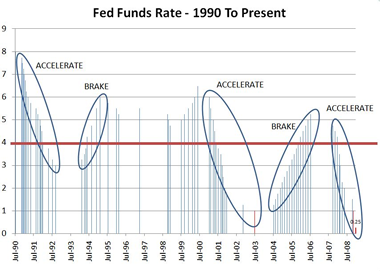
Go back to 1999-2000 and see what the Fed did. They are following the same pattern for 2005-06. If it ain't broke, the Fed will fix it... and good!
August 29, 2006 The Federal Reserve always acts on old information... and is the only cause of U.S. recessions.
December 5, 2006 Last spring I wrote about what I saw to be a sharp downturn in the economy in the "rustbelt" states, particularly Michigan.
March 28, 2007
The Federal Reserve sees no need to cut interest rates in the light of adverse recent economic data, Ben Bernanke said on Wednesday.
The Fed chairman said ”to date, the incoming data have supported the view that the current stance of policy is likely to foster sustainable economic growth and a gradual ebbing in core inflation”.

July 21, 2007 My guess is that if there is an interest rate change, a cut is more likely than an increase. The key variables to be watching at this point are real estate prices and the inventory of unsold homes.
August 11, 2007 I suspect that within 6 months the Federal Reserve will be forced to lower interest rates before housing becomes a black hole.
September 11, 2007 It only means that the overall process has flaws guaranteeing it will be slow in responding to changes in the economy... and tend to over-react as a result.
September 18, 2007 I think a 4% rate is really what is needed to turn the economy back on the right course. The rate may not get there, but more cuts will be needed with employment rates down and foreclosure rates up.
October 25, 2007 How long will it be before I will be able to write: "The Federal Reserve lowered its lending rate to 4% in response to the collapse of the U.S. housing market and massive numbers of foreclosures that threaten the banking and mortgage sectors."
November 28, 2007 FED VICE CHAIRMAN DONALD KOHN
"Should the elevated turbulence persist, it would increase the possibility of further tightening in financial conditions for households and businesses," he said.

"Uncertainties about the economic outlook are unusually high right now," he said. "These uncertainties require flexible and pragmatic policymaking -- nimble is the adjective I used a few weeks ago."
http://www.reuters.com/

December 11, 2007 Somehow the Fed misses the obvious.
fed_rate_moves_425_small.gif
[Image from: CNNMoney.com]
December 13, 2007 [from The Christian Science Monitor]
"The odds of a recession are now above 50 percent," says Mark Zandi, chief economist at Moody's Economy.com. "We are right on the edge of a recession in part because of the Fed's reluctance to reduce interest rates more aggressively." [see my comments of September 11]
January 7, 2008 The real problem now is that consumers can't rescue the economy and manufacturing, which is already weakening, will continue to weaken. We've gutted the forces that could avoid a downturn. The question is not whether there will be a recession, but can it be dampened sufficiently so that it is very short.
January 11, 2008 This is death by a thousand cuts.
January 13, 2008 [N.Y. Times]
“The question is not whether we will have a recession, but how deep and prolonged it will be,” said David Rosenberg, the chief North American economist at Merrill Lynch. “Even if the Fed’s moves are going to work, it will not show up until the later part of 2008 or 2009.”
January 17, 2008 A few days ago, Anna Schwartz, nonagenarian economist, implicated the Federal Reserve as the cause of the present lending crisis [from the Telegraph - UK]:
The high priestess of US monetarism - a revered figure at the Fed - says the central bank is itself the chief cause of the credit bubble, and now seems stunned as the consequences of its own actions engulf the financial system. "The new group at the Fed is not equal to the problem that faces it," she says, daring to utter a thought that fellow critics mostly utter sotto voce.
January 22, 2008 The cut has become infected and a limb is in danger. Ben Bernanke is panicking and the Fed has its emergency triage team cutting rates... this time by 3/4%. ...

What should the Federal Reserve do now? Step back... and don't be so anxious to raise rates at the first sign of economic improvement.
Individuals and businesses need stability in their financial cost structures so that they can plan effectively and keep their ships afloat. Wildly fluctuating rates... regardless of what the absolute levels are... create problems. Either too much spending or too much fear. It's just not that difficult to comprehend. Why has it been so difficult for the Fed?

About Me

My photo
Michigan, United States
Air Force (SAC) captain 1968-72. Retired after 35 years of business and logistical planning, including running a small business. Two sons with advanced degrees; one with a business and pre-law degree. Beautiful wife who has put up with me for 4 decades. Education: B.A. (Sociology major; minors in philosopy, English literature, and German) M.S. Operations Management (like a mixture of an MBA with logistical planning)