READ ABOUT DETROIT AND SOLUTIONS TO ITS PROBLEMS. CLICK HERE.
Showing posts with label Michigan Service Tax. Show all posts

Friday, February 12, 2010

Michigan Service Tax Resurrection

SEARCH BLOG: SERVICE TAX

Appearing in the electronic version of The Detroit News:


We went through this once before... so I'll make it easy for you.

One major change from the last round:
The tax would not apply to health care, education, construction, real estate com­missions, insurance premiums or busi­ness-to-business transactions, but it would boost the number of consumer services that would be affected from 27 to about 150. If approved by the Legislature it would cost the average family with $50,000 in­come about $140 a year, state Treasurer Bob Kleine said.
In the last go-round, the business-to-business taxes acted as a Value Added Tax and became a big problem. Now it is only a very costly proposal for the businesses and customers involved. Of course, accountants will love this.

2012 IS GETTING CLOSER

..

Saturday, December 01, 2007

Michigan Service Tax Dead?

SEARCH BLOG: MICHIGAN SERVICE TAX

It appears that the governor and legislature have heard the objections to the service tax. The morning paper headlined that the service tax would be repealed and, in its place, a higher business tax... a 22% surcharge for the next 10 years. So, one onerous tax is replaced with another.

As I wrote on November 7,

Therefore, it is unlikely that the service tax will be repealed without a pound of flesh being taken elsewhere.
Now a difficult environment for businesses is made more difficult... in just another way.
By the way, take a look at your next pay stub in December. You'll see that some of your take home has now become take out.
Although businesses do it all of the time, when is the last time you saw a state or federal budget reduced from one year to the next... even when it is appropriate to do so?

Never....

..

Friday, November 30, 2007

Michigan Service Tax Recap

SEARCH BLOG: MICHIGAN SERVICE TAX

It's December 1 and it's time to start collecting 6% of service revenues. Not sure if that applies to what you are doing as a businessman or the services for which you are paying as a customer?

Don't worry, the state government will get around to clarifying that. Trust them.
But, first, how about a recap of what has been posted here during the past year regarding the Michigan Service Tax. For those of you who are interested in the full versions, the links to the right are to previous posts [newest on top] about this shining example of Michigan government.

For those of you who would like the "Cliff Notes" version, here are some excerpts:
January 21 - Rather than creating a whole new tax structure with whole new administrative burdens for both businesses and the state (don't you think there will be a whole new department just to administer this new tax?), perhaps a simple way is this:
Implement a two-year special, non-renewable, 1% increase in both the sales tax and income taxes. The government would have two years to work out a new budget and structure based on significant reductions in revenue (if the economy doesn't recover).
January 24 - [after giving this more thought] It's time for the state to do the same with less or simply do less. Increasing taxes will only exacerbate a bad economic situation for residents and businesses. Options will vary depending on the expenditures. They include:
  1. reducing operating and staffing budgets
  2. eliminating operating and staffing budgets
  3. eliminating new projects
  4. extending timelines for existing projects (such as road construction)
  5. privatizing some functions where feasible
The usual response is "we can't" and the appropriate response is "you must."

February 9 - Besides ignoring the will of the voters with regard to taxes, the Governor has proposed a tax that is likely to be a source of a giant accounting and administrative mess. Are the taxes only applicable to retail transactions or also applicable to business-to-business services? Sales taxes can be audited through inventory records. How do you audit the number of lawns cut or heads of hair cut? The "proof of transaction" disappears in a few weeks.

This seems like a natural incentive to move toward a cash-transaction marketplace. Rather than be satisfied with taxes on the incomes of service providers, the Governor thinks that they ought to collect a fee for the service provider's privilege of earning that taxable income. More than likely, some part time service providers will "go out of business" as far as the state is concerned rather than deal with honestly reporting those extra-hours dollars.

September 21 - The philosophy of the governor and her friends that "all perceived needs of special interests must be met by the state regardless of consequences" is driving out businesses and people. This is pretty much the same approach used the Detroit's city government as the first million people left town. Now there is just fighting over scraps.

The governor and her friends have talked about revitalizing the state for the past 5 years... or was it the state government?
The inability of the governor and her friends to face the reality that business-as-usual left the state and government-as-usual must follow, leaves the state in pretty much a sad state.
September 30 - However, as reported by Nolan Finley of The Detroit News, not all government in Michigan feels the need to expand continually. An examination of the differences between the State's government and Oakland County's [biggest county government] comes up with these differences:

The state begins anew each year with a revenue estimate, budgets spending to consume every dime and then adjourns to watch everything fall apart in short order.

Oakland budgets two years at a time and works with five-year revenue projections. Right now, [Bob] Daddow [Oakland County] sees a $10 million deficit in 2010, so he's building in cuts over the next three years to wipe it out before it becomes a crisis.

... Why bother to plan ahead or take help when you can just take the taxpayers money?
The difference between a badly run business and Michigan state government is that the business goes out of existence.
October 2 - It's amazing that so many people... and government officials(?)... believe that just the state government must continue to expand while the economy of the state shrinks. By some strange accounting logic, a $2 billion increase in the budget offset by a $440 million cost reduction is considered good management... and a reduction in government.
What seems to be the case is that some believe a reduction in the rate of increase is a reduction. What taxpayers want is an absolute year-to-year reduction in government spending. Cut the damn budget by 5% and learn to live with it.
October 7 - The state's economy has badly affected the business climate and now our governor and legislators have enacted an onerous business service tax that has me seriously thinking about shutting our business down. After 25 years, it just doesn't seem worth the time or effort to be a Michigan business anymore.

October 12 - In today's Detroit Free Press website, Tom Walsh posted an article implying that people were over-reacting to the new service tax and taxes in general for Michigan.

One of those "over-reacting" readers wrote the following: see Michigan Service Tax Anger
October 17 - If you have someone help you on a project where their work is integrated into a product you are selling, then you pay a tax for the service and pass the cost on to the customer who is buying your product. Currently, if that customer is another business who will sell your product as a retail item, then he is exempt from the sales tax, but ends up paying it as a hidden service tax.
The state effectively revokes the sales tax exemption and makes the product cost 6% more from a Michigan retailer than a retailer in another state.
October 30 - Well, I'm going out on a limb here, but I'm predicting that 1) the Democrats will do everything they can to make sure the service tax sticks and 2) the service tax revenues will be far less than the Democrats predict which will bring them back to the trough for increases in other taxes. [It should be noted that the income tax is increasing, too]. The turnip is drying up and the Democrats are still trying to squeeze it.

November 1 - As I said earlier, the process was "Fire, ready, aim."

November 7 - The Michigan Senate voted to repeal the service tax before it begins reports The Detroit News. That may turn out to be only symbolic.
The Democrat party controls the House and governorship. Therefore, it is unlikely that the service tax will be repealed without a pound of flesh being taken elsewhere.
Although businesses do it all of the time, when is the last time you saw a state or federal budget reduced from one year to the next... even when it is appropriate to do so?
Sadly, it's just too easy to predict the way our Governor's gang operates.

..

Wednesday, November 07, 2007

GM, Toyota, and Michigan Gov. Granholm

SEARCH BLOG: TAXES and CURRENCY MANIPULATION

The Detroit Free Press reports:

Toyota reports record income
Toyota Motor Corp. reported early this morning record net income for the first half of its fiscal year of 942.4 billion yen, or $8 billion, up 21.3% from the same period last year. | StoryChat 36 Comments

* • GM takes loss of $39 billion
A question for Gov. Granholm:
What are the Japanese tax policies that affect/assist Toyota versus Michigan tax policies that affect/hurt General Motors [before/after your beloved service tax takes effect]?
Then consider the Japanese practice of currency manipulation to favor their industries.

Can it be that Gov. Granholm just doesn't understand?

..

Michigan Service Tax - Gone... Not Really

SEARCH BLOG: MICHIGAN TAXES

The Michigan Senate voted to repeal the service tax before it begins reports The Detroit News. That may turn out to be only symbolic.

The Democrat party controls the House and governorship. Therefore, it is unlikely that the service tax will be repealed without a pound of flesh being taken elsewhere.
Although businesses do it all of the time, when is the last time you saw a state or federal budget reduced from one year to the next... even when it is appropriate to do so?

..

Thursday, November 01, 2007

Michigan Service Tax - Rethinking Is Better Late Than Never

SEARCH BLOG: MICHIGAN TAXES

From The Detroit News:

Thursday, November 1, 2007

Lansing may repeal service tax

Governor, lawmakers look for alternatives after business outcry.

Mark Hornbeck and Charlie Cain / Detroit News Lansing Bureau

LANSING -- The just-passed state budget had barely arrived on Gov. Jennifer Granholm's desk Wednesday when the governor and legislative leaders said they are open to repealing the widely unpopular new $725 million tax on services before it takes effect Dec. 1.

Granholm acknowledged that the hastily assembled service tax is likely to take on a different form in coming weeks. The tax was cobbled together under a veil of secrecy, and with no public input, during the mad scramble to raise enough money to avoid a government shutdown a month ago.

"Those discussions have got to begin now and any changes have to be made in the near future," Granholm said.

You think?
As I said earlier, the process was "Fire, ready, aim."
Now about that budget cut....

..

Tuesday, October 30, 2007

Michigan Service Tax - Calm Before The Storm

SEARCH BLOG: MICHIGAN TAXES

It's been strangely quiet since the lines have been drawn: expanding government on one side; shrinking economy on the other. A few editorials here and some baffling noises from politicians there. But I'd say that this is just the calm before the tax storm hits in Michigan.

Michigan's Democrat Governor Jennifer Granholm [who just endorsed Mrs. Clinton for president] and Democrat legislators have gotten their way and passed a tax on services in order to erase a budget deficit of about 5%. There is talk of some budget cuts [after the increase], but that's just talk so far.

Meanwhile, Michigan residents are tightening their belts. Some are trying desperately to get out of Michigan by selling their homes at 1990 prices. Others are simply walking away from what they can no longer afford. Business are folding their tents.

But Michigan Democrats are wringing their hands about a budget that is only expanding by a couple billion dollars. As I wrote on October 1:

It's difficult to find how the 2008 budget bottom line actually compares with the 2007 budgeted/actual spending [strangely, the budget numbers seem hard to find]. It looks as if the 2008 budget is $43.4 billion, but that could be changing minute-to-minute. Compare that with the $41.7 billion approved for the 10/2006 - 10/2007 period.
That works out to a year-to-year state budget increase of almost 4.1%.
Well, I'm going out on a limb here, but I'm predicting that 1) the Democrats will do everything they can to make sure the service tax sticks and 2) the service tax revenues will be far less than the Democrats predict which will bring them back to the trough for increases in other taxes. [It should be noted that the income tax is increasing, too].
The turnip is drying up and the Democrats are still trying to squeeze it.
Well, it's just a tax on business... not on people.
And what runs those businesses and what do those businesses employ and from what does the state receive income and profit taxes now?
It's time government does what businesses do when faced with very difficult situations: cut back... significantly.
There have been enough examples of waste identified and processes so inefficient and unresponsive that a flat 5% cut... across the board for every single program... should be enacted.
Sure, the reaction is "We can't do that. [Fill in the blank] can't survive with a 5% cut in the [fill in the blank] program."
Yes [fill in the blank] can survive with 5% less state involvement. Has anyone wondered how much Ford, GM and Chrysler's budgets have been cut over the past few years so that they can survive?
That still leaves 95%... which is still higher than many people can budget for themselves versus a year or two ago.
And about all of those new programs... to give away those service tax dollars....
What do you think will happen when the expanding Democrat government comes back for more taxes to balance their expanding budget?
Don't stand in front of the fan.
..

Wednesday, October 17, 2007

Michigan Service Tax - What's Next?

SEARCH BLOG: MICHIGAN TAX

Concern, confusion, and anger all describe the reaction of Michigan residents to their state's new service tax. Relief is not a typical reaction.

The tax, which is supposed to go into effect on December 1 or January 1 depending on where you read accounts, remains a mystery to most people and businesses. A tentative list of affected business categories has been published, but no real insight regarding the way the system is to work.

Will this be a simple extension of the sales tax system or will there be another entirely new administrative maze to wander?

Since the service tax involves business-to-business transactions... including sub-contractors and sub-sub-contractors... the issue of being taxed versus tax exempt becomes a nightmare for businesses.
If you have someone help you on a project where their work is integrated into a product you are selling, then you pay a tax for the service and pass the cost on to the customer who is buying your product. Currently, if that customer is another business who will sell your product as a retail item, then he is exempt from the sales tax, but ends up paying it as a hidden service tax.
The state effectively revokes the sales tax exemption and makes the product cost 6% more from a Michigan retailer than a retailer in another state.
Will lawmakers then say this is not what they intended and have the retailer send in a form with an accounting of all of his purchases to get a service tax rebate?
  • Or will the state tell the wholesaler to eat the cost so that the retailer will buy from him instead of the company in Indiana?

  • Or will businesses and taxpayers start recalling legislators who voted for this mess?

  • Or will legislators see the writing on the wall and repeal this mess?

  • Or will the governor simply lecture the residents of Michigan about the fact that the money they earn shouldn't be considered theirs, but rather an investment in expanding the state government?

Fire, ready, aim... good job Michigan government! Your present and future tax dollars in action.

...

Friday, October 12, 2007

Michigan Service Tax Anger

SEARCH BLOG: MICHIGAN TAXES

In today's Detroit Free Press website, Tom Walsh posted an article implying that people were over-reacting to the new service tax and taxes in general for Michigan.

One of those "over-reacting" readers wrote the following:

notax

Mr. Walsh appears to be incredulous as to why we are so angry with regard to having our taxes increased at a time when this state has the highest unemployment in the nation.

Well Mr. Walsh here are a few reasons.

Commie Granholm said we have not had a tax increase in over 12 years and we taxpayers have little patience for a LIAR!

Michigan has had 12 years of tax cuts------------------------FALSE
Michigan’s income tax was 4.6% before----------------------TRUE
Michigan’s income tax is now 3.9%-----------------------------TRUE

When Michigan voters lowered income tax from 4.6% to 3.9% Sales tax was 4%-------------TRUE
Prior to Michigan lowering income tax to 3.9% there was no 8.6% real estate transfer tax—TRUE


After Michigan lowered income tax, sales tax was raised to 6%--------------------------------------TRUE
After Michigan lowered income tax, new transfer tax was created------------------------------------TRUE

With Michigan lowering income tax and raising sales tax and transfer tax, the States revenue was the same meaning the lower income tax was offset by the increase in the other two taxes. -----------------TRUE

Now Michigan is the ONLY state to have both a service tax and a transfer tax in the nation. ------TRUE

Don’t believe me, listen to Granholm grudgingly acknowledge it on audio.

Here is the web site to the Frank Beckman show:

Also listen near the end of the clip where commie Granholm claims she never made a pledge to not raise taxes and then listen to Frank Beckman play the clip where in fact she did state that.

http://www.wjr.net/Article.asp?id=488295&spid=6525

_________________
On October 16th 2006 during the third debate. Channel 7 reporter asked Granholm if she would raise taxes. Her answer: "NO"

Or maybe the taxpayers are upset that the Governor who claims to feel our pain doesn’t give us a break at the gas pump.

the figures below were based on 80 cents a gallon so triple the states take of over $1.29 a gallon times the number of average gallons in a car of say 18 equals $23.22 cents a fillup we are paying to the state.

Michigan
• Federal Tax 18.3
• State Excise Tax 19
• State Sales tax 6%
In Michigan the sales tax is applied to the actual sales cost + Federal Tax. So Michigan not only is taxing gasoline for non-road use (the sales tax revenue goes to the general fund - not roads) but also is taxing a tax.
Total taxes per gallon assuming a sale price of 80 cents per gallon is ((80 + 18.3) * .06) + 18.3 + 19 = 43 cents per gallon.

Or just maybe the taxpayers of this state do not like a commie at the helm who truly thinks our money is HER money to spend as she please with whom she pleases.

COMMIE GRANHOLM QUOTE:

"It's not just about me, me, me. It's about investing in Michigan," she said. "Where's the notion of the common good? It's been lost over decades because there's been ... this idea that it's your money, it's your money.
BY CHRIS CHRISTOFF
FREE PRESS LANSING BUREAU CHIEF

http://www.freep.com/apps/pbcs.dll/article?AID=/20071007/NEWS06/710070598
Yeah, that's a little anger.

..

Sunday, October 07, 2007

Closing Shop Because Of The Michigan Service Tax

SEARCH BLOG: MICHIGAN TAXES

If you read my profile on the sidebar, you will see that I'm retired and running a small business in Michigan.

The state's economy has badly affected the business climate and now our governor and legislators have enacted an onerous business service tax that has me seriously thinking about shutting our business down. After 25 years, it just doesn't seem worth the time or effort to be a Michigan business anymore.
That's unfortunate because those clients we serve will lose a significant opportunity to earn money from their investments, we'll lose the extra income... and Michigan will lose taxes from our income and our clients' income. This is just one small example of how short-sighted the government's approach is in their "investment" in Michigan marketing spin.
Our decision isn't final yet and I don't want to make it out of anger toward politicians, but let's just say that the outcome is very likely going to be lose-lose-lose. Well, there is always social security... maybe.
..

Tuesday, October 02, 2007

Michigan Service Tax Confusion

SEARCH BLOG: MICHIGAN TAXES

Michigan has become the poster child for government that believes all good things comes from taxing its citizens.

When things are bad, make them worse.
It's amazing that so many people... and government officials(?)... believe that just the state government must continue to expand while the economy of the state shrinks. By some strange accounting logic, a $2 billion increase in the budget offset by a $440 million cost reduction is considered good management... and a reduction in government.
What seems to be the case is that some believe a reduction in the rate of increase is a reduction. What taxpayers want is an absolute year-to-year reduction in government spending. Cut the damn budget by 5% and learn to live with it.
That's not going to happen in our lifetimes, however. So we get more taxes. The income tax may be burdensome, but it is understandable and relatively simple. The new service tax will be a source of anger, confusion, and [probably] avoidance.
The service tax problem is two-fold:
  • Many highly visible "services" are exempt.
  • Unlike retail sales taxes which can be legally exempted between businesses as part of the final retail sales chain [manufacturer to wholesaler to retailer], business-to-business service [consulting or subcontracting] transactions apparently will be charged at every step of the way... taxing taxes so to speak. This aspect of the service tax has to be eliminated before the tax goes into effect or it will drive significant business out of Michigan.
When will Michigan government realize that taxes are real costs to real people and real businesses... not simply revenue enhancements to the state coffers?

..

Monday, October 01, 2007

Michigan Taxpayers To Receive More... Taxes

SEARCH BLOG: MICHIGAN TAXES

Surprise! Michigan legislators decided that maybe it was okay to dump more burden on an already down-and-out state economy. Was it any surprise that the vote was pretty much along party lines? From the Detroit Free Press:

Here's how the Michigan House and Senate voted on key bills before them Sunday night and this morning:

HOUSE VOTE ON INCOME TAXES

The House passed the income tax measure 57-52. Democrats hold a 58-52 edge in the House, but three Democrats — Martin Griffin and Michael Simpson of the Jackson area and Lisa Wojno of Warren — voted against it. Two Republicans, Chris Ward of Brighton and Ed Gaffney of Grosse Pointe Farms, voted in favor of the proposal.

SENATE VOTE ON INCOME TAXES

The vote was 19-19, and Lt. Gov. John Cherry broke the tie. Four Republicans voted for the higher income tax — Patricia Birkholz of Saugatuck, Tom George of Portage, Ron Jelinek of Three Oaks and Gerald Van Woerkom of Norton Shores. Democrats Glenn Anderson of Westland and Dennis Olshove of Warren voted against the tax increase.

HOUSE VOTE ON SALES TAX ON SERVICES

No House Republicans voted for the bill placing the sales tax on services — a proposal stiffly opposed by the business community. All Democrats did, except for Reps. Marc Corriveau of Northville and Kate Ebli of Monroe, who voted no. The final vote was xxx to xxx. [sic]

SENATE VOTE ON SALES TAX ON SERVICES

The final tally was 19-19, with Lt. Gov. John Cherry again casting the tie-breaking vote. Three Republicans voted for it -- Wayne Kuipers of Holland, Roh Jelinek of Three Oaks and Valde Garcia of Howell. One Democratic -- Glenn Anderson of Westland -- voted against it.

Let's summarize:
Taxpayers situation
  • Foreclosure rates 3rd highest in nation
  • Unemployment the highest in the nation
Michigan budget situation
  • ???
It's difficult to find how the 2008 budget bottom line actually compares with the 2007 budgeted/actual spending [strangely, the budget numbers seem hard to find]. It looks as if the 2008 budget is $43.4 billion, but that could be changing minute-to-minute. Compare that with the $41.7 billion approved for the 10/2006 - 10/2007 period.
That works out to a year-to-year state budget increase of almost 4.1%.
That giant sucking sound you hear is the state government vacuuming out your savings account... or food budget.

..

Sunday, September 30, 2007

When Politicians Compromise We Lose

SEARCH BLOG: MICHIGAN TAXES

As a Michigan resident, I have a vested interest in the financial machinations of our State government.

The Detroit Free Press newspaper headline for today was, "Close To A Deal."
It looks like the governor will mostly get her way and income taxes will go up and the 6% sales tax will be extended to services [originally the discussion was about a 2% service tax].
The Governor will not be denied what she sees as her due.
However, as reported by Nolan Finley of The Detroit News, not all government in Michigan feels the need to expand continually. An examination of the differences between the State's government and Oakland County's [biggest county government] comes up with these differences:

The state begins anew each year with a revenue estimate, budgets spending to consume every dime and then adjourns to watch everything fall apart in short order.

Oakland budgets two years at a time and works with five-year revenue projections. Right now, [Bob] Daddow [Oakland County] sees a $10 million deficit in 2010, so he's building in cuts over the next three years to wipe it out before it becomes a crisis.

Oakland closes its books at the end of each quarter. It knows right away if the budget is running off track and can adjust spending. The state, by contrast, didn't discover $70 million in unbudgeted spending until well after the last fiscal year ended. The shortfall got rolled into this year's deficit.

Employee benefits are reformed to match cost increases. Patterson side-stepped a gubernatorial veto to set up a health care fund similar to the one agreed to by GM and the UAW.

The liability for retiree health care is now off the books. The state, meanwhile, faces hundreds of millions in future health care obligations, with no clue where the money will come from.

And the county doesn't allow government to pork up on state and federal freebies. By law, Oakland kills any grant-funded program when the grant runs out. The state too often keeps the program when it loses the free money and builds the cost into the general fund.

Creative use of technology continues to save Oakland money and is shared with local communities and school districts. An offer to share it with the state as well got no takers.

Why bother to plan ahead or take help when you can just take the taxpayers money?
The difference between a badly run business and Michigan state government is that the business goes out of existence.
The Governor's philosophy:
I want it, I want it, I want it, I want it... I want it, I want it, I want it, I want it... I want it, I want it, I want it I want it... I want it, I want it... now! [It is your money]
Hey, it's a lot easier than managing well.

..

Friday, September 21, 2007

Michigan One Note

SEARCH BLOG: MICHIGAN

As a resident of the only state in the Union that can claim to be in a recession, I find it quite incredible [but not unexpected] that government special interests are continuing to try to add to the burden of a sinking ship.

  • The governor and her friends don't seem to correlate 7.4% unemployment and record foreclosures with the need to reorganize, restructure, and refrain from "trying to bleed turnips."
  • Housing values have plummeted by nearly 20% in a state where housing values barely kept pace with inflation. That didn't prevent the governor and her friends from making residents pay their property taxes early.
  • Now that more people are out of work or working at jobs that pay much less than the jobs they used to have, the governor and her friends are asking for an increase in the income tax rates.
  • Of course, since gasoline prices have continued to stay around $3.00 per gallon here, the governor and her friends think raising the sales tax from 6% to 7% is a great idea because the sales tax applies to the gasoline purchases of those who must drive to their lower paying jobs.
  • The governor and her friends appear to have given up on the idea of a new service tax, but only time will tell on that. "Cut your grass? That's $10 for me and a 20 cents for the governor and her friends." Don't worry, we'll take it out of your tip.
The philosophy of the governor and her friends that "all perceived needs of special interests must be met by the state regardless of consequences" is driving out businesses and people. This is pretty much the same approach used the Detroit's city government as the first million people left town. Now there is just fighting over scraps.

The governor and her friends have talked about revitalizing the state for the past 5 years... or was it the state government?
The inability of the governor and her friends to face the reality that business-as-usual left the state and government-as-usual must follow, leaves the state in pretty much a sad state.
..

Friday, February 09, 2007

Michigan Service Tax Concerns

SEARCH BLOG: MICHIGAN and TAXES

Also see:

More On Michigan Service Tax Proposal

Michigan Service Tax

The idea of a 2% service tax is appealing to Michigan's Governor Granholm because it avoids having to deal with limitations on taxes that the citizens of Michigan voted into their state constitution. Property tax increases are capped to the rate of inflation... a message that government should learn to live within constraints. Sales taxes are capped at 6%... a message that government can share in good times, but not grab a bigger share in bad times.

Apparently, the message is being ignored.

Besides ignoring the will of the voters with regard to taxes, the Governor has proposed a tax that is likely to be a source of a giant accounting and administrative mess. Are the taxes only applicable to retail transactions or also applicable to business-to-business services? Sales taxes can be audited through inventory records. How do you audit the number of lawns cut or heads of hair cut? The "proof of transaction" disappears in a few weeks.

This seems like a natural incentive to move toward a cash-transaction marketplace. Rather than be satisfied with taxes on the incomes of service providers, the Governor thinks that they ought to collect a fee for the service provider's privilege of earning that taxable income. More than likely, some part time service providers will "go out of business" as far as the state is concerned rather than deal with honestly reporting those extra-hours dollars.

Why not increase fees for government services, as well? How about $1,000 to renew a vehicle license plate? Got to fix the roads. How about a $1,000 enrollment fee for schools... the education is still "free", but the schools need repairing. How about a $1,000 annual fee for filing your taxes? Taxes need to be collected and checked. Can't afford the fee for the license plate? Ride a bicycle or take a bus. Can't afford $1,000 each to enroll your kids? Home school them. Can't afford a fee to pay your taxes? Pay it anyway... you have to pay your taxes.

Fees aren't really taxes, so no one would object to a fee for the real necessities. Would you? I'm sure the Governor wouldn't. Just call it "pay for play" or something like that. The state would just be ensuring that you pay your fair share for the benefits received. Oh, and if you should die in Michigan, maybe the state could have a $5,000 fee for a death certificate. After all, it would be their last chance to collect from you.

Or the State could learn to live within the means of the voters... as the voters have declared.

My comments regarding agreement and disagreement with the Governor:
Where I agreed with the Governor:
  • Contain costs through consolidation of purchasing and other services
  • Reduce prison population by alternative sentencing of non-violent criminals (including use of large fines, as feasible)
  • Provide incentives/penalties for colleges and communities to contain costs related to state funding
  • Re-prioritize budgets to insure basic human services are funded (but not necessarily expanded)

Where I disagree with the Governor:
  • Free tuition for workers who have lost their jobs. There is no guarantee that this effort will provide any positive effect for Michigan. Workers are not required to stay and work in Michigan after completion of their studies.
  • Directing state agencies to clear blighted areas in cities. Rather than use state resources, offer up the property at no cost to firms that will clear and redevelop the areas with specific performance parameters (time, land use, and design)... this has been done successfully elsewhere.
  • Increasing or adding new taxes that will place a greater burden on businesses and residents simply to have the state redistribute the money
I sent an email to the Governor via the State's website to this effect and suggested that she contact Dr. Steven Levitt of the University of Chicago who is a brilliant economist and practical problem solver. Perhaps a truly brilliant and insightful mind might see past the fog generated by thousands of less-than-brilliant advisers. Of course, the Governor could thank me for my less-than-brilliant advice, since I set that up so well.
..

15°F
Clear
Wind: W at 8 mph
Humidity: 68%
Today
Mostly Sunny
22° | 10°

Wednesday, February 07, 2007

State of the State

SEARCH BLOG: STATE OF MICHIGAN

Last night, Governor Granholm gave a stirring speech in which she emphasized for nearly an hour how she was not going to let the state fall apart, but was going to "invest" in its future with many new or expanded programs meant to stimulate better education and repair the cities.

Some of the sound bites seemed appealing, if you accepted the rhetoric. Others made you wonder what she was focused on the first four years of her administration. The "new" programs sounded vaguely like her original campaign stumping. Some sounded a little pollyannic such as her plan to widely expand the scope of alternative fuels programs and availability by 2008... which is now less than a year away. Some were good business such as combining city/county purchasing to get volume discounts.

She appealed to our sense of family by saying that she wanted to expand child protection services and add many more workers in that area. She appealed to our idea of rising from the ashes by offering free education for the next 3 years to displaced workers.

We might be in a recession in Michigan and businesses may be folding and homes may be unsalable... but Michigan government was going to fix things.

I waited for the "hammer" and it fell oh so softly near the end when she spoke of the need to make up the lost revenue and how the "naysayers" had to step up [with the money]. She never said "raise taxes," but it was obvious that 2 plus 2 was equalling 7 until that point.

So it boiled down to this: the State is in trouble because, despite her best efforts for 4 years, the economy is a mess and the people need to be bailed out. In order to achieve this bailout, the Governor is simply asking for more of our money which will be redistributed to make this state "miraculously pleasant and healthy" once again.

"Trust me."

Wednesday, January 24, 2007

More On Michigan Service Tax Proposal

SEARCH BLOG: TAXES

Also see:

Michigan Service Tax Concerns

Michigan Service Tax

The day after newspapers' headlines announced the consideration by the State of Michigan for a new tax on services, Pfizer, a huge pharmaceutical firm, announced that it was closing its Michigan research facility in Ann Arbor. 2,400 employees would be either laid off or moved to other Pfizer locations outside of Michigan.

This was stunningly bad news on the heels of massive job losses in the automotive industry. The tax base was taking yet another hit.

I had written to the Citizens Research Council of Michigan that had been involved in the budget crisis analysis and had been part of the process that came up with the notion of the service tax.
A simpler and more manageable approach would be a one-time, two-year increase in the sales and income taxes by one percentage point each. The sales tax increase could be effective by July 1 and the income tax increase effective January 1, 2008. While these might not be popular, they could be implemented with no additional staffing or changes in business burdens.

This two-year period would give the State sufficient time to develop and implement a restructuring plan similar to the efforts by General Motors and Ford Motor Company. The State cannot afford to be a generous "sugar daddy" under current conditions; especially when it does nothing except redistribute incomes while incomes in total are declining.
I'm not a fan of increased taxes, but the economic downward spiral has left the state budget in disarray... primarily because the state government has not been willing to take the measures to "resize" in the way that businesses have had to.

I received a reasonable and measured response:
There is no question that, if a sales tax on services were adopted, certain firms would experience an increase in administrative costs associated with reporting and collecting such a tax. Many businesses that primarily sell services, however, also sell goods, so their increased costs would be negligible because they are already set up to collect a sales tax. The state would also experience marginal increases in administration, but it would be a tiny fraction of the revenue involved.

There is no such thing as a perfect tax system and any tax will create economic problems. The best a state can do is to attempt to maintain a tax system that treats all sectors of the economy equitably, so that each sector pulls its weight in supporting public services.

With respect to your specific proposal regarding temporary increases in the sales tax and the income tax, I have a couple of comments. First, the Michigan Constitution would have to be amended for the current sales tax on tangible personal property to be increased. It is capped at a 6 percent rate and it could not be increased until the voters approved such an increase and voter approval of tax increases has been rare. Even Proposal A in 1994, which produced the current 6 percent rate, brought about a large decrease in the property tax in exchange.
I'm not so sure that adding a new tax system would have "negligible" impact on business, but given that the state has certain limits with regard to raising taxes on sales and property, I can only say this:
It's time for the state to do the same with less or simply do less. Increasing taxes will only exacerbate a bad economic situation for residents and businesses. Options will vary depending on the expenditures. They include:
  1. reducing operating and staffing budgets
  2. eliminating operating and staffing budgets
  3. eliminating new projects
  4. extending timelines for existing projects (such as road construction)
  5. privatizing some functions where feasible
The usual response is "we can't" and the appropriate response is "you must."
The state cannot continue to pretend that there is this vast reservoir of potential tax revenue in a state where businesses are retrenching or relocating elsewhere, where unemployment levels are high while employment opportunities are dwindling, and where housing values are falling rapidly and many owners are facing the loss of their homes.

My oldest son commented that if you put Michigan's conditions into one of those "Sim" games, you get a collapse. Hopefully, the reality won't end up being that dire.

It is time for the state to recognize that "business as usual" in no longer feasible.

Sunday, January 21, 2007

Michigan Service Tax

SEARCH BLOG: TAXES

Also see:

Michigan Service Tax Concerns

More On Michigan Service Tax Proposal

Michigan Taxpayers To Receive More... Taxes [10/1/07 update]

Michigan is one of the few states that has not shared in the good economy of the past 3 or 4 years. The failing domestic automobile manufacturers have created failing automobile suppliers which have created failing ancillary support businesses which have created failing governmental budgets.

So how have governments responded? Well, the State of Michigan is looking to increase taxes. Gee, what a surprise!

The idea is to now tax services in addition to sales. Get a haircut and pay a service tax. Get a leak repaired and pay a service tax. Will we have to pay a tax to have our taxes prepared? That would be a real kick in the head.

Just a couple of questions:
  1. Is the administrative cost of collecting, reporting and submitting these new taxes going to be absorbed by businesses?
  2. Is the additional tax paid by consumers going to be absorbed by their budgets?
My guess is that the answer to both of these questions is "no." The results will be higher prices and lower volumes... and more companies that are struggling to survive shutting down.

The State believes it will not have to adjust its spending habits simply by putting more economic pressure on an already depressed economy. But that is pretty much the way government doesn't work all of the time.

Hey, I have an idea. How about a 6% sales tax on home sales. Oh, wait. Home sales are pretty much non-existent in Michigan, too. But in case a home is sold, how about a 6% sales tax and a 6% service tax (for agent services). That will fix the budget problems! After all, who could be a loser in that situation?

Rather than creating a whole new tax structure with whole new administrative burdens for both businesses and the state (don't you think there will be a whole new department just to administer this new tax?), perhaps a simple way is this:
Implement a two-year special, non-renewable, 1% increase in both the sales tax and income taxes. The government would have two years to work out a new budget and structure based on significant reductions in revenue (if the economy doesn't recover).
Otherwise, last one out, turn off the lights.

Can"t Find It?

Use the SEARCH BLOG feature at the upper left. For example, try "Global Warming".

You can also use the "LABELS" below or at the end of each post to find related posts.

Blog Archive

Cost of Gasoline - Enter Your Zipcode or Click on Map

CO2 Cap and Trade

There is always an easy solution to every human problem—neat, plausible, and wrong.
Henry Louis Mencken (1880–1956)
“The Divine Afflatus,” A Mencken Chrestomathy, chapter 25, p. 443 (1949)
... and one could add "not all human problems really are."
It was beautiful and simple, as truly great swindles are.
- O. Henry
... The Government is on course for an embarrassing showdown with the European Union, business groups and environmental charities after refusing to guarantee that billions of pounds of revenue it stands to earn from carbon-permit trading will be spent on combating climate change.
The Independent (UK)

Tracking Interest Rates

Tracking Interest Rates

FEDERAL RESERVE & HOUSING

SEARCH BLOG: FEDERAL RESERVE for full versions... or use the Blog Archive pulldown menu.

February 3, 2006
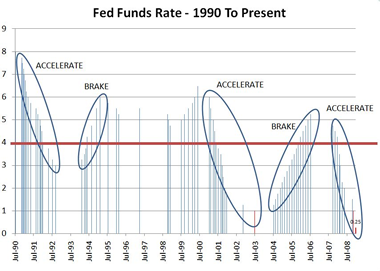
Go back to 1999-2000 and see what the Fed did. They are following the same pattern for 2005-06. If it ain't broke, the Fed will fix it... and good!
August 29, 2006 The Federal Reserve always acts on old information... and is the only cause of U.S. recessions.
December 5, 2006 Last spring I wrote about what I saw to be a sharp downturn in the economy in the "rustbelt" states, particularly Michigan.
March 28, 2007
The Federal Reserve sees no need to cut interest rates in the light of adverse recent economic data, Ben Bernanke said on Wednesday.
The Fed chairman said ”to date, the incoming data have supported the view that the current stance of policy is likely to foster sustainable economic growth and a gradual ebbing in core inflation”.

July 21, 2007 My guess is that if there is an interest rate change, a cut is more likely than an increase. The key variables to be watching at this point are real estate prices and the inventory of unsold homes.
August 11, 2007 I suspect that within 6 months the Federal Reserve will be forced to lower interest rates before housing becomes a black hole.
September 11, 2007 It only means that the overall process has flaws guaranteeing it will be slow in responding to changes in the economy... and tend to over-react as a result.
September 18, 2007 I think a 4% rate is really what is needed to turn the economy back on the right course. The rate may not get there, but more cuts will be needed with employment rates down and foreclosure rates up.
October 25, 2007 How long will it be before I will be able to write: "The Federal Reserve lowered its lending rate to 4% in response to the collapse of the U.S. housing market and massive numbers of foreclosures that threaten the banking and mortgage sectors."
November 28, 2007 FED VICE CHAIRMAN DONALD KOHN
"Should the elevated turbulence persist, it would increase the possibility of further tightening in financial conditions for households and businesses," he said.

"Uncertainties about the economic outlook are unusually high right now," he said. "These uncertainties require flexible and pragmatic policymaking -- nimble is the adjective I used a few weeks ago."
http://www.reuters.com/

December 11, 2007 Somehow the Fed misses the obvious.
fed_rate_moves_425_small.gif
[Image from: CNNMoney.com]
December 13, 2007 [from The Christian Science Monitor]
"The odds of a recession are now above 50 percent," says Mark Zandi, chief economist at Moody's Economy.com. "We are right on the edge of a recession in part because of the Fed's reluctance to reduce interest rates more aggressively." [see my comments of September 11]
January 7, 2008 The real problem now is that consumers can't rescue the economy and manufacturing, which is already weakening, will continue to weaken. We've gutted the forces that could avoid a downturn. The question is not whether there will be a recession, but can it be dampened sufficiently so that it is very short.
January 11, 2008 This is death by a thousand cuts.
January 13, 2008 [N.Y. Times]
“The question is not whether we will have a recession, but how deep and prolonged it will be,” said David Rosenberg, the chief North American economist at Merrill Lynch. “Even if the Fed’s moves are going to work, it will not show up until the later part of 2008 or 2009.
January 17, 2008 A few days ago, Anna Schwartz, nonagenarian economist, implicated the Federal Reserve as the cause of the present lending crisis [from the Telegraph - UK]:
The high priestess of US monetarism - a revered figure at the Fed - says the central bank is itself the chief cause of the credit bubble, and now seems stunned as the consequences of its own actions engulf the financial system. "The new group at the Fed is not equal to the problem that faces it," she says, daring to utter a thought that fellow critics mostly utter sotto voce.
January 22, 2008 The cut has become infected and a limb is in danger. Ben Bernanke is panicking and the Fed has its emergency triage team cutting rates... this time by 3/4%. ...

What should the Federal Reserve do now? Step back... and don't be so anxious to raise rates at the first sign of economic improvement.
Individuals and businesses need stability in their financial cost structures so that they can plan effectively and keep their ships afloat. Wildly fluctuating rates... regardless of what the absolute levels are... create problems. Either too much spending or too much fear. It's just not that difficult to comprehend. Why has it been so difficult for the Fed?

About Me

My photo
Michigan, United States
Air Force (SAC) captain 1968-72. Retired after 35 years of business and logistical planning, including running a small business. Two sons with advanced degrees; one with a business and pre-law degree. Beautiful wife who has put up with me for 4 decades. Education: B.A. (Sociology major; minors in philosopy, English literature, and German) M.S. Operations Management (like a mixture of an MBA with logistical planning)