READ ABOUT DETROIT AND SOLUTIONS TO ITS PROBLEMS. CLICK HERE.
Showing posts sorted by date for query china. Sort by relevance Show all posts

Thursday, January 10, 2013

Gasoline Prices To Go Down... Up... Down... Up

SEARCH BLOG: GASOLINE.

It's interesting to follow the "experts" when it comes to gasoline price predictions.  One gets the feeling that an expert is only such in forecasting the past.

The government is quite optimistic that gasoline prices will fall.  That's because the economies of the world are improving which will lead to greater demand which will lead to falling prices.  Perhaps there is a supposition that there will be even greater supply... something that "peak oilers" have denied... to offset the greater demand.

In its monthly Short-Term Energy Outlook released today, the U.S. Energy Information Administration (EIA) has for the first time forecast crude oil prices for 2014 to go along with forecasts for this year. A more dramatic difference, though, comes in the expected differential between WTI crude prices and the price for Brent crude.
The EIA reported that the price of Brent crude in 2012 averaged $112 a barrel and expects that to fall to an average of $105 a barrel in 2013 and to $99 a barrel in 2014. The differential between Brent crude and WTI crude averaged $18 a barrel in 2012, and the differential is expected to fall to $16 a barrel this year and to $8 a barrel in 2004.
Based on the EIA’s figures, WTI crude will average about $89 a barrel in 2013 and $91 a barrel in 2014, compared with $94 a barrel last year. WTI crude is trading at around $93 a barrel today.  ]Read more: Gasoline, Oil Prices to Fall Further — EIA - 24/7 Wall St.] 
On the other hand...
The current national average for a gallon of regular gasoline is $3.30. Drivers shouldn’t expect prices to get cheaper at any point in 2013.
That’s according to the analysts at GasBuddy, who have just released a forecast for gas prices throughout 2013, which include month-by-month projections. The predictions call for an average price of $3.29 throughout January, followed by a gradual run-up to the year’s highest prices come springtime. Prices are expected to retreat in fall and early winter, though the lows reached in December 2012—average of $3.25 per gallon nationwide—aren’t likely to be repeated.  [Read more: http://business.time.com/2013/01/09/2013-gas-price-forecast-around-4-per-gallon-by-spring/#ixzz2HaGDEnLy]
On the third hand...
Increased domestic oil production and lower demand will push gas prices lower in 2013, AAA said.
The national average price of gasoline should peak at $3.60-$3.80 per gallon barring any significant unanticipated events, which compares to a peak of $3.94 a gallon in 2012.
Wednesday's national average price of gasoline was $3.30 per gallon, which is 7 cents less than last year and 4 cents less than a month ago.
Florida’s price per gallon now averages $3.41 — up 5 cents over last week, AAA Auto Club South said. Gas prices in Jacksonville averaged $3.45 a gallon on Thursday, up 7 cents from a week ago. [source]
On the fourth hand...
But oil prices should dictate what happens next with pump prices. The economies in the U.S. and China are showing improvement, while Europe remains in recession. 

"They set it down and raise it back up whenever they want to; right before Christmas it seemed to go down quite a bit and the right back up after Christmas it seems to jump right back up again," said Jackson resident, Tim Caldwell.

Energy experts said the wild card in prices is the Middle East.  In the past two years, threats to shipments of oil form the region drove crude prices during the winter, which led to a surge in prices. [source]
So there you have it... forecasted gasoline prices for 2013 will be either up or down.
..

Sunday, December 16, 2012

Cultural Sterotypes

SEARCH BLOG: CULTURE.

When it comes to making judgments about the people of various countries, stereotyping is a convenient shortcut.  Of course, like all short cuts, the results might be a little short-circuited and short sighted.  Still, stereotyping doesn't just happen in a vacuum.

Just for fun, let's stereotype a list of countries starting with the United States so no one gets offended that they are being picked on.  This is not politically correct.

  • U.S.A. - cowboy mentality; crassly rich; violent; boorish; generous; land of opportunity; land of special interests.
  • Canada - 51st state; always heading south; socialistic Americans.
  • England - land of oddballs; sports nuts; underachievers; living in the royal past; terrific spies; cowering in the face of Muslims.
  • France - snooty about culture and food and wine; would rather make love than fight; inflated egos; generally intolerant but try to appear cosmopolitan.
  • Germany - industrious; neat; clean; amenable to following orders; more friendly than you'd expect.
  • Spain - laid back; hiding in plain sight.
  • Eastern European nations - we know someone whose ancestors emigrated from there.
  • Russia - depressing; corrupt; deteriorating.
  • Japan - overcrowded; over-achievers; over-wired.
  • China - oppressive; unethical; sneaky; dangerous.
  • North Korea - hell on earth.
  • South Korea - same as Japan a few decades ago.
  • India - chaotic; weird; crowded; dirty; a parody of western civilization.
  • Israel - resourceful; politically incorrect.
  • Iran - rich history; well-oiled; ruled by nutjobs.
  • Turkey - trying to live in the past and present; trying to be Islamic and Western.
  • Arab countries in general - violent; misogynists; prone to religious extremism.
  • Sub-Saharan countries in general - tribal; violent; dramatically underachieving.
  • South American countries in general - speak Spanish or Portuguese; lousy economies; grow stuff; mostly forgotten by the rest of the world.
  • Australia - have a Fosters, ay mate?

Shortcuts, but they can give a flavor for the culture and attitudes that affect global relationships.  The problem is that they are stereotypes and miss the complexity as well as the individuality that can and do significantly vary from these shortcuts.  That said, stereotypes don't emerge from thin air.
..

Tuesday, December 11, 2012

The U.S. Subsidizes Chinese Takeovers Of U.S. Advanced Battery Business

SEARCH BLOG: CHINA.

The other day, it was announced that A123 systems would be selling most of its assets to the Chinese through the bankruptcy process.  This was after a quarter-billion dollar grant from the U.S. government simply failed to be enough to keep the company in operation making batteries for electric cars like the Chevy Volt ... which has the U.S. government as its biggest owner and biggest customer.

China Picks Up The Pieces Of U.S. Battery Manufacturer

Not everyone is enamored with this outcome.


Could this be part of Obama's strategy for a greater American presence in southeastern Asia?  He just accidentally transposed the countries.
..

Monday, December 10, 2012

China Picks Up The Pieces Of U.S. Battery Manufacturer

SEARCH BLOG: CHINA and ECONOMY.

A123 Systems, Inc. is headquartered in Massachusetts with locations around the world.  But soon, its actual ownership will move to China.

A123 confirms Wanxiang wins bid for bankrupt battery maker

NEW YORK (Reuters) - China's largest maker of auto parts won an auction for A123 Systems Inc (AONEQ.PK), a bankrupt maker of batteries for electric cars that was funded partly with U.S. government money, A123 confirmed in a statement Sunday.
Wanxiang Group Corp's bid of $256.6 million topped a joint bid from Johnson Controls Inc (JCI) of Milwaukee and Japan's NEC Corp, for the maker of lithium-ion batteries.
The sale did not include A123's Michigan-based government business that works with the U.S. Defense Department, which was instead sold to Navitas Systems for $2.25 million, A123 said.
Actually, A123 Systems received a $250 million grant from the U.S. government and anther $140 million in tax credits from the State of Michigan.  The Michigan plant was sold for $2.25 million versus tax credits and subsidies about 65 times that.

One question is this: why is A123 attractive as an investment to the Chinese when it was a failure as an investment for the U.S. government?  Could be that the Chinese are buying the company for pennies on the dollar.  Could be that the technology is more valuable than the other assets.  Could be any number of reasons.

Another question: is the operating environment in the U.S. filled with too many barriers to success for new technology efforts?  Could be that government involvement came with too many strings.  Could be that A123 had good ideas and bad management.  Could be that the real market for A123 products was less than planned for and resulted in a bad financial situation from over-commitments..

But whatever the reason behind the bankruptcy, this was another government investment in alternative energy that went bust.  Maybe it's time for any government... state or federal... to quit picking winners and losers in the energy sector and let the marketplace do the picking.  There are just too many bad decisions being made by politicians who have drunk the electric car kool-aid.

Anybody want to buy a Chevy Volt?
..

Friday, November 09, 2012

Fiscal Cliff For U.S. Military

SEARCH BLOG: MILITARY.

An interesting video from The Heritage Foundation.  The question is: does the U.S. want to continue to be the policeman of the world... or is it willing to cede that position to ... China?  No one?  If the U.S. takes the Libertarian Party viewpoint that free trade is all that is necessary to ensure world peace, then the U.S. can save a lot of money... presuming that Libertarians are correct.

Raise your hand if you agree with saving trillions of dollars by converting aircraft carriers into cargo ships.

..

Sunday, November 04, 2012

China Replacing The U.S. - Part 2

SEARCH BLOG: CHINA.

As the U.S. economy continues to run at stall speed under the mounting legislation and regulation of the Obama administration, China is doing exactly what was predicted here just 5-years ago.

FRIDAY, OCTOBER 19, 2007

China Replacing The U.S.

SEARCH BLOG: CHINA
On September 12, I wrote about the issue of "why is China subsidizing the U.S.":
I believe that the Chinese government's goal is to be the dominant nation in the world by the end of the 21st century... economically and militarily... so that it will have priority access to the rest of the world's resources.
Oh yes it is. h/t Mike McIntyre.

Asian economies turn to yuan

A "renminbi bloc" has been formed in East Asia, as nations in the region abandon the US dollar and peg their currency to the Chinese yuan — a major signal of China's successful bid to internationalize its currency, a research report has said. 
The Peterson Institute for International Economics, or PIIE, said in its latest research that China has moved closer to its long-term goal for the renminbi to become a global reserve currency. 
Since the global financial crisis, the report said, more and more nations, especially emerging economies, see the yuan as the main reference currency when setting their exchange rate. 
And now seven out of 10 economies in the region — including South Korea, Indonesia,Malaysia, Singapore and Thailand — track the renminbi more closely than they do the US dollar. Only three economies in the group — Hong Kong, Vietnam, and Mongolia — still have currencies following the dollar more closely than the renminbi, said the report, posted on the institute's website. 
The South Korean won, for example, has appreciated in sync with the renminbi against the dollar since mid-2010. 
China has long vowed to raise its currency's global sway, along with the rise of its economy,which became the world's second-biggest last year. 
The goal has seen significant development in recent years as the country promotes renminbi-denominated cross-border trade and gradually loosens control over its capital accounts. [full article here]
[click image for larger view]

2012 IS HERE

..

Monday, October 22, 2012

Foreign Affairs Turn Into 2nd Debate Rehash Then Refocuses

SEARCH BLOG: OBAMA and ROMNEY.

The debate on foreign affairs boiled down to this: the Middle East is a mess, we don't want the bad guys in charge, and we don't want more military involvement.  Both Obama and Romney agreed and tried hard to make it sound as if they disagreed.  Obama skated around the fact that the Arab Spring has became an Arab Chaos.  Romney skated around the fact that the new governments are not America's friends nor will they become our friends because they are in control of the Muslim Brotherhood and further changes in governments will open more doors to the Muslim Brotherhood.

Beyond that... the 2nd debate took a major portion of the debate time.

President Obama says he will stand with Israel ... if attacked.  President Obama say Iran will not get a nuclear weapon as long as he is President.  He pointed out that sanctions have now forced Iran to give up their pursuit of nuclear weapons.

Mitt Romney agrees that sanctions have been effective and wants to tighten them.  He want Iran's Ahmadinejad indicted for inciting genocide.  He agrees that military options are the last resort.

President Obama denies that he is working out a "one on one" deal with Iran.  The deal he will accept is that Iran ends their nuclear program.  He said "the clock is ticking" and he will not all them to use negotiations to protract their weapons development.

Mitt Romney said that Iran has seen U.S. as weak because Obama would meet with them without conditions.  Obama's failure to support the Iranian dissidents was seen as a sign of weakness.  Obama's apologies for U.S. actions were seen as another sign of weakness.

President Obama said, "Nothing Gov. Romney has said is true."  Romney: we're four years closer to a nuclear Iran with 10,000 centrifuges... you skipped Israel in your "Middle Eastern tour."  Obama: I went to Israel as a candidate in 2008 and learned about the dangers that face Israel.  Romney: the Middle East is deteriorating; our influence is receding.  Obama: the problem is on a whole range of issues is that you've been all over the map.

Afghanistan: 2014 deadline for withdrawal.  Romney: we'll get out by 2014... everything is on schedule.  We have to focus on Pakistan because a failed Pakistan would be dangerous to both Afghanistan and us.  President Obama: we got out of Iraq which allowed us to focus on Afghanistan and target the Taliban and al Qaeda...  now the Afghan military is capable of taking care of their country and we can pull our soldiers out and get them health care and treatment for PTSD.

Question to Romney: what is your position on drones.  Romney: use our technology, but what's missing is a strategy to move the Middle East away from Islamic extremism.  Obama: we've created partnerships with countries to go after the terrorists.  We've stood on the side of democracy and women's rights.  No doubt that attitudes toward America have changed [for the better].

China: what is the greatest threat to the future of this country.  Obama: China is an adversary, but a potential partner if they follow the rules.  A trade task force set up to deal with Chinese "cheaters."  Over the long term in order to compete with China, we have to improve education and expand government investments.  Romney: business makes investments, not government.  China needs trade.  We can be a partner; we don't have to be an adversary.  They question our economic and foreign affairs strength.  We have to focus on trade that is by the rules.  Would declare China a currency manipulator and economic pirates and counterfeiters.

Obama: Romney shipped jobs to China.  We want to have a stronger military presence in the Far East and create more trading partners other than China.  Romney: we have to have President that doesn't invest in companies, but invests in basic research.  Obama: that's not right.  Romney: you're wrong.

Well, that about sums up things.  We are better off/worse off; we are more/less influential in the world.

2012 IS HERE

..

Sunday, October 07, 2012

Chinese Building U.S. Infrastructure And Becoming A Security Threat

SEARCH BLOG: CHINA.

Remember those jobs President Obama promised.  Well, the unemployment rate fell to 7.8% after summer jobs were revised upward by 86,000. But the number of people counted as part of the jobs market went down... yes fewer people in the jobs market even though more people were out there.  The reason... the unemployment number doesn't count the people who have given up or who have taken jobs well below their skill levels.  That's counted in the U6 measure which, not so surprisingly, hasn't moved down.

But that's not really the big issue.  The big issue is that our government is saying it seeks to find employment opportunities on the one hand while it undermines those opportunities on the other.  More critically, it undermines those opportunities while, at the same time, it creates an opportunity for our safety and security to be undermined.

A recent post highlighted the fact that the Chinese were now building bridges in the U.S. ... bridges paid for by state and federal money.  Not only were they designed and manufactured by the Chinese, but they were installed... built on site... by the Chinese.  No U.S. jobs there.  Nothing to look at.

WEDNESDAY, SEPTEMBER 12, 2012


Now another part of our infrastructure may be designed, manufactured, and installed by the Chinese... an even more sensitive part of our infrastructure.
Chinese telecom giant eyed as security threat
Huawei, a global Chinese telecommunications equipment manufacturer already doing limited business in the U.S., poses a threat to national and corporate security say members of the U.S. House Permanent Select Committee on Intelligence. Those congressmen speak to Steve Kroft for a 60 Minutes investigation to be broadcast Sunday, Oct. 7 at 7:30 p.m. ET and 7:00 p.m. PT.
The world's largest maker of telecommunications equipment has been under investigation for the past year by the committee, which will issue its report on the Chinese company on Monday. The committee's chair, Rep. Mike Rogers (R-Mich.), tells Kroft, "If I were an American company today...and you are looking at Huawei, I would find another vendor if you care about your intellectual property, if you care about your consumers' privacy, and you care about the national security of the United States of America."
Rep. Dutch Ruppersberger (D-Md.) adds, "One of the main reasons we are having this investigation is to educate the citizens in business...in the telecommunications world."
The committee believes allowing Huawei to build and maintain large swaths of America's telecommunications infrastructure opens a door for the Chinese government to spy on the U.S. government and engage in industrial espionage. [read more]
Who would have guessed?

RELATED:

MONDAY, MAY 21, 2012

2012 IS HERE

..

Monday, October 01, 2012

And Why Are Union Members Voting For Democrats?

SEARCH BLOG: POLITICS and CHINA

From ABC News last year:


Well, at last it can be revealed.  Here is the reason.

WEDNESDAY, SEPTEMBER 12, 2012


2012 IS HERE

..

Wednesday, August 08, 2012

Don't Look To 2013 For The Economic Cure

SEARCH BLOG: GOVERNMENT and ECONOMY

Had a long chat with Bill today.  Bill and I have become acquaintances through this blog.  He emailed and then called several years ago and we have kept in touch on political and personal issues since then.  He keeps his finger on the pulse of politics and the economy in the southeast... and has not been very optimistic for awhile.  He expressed deep frustration with the lack of anyone resembling a "leader" to take the country out of this economic morass.  While Obama has been a disaster, he doesn't have much faith that Romney can fulfill the role of a leader or a plan for fixing this mess.

What follows is an email he sent to me and my reply:

Putting Off Addressing Fiscal Cliff Risks DepressionPeter MoriciTwitter @pmorici1
President Obama and Congressional Republicans are engaging in dangerous brinksmanship. Putting off addressing the fiscal cliff until after the election risks a second Great Depression.
Without a compromise by January, $400 billion in mandatory spending cuts and more than $100 billion in tax increases immediately go into effect. With GDP only growing $300 billion annually, such a shock would thrust the economy into prolonged contraction.   
With the federal deficit already exceeding $1 trillion, additional stimulus spending significant enough to rescue the economy is unlikely, and interest rates are at record lows. These leave policymakers with few tools once things start unraveling. However, President Obama has given Republicans few political choices but to roll the dice. Facing reelection, he promises to veto any extension of Bush-era tax cuts for middle- income Americans if Congress does not raise rates on upper-income families. He won't entertain meaningful cuts in entitlement spending or health care.
Even if Mr. Obama wins, he likely will be saddled with a Republican House.
Armed with a mandate, he will get higher taxes on upper income families. However, he has made commitments to expand the U.S. naval resources in the Persian Gulf and Asia to counter Iran and China. He can't finance those without giving Republicans some of the entitlement reforms they want but can't get now.
For the economy, one of three outcomes is likely.
President Obama wins but doesn't reach a deal with Republicans before February or March. Mass layoffs begin late this fall, especially in the defense sector, and the economy stumbles badly.
Mr. Obama wins and deals with Republicans in Congress by late December. Taxes go up, and overall spending is cut, but not as much as current legislation requires. The combination still derails the fragile recovery.
Governor Romney wins and implements a pro growth agenda, but the current situation is too urgent to wait for actions that won't take effect until at least next spring and summer.
Businesses are already curtailing investments in machinery and information technology as a hedge against a contracting economy in 2013, and consumers are spending less. Retail sales fell each of the last three months.
The Great Recession was caused by manifest structural problems in the economy: a wide trade gap with China and on oil, banks that had forgotten how to earn profits through sound lending, failed financial regulations, and skyrocketing health care costs.
President Obama's policies have mostly exacerbated those problems. That's why the recovery is so weak, and a second recession now could put the economy down for good.
Too many young adults unemployed or in poorly paying jobs are living with aging parents. Many older Americans are running down IRAs before reaching retirement age, hoping for better days.
The safety nets provided by parents and savings will soon tear. If the economy goes down again, the negative feedback cycle of fewer jobs, less spending, more layoffs, and so forth will be much more severe than in 2008.
The hallmark of a depression is a recession that does not sow seeds of recovery by creating pent up demand for business and consumer durable goods. Truck and car replacements played a mighty roll in the most recent recovery.
With many Americans slipping from the middle class, businesses may simply downsize for a permanently smaller U.S. economy, and families will own fewer vehicles, appliances and electronic toys. Unemployment in the range of 15 percent easily could become the new normal.
President Obama should risk upsetting his base and offer Republicans in Congress a reasonable deal now.
Republicans should admit what they already know-Mitt Romney is no messiah-and take the risk of compromising now.
American can't afford for their elected officials to dither any longer.
Peter Morici is an economist and professor at the Smith School of Business, University of Maryland, and widely published columnist.
Peter MoriciProfessor        Robert H. Smith School of BusinessUniversity of MarylandCollege Park, MD 20742-1815
My reply:
We have had a period of antipathy toward business that has incentivized the bases of this present economic spiral.  One could point to the no-down-payment-homes-for-the-unqualified as the trigger, but the table was set a long time ago. 
I fear that we are entering a Japan-like malaise with regard to employment.  Businesses that remain have already adjusted to the new reality [hope and change] by outsourcing peripheral functions and becoming very lean in core functions.  More and more, the financial "magicians" come and go making a quick fortune with smoke and mirrors and outright fraud, while the old-line "build something people want and need" types have been disappearing.  That's why the Facebooks are the big IPOs.  Smoke, mirrors, no substance. 
MONDAY, AUGUST 06, 2012 
Recovery In Name Only 
What we are faced with an inverse relationship: the growth of government = the decline of the economy.

2012 IS HERE

..

Tuesday, July 24, 2012

China's Active Expansionism

SEARCH BLOG: CHINA

Back in 2007, I created this graphic to explain China's long-term expansionist goal which was based on the strategy of accumulating wealth by undercutting the world's manufacturers with cheap labor to become the world's manufacturing center.  That strategy has worked superbly.

[click image to enlarge]

The latest tactic China is employing is to claim territory and vast tracts of ocean by establishing "cities".

As reported in The Telegraph:
China declares new city to assert control over South China Sea
China founded a new city yesterday more than 200 miles from the mainland, in a bid to cement control over 800,000 squares miles of the South China Sea.
Sansha is based on Yongxing Dao, or Woody Island, a petite heart-shaped island barely a mile long. It is shorter than its airport runway, which is left jutting out to sea.
China's 657th city, as classified by the country's State Council, has a floating population of a few hundred fishermen, a post office, library, bank, supermarket, and hospital and not much else. A casino is planned to drum up tourism.
But it will have a full 45 government officials to run the city, its own mayor, and a Communist party secretary, Fu Zhuang, who has spent his entire career in the People's Liberation Army, rising to become the deputy chief of the Air Defence Office of Hainan province.
It will also have a military garrison, responsible for "national defence mobilisation ... and carrying out military missions".
From here, China expects to administer almost the entire South China Sea, including both the Paracel and Spratly island chains.
While the Islamic march into Europe and America has garnered most of the attention in the West, China has steadily and stealthily worked toward expanding its own empire. 

2012 IS HERE

..

Tuesday, July 17, 2012

Term Limits Are Needed

SEARCH BLOG: GOVERNMENT and ETHICS


Sen. Harry Reid reminds me of a character in Vince Flynn's "Term Limits."  While he yells about the U.S. Olympic Committee buying uniforms made in China, he supports a Chinese solar panel manufacturer for which his son acts as a lobbyist ... despite the fact that he supposedly supported the $.5 billion loan to U.S. solar panel maker, Solyndra, which just happen to go bankrupt and which was financially backed by an Obama campaign bundler, George Kaiser.

Sen. Reid represents all that is wrong in the U.S. government [along with his compatriot Rep. Nancy Pelosi].  They pander while being the most two-faced specimens imaginable.

Vince Flynn's book quoted Thomas Jefferson:
"Whenever any form of government becomes destructive of these ends [i.e., securing inherent and inalienable rights, with powers derived from the consent of the governed], it is the right of the people to alter or abolish it, and to institute new government, laying its foundation on such principles, and organizing its powers in such form, as to them shall seem most likely to effect their safety and happiness." --Thomas Jefferson: Declaration of Independence, 1776. ME 1:29, Papers 1:315 [source]
There is little doubt that Thomas Jefferson would have been speaking directly about Barack Obama, Harry Reid, and Nancy Pelosi had he had the chance.  He would have approved of term limits for them.
“This is my last political campaign…I’m term limited,” he said Saturday at Centreville High School in Clifton, Virginia in remarks that were similar to others he’s delivered in recent weeks. -- President Barack Obama [source]
I suspect Vince Flynn's fictional Rep. Michael O'Roarke might have felt comfortable with term limits for Harry and Nancy.  But we would be happy if they simply didn't run again.  Fat chance.  Still too much pork to barbecue.

2012 IS HERE

..

Friday, July 06, 2012

Low Interest Rates Indicate Economic Malaise

SEARCH BLOG: ECONOMY

All of the optimistic talk about "summers of recovery" and "stimulus jobs" has pretty much disappeared.  Now it's, "we got healthcare taxes implemented."

Nevertheless, President Obama remains remarkably popular among the unemployment recipients and "got me some of Obama's stash" crowd and women seem to think that he is on their side despite continued high unemployment for both men and women.  It seems free condoms and birth control pills is all that it takes when all you have left to look forward to is sex... and abortion on demand when you forget to use the freebies.


There is nothing on the horizon of the Obama administration that can do anything except reduce growth. The Bush-era tax cuts will expire.  The "Affordable" Care Act will create massive government deficits and suppress the growth of small businesses that are concerned about their health care costs because of the new law.

A quick look at the headlines indicate that we can't look to the rest of the world as conditions worsen generally:

What does that mean for the U.S. economy?  Well, if we continue to do what we've been doing...


It's time for a massive reduction of government mandates and regulations.  It's time to let the private economy work without the government vainly attempting to pick winners and losers.  It's time to let innovation flourish without the crushing weight of more taxes.  It's time for a reversal of the widespread economic dependency on government... a massive Ponzi scheme leading to a black hole of debt and economic malaise.

Let's hope for change... starting at the top.

Tuesday, May 29, 2012

New Computer Malware Attacks The Middle East

SEARCH BLOG: TECHNOLOGY

From the BBC:


This new threat appears not to cause physical damage, but to collect huge amounts of sensitive information, said 
[Russian security firm] Kaspersky's 
[Labs] chief malware expert Vitaly Kamluk. 
"Once a system is infected, Flame begins a complex set of operations, including sniffing the network traffic, taking screenshots, recording audio conversations, intercepting the keyboard, and so on," he said. 
More than 600 specific targets were hit, Mr Kamluk said, ranging from individuals, businesses, academic institutions and government systems....

Among the countries affected by the attack are Iran, Israel, Sudan, Syria, Lebanon, Saudi Arabia and Egypt. 
"The geography of the targets and also the complexity of the threat leaves no doubt about it being a nation-state that sponsored the research that went into it," Mr Kamluk said.
If this is a nation-sponsored attack, the question is which nation has the most to gain from gathering all of this intelligence?  One can safely assume that the malware code does not have a line saying "Made in USA" or "Made in China."  Looking at the list of countries affected, only two... Iran and Israel... would be likely targets for technology information.  The other countries are buyers of technology, not developers.  So, one can safely assume that technology secrets are not the primary targets of this malware.

What is more likely is that military and terrorist operations are the targets.  Some nation really wants to infiltrate the inner workings of the political/military apparatuses in these countries.

I'll give you three guesses... three different guesses.

RELATED:

2012 IS HERE

..

Saturday, May 26, 2012

Economic Post Mortem

SEARCH BLOG: ECONOMICS

My background is business and I get a bit ticked when I read something like this:

And that's what business types have a hard time understanding because in the business world money equals income. If those failed green projects that Obama tried had not been attempted and if we had simply decided to not increase the deficit, that would not have been a savings for the macro economy. Those saved dollars would have leaked from the income flow. 
Way back in college I noticed that business majors did fine in micro, but they seemed to have a hell of a time getting macro. Business types just don't have the intuition for macro because they tend to think in terms of stock variables...that might be why so many of them also had problems with calculus. Anyway, I see this same confusion with Romney. I'm sure he's a smart and sharp businessman. And he might have excellent CEO skils (and that's important in a President); but the guy is clearly at sea when it comes to macroeconomics. Clueless beyond belief.
Back awhile, I wrote this:

THURSDAY, OCTOBER 13, 2005Excessive Spending - The Next RecessionI'm going out on a limb now, but I think the 4th Quarter of 2005 will be viewed, retrospectively, as the beginning of a new recession in the U.S. 
For those of you who did not read my post of September 16, check it out.
Here are some economic stories from Reuters:

The Fed is getting ready to pounce on the economy. Why? Well, apparently it sees that the economy is running out of energy (pun intended), so it is time to put on the economic brakes by raising interests rates further. For those of you with short-term memory loss, go back to 2000 when the Fed raised the prime to 8.5% for our own good. Alan G. did admit to a slight error in judgment on that action. Unfortunately, the Fed seems to have a short-term memory loss, but the logic is still consistent: when the economy is hit with natural disasters, energy market aberrations, job losses and currency manipulation by competitors, then it is time to cripple the economy by tightening the money supply and raising interest rates.

The official recognition of the "recession" was about 3 years later... well after the malaise hit the economy.  The "macro" numbers showed things were pretty good. The "macro" numbers failed to recognize what millions of businesses and individuals were seeing... the U.S. was in big trouble.  I'll admit that I used the term "recession" in a way that would make a macro-economist cringe... but in a way that most individuals and businessmen would understand.

Macroeconomics is the belief that looking at large amounts of aggregated data can tell you what you need to know about the economy... like this:
February 27, 2008 
Federal Reserve Chairman Ben Bernanke went to Capitol Hill today to provide Congress with an update on the struggling US economy. The Fed forecast he summarized called for very slow growth in 2008, but no recession; and that was the good news. 
The Feds forecast says that growth could be as low a 1.3 percent for all of 2008, down sharply from its July forecast. And with the economy expected to pick up only in the second half of the year, that could mean almost no growth at all in the first six months. 
Chairman Bernanke acknowledged the problem in the second paragraph of his testimony. "The economic situation has become distinctly less favorable since our July report," said the chairman. 
Now the song, 4 years later, is that all we have to do is spend money on green projects to make sure "income" doesn't fall.  My thoughts:
So, you say that it doesn't matter that the government dumped money into "investments" that had no real business cases. What was the opportunity cost? Come on, don't tell me there was no opportunity cost because the government can spend as much as it wants. Chickens come home to roost. 
At the same time that the "don't need no business case" geniuses [like Frank and Dodds who liked the idea of everyone owning a home even if they couldn't afford it because all that spending was good stuff] were dumping money down a series of black holes, the government was waging its own Don Quixote wars on carbon vapor. The goal? Why to protect us from plant food, of course. Better to kill the most efficient sources of energy and thousands of jobs along with it than to risk having to run the air conditioners a few more days. 
So, our macro data experts have urged spending and our macro data bureaucrats have responded with policies and investments that have guaranteed a far less cost effective source of energy. Gee, if you pay more per KW, that means the economy will be booming. Think of all of that spending. 
If Ben [big economics] Bernanke couldn't see the writing on the wall and all of that recent government spending has simply increased government debt with very little to show for it, why it's just those stupid business types who don't understand how good things are? ...
Tell me, what besides the imaginary 4.2 million jobs saved has all of that spending achieved? Housing is still a mess, unemployment is still over 8% and millions have stopped being counted because they are discouraged, and government debt will soon be beyond servicing when interest rates do increase... the time implication of current spending.
Government spending that simply expands dependency on government [Nancy Pelosi's more people on unemployment is good for the economy] while the government attacks those who create jobs and incomes is a recipe for... well, the Obama administration and Keynesian economics. In your words: "clueless beyond belief." 

UPDATE:
With regard to the impact of government spending, three professions from the Harvard Business School [uh, oh... not economists] came to the following conclusion [click on image for larger view]:

2012 IS HERE

..

Monday, May 21, 2012

China's ‘Economic Espionage’

SEARCH BLOG: CHINA

From FT via IBN:

China linked to ‘economic espionage’ 
Washington: China is the world’s biggest supporter of “economic espionage”, the Pentagon says in its annual report on the Chinese military which also claimed that Beijing’s defence budget is much higher than official numbers. 
Friday’s report said China would continue to be an “aggressive and capable” collector of sensitive US technological information, including that owned by defence-related companies, and represented a “growing and persistent threat to US national security”. 
“Chinese actors are the world’s most active and persistent perpetrators of economic espionage,” the report said.
Over the years, the subject of China's military and expansionist policy has appeared in this blog many times [see label "China"].  The one persistent graphic is this which first appeared in 2007:

[click image for larger view]

China has since gone on to establish itself as a "trading partner" with Iran and many African nations... and been a continual source of computer espionage against both U.S. government and U.S. business.

Rep. Mike Rogers who heads up the House Intelligence Committee sent this out last month:
House to Consider Bipartisan Cyber Security BillNext week the House of Representatives will consider my bipartisan cyber security legislation.  The Cyber Intelligence Sharing and Protection Act (H.R. 3523), which has over 100 bipartisan cosponsors, allows the private sector to defend its own networks on a voluntary basis.  This bill is designed to protect American innovation and the jobs that come with it from foreign cyber attacks. 
Every day, countries like China and Russia launch countless cyber attacks against U.S. businesses, military targets, and critical infrastructure.  These attacks have increased at an alarming pace over the past few years.  Top intelligence officials estimate over $400 billion in economic output is lost every year due to cyber espionage.  These losses are a direct threat to jobs in Michigan and across the country.  My legislation is a simple solution that would allow the government and private sector to share cyber threat information in order to defend our networks.  It also includes strong privacy and civil liberty protections.  
CLICK HERE to read the text of the bill and additional background.  CLICK HERE
 to read more about this issue in Congressional Quarterly.  CLICK HERE
 for more information in U.S. News & World Report.

2012 IS HERE

..

Can"t Find It?

Use the SEARCH BLOG feature at the upper left. For example, try "Global Warming".

You can also use the "LABELS" below or at the end of each post to find related posts.

Blog Archive

Cost of Gasoline - Enter Your Zipcode or Click on Map

CO2 Cap and Trade

There is always an easy solution to every human problem—neat, plausible, and wrong.
Henry Louis Mencken (1880–1956)
“The Divine Afflatus,” A Mencken Chrestomathy, chapter 25, p. 443 (1949)
... and one could add "not all human problems really are."
It was beautiful and simple, as truly great swindles are.
- O. Henry
... The Government is on course for an embarrassing showdown with the European Union, business groups and environmental charities after refusing to guarantee that billions of pounds of revenue it stands to earn from carbon-permit trading will be spent on combating climate change.
The Independent (UK)

Tracking Interest Rates

Tracking Interest Rates

FEDERAL RESERVE & HOUSING

SEARCH BLOG: FEDERAL RESERVE for full versions... or use the Blog Archive pulldown menu.

February 3, 2006
Go back to 1999-2000 and see what the Fed did. They are following the same pattern for 2005-06. If it ain't broke, the Fed will fix it... and good!
August 29, 2006 The Federal Reserve always acts on old information... and is the only cause of U.S. recessions.
December 5, 2006 Last spring I wrote about what I saw to be a sharp downturn in the economy in the "rustbelt" states, particularly Michigan.
March 28, 2007
The Federal Reserve sees no need to cut interest rates in the light of adverse recent economic data, Ben Bernanke said on Wednesday.
The Fed chairman said ”to date, the incoming data have supported the view that the current stance of policy is likely to foster sustainable economic growth and a gradual ebbing in core inflation”.

July 21, 2007 My guess is that if there is an interest rate change, a cut is more likely than an increase. The key variables to be watching at this point are real estate prices and the inventory of unsold homes.
August 11, 2007 I suspect that within 6 months the Federal Reserve will be forced to lower interest rates before housing becomes a black hole.
September 11, 2007 It only means that the overall process has flaws guaranteeing it will be slow in responding to changes in the economy... and tend to over-react as a result.
September 18, 2007 I think a 4% rate is really what is needed to turn the economy back on the right course. The rate may not get there, but more cuts will be needed with employment rates down and foreclosure rates up.
October 25, 2007 How long will it be before I will be able to write: "The Federal Reserve lowered its lending rate to 4% in response to the collapse of the U.S. housing market and massive numbers of foreclosures that threaten the banking and mortgage sectors."
November 28, 2007 FED VICE CHAIRMAN DONALD KOHN
"Should the elevated turbulence persist, it would increase the possibility of further tightening in financial conditions for households and businesses," he said.

"Uncertainties about the economic outlook are unusually high right now," he said. "These uncertainties require flexible and pragmatic policymaking -- nimble is the adjective I used a few weeks ago."
http://www.reuters.com/

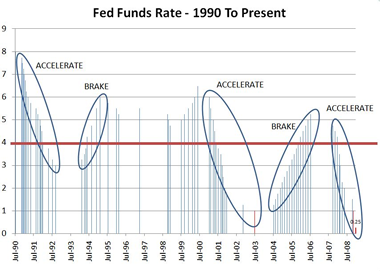
December 11, 2007 Somehow the Fed misses the obvious.
fed_rate_moves_425_small.gif
[Image from: CNNMoney.com]
December 13, 2007 [from The Christian Science Monitor]
"The odds of a recession are now above 50 percent," says Mark Zandi, chief economist at Moody's Economy.com. "We are right on the edge of a recession in part because of the Fed's reluctance to reduce interest rates more aggressively." [see my comments of September 11]
January 7, 2008 The real problem now is that consumers can't rescue the economy and manufacturing, which is already weakening, will continue to weaken. We've gutted the forces that could avoid a downturn. The question is not whether there will be a recession, but can it be dampened sufficiently so that it is very short.
January 11, 2008 This is death by a thousand cuts.
January 13, 2008 [N.Y. Times]
“The question is not whether we will have a recession, but how deep and prolonged it will be,” said David Rosenberg, the chief North American economist at Merrill Lynch. “Even if the Fed’s moves are going to work, it will not show up until the later part of 2008 or 2009.”
January 17, 2008 A few days ago, Anna Schwartz, nonagenarian economist, implicated the Federal Reserve as the cause of the present lending crisis [from the Telegraph - UK]:
The high priestess of US monetarism - a revered figure at the Fed - says the central bank is itself the chief cause of the credit bubble, and now seems stunned as the consequences of its own actions engulf the financial system. "The new group at the Fed is not equal to the problem that faces it," she says, daring to utter a thought that fellow critics mostly utter sotto voce.
January 22, 2008 The cut has become infected and a limb is in danger. Ben Bernanke is panicking and the Fed has its emergency triage team cutting rates... this time by 3/4%. ...

What should the Federal Reserve do now? Step back... and don't be so anxious to raise rates at the first sign of economic improvement.
Individuals and businesses need stability in their financial cost structures so that they can plan effectively and keep their ships afloat. Wildly fluctuating rates... regardless of what the absolute levels are... create problems. Either too much spending or too much fear. It's just not that difficult to comprehend. Why has it been so difficult for the Fed?

About Me

My photo
Michigan, United States
Air Force (SAC) captain 1968-72. Retired after 35 years of business and logistical planning, including running a small business. Two sons with advanced degrees; one with a business and pre-law degree. Beautiful wife who has put up with me for 4 decades. Education: B.A. (Sociology major; minors in philosopy, English literature, and German) M.S. Operations Management (like a mixture of an MBA with logistical planning)