READ ABOUT DETROIT AND SOLUTIONS TO ITS PROBLEMS. CLICK HERE.

Tuesday, October 11, 2005

Excessive Litigation - Rules of the Game

The federal case against the former KMart executives who oversaw the bankruptcy of that company has been dropped according to The Detroit News.

That will be seen as good news by the executives of Delphi and, perhaps, many more corporations. The fact that the executives of KMart got quite wealthy during the time the company was failing and stockholders were losing their investments apparently has no legal connection. Moral, perhaps. Legal, apparently not.

Just doing their job and getting well paid for it, thank you.

Hey, where was the board of directors. Well, they only "approved" of the executives. They didn't actually oversee anything those guys did... until it was just a little too late. The chaiman of the KMart board, Edward Lambert, also the majority stockholder, formed a new KMart Holding company and bought Sears. They are doing well, thank you.

As for the rest of you KMart stockholders, serve up those securities in a ketchup sauce and call it the "blue plate special." The sauce is considered nutritious by the government.

Small comfort.

Sunday, October 09, 2005

Excessive Spending - I got mine

The following are self explanatory:

Delphi demands 63% pay cut from UAW

October 7, 2005

BY MICHAEL ELLIS
FREE PRESS BUSINESS WRITER

Delphi Corp. has demanded such drastic cuts in wages and benefits for workers that, according to one UAW local , its members would no longer be able to afford the cars they help build.

DELPHI'S PAY DEMANDS
Delphi has threatened to declare bankruptcy unless it gets concessions from the UAW and aid from former parent General Motors Corp. The demands, according to newsletters sent to UAW locals, include:

•Reducing pay by as much as 63% to $10 to $12 an hour and total wages and benefits by as much as 77% to $16 to $18 an hour. Delphi currently pays its union workers from $25 to $27 an hour and total wages and benefits of $65 to $70 an hour, making its employees among the best-paid industrial workers in America.

•The right to close, sell or consolidate most of its U.S. plants over the next three years.

•Ending all cost-of-living pay increases.

•Eliminating pay during the Independence week shutdown in July.

•Eliminating the jobs bank, under which Delphi guarantees the pay and benefits for unnecessary workers.

•Reducing holidays to 10 to 12 days per year, down from about 16.

•Reducing vacation to a maximum of four weeks per year.

•Increasing employee contributions for health care to match the salaried plan by increasing doctor and prescription co-pays and other measures. Delphi hourly employees pay about 7% of their health care costs, compared with the 27% paid by salaried workers.

•Changing pensions to reflect the lower wage rates by cutting them to less than $1,500 a month instead of the current rate of about $3,000.

According to a flyer sent to at least two UAW locals Thursday, the company is asking for wage cuts of as much as 63%, to $10 an hour, and for workers to pay 27% of their health care costs versus 7% currently
Delphi execs get severance boost

October 8, 2005

BY MARK PHELAN
FREE PRESS BUSINESS WRITER

With reports circulating that Delphi Corp. could file for bankruptcy as early as today, the company promised about 21 of its top executives Friday that they'd get more money if they are fired or laid off.

RELATED CONTENT
THE WORKERS: Take a 63% cut in pay? First reaction is anger
The Troy-based maker of almost every part you'll find on a car, from brakes to satellite radio receivers, wants to encourage those leaders to stick with the company, even if it files for bankruptcy. Delphi is the nation's largest auto supplier and the fourth-largest company in Michigan.

But the richer benefits for top executives were just another insult to many of the company's blue-collar workers, who found out Thursday that the company wants to cut their pay as much as 63% and reduce health care and retirement benefits.

Wednesday, October 05, 2005

Excessive Spending - Wasting Fuel - 6th Verse

"Tweak clears intersection jams" reports The Detroit News.

This might seem amazing to some, but a community actually addressed a real traffic problem by simply correctly timing a traffic signal.

Congratulations, Center Line.

Now about Bloomfield Township and Troy....

Tuesday, October 04, 2005

Excessive Litigation - A Pig in a Poke?

President Bush has selected Harriet Miers as his second choice to the Supreme Court.

According to sketchy reports in the news, the President has had a long-term working relationship with Ms. Miers and has a great deal of admiration for her capabilities as a lawyer and legal counsel.

I'm going to go out on a limb here and say that she probably is a heck of a lawyer. Since she is the president of the Texas Bar Association, that should give some credence to that position. There is no doubt that she understands the law... from a lawyer's perspective. Nevertheless, I think that the fact that someone is an excellent physicist and researcher does not necessarily make that person a great physics teacher. The fact that someone has exceptional expertise in anatomy does not make that person a great surgeon. The fact that someone builds exceptionally fast cars does not qualify that person to race at Daytona. The fact that someone has studied Plato and Aristotle does not qualify them as a Greek philospher (even if they are Greek).

You get my point. While there is nothing in her background that indicates she may be a bad judge, there is no record to base her selection to the Supreme Court. She may actually have the potential to be a very good Justice. But for now, it looks like Congress could be buying a "pig in a poke."

Monday, October 03, 2005

Education Failure - Longer Summers

Michigan recently announced plans to extend "summer vacation" for schools to Labor Day. Part of the rationale was that the present practice of starting schools the last week of August hurt the tourism industry. Well, that's probably true. But a lot of students go back to school early in one way or another for things like sports practices or band camps or knitting circles. The new schedule simply moves vacation from other parts of the year back into summer the way it was when I was a kid in the agrarian society.

I find it kind of refreshing that our politicians are so concerned with the quality of education that they give our kids some extra time in the summer to soak up more sunshine to sustain them through the dark days of winter.

Interestingly, the U.S. does not appear in a list of nations that have 33 weeks or more per year of elementary education. However, when you look at the list, you have to wonder if there is a relationship between time in classroom and economic success. I suspect that the nature of education in many of these countries is different from the U.S. Sure, readin', writin', and 'rithmetic are taught, but perhaps with religion thrown in for some countries or more social studies in others. Just speculating. Russia has the 3rd longest school year and Mexico the 5th longest. I'm not sure that their countries have been particularly successful as a result.

And that may be just the point: education failure or success is not achieved in an educational vacuum. Without a social and political fabric to provide opportunities to use educational training to its fullest, the amount of time spent in a classroom might just be irrelevant. Certainly, the more time one spends reading and receiving instruction, the more information can be absorbed. But information without the freedom of application is trivia.

So should summer vacation be extended to a more traditional Labor Day? I don't believe the week or so extension (and subsequent reduction during the rest of the year) makes any difference at all. Is 26 weeks of classroom versus an average of 40 weeks for the longest 36 school years important? That depends on the opportunity to use the extra training.

India is an example of where those extra weeks are eventually turning into a lot of extra Ph.Ds. At least for a segment of its population. European countries make up many of those top 36. Some of those nations have prospered and some not so much. So the ultimate question is: should education focus on improving a nation's wealth or its intellectual quality? The anwser is yes.

Sunday, October 02, 2005

Excessive Spending - Wasting Fuel - Deaf Ears and Blind Eyes

I've received some comments that indicate an either/or mentality about traffic signal progression. It doesn't have to be that way. As one example, Lone Pine Road intersects Telegraph Road between two major intersections: Maple Road and Long Lake Road. Lone Pine Road has nothing that distinguishes it as a high priority route; no great volume of traffic and no commerce (except for some community buildings). Yet the signals at this location will stop traffic from both north and southbound Telegraph (at the posted speed) for at least part of the various signal cycles used on Telegraph Road.

Therefore, one can only conclude that Bloomfield Hills is not paying attention. Hey, Bloomfield Hills, Telegraph Road gets priority on the signals!

In today's Detroit Free Press, another reader echoed my sentiments published in The Detroit News:

"To save gasoline, have the traffic engineers in different municipalities get together and set traffic signals so that a driver can have green signals if he or she drives at a given speed down main streets.

Now, on many streets - Big Beaver in Troy for example - you go from green light to red light. Wait, then go from green light to red light again."

Deane B. MacMillan
Bloomfield Hills
Exactly, Deane. And besides wasting gasoline and time, it makes the entire area more dangerous to navigate. Part of the problem is that traffic engineers are attempting to regulate traffic with too many traffic signals instead of "intelligent design".

Too much traffic is an excuse. Well, excuse me, but drivers emerging from several hours of shopping at high-end malls should not be an excuse for snarling traffic on a main thoroughfare. Perhaps subtle adjustments like NO EXITS FROM THE MALL TO THE MAIN THOROUGHFARE might be one solution. Another might be exclusive exit and entry lanes which are blocked by road dividers and allow merging half a block away. Okay, it snarls traffic from the mall, but so what?

Actually, it doesn't snarl any traffic.


The problem is that virtually none of our elected or appointed officials really has much interest in this problem. MDOT doesn't even respond to correspondence. Maybe they just can't hear us... or see the problem.

They are, evidently, more interested in their budgets than yours.

Friday, September 30, 2005

Excessive Spending - Wasting Fuel - 5th Verse

Okay, I'm just a wild environmentalist who spends my winters tracking whales along the coast of Antarctica, but I still believe that we should have more nuclear power plants and less waste. Well, the second part of that statement is true.

Minnesota Public Radio reports that some of those crazy Minnesotans agree with me about the tremendous amount of fuel being wasted because those responsible for traffic management, specifically signal progression, are doing a lousy job. In fact, one of those Minnesotans happens to be one of those responsible.

Hey, I know those Minnesotans and Minnesota Public Radio people are all left-wing extremists. But if Greenpeace co-founder, Patrick Moore, can agree with me about Nuclear power plants, I can agree with MPR about the primary cause of wasting fuel: chaotically timed traffic signals.

Okay, if you don't think my word or that of MPR is good enough, will you accept Voice of America?

Thursday, September 29, 2005

Human Nature

It is human nature to insist on an answer when the answer is beyond our ken.


Click on the picture for a better view. Thanks to Wiley at Non Sequitur

Excessive Spending - Not Wasting Fuel

After dropping off a load of furniture and clothes to the Salvation Army in Livonia, I decided to return on the surface roads. Heading north on Farmington Road from Plymouth Road, I managed to travel to the north end of Livonia at the posted speed in noontime traffic without being delayed by poorly timed traffic signals. There were a few "jackrabbits" who raced from one light to the next and managed to stay roughly even with me by the end of the trip despite their unnecessary and self-inflicted stops.

If Livonia can get it right on its secondary surface routes, why can't other communities do it on major arteries? Perhaps they haven't tried hard enough? Perhaps they haven't tried?

Anyway, thanks for saving me some time and money, Livonia. Any chance you have a traffic engineer you can loan out to the rest of the metro area?

Wednesday, September 28, 2005

Excessive Spending - Tax Cuts, Spending, or Spending Cuts

A few days ago I wrote about the growing propensity of our government to throw money at every problem. Sure, money is an important aspect of making sure the nation runs well and providing aid to the needy during disasters. But it seems that the federal government is seen as an open bank vault... withdrawals welcome... repayment not necessary.

Well, even though it's not supposed to work like that, both political parties are pretty good at operating in that fashion. While large corporations are forced to be as efficient as possible to continue operating (except for the process of default called bankruptcy), the federal government simply issues more notes payable. At some point, the lenders will get their due or we will all be in trouble. More and more, the lenders are not fellow Americans buying savings bonds or treasury notes, but our overseas competitors. The same people who are benefitting from our job losses and dismantling of our manufacturing capabilities are the ones who can decide when our country goes into an economic tailspin. Now is not the time. First they have to build their own and other markets. Then we are fair game.

So what to do? My son an I have slight differing opinions. We both acknowledge spending is out of control by whomever is in power at the federal level. He believes the only solution is to raise taxes. I told him I thought we should cut half of the federal programs through either consolidation or outright elimination.

Tax more. Okay, since we are not investing in manufacturing and our research is increasingly being "outsourced", why have tax breaks for stock investments? Sounds too much like the wealthy getting a free pass. Certainly there are no middle class people investing in the stock market anymore. While we are at it, eliminate all of those tax deferred saving plans. They may not be all that great in the long run. Throw on a national consumption tax, too. Wasn't there a disease call "consumption"? Well then, lets tax health services. Then we can build more nice parks for the homeless in case we can't build federal housing fast enough..

Spend more. Hey, we are doing that already.

Spend less. That's just not fair. Someone else got theirs and I want mine! Should somebody evaluate all of the federal programs and determine which of the 1,000 or so should continue? Is someone challenging what is happening:

Demanding that programs prove results in order to earn financial support, however obvious and sensible, marks a dramatic departure from past practice. No one has asked about the extent to which Elderly Housing Grants help the one million very low-income elderly households with severe housing needs. Is $4.8 billion in federal foster care funding preventing the maltreatment and abuse of children by providing stable temporary homes? Have federal efforts to reduce air pollution been successful? These programs seek to accomplish important goals but fail to provide evidence that they are successful in serving the citizens for whom they are intended.

Even programs known to be failing continue to get support. For example, the Safe and Drug Free Schools Program, which a 2001 RAND study determined to be fundamentally flawed, has only grown larger and more expensive. The current system discourages accountability, with no participant incentives to take responsibility, much less risks, to produce improvements in results.

Just maybe the government watchdog. Let's see what happens once they identify those pet projects of the influential senators that control the purse strings.

By the way, do read the report at the link above. You'll find an interesting coincidence between my off-the-cuff response of cutting half of the programs and what the OMB has to say.

Monday, September 26, 2005

Environmental Extremism - Joining the Nuclear (Power Plant) Club

Today's edition of The Detroit News had an editorial espousing significant increases in nuclear power plants. Congratulations.

For further articles about the need and advantages of nuclear power plants, read the following:

Environmental Extremism - It's a step...

Environmental Extremism - If only I had a brain

Environmental Extremism - Global Warming

Environmental Extremism - Energy Policy

Environmental Extremism - Spencer Abraham

Environmental Extremism - Another look at nuclear energy

Environmental Extremism: Limitless Energy Beneath Our Feet

Environmental Extremism: The French Are Correct

Environmental Extremism: Fear... Not!


Well, Detroit News, better late than never.

Sunday, September 25, 2005

Excessive Spending - If You Don't Have It; Flaunt It

Alan Greenspan apparently told the French (why them?) that U.S. deficit spending is out of control.

Okay, a couple of hurricanes, an overseas war, individual and corporate bankruptcies increasing, manufacturing jobs going overseas, energy costs soaring... and Alan complains about a little government debt.

Why should we worry? ...tax ...payers.... Oh, yeah. There is a bill at the end of the tunnel. But, hey, our credit is good, isn't it? Besides, the Chinese are using all of those excess dollars that they have to fund that debt, so we don't have to worry, right? Right??? ...debt ...service.... Oh, yeah.

Okay, the government is spending like there is no tomorrow. Hmmm, maybe it knows something we don't?

Friday, September 23, 2005

Flexibility or Breakage - Force of Habit Prevails

My wife and I were watching the evacuation of Galveston and Houston on television last night and one particular scene struck me as most peculiar. With the magic of a DVR, I backed up the broadcast a few seconds and paused it for my wife to ponder a little longer. "Notice anything wrong?" I asked. She responded, "Yes, there's nobody on the other side of the road."

Here were 4 or more lanes of freeway traffic at a complete standstill on one side of the road while the other side of the road was empty. Nobody... the mayors, the local police, the state police, the governor, the 7-11 guy... nobody seemed aware of the possibility that you could actually go the "wrong" way on a freeway in an emergency. Oh, sure, it would have taken some coordination at the entrances to funnel traffic in properly, and it would have taken coordination down the road a bit to disperse all of that "wrong way" traffic. But literally nobody appeared to consider that instead of endangering thousands of people in a gridlock situation, twice as much traffic could have been accommodated by being a little flexible... breaking the force of habit.

If the ability to form creative solutions is a mark of intelligence, there appeared to be an abundance of dullards running the show in Texas. Sorry, that's a bit harsh. After all, who would have thought that there was a possibility of hundreds of thousands of people that might have to be evacuated from a coastal area because of a hurricane? So it's unreasonable to think that anyone should have been able to foresee traffic gridlock, vehicles running out of gas, people being trapped in high heat and no facilities to help.

Geeez.

Wednesday, September 21, 2005

Excessive Spending - A BandAid on a Gunshot Wound

From the Miami Herald:


Posted on Tue, Sep. 06, 2005
House vote would let governor eliminate sales tax from gasoline

AMY F. BAILEY

Associated Press

LANSING, Mich. - The Michigan House voted Tuesday to allow the governor to lift the 6 percent state sales tax on gasoline and diesel fuel during a fuel emergency.

The bill, passed unanimously, would allow the governor to issue an executive order eliminating the sales tax on gasoline for a specific time. Without the sales tax, a motorist with a 15-gallon gas tank could save about $2.70 on each fill-up if gas was running about $3 a gallon.
Let's see, here's the math:
  • 15 gallons @ $3.00 per gallon is $45.00
  • eliminate the sales tax and save $2.70
  • eliminate the poor signal progression and make that 15-gallon purchase a 12 gallon purchase for the same distance travelled and save $9.00
Okay, let's not solve the problem; let's cut tax revenue for schools.

Gosh, and I thought our government didn't understand.

Tuesday, September 20, 2005

Excessive Spending - Wasting Fuel - 4th Verse

Bragging about your accomplishments may not always be the best practice.

The next time you are caught in a long sequence of poorly timed lights along a main road in Oakland County, you can thank this company who takes great pride in what they have accomplished.

Ironically, one of their boasts struck a real chord with me when I read it today:

  • Provide timing charts required by the agencies with traffic signal maintenance responsibilities, namely RCOC, Pontiac, Royal Oak and Ferndale.
  • Provide a detailed network signal progression plan with optimized traffic signal operations for at least three periods for over 300 intersections.
  • Conduct a follow-up critique of the network and recommend adjustments to the system as required.
  • Provide a smoother commute with better synchronization of red lights.
Why was is so ironic? Because a few days ago, prior to reading these boasts, I sent the heads of this company a communication which included the following under the heading of "What's Lacking":
  • central authority - travel from one city/town to another and signal progression is uncoordinated or arbitrarily different; e.g., Van Dyke traveling from Warren to Royal Oak;
  • central strategy - a variety of approaches in a variety of situations leave drivers hopelessly confused about why lights on a main artery turn red for a light at an intersection where there is no possible cross traffic (e.g. South Ave in Pontiac between MLK Blvd and Centerpoint Pkwy in the evening when all of the GM facilities are closed). Some cities have systems that turn such intersections to flashing yellow, while others have the intersections stay green for the main route and change only when traffic arrives from the side street, while others ignore the problem entirely (Pontiac).
Well, now. It seems that either the advice that was given was really, really faulty... or the cities of Pontiac and Royal Oak simply don't know how to follow truly great instructions. Regardless, the traffic management for South Blvd in Pontiac and Van Dyke in Royal Oak deserve an F.

And those are just two of so, so many examples... so many....

Now it may be that Van Dyke in Royal Oak or South Blvd in Pontiac were not part of the sequencing done by this company. That would be a strange oversight, but possible. If so, they really should go back and take a look at these avenues. And maybe they'll get a chance to take a look at U.S. 24 -- Telegraph Road.

Monday, September 19, 2005

Excessive Spending - Wasting Fuel - 3rd Verse

For those state, county and township officials who best understand pictures with very few words, here is the fuel wasting example I cited earlier:

(Saturday morning light to moderate traffic)


Since this is the main north-south route for many miles, it would SEEM that -- if nothing else could be fixed -- that this route could be timed for smooth traffic flow. This could be done by a competent 9th grade math student... okay, maybe 10th grade after seeing the MEAP scores. But remember... this is only one example of many hundreds available.

It's a shame that millions of dollars are spent on studies, computer systems, highly paid consultants and more studies. But officials seem more interested in STUDYING traffic problems and then ADDING MORE SIGNALS TO FURTHER IMPEDE TRAFFIC rather than to do a decent job regulating traffic flow for greater efficiency. Meanwhile, you and I pay about $0.35 per gallon in state taxes on gasoline while nothing gets done to improve the efficiency of traffic flow... and that leads to buying more fuel with $0.35 per gallon taxes to waste on inefficient roads ... as well as a lot of our time. JUST WHERE ARE THOSE TAXES GOING?

THIS SHOULD BOTHER ANYONE WHO DRIVES!

p.s. Saturday: 10:30 p.m. on southbound Telegraph from Square Lake Road - traveling at posted speed...

  • at Hickory Grove Road (1st signal) - light turns red approaching intersection
  • at Long Lake Road (2nd signal) - light turns red approaching intersection
After that... forget it... watch the signals ahead and adjust speed accordingly... and let's just say that no one who got through subsequent signals (the majority of vehicles) was near the posted speed.

So let's add another issue with poor signal progression: SAFETY

Sunday, September 18, 2005

Ethnic Divisiveness - Myth of Muslim Solidarity

The IRA (Iraqi Republican Army aka al-Qaeda aka Charles Manson & Associates) have officially "declared war" on Shi'ite Muslims.

That reminds me a lot of the "other IRA" that has had an ongoing war against certain Protestant Christians.

It's A L L__A B O U T__P O W E R; it's not about religion. Repeat that 72 times.

Now listen carefully so that you can hear the voices of protest amongst the Muslims worldwide to this anti-Islamic display. You have to listen very carefully. Very, very carefully. Shhhh....

Okay, repeat that another 72 times.

Saturday, September 17, 2005

Excessive Litigation - All or Nothing?

We seem to be moving toward a nation of exterme positions. Where's the middle ground. I don't mean the "compromise" (or compromised) position. I mean the point of balance... the point where all interests are served reasonably... the point where license and prohibition are excluded so that a reasonable accomodation can be achieved.

The following letter appeared in the Detroit Free Press:

Drug victims have no recourse in Michigan

I want to thank the 12 Americans from Texas who, with no financial stake in the outcome of the Vioxx case, determined that corporate profit at any cost is unacceptable.

Dozens of documents -- internal memos, e-mails and opinion pieces by scientists and officers -- showed Vioxx increased heart risks. Jurors witnessed statements and conduct by Merck officials that showed that -- despite problems -- Merck tried to rush federal approval of Vioxx just to beat a competitor.

In letters to doctors, Merck seriously understated the heart risks to patients taking Vioxx and told drug salesmen to play "Dodge ball" when doctors voiced concern.

In Michigan, Merck will never face a jury. The Michigan Legislature handed the drug industry a "get out of jail free" card that will allow it to keep every nickel of blood money profit from drugs that injure and kill citizens in our state.

Despite misleading claims from advocates for immunity like Lawrence Mann ("Drug lawsuits demand one national rule," Aug. 31), there is no exception to the drug industry's immunity from responsibility in Michigan. The U. S. Supreme Court has declared that Michigan victims of Vioxx and other deadly drugs cannot bring such claims, and the U.S. Court of Appeals for the Sixth Circuit has held that the drug industry's immunity is absolute. In Michigan -- unlike any other state -- there is no exception, there is no recovery and there is no justice.

Jesse M. Reiter
President-Elect
Michigan Trial Lawyers Association
Bloomfield Hills

What did the 12 Texans do?
In August 2005, Merck & Co. lost its first Vioxx trial in a Texas state court after the jury found that Vioxx was responsible for the death of Robert Ernst, and awarded his widow a verdict of $253 million.
What is the Michigan situation?

Compensatory Damages

Economic

No limit

Non-Economic: Limited in medical liability actions
  • Total noneconomic damages recoverable by all plaintiffs against all defendants in a medical liability action are limited to $280,000, adjusted annually for inflation, except in cases where the plaintiff is hemiplegic, paraplegic, or quadriplegic due to an injury to the brain or spinal cord, or where the plaintiff has permanently impaired cognitive capacity, or the plaintiff has had a permanent loss of or damage to a reproductive organ, then noneconomic damages shall not exceed $500,000.

Mich. Comp. Laws § 600.1483.

Punitive Damages

Allowed: Not permitted*

  • *Michigan permits “exemplary” damages as compensation for mental suffering consisting of a sense of insult, indignity, humiliation, or injury to feelings, but does not permit punitive damages for purposes of punishment.

Yamaha Motor Corp. v. Tri-City Motors, 429 N.W.2d 871 (Mich. Ct. App. 1988).

It seems the difference between Texas and Michigan is just under $253 million. The question is: where is the point of balance? Is it an arbitrary limit or "the sky's the limit"? The problem is that the process of deciding the range of damages is not very apparent.

Friday, September 16, 2005

Excessive Spending - Inflationary Contraction

  • Housing sales stalling in some areas (inventory trend increasing)
  • Factory orders stalling in some areas
  • Energy costs increasing rapidly (you don't need a link for gasoline costs, but here is one and another for your other energy needs)
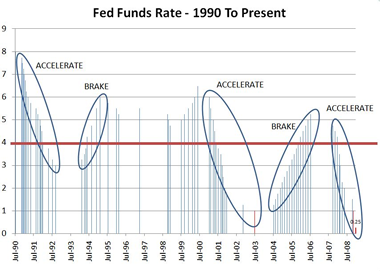
  • Interest rates to continue rising Fed officials have said rates are still too low for an economy facing only a temporary setback from the storm.
Does anyone else see an ominous economic pattern appearing?

Meanwhile...
  • Northwest and Delta Airlines files for bankruptcy
  • Ford plans to import at least 50% of its parts requirements ... that's really good for U.S. suppliers, eh?
Let's resequence these observations:
  • U.S. moving from a producing nation to a consuming nation
  • Non-entreprenurial workers (salaried) getting sqeezed by jobs moving overseas through little or no increase in incomes and companies going out of business or sourcing product elsewhere, while the cost of living is going up quickly
  • The Federal government's response is to fight inflation by raising interest rates which will make it increasingly difficult for those on fixed or no incomes to obtain necessities (you may not have to drive, but you probably will have to heat and cook... until you can't afford to live in a house... which fewer and fewer people can afford to buy from you)

Thursday, September 15, 2005

Google Earth

  1. Go to www.google.com
  2. Download and install Google Earth (unless you have an old PC or a Mac)
  3. Spend hours with this most fascinating software (this could make geography fun)

Who's to Blame - Conservatives or Liberals?

According to an article in The New Republic, the answer is a resounding "Yes."

Okay, that's it. Read the article.

Wednesday, September 14, 2005

Random Thoughts

Bush accepts responsibility for Federal government failures after Hurricane Katrina.

Now just what does that mean? Major changes coming? Resignation? "I've said it so now we can move on to another subject?"

Let's face it: government at all levels tends to focus on the daily and mundane. The extraordinary is relegated to some "plan" that few, if any, understand or can implement with any efficiency or effectiveness. It's human nature to have some concern about really bad things that could happen, but not really do anything about it.

Okay, then, how may of you have a whole house intruder alarm system and fire suppression system? Thought so.
From the Detroit Free Press: "In the six weeks since the August primary narrowed the field to Mayor Kwame Kilpatrick and former deputy mayor Freman Hendrix, blogs and a pointed e-mail have attacked Hendrix, trying to convince Detroiters he's not black enough to be their mayor."
Not Black enough? Okay, now you begin to understand why you get the kind of government you get. I never recalled hearing the good folks of Grand Forks, ND talk about a mayoral candidate as not being Norwegian enough. Hey, L. Brooks Patterson isn't White enough. What do you mean that our government can't handle emergencies properly? How could that be?
Iraq is still an issue, but our attention has been diverted. My nephew faces a second tour there next winter as part of a Marine reserve unit scheduled to return. A lot of families are sacrificing much in the effort to counter some very sinister people.

Michigan continues to be pummeled by economic forces: high unemployment, high cost of fuel, projected increases of 50-70% for heating (after pretty hefty increases last year), double-digit increases in tuition costs, home sales grinding to a halt.
Is this a case of Michigan lagging the recovery or leading the bust?

Tuesday, September 13, 2005

Excessive Spending - Wasting Fuel - 2nd Verse

One reader challenge my accounts of the problems around signal light progression on Telegraph Road, a main surface road in the Detroit area.

He wanted to know if I was speeding or simply being "tripped up" by other drivers creating backups.

The answer is that I have driven that road countless times attempting to maintain the posted speed of 50 mph. In some sections, the progression is timed for about 45 mph, in others it has to be closer to 60 mph, while specifically between 12 Mile and 13 Mile Roads on Saturday (no real traffic) the 2 intermediate lights will stop you just before you reach them if you are the first driver traveling at the posted speed (I think they are timed for 25 mph progress in a 50 mph zone).

No, dear readers, it is just the chaotic mismanagement of signals from township to city to village that is the problem.

I think some high school students could probably work out the progression so that traffic under normal conditions (peak conditions will kill most roads) flows smoothly. Or it is just that those Intel 286 chips controlling the signals can't keep up with the data processing requirements.

Sunday, September 11, 2005

Excessive Spending - Wasting Fuel

I've told my wife that I don't mind spending money; I hate wasting money. Why buy so much food at once that it spoils before it can be eaten? Just take some cash and throw it in the trash and save the fuel needed to drive to and from the grocery store.

I hate it when other people force me to waste money. I wrote about wasting fuel recently: Excessive Spending - The Cost of Inefficiency. Today, I wrote the following to The Detroit News:

Sunday's article about gas (Sunday, September 11, 2005 - High gas prices: gouging or not?) prices really misses the point. It is not simply supply nor demand, but rather waste that is a key factor in the cost of our personal transportation. More than a month ago, I wrote a letter to MDOT's chairman, Gloria Jeff, concerning the poor signal progression along one of Detroit's busiest arteries, Telegraph Road, and the associated waste in gasoline and time resulting from exceptionally bad signal progression. Neither Ms. Jeff, nor any representative of MDOT, has seen fit to respond.

The situation on Telegraph road is one of countless examples of how local, county and state traffic engineering departments are completely failing drivers in metropolitan Detroit. Think not? Consider the difference between EPA mileage estimates for highway and city driving. Why the difference? Because the EPA recognizes the waste associated with stop and start driving versus constant speed driving, which is not a function of vehicle speed. By properly timing signal light progression, millions of gallons of gasoline can be saved weekly in just the Detroit area.

The State of Michigan has enjoyed a 50% increase in revenues from gasoline sales taxes this year, yet has spent a paltry few million dollars to improve traffic flow. So the citizens of Michigan now pay twice for the failure of state, county and local traffic management to do their job; once at the pump and once again on the road.
The State of Michigan charges almost 20 cents per gallon of gasoline as a flat tax plus 6% sales tax on the price per gallon. This is an incentive for the state to promote fuel inefficiency! Am I the only one who gets really PO'd about this situation?

If not, feel free to write to MDOT or your own state's department of transportation:
Gloria J. Jeff, Director
Michigan Department of Transportation
State Transportation Building
425 W. Ottawa St.
P.O. Box 30050
Lansing, MI 48909

Tuesday, September 06, 2005

Environmental Extremism - Un-Natural Disasters

We think of nature in human terms: naturally occurring weather or geological extremes are disasters. But in purely physical terms, they are simply occurrences that change the conditions on this planet, either short-term or long-term. Since change is continually occurring, the scope of change is basically all that we concern ourselves with.

Let's put things into perspective regarding the latest hurricane. No doubt, it was devastating in human terms. The affected area is about the size of Great Britain. Indeed, if that had happened to the British Isles, the country would be crippled. This hurricane will cost thousands of lives and billions of dollars. FEMA is being criticized for its response. Well, that's easy to do. But let's look at some other possibilities.

  • 9.5 earthquake hits San Francisco and triggers subsequent earthquakes up and down the coast. Several million lives lost and hundreds of billions of dollars in property damage. San Francisco and Los Angeles fall into chaos. City officials blame (fill in the blank).
  • Freak storm hits from Wisconsin to Massechusetts creating a coating of ice 6-10" thick destroying millions of homes and businesses, shutting down utilities and destroying the electric distribution grid and gasoline storage facilities. 8 states are without power or heat and millions are homeless. Chaos affects major cities from Chicago to Boston.
  • The Yellowstone Basin erupts on schedule (actually a little late). Western and Midwestern states are covered in 3-10 feet of volcanic ash and the air is poisonous. There are no actual accounts of damage; there will be no accounts for months.
  • A small asteroid strikes the Atlantic Ocean between Virginia and Northern Africa. 300' waves traveling at 700 mph strike the coasts of the U.S., Europe, Africa and South America. All remaining manufacturing is moved to China.
The big question in all of these scenarios is: who gets blamed?

Monday, September 05, 2005

Excessive Spending? - No... this is GIVING

Now is an opportunity to act on your concern for those in the U.S. who have been harmed by the hurricane Katrina.

The American Red Cross provides a significant presence during disasters such as this one. You can donate online quite easily. Some companies will match what their employees give. Check it out. It's simple and you can help someone for the price of a few rounds of golf. I won't miss those rounds that much.

There are other worthy charities. We also prefer The Salvation Army. But that's just a personal preference. We have a truckload of goods to take to their donation center. They will convert those goods into cash to help people.

Just because you can't be there to help, you can still help. We get morally bloated about helping other nations, as in "It's our duty as Americans to blah, blah, blah."

It's time to help our own.

Sunday, September 04, 2005

Excessive Spending - Killing the Golden Goose

Let's hope that $3.30/gallon regular gasoline is an indication of a "bubble" that will burst. The economy is already beginning to tighten its collective belt and people are "just saying no" to travel. Airlines and the tourist industry are getting hurt. Now hurricane Katrina has thrown another wrench into the gears. Will oil prices fall back?

Some, such as Irwin Kellner

Output from the Organization of Petroleum Exporting Countries alone exceeds 30 million barrels per day, and is still rising.

Why, then, are crude oil prices going up? Speculation, that's why.

Lured by rising prices, speculators have been pouring tons of money into the spot and futures markets, betting that prices will go even higher. They're forgetting one thing: the law of supply and demand.

The higher oil prices go, the more likely it is they'll fall. Either demand will drop off or new supplies will come onstream.

This could well result in speculators leaving the oil market as quickly as they came in, thus driving prices down even more.

Dr. Irwin Kellner is chief economist for MarketWatch. He also is the Weller professor of economics at Hofstra University and chief economist for North Fork Bank.

and David Nassar,
As crude retraces on each report that hinders higher prices, we begin to sense the market better suggesting the fear premium priced into oil is "priced to perfection" -- meaning that in the absence of sensational news, oil's correction seems ever closer.

Certainly unfortunate and substantial news could move prices higher, but fear is factored into the market and this leaves room for the oil bears to step in.

Editor's note: David Nassar is chairman and chief executive of MarketWise.com.

think so.

Let's hope they are right or it could be a very long economic winter.


CLICK ON PICTURE FOR A BETTER VIEW

Thanks, Stephan,

Saturday, September 03, 2005

Environmental Extremism - Category 5

This is the first new entry I've made in a week. It was time to observe what went on regarding the hurricane that struck the Gulf Coast. So here are the observations:

What went right:

  • The National Weather Service accurately predicted the course of the hurricane many days in advance
  • As the hurricane became more violent, people were told to evacuate the coastal areas, including all of New Orleans
  • Most areas hit by the hurricane are beginning the rebuilding process
  • The entire nation is rallying to help those in the damaged areas with supplies and money
What went wrong:
  • New Orleans
Yup, that's it in a nutshell. Oh, I don't just mean that New Orleans was virtually destroyed. That's just the aftermath. Also the chaos afterward is a result of what went wrong... before the hurricane actually struck the city.
  • Settling on a flood basin
  • Building levees that were inadequate to withstand one-in-a-century storms
  • A local government with no emergency plans, including evacuation of the poor, infirm, or hospitalized.
  • A state with no emergency plans
  • A federal government with no emergency plans
  • House representatives and senators unwilling to set aside their pork projects for needed improvements to the levees
  • Local officials unwilling or unable to lead local resources
  • State officials unwilling or unable to lead state resources... including the state national guard under control of the governor
  • Federal officials slow to react to the situation
What's going wrong now:
  • Finger pointing by "leaders"
  • Finger pointing by the press
What's going right now:
  • Army and Navy units have been deployed and are bringing the situation under control and actually helping people.
So what's the conclusion:
  • In a catastrophic situation, politicians and the press are virtually useless
  • When something really needs to be done, bring in the military
  • It's all President Bush's fault because he didn't sign the Kyoto Accord and that let excess CO2 expand too fast and cause a category 5 hurricane
Okay, the last one really doesn't count unless you are JFK, Jr.

Sunday, August 28, 2005

Stupid Design

In today's paper, I marveled at the depth of rationalization needed to come up with the concept of Intelligent Design. It's basically that "this [fill in the noun] couldn't exist randomly so it had to be designed with the influence of some outside intelligence."

Here's the problem: a lot of living species have existed and then not. Those designs may not have been too intelligent.

Well, that's because life is moving toward its intended design.

Here's the problem: some living species have existed virtually unchanged since the beginning of life.

Well, that's because they exist to promote the advancement of life toward its intended design.

Here's the problem: no one can say what that intended design might be. Is man made in the image of God? Literally? Figuratively? Allegorically?

What if intelligent life exists someplace else that looks like a cross between a slug and and dandelion? Is that intelligent design. Or are we just talking about life's processes on a molecular level? Mix enough chemicals together and get a "design".

Here's the problem: we just don't know enough about the intelligence behind the design... okay, we know nothing about the intelligence behind the design... okay, we presume there is an intelligence that we know nothing about behind the design....

Science doesn't purport to explain what lies "beyond". We let our imaginations do that with wild projections of ourselves unfettered by limitations. God was created in man's image. God gets angry, God seeks justice, God loves, God even dies for us. So we get angry and seek justice for God because we are protected by God's love even when we die for God. Kaboom! another martyr for God. See the design? Oops, strayed from the subject.

Our logic tells us that something could not have come from nothing. There had to be something before something. We can't imagine what that might be, so we project mightily. An intelligent, creative, all-powerful, all-knowing, all-loving, to-be-feared God.

And He (or She... got to have some gender politics in here) designed everything the way it should be... because it could not have happened randomly over 4 billion years... as we see it. Well, maybe it's not our logic in play here. Maybe it's not and issue of chance versus design. Maybe it's just our lack of intelligence.

Amen.

Friday, August 26, 2005

Ethnic Divisiveness - Uninviting Guests

Our friends have had some guests for quite awhile, but things are not working out very well. Their guests were really not their friends, but some people in need. Our friends had room for them and helped them get jobs. But it became apparent that these guests were really not all that compatible with the way our friends lived.

First it started out with some comments about our friends' lifestyle. Then their guests kept to themselves and even avoided our friends. Finally, their guests began breaking things and threatening our friends' family. It got pretty ugly. So, despite their best altruistic intentions, our friends have told their guests to leave.

Now, some of our friends' neighbors are actually criticizing our friends. They say our friends' action isn't fair. These neighbors say you can't just kick people out because of a few disagreements after you committed to helping them.

I don't know about you, but, to me, being a Good Samaritan doesn't mean you have to take abuse later. Oh well, maybe I just don't have a good understanding of what is fair and right... ethical, if you will.

The whole story appeared in our neighborhood newsletter. Take a look.

Thursday, August 25, 2005

Excessive Spending - As Low As It Can Go....

Fed's Moskow says higher rates "appropriate"
Wed Aug 24, 2005 05:59 PM ET

Moskow said the U.S. jobless rate of 5.0 percent in June and July "is about as low as the unemployment rate can go on a sustained basis."

Between falling unemployment and rising capacity utilization, "we've come quite close to eliminating what had been a significant output gap," he said.
Except of course...

By Tim Martin
Associated Press

Michigan's unemployment rate edged up to 7 percent in July, the state said Wednesday.

The seasonally adjusted rate is up from 6.8 percent in June, which was second-highest in the nation behind Mississippi. The national jobless rate for July was 5 percent.

But, then, Michigan is just one of those manufacturing states... you know... where they build stuff... things we can buy from China now... not real jobs like... you know... real ones... you know?

Wednesday, August 24, 2005

Environmental Extremism - It's a step...

From the New York Times by Anthony DePalma:

9 States in Plan to Cut Emissions by Power Plants

Officials in New York and eight other Northeastern states have come to a preliminary agreement to freeze power plant emissions at their current levels and then reduce them by 10 percent by 2020, according to a confidential draft proposal.

The cooperative action, the first of its kind in the nation, came after the Bush administration decided not to regulate the greenhouse gases that contribute to global warming. Once a final agreement is reached, the legislatures of the nine states will have to enact it, which is considered likely.

Enforcement of emission controls could potentially result in higher energy prices in the nine states, which officials hope can be offset by subsidies and support for the development of new technology that would be paid for with the proceeds from the sale of emission allowances to the utility companies....

Emissions would be capped at 150 million tons of carbon dioxide a year, a figure that is about equal to the average emissions in the highest three years between 2000 and 2004. Each of the nine states would have its own cap. New York's, at 65.6 million tons, would be the largest. Vermont's would be the smallest, with 1.35 million tons.

The caps would be enforced starting in 2009. By that time, restricting emissions to levels prevailing now would, in effect, require a reduction of emissions relative to power output, because electric generation is expected to increase between now and then. The 150 million-ton cap would be sustained through 2015, when reductions would be required, reaching 10 percent in 2020. The Kyoto protocol freezes emissions at the 1990 level and imposes a 7 percent reduction in 2012.
That's a very commendable effort. However, I did not see any mention of the approvals for the new nuclear power generating plants needed to achieve this goal and, by the way, the goal of the "hydrogen" economy. Oh, wait, that's because there wasn't any. I remember how it works:

Monday, August 22, 2005

Starting Out; Ending Up

It became real yesterday. My two younger sons started the process of moving their possessions out of our home. It will take a week or so before everything is complete; they can't move in until their internet connections are set up... they need the connections for work, but I suspect that they couldn't go "cold turkey" for a week without it.

They have their lists of things to do and so do we. After 25 years in one place, there are items that need attention... especially the boys' bedrooms and bathroom. But we've also go a list of "could you help us" items that need to be added to our list. That's good. We are glad that they want us to be involved in this major step. They will be living within shouting distance of each other, so we know that they will help each other through the daily needs. We'll be around... just in case.

Their excitement is contagious. It's a real effort to keep my wife from charging in to take over. She means well and has good ideas, but this is their day, not ours. We've given them everything they need to make good decisions and handle any mistakes. It's time to stand back and watch.

Their beginning as independent adults marks our end as guardians and protectors... but we'll always be parents.


Their new homes.

Sunday, August 21, 2005

Education Failure - The Cost of Failure

This story has been widely circulated over the past few days. Should it be a surprise? Should it be a surprise for those who claim that America's future is our intellectual strength versus the rest of the world? Should it be a surprise for those who say we should not worry about the loss of our manufacturing jobs because we will be the source of new research and ideas for the world? You decide.

An excerpt is below; click on the link for the full article.

Ph.D.s in America on the decline

By THOMAS HARGROVE
August 17, 2005

The United States in 1970 produced more than half of the world's Ph.D.s. But if current patterns continue, the United States will be lucky to produce just 15 percent of the world's doctorates by 2010.

"We don't know exactly why this is happening. But we do know that there are financial issues involved, including the increased debt burden that American students are facing," said Debra Stewart, president of the Washington-based Council of Graduate Schools.
Check out what I wrote on December 20, 2004. You decide.

Is the cost of pursuing an education (much less a Ph.D.) too much? You decide.
Prepaid college tab soars 20%
Last September, I wrote the following letter:
September 14, 2004

Rep. John Boehner, Chairman
Committee on Education and the Workforce
U. S. House of Representatives
2181 Rayburn House Office Building
Washington, D.C. 20515
(202) 225-4527


Subject: Expanding America’s Intellectual Resources

As the father of three sons, two of whom have Masters Degrees (Engineering and Computer Science) with the third approaching his Baccalaureate, I am concerned about the situation within the American education system.

Increasingly, the ranks of our universities' PhD programs are being populated with students from other nations. While diversity of opinion, experience, and skills are valuable, I believe that such diversity already exists within the tens of millions of American-born potential PhDs. The fact that a company such as Microsoft feels compelled to seek Chinese PhDs for their research staff while, at the same time, U.S. universities’ PhD programs are so heavily populated with foreign students sends a message to me that our system of education is failing to focus on American intellectual resources: U.S. citizen students. (http://www.nytimes.com/2004/09/13/technology/13china.html?pagewanted=all&position)

The point of my concern is this: the U.S. is losing manufacturing and technology jobs to lower cost labor suppliers, and the argument is that this is not serious because these jobs will be replaced by better paying ones based on the U.S. becoming the wellspring of new ideas. There is no guarantee that the foreign PhD students will stay here when booming economies in their native lands offer them the chance to become part of the elite there. I would argue that without support for creating the home-grown expertise, the U.S. eventually may be relegated to just another country that had a glorious past.

I propose a simple incentive to create a more favorable environment for U.S. students: allow students who are U.S. citizens at the time they enter a PhD program and who work in the U.S. for five years immediately after receiving their PhDs a tax break. This tax break would be very simple: average the last five years of income prior to receiving the PhD and then average that with the income received over the next five years. For example, if the average income during the last five years of the PhD program was $20,000 and the income over each of the five years following was $100,000 (for simplicity), then the taxable income before any other adjustments would be $120,000/2 or $60,000. At a 25% tax rate, that would be an annual incentive of $10,000 ($100,000 minus $60,000 times 0.25). Over five years, that would be a savings of $50,000 which could be used to offset some of the costs of pursuing a PhD.

This incentive could well be the difference between a U.S. student deciding to pursue a PhD or deciding that the burden of pursuing one is too great.
Is it time to take some positive steps toward strengthening our future? You decide.

Friday, August 19, 2005

Ethnic Divisiveness - We'll Show 'Em

THIS IS A LONG ENTRY, BUT WORTH THE READING, I THINK:

Michigan State Trooper Charged with Murder

By Michael Rosenfield
Web produced by Christine Lasek
May 9, 2005

A Michigan State Trooper is being charged with murder for a controversial shooting outside of a Detroit bar. The trooper is being asked to turn himself in.

Family members of the victim say they are relieved that a murder charge is now being brought against the trooper. Investigators say this case has taken several weeks because it is always difficult to investigate a police agency.

Wayne Co. Prosecutor Kym Worthy announced Monday morning that Michigan State Trooper Jay Morningstar will be charged in the April 14th incident that left a homeless man dead in the street.

According to Worthy, "After a thorough investigation, we are charging Trooper Jay Morningstar with one count of murder in the 2nd degree, and a separate count of manslaughter, intentionally aimed without malice."
What was missing in that news account?

KEEP GOING...

Trooper held in homeless man's death

$200,000 bond set; accounts of shooting differ about details

May 11, 2005

BY BEN SCHMITT
FREE PRESS STAFF WRITER
The two departments have given conflicting details.

A court file says Williams, whose family said he had mental problems, was harassing customers inside the bar and broke two windows while being escorted from the bar.

Detroit police said in a report that Williams had his pants down around his knees and walked toward Morningstar before the trooper shot him.

But Sgt. Mike Herendeen, president of the Michigan State Police Troopers Association, said Williams was not partially naked. He said Williams' baggy pants were sliding down as he approached Morningstar, and his hands were in his waist area.

Morningstar said: "Stop. Show me your hands," at least twice, according to Herendeen.

"This is not something he wanted to get involved in that night," Herendeen said. "Certainly this is devastating. He's charged with a serious crime for essentially doing his job and doing it the way he was trained to do it."

THERE'S MORE HERE...

Friday, May 13, 2005

Trooper pays price for Detroit's incompetence

By Frank Beckmann / Special to The Detroit News

Frank Koss sits in the Beaubien Street Saloon, right next door to the Old Detroiter. As a pseudo-doorman, he knew Magoo (nickname for the man who was killed), all too well.

"He'd come by every other night at 9 o'clock, and I'd give him 5 bucks to keep him out of here," Koss told me. "By midnight, he was a different guy."

And what made him different? The alcohol he would buy with the money he scrounged from Koss and anyone he could panhandle. Koss says Magoo was as "mean as a snake when he got a snoot full."

He tells of Magoo threatening a couple with a screwdriver in a nearby parking lot one night "when they wouldn't give him any money."

Pointing toward Beaubien Street, Koss says Magoo was known, without provocation, to "attack moving cars out in the street. If I'm lyin', I'm dyin'!"

Jim Steel works behind the bar at Beaubien Street Saloon. Still puzzled by the events of that night, he says "I just don't understand why you don't listen to a cop."

Let's set aside for the moment the obvious involving Wayne County Prosecutor Kym Worthy -- that she overcharged -- and move to another contemptible part of this tragedy.

At Trooper Morningstar's arraignment this week, Magistrate Sidney Barthwell Jr. (who was repremanded formally when he was a lawyer - Barthwell Jr., Sidney-Notice-NOTICE OF REPRIMAND-98-237-GA- 03/01/1999) called the defendant a danger to the community and set his bond at a staggering $200,000 at the request of Worthy's office.

This courtroom scene was pure grandstanding.

Noted Detroit criminal attorney Stephen Fishman told me, "I have represented many police officers charged with homicide. I have never had the prosecution request, nor the judge set, anything other than personal bond in those cases."

AH, THE CONCLUSION:

Let's look at what's in play here:
  • The incident occurred around 1:00 am in Detroit
  • The man who was killed is black and on other occasions was violent and erratic
  • The officer is white
  • The prosecutor is black
  • The judge is black and was reprimanded as a lawyer in 1999 - maybe not the straightest arrow in the quiver???
I really hate to think that this a case of "We'll show 'em!" This really should not be a racial statement by Kim Worthy or Sidney Barthwell Jr. State Troopers are black and white; they do their jobs based on the law, not on racial bias. But, I get the sense that this prosecution of Officer Morningstar is about racial grandstanding... so much so that I just mailed a contribution to:
JAY MORNINGSTAR

C/O THE JAY MORNINGSTAR DEFENSE FUND

REPUBLIC BANK

6549 CANTON CENTER RD.

CANTON, MI 48187

Thursday, August 18, 2005

Excessive Spending - Inflation

Wholesale Inflation Jumps on Gas Prices

Okay, that's no surprise.

Fuel prices, economy feed slump in tourism

Okay, that's no surprise.

Treasuries Fall; Inflation Report Fuels Speculation for Fed Rate Increases

Okay, that's no surprise.

See, now here is where most of us get a little bent out of shape.

  1. Energy prices go up making the necessities of life more expensive
  2. We give up the discretionary spending such as travel for fun
  3. The Fed raises interest rates making everything even more expensive
That way, not only do we have to scrimp to get along, we can suffer to get along. Businesses can tank, jobs can disappear, people can lose their investments, and things generally get worse.

But, we've addressed the issue of high energy costs... or have we? Remember, most of those costs are related to demand for oil in Asia. So, we have to keep importing more Asian products which are cheaper than American-made products to keep the prices down and that adds to energy demand in Asia which increases the cost of oil which ... okay, we keep going round and round... until things get so bad that we stop buying things from anyplace and then, once we have achieved worldwide recession, we can get the oil prices to fall.

Such supreme intelligence to come up with that strategy.

Wednesday, August 17, 2005

Ethnic Divisiveness - Same Planet... Different World

From the New York Times - by Dexter Filkins:

The prime minister, Ibrahim al-Jaafari; the president, Jalal Talabani; and Hussein Shahrastani, a leading Shiite member of the National Assembly, all described their disagreements as minor ones that would be solved by the new deadline, this coming Monday.

"There are no issues without solutions," Mr. Talabani said at a news conference. "The points left are very few, such as the role of Islam, human rights, and the rights of women. There is a general agreement on them, but we need to word them precisely."

Minor... indeed.

Looking back, on July 10 I wrote:
That said, it is unlikely that there will be any negative reaction coming out of the Muslim world... more likely a positive reaction to the murders in England.

What are the long term effects? I think that the Europeans will begin to resist further immigration of Muslims. It is likely that Turkey's efforts to join the European Union will be hurt further. Muslims living in Europe will find themselves the targets of hate crimes.
Since then, there has been a denial of re-entry into England of a particularly vocal Islamic cleric.

It is beginning.

Read further:
Muslims seem to have forgotten that the recent decades of Western European tolerance is really not part of their history... quite the contrary. First Spain, then Denmark, now Britain; these are strategic mistakes by the Islamic radicals.

Monday, August 08, 2005

Excessive Spending - The Cost of Inefficiency

Over the past decade or so, I have written numerous letters to various government officials and departments concerning one needless and wasteful problem: incorrect traffic signal progression.

For those of you not familiar with the term, the concept is reasonably simple: the traffic signals along a route should change in a sequence and timing that corresponds to a vehicle traveling at the posted speed. If the posted speed is 40 mph, then you should be able to travel at 40 mph and have the traffic signals remain green. Obviously, there are factors that affect the actual progression of traffic through the signals including too many vehicles on the road, vehicles traveling too fast or too slow causing unnecessary stopping or delays, and emergency situations.

In every case, when I have written to the officials with a specific problem, I have received either no response, a snooty response or one that says the problem is really, really, really difficult, but every available person is working on the problem. In truth, millions of dollars have been spent on the issue, but with strangely little improvement.

In the Detroit Metropolitan area, there are about 5 million people... maybe 6 million. If there are 1 million vehicles on the road each day and they travel, on average, 30 miles per day, that is 30 million miles traveled in just this area. Typically, stop and start travel consumes about 30% more gasoline than steady-speed travel. Let's assume for argument sake that of the 30 million miles traveled, 15 million miles are over roads controlled by traffic signals. Let's further assume that the average mileage for these vehicles is 15 mpg (we have small cars to large trucks).

That gives us 1 million gallons of fuel used for the roads with traffic signals.

Now let's presume that the traffic signals are poorly timed for half of those miles. That's 1/2 million gallons of fuel used. If the mileage were improved to 19.5 mpg by steady-speed driving over those roads, then instead of 500,000 gallons of fuel used, the consumption would be 385,000 gallons. That is a savings of 115,000 gallons @ $2.30 per gallon or $264,000 PER DAY.

That's almost $100,000,000 of waste per year or about 42,000,000 gallons of fuel used unnecessarily JUST IN THE DETROIT AREA. Even if these estimates are somewhat high, the message is obvious:

It would seem that somewhere we can find $1 or 2 million to address this problem just a little more.

Wednesday, August 03, 2005

Education Failure - We can't discriminate

We go through most of our lives discriminating in one way or another:

Main Entry: dis·crim·i·nate
Pronunciation: dis-'kri-m&-"nAt
Function: verb
Inflected Form(s): -nat·ed; -nat·ing
Etymology: Latin discriminatus, past participle of discriminare, from discrimin-, discrimen distinction, from discernere to distinguish between -- more at DISCERN
transitive senses
1 a : to mark or perceive the distinguishing or peculiar features of b : DISTINGUISH, DIFFERENTIATE <discriminate hundreds of colors>
2 : to distinguish by discerning or exposing differences; especially : to distinguish from another like object
intransitive senses
1 a : to make a distinction <discriminate among historical sources> b : to use good judgment
2 : to make a difference in treatment or favor on a basis other than individual merit <discriminate in favor of your friends> <discriminate against a certain nationality>

© 2005 Merriam-Webster, Incorporated
It is interesting that, in today's politically correct world, the secondary meaning has become the primary meaning. Instead of "using good judgment" we are treating others unfairly (not on individual merit). Or is it that we are not allowed to treat individuals on the basis of their merit and, therefore, cannot use good judgement.

My sister just completed her Masters Degree in Education with specializations in "Special" and Deaf education. She was pointing out how the "No Child Left Behind" act was unfair because schools that "mainstream" special or deaf education students are measured the same way as schools that educate those students separately or, in the case of private/charter schools, refuse admittance to those students on the basis of not having the necessary resources for those students.

Whereupon, I pointed out that it is that very politically correct approach to education that says that we can't be discriminating (use good judgment) because it is discriminating (measuring one on the basis of ability or merit) that the government now feels compelled to treat/measure all student progress the same regardless of particular students' special needs or limitations.

My sister acknowledged the "double-edged sword."

Monday, July 25, 2005

Education Failure - Linking Verbs

Be am is are was were been being seem feel look appear become grow taste smell sound continue remain....

Freshmen English... 1958. Every morning for 6 weeks we repeated this refrain until it was indelibly etched in our minds. We were not allowed to be "creative" with our language. We had to learn it. Learning the technical aspects of our language was as important as writing an essay of our own thoughts.

Three years of Latin; three years of German; Shakespeare, Milton and Chaucer... learning the foundations of our language. No phonetics... no "hooked on phonics." Knowledge passed along rather than invented on the fly.

I found Thomas Sowell's article (and part 2) about the impact of passing along knowledge versus "facilitating" learning less than surprising. Oh, I know, Thomas Sowell is not exactly revered among the left-leaning and maybe too revered among the right-leaning. Okay, let's just say that my own experience says that I got more out of teachers who passed along the information and how it was relevant than those who simply handed out assignments and tested.

Teaching is not a process of "facilitating" learning and it is not a process of being "conveyors of knowledge who enlighten their students with what they know." It is a process of facilitating learning by conveying specific knowledge in ways that are relevant and interesting.

I once asked my son's geometry teacher if he ever attempted to relate that subject to everyday applications. He responded with a dull, blank expression and a simple, "No." That confirmed my son's opinion that this guy was putting in his time until retirement. I wanted to tell him how I built a two-level deck with a bay front on the back of my house using a level, chalkline and standard length lumber, plus what I had learned in geometry. No tape measure was needed.

The point is that teachers have to be more than "guides"; teachers must be surrogate parents. Before you get all huffy about teachers being surrogate parents, think about the reality of the situation. For the better part of the day, teachers must be the authority, the counselor, the guide, and the expert in our children's lives. Many teachers prefer just one or two of those roles, but the effective teachers establish a personal relationship based on strength of knowledge, strength of position and strength of character. They don't replace parents; they assume the temporary position of a parent who is educating many offspring.

My father taught me how to build and fix things. He showed me the right way, guided my hands-on efforts, and corrected me until I understood and was competent. He didn't hand me a power saw and just say "don't put your hand in front of the blade" while I "discovered" how to cut wood properly. He was a teaching parent. Good teachers understand that they are surrogate parents.

By the way, that English teacher who drilled those linking verbs into our collective consciousness was a reasonably good teacher. She had a difficult subject... grammar... and a difficult group of students... freshmen. But I never really understood until much later just why we were learning that list. Regardless (not irregardless), she did convey the knowledge needed to advance my understanding and proper use of English. Admittedly, I have become a little sloppy in my use of punctuation and, occasionally, grammar, but her efforts largely were successful.

Friday, July 15, 2005

China - Market Opportunity, Trading Partner, Competitor, Enemy?

Nothing is ever as simple as it first seems.

Triple your original estimate.

Ignore the man behind the curtain.

China:

  • Market opportunity - GM goes in; Chery comes out
  • Trading Partner - jobs for cheap goods
  • Competitor - IBM, UNOCAL? (read the papers)
  • Enemy - We'll nuke you if you actively defend Taiwan
http://washingtontimes.com/specialreport/20050626-122138-1088r.htm

Read both parts.

Thursday, July 14, 2005

Education Failure - I'd Rather Not Go There

In Michigan:

State high school science test scores show a slight drop
In Detroit:
Earn your GED through television
In Ontario, Canada
Toyota to build 100,000 vehicles per year in Woodstock, Ont., starting 2008

Nissan and Honda have encountered difficulties getting new plants up to full production in recent years in Mississippi and Alabama due to an untrained - and often illiterate - workforce. In Alabama, trainers had to use "pictorials" to teach some illiterate workers how to use high-tech plant equipment.

"The educational level and the skill level of the people down there is so much lower than it is in Ontario."
(Thanks to Steven for the lead)

Alabama, Mississippi, Michigan, Detroit... what do they have in common?
a) What, me study?
b) A lot of free time.
c) Professional TV watchers
d) All of the above

Sunday, July 10, 2005

Ethnic Divisiveness - Biting The Hand That Feeds You

Gratitude: grat·i·tude

Pronunciation: 'gra-t&-"tüd, -"tyüd
Function: noun
Etymology: Middle English, from Middle French or Medieval Latin; Middle French, from Medieval Latin gratitudo, from Latin gratus grateful
: the state of being grateful : THANKFULNESS [Merriam-Webster Online]

The New York Times reports today:
Imran Waheed, a spokesman for a radical British-based group, Hizb ut Tahrir, which is allowed to function here but is banned in Germany and much of the Muslim world, said: "When Westerners get killed, the world cries. But if Muslims get killed in Iraq or Afghanistan, it's the smallest of news. I will condemn what happened in London only after there is the promise from Western leaders to condemn what they have done in Falluja and other parts of Iraq and in Afghanistan."

So far, there appears to be little effort to restrain outspoken clerics, including prominent extremists like Sheik Omar, who has reportedly been under investigation by Scotland Yard.

Sheik Omar, who remains free, is an example of the double-edged policies in Britain. He is a political refugee who was given asylum 19 years ago and is supported by public assistance. Asked in an interview in May how he felt about being barred from obtaining British citizenship, he replied, "I don't want to become a citizen of hell."
The Christian/Humanistic culture of the West may have a slight problem understanding the depth of Islamic thinking. On the other hand, radical Islamists may have a difficult time understanding why anyone would actually want to guarantee their civil rights... but they will certainly take advantage of it.

Friday, July 08, 2005

Environmental Extremism - If only I had a brain

The Scarecrow could be excused for his shallow thought process. After all, he didn't have a brain. But when our leaders and editors use the old "we should do something" as a statement of policy, it is hard to excuse.

In today's Detroit Free Press, columnist Tom Walsh wrote:

If the United States and other major economic powers were to switch from gasoline to hydrogen or another alternate fuel for cars and trucks, just imagine the geopolitical impact. Radical regimes in the Middle East would lose the only clout they have, as demand for oil falls along with its price.
Well, yes, if we just switched fuels that would be great. But, as I have written several times, each alternative has a price that, so far, we haven't been willing to pay.

A hydrogen-based transportation system would require massive efforts to build a distribution infrastructure. It would also require new nuclear or clean-burning coal power generation plants to make enough energy to create the hydrogen gas which, incidentally, is a storage medium like a battery, not an energy source. Even Greenpeace co-founder, Patrick Moore, agrees with that (see June 13).

Meanwhile, Congress toys with dismantling Amtrak which is a mass-transportation alternative.

But, we gotta do something... something. If I only had a brain to figure out what.

But as Tom Walsh put it:
I don't have a clue what will ultimately emerge as the best replacement for gasoline.
His solution:
Why not just put a lot of really smart people on the case, give them the money and resources they need, then light a fire under them and keep it lit until they find a way to kick the oil addiction?
Tom, the answers are already out there. It's just that our "leaders" don't want to face the heat from a "fire under them". And, quite frankly, neither do most citizens if it means $5.00/gallon gasoline.

Current energy alternatives to oil products and where best used:
  • nuclear power - regional/national (Chernobyl - not!)
  • clean-burning coal - regional/national (millions of tons of that stuff in our back yard)
  • tidal - regional/local
  • solar - regional/local/homes (heat and light)
  • wind - local/homes
  • geothermal - commercial buildings/homes
  • hydrogen - storage medium
  • batteries - storage medium
  • insulation - duh!
  • triple-pane low-e glass - duh!
  • skylights - duh!
  • sweaters - duh!
  • walking and bicycling - duh!
If I only had a brain.... No, if I only had the will.
Thursday, July 07, 2005

Ethnic Divisiveness - London Bombing

Today's bombing in London will create a temporary crisis of confidence... very temporary. What is more likely to happen is that Europeans will begin to view all Muslims with increasing hostility.

Why? Because most Muslims in Europe have not demonstrated any indication that they are against those who are responsible for a similar attack in Spain and the murder of a Danish film maker Theo Van Gogh, recently. There have been no clerics or leaders stepping forward denouncing these actions. Don't expect them in England. I suspect that even though the Muslims might be horrified by the actions, they are secretly delighted that the Europeans are getting "payback" for displacing the Ottoman Empire's glory.

The Middle Eastern version of Islam, particularly the religious state versions, have stifled the Muslims with regard to social, intellectual, and economic growth which they are all too willing to blame the on the West.

That said, it is unlikely that there will be any negative reaction coming out of the Muslim world... more likely a positive reaction to the murders in England.

What are the long term effects? I think that the Europeans will begin to resist further immigration of Muslims. It is likely that Turkey's efforts to join the European Union will be hurt further. Muslims living in Europe will find themselves the targets of hate crimes.

But what would surprise me least is that there may be secret communications by the European governments with the leaders of Iran and Syria warning that further attacks by the Muslim extremists will result in mysterious explosions in Damascus and Tehran. It is no secret that Iran and Syria directly and actively support the terrorists. They may not control them, but they give them sanctuary and resources. An EMP cruise missle or two would send a strong message: DON'T TREAD ON ME! It's time the jackels were restrained... or the lions may be unleashed.

Can"t Find It?

Use the SEARCH BLOG feature at the upper left. For example, try "Global Warming".

You can also use the "LABELS" below or at the end of each post to find related posts.

Blog Archive

Cost of Gasoline - Enter Your Zipcode or Click on Map

CO2 Cap and Trade

There is always an easy solution to every human problem—neat, plausible, and wrong.
Henry Louis Mencken (1880–1956)
“The Divine Afflatus,” A Mencken Chrestomathy, chapter 25, p. 443 (1949)
... and one could add "not all human problems really are."
It was beautiful and simple, as truly great swindles are.
- O. Henry
... The Government is on course for an embarrassing showdown with the European Union, business groups and environmental charities after refusing to guarantee that billions of pounds of revenue it stands to earn from carbon-permit trading will be spent on combating climate change.
The Independent (UK)

Tracking Interest Rates

Tracking Interest Rates

FEDERAL RESERVE & HOUSING

SEARCH BLOG: FEDERAL RESERVE for full versions... or use the Blog Archive pulldown menu.

February 3, 2006
Go back to 1999-2000 and see what the Fed did. They are following the same pattern for 2005-06. If it ain't broke, the Fed will fix it... and good!
August 29, 2006 The Federal Reserve always acts on old information... and is the only cause of U.S. recessions.
December 5, 2006 Last spring I wrote about what I saw to be a sharp downturn in the economy in the "rustbelt" states, particularly Michigan.
March 28, 2007
The Federal Reserve sees no need to cut interest rates in the light of adverse recent economic data, Ben Bernanke said on Wednesday.
The Fed chairman said ”to date, the incoming data have supported the view that the current stance of policy is likely to foster sustainable economic growth and a gradual ebbing in core inflation”.

July 21, 2007 My guess is that if there is an interest rate change, a cut is more likely than an increase. The key variables to be watching at this point are real estate prices and the inventory of unsold homes.
August 11, 2007 I suspect that within 6 months the Federal Reserve will be forced to lower interest rates before housing becomes a black hole.
September 11, 2007 It only means that the overall process has flaws guaranteeing it will be slow in responding to changes in the economy... and tend to over-react as a result.
September 18, 2007 I think a 4% rate is really what is needed to turn the economy back on the right course. The rate may not get there, but more cuts will be needed with employment rates down and foreclosure rates up.
October 25, 2007 How long will it be before I will be able to write: "The Federal Reserve lowered its lending rate to 4% in response to the collapse of the U.S. housing market and massive numbers of foreclosures that threaten the banking and mortgage sectors."
November 28, 2007 FED VICE CHAIRMAN DONALD KOHN
"Should the elevated turbulence persist, it would increase the possibility of further tightening in financial conditions for households and businesses," he said.

"Uncertainties about the economic outlook are unusually high right now," he said. "These uncertainties require flexible and pragmatic policymaking -- nimble is the adjective I used a few weeks ago."
http://www.reuters.com/

December 11, 2007 Somehow the Fed misses the obvious.
fed_rate_moves_425_small.gif
[Image from: CNNMoney.com]
December 13, 2007 [from The Christian Science Monitor]
"The odds of a recession are now above 50 percent," says Mark Zandi, chief economist at Moody's Economy.com. "We are right on the edge of a recession in part because of the Fed's reluctance to reduce interest rates more aggressively." [see my comments of September 11]
January 7, 2008 The real problem now is that consumers can't rescue the economy and manufacturing, which is already weakening, will continue to weaken. We've gutted the forces that could avoid a downturn. The question is not whether there will be a recession, but can it be dampened sufficiently so that it is very short.
January 11, 2008 This is death by a thousand cuts.
January 13, 2008 [N.Y. Times]
“The question is not whether we will have a recession, but how deep and prolonged it will be,” said David Rosenberg, the chief North American economist at Merrill Lynch. “Even if the Fed’s moves are going to work, it will not show up until the later part of 2008 or 2009.”
January 17, 2008 A few days ago, Anna Schwartz, nonagenarian economist, implicated the Federal Reserve as the cause of the present lending crisis [from the Telegraph - UK]:
The high priestess of US monetarism - a revered figure at the Fed - says the central bank is itself the chief cause of the credit bubble, and now seems stunned as the consequences of its own actions engulf the financial system. "The new group at the Fed is not equal to the problem that faces it," she says, daring to utter a thought that fellow critics mostly utter sotto voce.
January 22, 2008 The cut has become infected and a limb is in danger. Ben Bernanke is panicking and the Fed has its emergency triage team cutting rates... this time by 3/4%. ...

What should the Federal Reserve do now? Step back... and don't be so anxious to raise rates at the first sign of economic improvement.
Individuals and businesses need stability in their financial cost structures so that they can plan effectively and keep their ships afloat. Wildly fluctuating rates... regardless of what the absolute levels are... create problems. Either too much spending or too much fear. It's just not that difficult to comprehend. Why has it been so difficult for the Fed?

About Me

My photo
Michigan, United States
Air Force (SAC) captain 1968-72. Retired after 35 years of business and logistical planning, including running a small business. Two sons with advanced degrees; one with a business and pre-law degree. Beautiful wife who has put up with me for 4 decades. Education: B.A. (Sociology major; minors in philosopy, English literature, and German) M.S. Operations Management (like a mixture of an MBA with logistical planning)