READ ABOUT DETROIT AND SOLUTIONS TO ITS PROBLEMS. CLICK HERE.

Tuesday, December 26, 2006

University of Michigan Makes a Little Effort

SEARCH BLOG: EDUCATION and AFFIRMATIVE ACTION

Two years ago I wrote:

I applaud efforts for "reaching out to students" in Detroit and elsewhere, but simply speaking to an auditorium full of students who have poor preparation and little interest in your message is nothing more than taking bows for "trying". If you and the University are serious about wanting to have more black students enter U of M as qualified applicants, then perhaps you need more than just a few pep rallies.

...U of M has the resources to help address the root causes of dysfunctional education processes, and that is where its efforts should be. Create in-school assistance programs in schools deemed under-performing. Create seminars to explain to under-performing parents the economic impact of their lack of responsibility. Offer free, on-site university programs to grade school and new high school students that show them the range of opportunities that an education offers. Create an excitement for education. Then "special considerations" will not be used in place of real effort.
The other day an article appeared in The Detroit News:
MacArthur Elementary School will reopen in the fall as MacArthur K-8 University Academy, thanks to a partnership with the University of Michigan-Dearborn and the Engineering Society of Detroit.

The plan is to take the school to a new level of excellence in math, science, technology and leadership skills, while keeping the students with the same classmates and teachers for three additional years.

This is a great step forward... except for one thing: MacArthur Elementary School is in Southfield which is Oakland County, a relatively affluent county (Southfield's median income in 2000 was over $51,000). My article was about Detroit (median income under $30,000) which in Wayne County.

The idea is right; the location is wrong. Also, the effort is through the smaller satellite Dearborn (ironically Wayne County) campus of UM rather than the main Ann Arbor campus.

Perhaps this can be viewed as a "pilot program" that could be expanded to the Detroit schools, with over 80% black student population, where the program is really... really... needed and using the resources of the main campus in Ann Arbor. Until then, this is nice PR for UM, but not really putting "their money where their mouth is."

Meanwhile, the University continues to argue for racial preference programs as the way to overcome poor preparation and economic disadvantage.

..

Saturday, December 23, 2006

Merry Christmas


May you all have the very best Christmas ever.

Back on the 26th.


Friday, December 22, 2006

A Dirty Little War

SEARCH BLOG: IRAQ

Since President Bush has asked for more money and soldiers, Iraq, which is a dirty little war, continues to consume Americans' attention and generate high emotion about its costs... especially the lives of its servicemen... closing in on 3,000.

Let's take a closer look,

Below are charts from www.globalsecurity.org:


Compare this to Vietnam (1964-73):

             CASUALTIES
--------------------------
BRANCH OF NUMBER BATTLE OTHER
SERVICE SERVING DEATHS DEATHS
TOTAL 8,744,000 47,378 10,799
ARMY 4,368,000 30,922 7,273
NAVY 1,842,000 1,631 931
MARINES 794,000 13,084 1,753
AIR FORCE 1,740,000 1,741 842

In case that is difficult to make out, there were 58,000 deaths in Vietnam or about 20 times what has been experienced in Iraq.

That comparison is not meant to minimize the cost or suffering of our soldiers in Iraq. It meant is to highlight the significant differences in the way that the military is operating today in an insurgent situation versus 40 years ago. War will always be dirty and painful and costly... but, increasingly, the brunt of the cost is for more effective weapon systems and keeping our soldiers safer.

Whatever you think about the politics of the war, the execution of the war is a magnitude better. Perhaps our collective impatience will cause us to take the same path that we did in Vietnam. If so, we may have to face more significant consequences later.

..

Thursday, December 21, 2006

Be worried, be very worried...

SEARCH BLOG: GLOBAL WARMING

Never mind what you've heard about global warming as a slow-motion emergency that would take decades to play out. Suddenly and unexpectedly, the crisis is upon us.

From heat waves to storms to floods to fires to massive glacial melts, the global climate seems to be crashing around us.
Special Report
Time Magazine
Reported in CNN.com
March 26, 2006
This discourse is now characterised by phrases such as "climate change is worse than we thought", that we are approaching "irreversible tipping in the Earth's climate", and that we are "at the point of no return".

I have found myself increasingly chastised by climate change campaigners when my public statements and lectures on climate change have not satisfied their thirst for environmental drama and exaggerated rhetoric.

It seems that it is we, the professional climate scientists, who are now the (catastrophe) sceptics. How the wheel turns.
By Mike Hulme Director, Tyndall Centre for Climate Change Research
BBC News
November 4, 2006
A panel convened by the U.S National Research Council, the nation's premier science policy body, in June 2006 voiced a "high level of confidence" that Earth is the hottest it has been in at least 400 years, and possibly even the last 2,000 years. Studies indicate that the average global surface temperature has increased by approximately 0.5-1.0°F (0.3-0.6°C) over the last century. This is the largest increase in surface temperature in the last 1,000 years and scientists are predicting an even greater increase over this century. This warming is largely attributed to the increase of greenhouse gases (primarily carbon dioxide and methane) in the Earth's upper atmosphere caused by human burning of fossil fuels, industrial, farming, and deforestation activities.

As you undoubtedly know, an especially suspicious correlation is that of a period of no sunspots (and hence low solar activity) corresponding with the Maunder Minimum of ~1645 to 1715 A.D, a period of extreme cold in Europe. Because of the complexity of effects on the Earth's climate, the jury is still out on whether this period of a Little Ice Age was indeed caused by the lack of solar activity.
Stanford Solar Center
Stanford University

The sky is falling... maybe not... the sky is falling... maybe not....

But I like the temerity of Stanford to put those phrases highlighted in red in the same academic article. I can count back 400 years, can you?

..

Christmas Charity

SEARCH BLOG: GIVING

I posted this the other day at Economist's View where the discussion was all about charity and tax deductions:

Sometimes charity is given because it is the right thing to do, not because of tax deductions.

My brother-in-law is an Episcopalian priest who, last Christmas, disguised himself as a homeless man and stationed himself next to the stairs of the church before the services. Most of the congregation simply tried to ignore him. A few offered a small amount of money. They all were quite surprised when he walked to the front of the church after they had all been seated and revealed who he was.

From that stunt and the following notoriety, the churches in his area formed a loose, voluntary coalition of informal shelters to ensure that no homeless people would be forced to live on the streets. Men are housed at the churches while women and children go to hotels... all from money donated to the churches for that purpose... charity. See here.

It is people stepping up to do the right thing regardless of what the government offers as incentives.

Too bad it doesn't happen often enough.

I guess it's a matter of economics.

This ad hoc system in Delavan, Wisconsin, still struggles to provide basic subsistence for the unfortunate as do other similar efforts. Delavan is just a small spot on the map. But this is big help to the people who receive it. Especially when the temperatures start hovering around 10 degrees.

If you want to help, you can donate to:
Rev. William Myrick
Christ Episcopal Church
503 E. Walworth Ave.
P.O. Box 528
Delavan, Wisconsin 53115
Memo your donation for the Homeless Shelter.

Or you can just pass this message on. A small act at Christmas can last all year. Just ask Rev. Myrick.

p.s., all of the money is used for housing the women and children; the churches donate their space and food for the single men.

..

Global Warming - Unanswered Questions

SEARCH BLOG: GLOBAL WARMING

I appreciated James Killus' essay which was posted yesterday. While it explains his reasons for accepting the popular thinking about the relationship between CO2 and climate change, it didn't address, nor reasonably should it have been expected to address, the issue raised by Dr. Tim Patterson of Carleton University in Ottawa:

How can CO2 be the cause of global warming when the sequence, geologically, has always been an increase in temperature followed by an increase in CO2... with the lag about 800 years. Isn't the change in solar activity that has been correlated strongly with climate change a far more significant factor?
Dr. Patterson's arguments and those of like-minded scientists are not enough to say that human caused CO2 increases can't affect climate, but they certainly are strong enough to merit more investigation into CO2's real role in the overall dynamics of climate change. Simply being a "greenhouse" gas with the potential to raise atmospheric temperature is not enough.

There are so many variables... and lesser understood interactions such as the effect of shifting ocean currents on CO2 absorption rates among others... that to accept James Killus' contention that we should act quickly because there is an apparent connection seems, at the least, premature and at the worst, panicky. He is concerned about the impact of change because it represents an unknown.

Regardless, humans have shown adaptability beyond any other species... having originated in the tropical jungles and now inhabiting the farthest northern reaches of Canada, the most southern reaches of South America, the highest altitudes of the Himalayas and the hottest, driest deserts of Africa. It is unlikely that a few degrees of average temperature change is going to threaten mankind... maybe alter some lifestyles, but not threaten mankind.

We always have and we always will be a species that can adapt as our world changes around us. We do not have to be rushing to control climate change. There are a lot of other more pressing problems of our own making we should be addressing.

..

Wednesday, December 20, 2006

A Few Notes About Global Warming

SEARCH BLOG: GLOBAL WARMING

From:
James Killus

I had a recent exchange with a global warming skeptic named Bruce Hall, first in the comments section on Economist’s View, then in an email exchange. We were polite, amidst a certain degree of rancor, and that made the exchange pleasant enough that the “agree to disagree” option came up from the magic 8 ball. (But let it be acknowledged that I did give in to snarkiness with a few other posters, who rubbed me more the wrong way, so I guess I can’t claim politeness as my inevitable demeanor).

Part of the exchange was some historical background, which I’m expanding a bit here.

*

One of the claims sometimes made by global warming skeptics is that there was a time in the 1950s (or sometimes it’s said to have been in the 1970s), that there was a time when scientists were warning about an impending ice age. But, there was never a general scientific consensus, in the 1950s or any other time, that a new ice age was imminent. There was, of course, the recognition that we are currently in what is called an "interglacial" period, and that, other things being equal, another ice age would eventually return. However, the greenhouse gas hypothesis has been around for over a century now, and the CO2 readings from Mauna Loa in the mid-50s caught a lot of people's attention, with some pretty explicit greenhouse warnings dating back at least that far. Indeed, I saw one in an editorial in Analog. One the other hand, there was a cooling trend in the middle of the 20th Century. That was one reason for a lack of consensus about greenhouse warming.

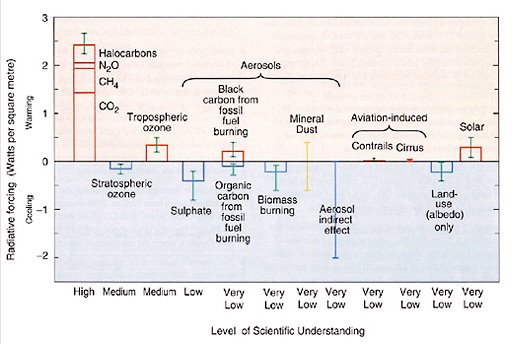
There is now what I’d call at least a plurality of belief among climatologists that what was going on with mid-century climate was that the great increase in the use of high sulfur coal to generate electric power actually did have an aerosol cooling effect, at least on a local or regional basis. Climatologists are also very aware that there is a measurement bias in surface temperature readings, because so many are on land and so few at sea. Again, another reason why a consensus was slow to develop.

(As an aside, I'll note that there was a Fritz Leiber story in the 1940s, "Destiny Times Three" that presented a view of an ice age as a result of a nuclear war, not from "nuclear winter" but rather because enough of the Earth's lower crust had been exposed that rock weathering had removed so much CO2 from the atmosphere that "global cooling" resulted. I think that this was the first appearance of the greenhouse hypothesis in science fiction).

Now it so happens that I was a global warming skeptic for probably longer than I should have been, in retrospect. There were several things that changed my mind. One was that, in the late 80s and early 90s, James Hansen made a very persuasive case, including some spot on model predictions of the effects of the Pinatubo Eruption. Just as important was the paper by David J. Thompson in Science in 1995 that found a season change signal (actually a "flipping" local climates to more resemble a Mediterranean seasonal pattern), that dates back over a century.

(It’s interesting that, while checking on the date of the Thompson paper, I came across an article arguing that what Thompson was showing was a good thing. After all, who wouldn’t want an earlier spring? Why wouldn’t Labrador prefer to have a climate more like Spain? One might also ask why we shouldn’t want to get rid of all that ugly ice in Greenland. Lush forests would be much prettier than ice caps, if it weren’t for the fact that Florida would then be underwater.)

Anyway, Thompson’s point was that greenhouse gases had, in fact, been changing climate during all the time that climatologists had been wondering why greenhouse gases weren’t changing climate. Now I will admit that the statistical methods that Thompson used are pretty arcane, and I wouldn’t blame anyone who didn’t undergo a similar “conversion reaction” as I did. I am trained in both advanced statistics and ecological modeling, however, and I found Thompson’s paper both persuasive and disturbing.

The other part of my "conversion" as it were, has more to do with philosophy. First, uncertainty is not our friend. To say that some potentially catastrophic global phenomenon is uncertain does not reduce the degree to which we should be concerned; if anything, it should increase our concern, because we do not have any better a handle on the downside potential than we have on the economic costs of reducing CO2 emissions. In fact, we have less of an idea of the potential future costs of climate change.

Secondly, in the most fundamental way, this is a matter of rights. No one has the right to change the nature of the air you and I breathe, nor does anyone have the right to change global climate (or, pacé Thompson, regional ecosystems). Yet the first is undeniably happening, and the evidence of the second is very strong, strong enough to have produced a real scientific consensus on its existence, if not its magnitude.

One might argue for the "rights" of people to conduct economic activities, to buy and sell goods, to burn coal, oil, or gas from their own property etc., but in fact, the massive emissions of CO2 that are currently occurring are due to organizational behavior, not the sum of individual behaviors. Governments set policies, with other large organizations such as corporations influencing and benefiting from those policies. And no matter what some libertarians might think, corporations are not simply "private;" they enjoy all manner of special, legally (i.e. governmentally) derived privileges. Also, and maybe even more to the point, corporations have much more influence over specific parts of public policy than do mere individuals.

Finally, there are large amounts of money being spent on what amount to disinformation campaigns of the sort noted in the EV thread. I know, for example, S. Fred Singer; I have read what he has written for the popular press, what he has managed to insert into technical publications via the comment process, and what he has testified to before congress. Singer is a perfect example of one of the "liars and charlatans" that the EV thread referred to, and anyone dealing with the issue needs to understand just how mendacious some of the actors are. If you delve far enough into the background of much of the global warming skeptic literature, you'll find Singer and his Science & Environmental Policy Project. Singer is one of those people that, if you ever find yourself on his side in an argument, you need to check your bearings very carefully. And Singer has been against the theory of stratospheric ozone depletion, global warming, and the dangers of cigarette smoke and indoor air pollution. As I say, if you find yourself agreeing with Singer, take a careful look around at the company you’re keeping.

Finally, Mr. Hall mentioned nuclear power, as a non-greenhouse gas emitting power source. I'm actually a fan of what are called "accelerator driven spallation reactors," partly because they are so technically spiffy. However, nuclear power is another absolutely socialist enterprise; it requires massive government interference in the market for any form of nuclear power to be feasible (at the very least, standard insurance and liability requirements must be totally revised for the benefit of a nuclear industry), and it doesn't look to me like our country does a very good job at socialist enterprises, so it doesn't seem like that good a deal for our circumstances. One need only look at the absolute mess that has been made of the nuclear waste disposal process in this country to get the feeling that maybe we need to be looking at some other way out.
Tuesday, December 19, 2006

Supporting Global Warming

SEARCH BLOG: GLOBAL WARMING

I have had some email communications with James Killus, an intelligent and polite commenter in blog discussions, who supports the prevalent view of CO2's role of accelerating global warming. His list of publications is impressive, but I have not been able to determine his specific credentials at this time.

James will, in the near future, provide a for-viewing version here of the off-the-cuff exchange we had. While I don't expect that either sides of the global warming debate will change their views, it is good to be sure you understand what the different perspectives are and why they are that way.

As I pointed out to James:

At issue, and I again only point to those scientists who disagree with you on climate change, is what are the real drivers of climate change and what is controllable and what is not... and what the real impact will be. The impact will not be uniformly bad or good if/when significant changes to the climate occur. However, focusing on one aspect... atmospheric carbon dioxide... of environment and climate will probably lead to some very dubious economic and legislative decisions driven by well-meaning people and governments. The law of unintended consequences usually comes into play when one thing is optimized and everything else is sub-optimized based on limited resources (we can't do everything we want to do... or maybe even should do).
I look forward to his insights.

Addendum

I posted this as part of a very long thread at Economist's View where James was also contributing comments though this was not directed at him:

With a vast and growing population, the first priority needs to be to apply technology that preserves or improves the environment. If some of these technologies can also reduce the uncertainty about the potential harm of higher CO2 levels, that's fine, too. But optimizing the effort to control CO2 will require vast resources and create a substantial risk of suboptimizing other important environmental efforts as limited resources are used. One could factiously ask for volunteers among the 6 or 7 billion humans to stop breathing so much and reduce their CO2 output. But they would soon be replaced anyway.

Additionally, nothing is for free. The cost differential between producing all present vehicles with no CO2 emissions versus today's levels is about $3000 per vehicle. That goes direct to the selling price. That is made up either by lower volumes or less money for use elsewhere. That's billions per year and trillions long term. Yes, electric cars/truck still need a source of power for the electricity and we are talking about a lot more electricity. (Yes, I know about the local power generation schemes...$$$)

Unless you are willing to spring for a lot more nuclear power plants, the cost of CO2 scrubbers for existing and new coal powered plants will be billions in the U.S. The issue is that China and India are the future source of significant new numbers of coal powered plants. They will wipe out any CO2 reductions achieved here. New Thorium-based nuclear power plant designs could be built resulting in magnitudes less radioactive waste and danger of creating weapons grade plutonium. Billions and billions of dollars.

Your assumptions that legislation will lead to future safety may or may not have a basis in reality, but it will have a significant basis in cost.

And this is a site dedicated to economics, after all.


..

It's How You Look At It

SEARCH BLOG: SKEPTICISM

It's not what you say, it's how you say it... or something like that.

Recently I talked about obfuscation. Here's some beauties:

The point is that once something gets repeated often enough it seems to take on a life of its own. As Harry Truman is purported to have said, "If you cannot convince them, confuse them."

Sometimes having a slightly jaundiced eye is good for you.

Monday, December 18, 2006

The Economy and Economic Issues

SEARCH BLOG: ECONOMY

It is difficult to get of measure of what the economic big picture is right now. The Christmas season is not over so no real numbers are available for comparison with other years. We know that housing and autos are quite weak. Stable oil prices have been good news as is the Federal Reserve's less aggressive attitude.

Martin Kelly has a good post today regarding both the U.S. and the U.K. which seem to share many issues. I've mentioned Martin recently in connection with his series, The Litvinenko Posts, on the death of Alexander Litvinenko who was suspected of being poisoned by former associates in the defunct KGB.

The brouhaha at Economist's View this weekend centered around the economic costs of Global Warming and quickly deteriorated into name calling. I used the phrase "spend your trillions well" with regard to the massive economic drain that could come as a result of simply focusing on CO2 issues rather than determining if that truly is the issue (you'll have to read down through some recent posts to catch up on that one). My point, although not spelled out in detail, was that proposed legislation could lead to new products cost such as $3,000 per vehicle for CO2 control ... that's $ billions per year over many years... that's trillions for just one product which doesn't get into massive costs related to energy production. While some efforts might have ancillary environmental benefits (as opposed to climate benefits), the focus is a red herring.

Here in Michigan, health care seems to be replacing the automotive industry as the largest employer. I'm not sure if that's related to better health care or the deteriorating health of the state. My guess is that it might not be a good sign... paying for all of that health care is getting harder for people who no longer receive great health benefits.

Meanwhile, the DOW continues to climb which seems to indicate that Wall Street has confidence in what is happening... or that this is the time of the year for portfolio managers to dress up their results. We'll have to see what happens in January and February.

U.S. trade deficits continue at record levels (which our economist friends say is a healthy sign). The dollar is easing versus the Yen and Yuan (or maybe not) which may stem the tide very slightly, but certainly won't bring a big increase in manufacturing for export.

So, now you see the "big picture." Good, tell me what you see, because I see a lot of fog.

..

Sunday, December 17, 2006

Global Warming - The New Religion

SEARCH BLOG: GLOBAL WARMING

Mankind seems to have an innate need for something beyond... a greater power... a greater cause.

It would seem that global warming has become mankind's newest religion. "Converts" are everywhere; "green" is the color of its flag; "CO2" its devil; the automobile is the carrier of mankind's demise.

When someone points out a few weaknesses in the thinking of these new religious adherents, the response is:

Bruce Hall is mostly dead wrong of course.

Posted by: Art | Dec 17, 2006 6:09:34 AM

That's it. The whole rebuttal. I am an infidel. Reason and knowledge are not necessary any longer. The new religion has been accepted and unbelievers can simply be dismissed. The Crusade is going forward. Let the choir resound... "Onward Climate Soldiers, marching as to war...."

Addendum:
"Reading:

http://hallofrecord.blogspot.com/2006/12/solar-global-warming.html

http://cafehayek.typepad.com/hayek/2006/12/wise_words_on_g.h"

Thank God for small miracles. Most trolls don't link back at all. This one at least leads me to a blogspot blog and cafehayek. It doesn't get more definitive than that.

Posted by: Bruce Webb | Dec 17, 2006 9:50:44 AM

Apparently, the word "troll" is supposed to be another classic rebuttal. The fact within the links cited there are discussions with additional links to some pretty heavy-duty material is beyond this pseudo-economist (his blog is available through the link above).

I make no claim to being an economist nor an earth scientist. I use a wide variety of sources to defend my opinions in the most rational manner I can. That's a reasonable requirement for wide-ranging discussions such as this one.

For example, with regard to the reference to my posting on Solar Global Warming, Dr. Tim Patterson, whose work was cited and quoted in the post, wrote the following to me:
Hi Bruce. A very nice blog piece. Thank you very much. I gave a very well received seminar on my celestial driver work here at Queen's University in Belfast, Northern Ireland where I am visiting at present. Very well received -- which is something considering the general consensus on climate change among academics here in the UK.

Thanks again...

Tim
But those who have no credibility in the field of science write "mostly dead wrong" "troll"....

Religious fervor, however, provides no suitable forum for rational discussion.

..

Saturday, December 16, 2006

Automakers Tell California to Suck C02

SEARCH BLOG: GLOBAL WARMING

In an attempt to mix political agendas and bad science, California sued automakers for damages suffered from automotive carbon dioxide emissions. Regardless of the fact that the state could not possible show it was damaged directly or indirectly from automotive CO2 emissions, it makes great political press.

The automakers responded
:

The suit, filed by Attorney General Bill Lockyer in September, argues that General Motors Corp., Toyota Motor Corp., Ford Motor Co., Honda Motor Co., Nissan Motor Corp. and DaimlerChrysler A.G.'s Chrysler Group have violated public nuisance laws by contributing to global warming. The lawsuit seeks millions of dollars in damages.

It's the latest front in a multi-pronged legal battle to force the automakers and the federal government to reduce greenhouse gas emissions.

In a 35-page motion to dismiss filed late Friday, the automakers responded to the latest fight in California.

The lawsuit "has no legitimate origins in federal or state law, no jurisprudential stopping point and the potential to wreak incalculable damage on the nation's carefully regulated transportation industry and the national economy. The lawsuit is frivolous, meritless and must be dismissed," the automakers wrote.

"California, in particular, fosters a culture and identity that affirmatively encourages the use of the very product that it now seeks to brand as a nuisance," the automakers said.

Theodore J. Boutros, a Los Angeles lawyer representing the automakers, said the global warming debate belongs in Congress, not in the courts.

"These products are lawful, they are expressly allowed by federal and state law and California encourages their use," Boutros said in an interview Friday.

The suit notes that California has more than 37,000 government owned vehicles, builds highways and actively encourages people to drive. There are 500,000 state, federal and locally owned vehicles in California.

California residents own 32.5 million vehicles -- or 13.5 percent of all U.S. vehicles, according to Transportation Department statistics released this week.

Meanwhile, the Supreme Court listens to another related case:

The U.S. Supreme Court heard arguments Wednesday in its first global warming case, one that could have major implications for the U.S. auto industry.

The case pits Massachusetts, 11 other states, the District of Columbia and environmental groups against the Environmental Protection Agency in a dispute over whether the agency must regulate carbon dioxide emissions from vehicles, which have been linked to global warming, under the federal Clean Air Act.

The EPA says the act, passed in the 1970s to combat air pollution, does not govern carbon dioxide from vehicles.

Automakers, through their trade group, the Alliance for Automotive Manufacturers, filed a brief with the court siding with the EPA. Ted Olson, former solicitor general and an attorney representing the alliance, was in the courtroom Wednesday.

"The EPA has followed the advice of doctors: First do no harm," Olson said. He said the court should show deference to the EPA, which carefully studied the issue, rather than attempt to legislate a solution to global warming from the bench.

U.S. automobiles account for 6 percent of the world's carbon dioxide emissions; Massachusetts believes automakers could reduce emissions 40 percent, eventually resulting in a 2.5 percent cut in global emissions.

The automakers say mandated reductions could add $3,000 to the cost of every vehicle and prevent them from selling many larger, less-efficient vehicles.

In its argument, Massachusetts said it has a legal right to sue because it faces losing much of its coastline if global warming leads to rising ocean levels that put parts of the state underwater.

"While reducing U.S. emissions will not eliminate all the harm we face, it can reduce the harm that these emissions are causing," said assistant Massachusetts attorney general James Milkey.

The justices seemed split on the case, aligning along liberal and conservative lines.

Justice Stephen Breyer, a former trustee of the University of Massachusetts, was the most animated, comparing carbon dioxide emissions to a potentially more toxic output.

"Suppose there is a car coming down the street and it sprays Agent Orange," he said. "And I come to court and I say, 'You know, I think Agent Orange is going to kill me,' " conjuring an image of a "green cloud all over the city."

Breyer asked why "is it unreasonable to go to an agency and say 'now do your part' " -- through ethanol or other technological measures and "lo and behold Cape Cod is saved."

Chief Justice John Roberts said Massachusetts' arguments were "spitting out conjecture on conjecture" in suggesting a mandated reduction would lead to a chain reaction of improved technologies around the world and new reductions in emissions.

"It assumes there isn't going to be a greater contribution of greenhouse gases from economic development in China," he said.


Yes, but at least they fixed the blame... even if there isn't a problem to fix.

Friday, December 15, 2006

Essential Curmudgeons

SEARCH BLOG: SKEPTICISM

H.L. Mencken comes to mind. But more to the point... in today's blogging environment with all of its "facts" available to all, I enjoy the occasional curmudgeon who consciously or unconsciously follows Mencken's creed that:

I believe that no discovery of fact, however trivial, can be wholly useless to the race, and that no trumpeting of falsehood, however virtuous in intent, can be anything but vicious.
Just a few curmudgeons you might want to check out:
They are likely to irritate as much as elucidate, but their skepticism is needed. Note that Martin and John have multiple blogs so they probably irritate a lot more people.

Thursday, December 14, 2006

Floating at Different Academic Levels

SEARCH BLOG: AFFIRMATIVE ACTION

Educators are struggling with Michigan's Proposition 2 that prohibits the use of racial factors in the admissions process. In today's Detroit News, Dr. Douglas Kahn, professor of the University of Michigan Law School, argued that new admission standards should not be delayed because:

There has been no hue and cry that there is a basic unfairness in applying different standards for different times during the existing rolling admissions process. The situation with applying the ban on racial preferences is no different in principle.

Besides, there is no reason that the same admissions standard must apply to one year when different standards are applied to different years.

Students who are admitted this year will be judged on a different standard from those who apply for next year's class. Once students enroll, they become integrated into the student body, not all of whom were admitted on the same standards.

I think I understand this to mean that taking the top 10,000 students each year is just as unfair as banning racial preferences because what is "the top 10,000" may be different, academically, from year to year.

But then he seems to say that since the basic process is unfair, that we might as well ban racial preferences as well.

It is difficult to determine if he is arguing that the admissions process, in general, is unfair... or that we have to accept the fact that standards have variability... or that we might as well kill off racial preferences which are good because the whole system stinks. In any case, I would argue this:
All incoming students, under the new law, would compete on a single standard. Presuming 10,000 available slots, the top 10,000 would be admitted. If the academic achievement of the entire incoming group was slightly lower than those selected during the prior year, the selection would still be unbiased because the process remained consistent. To say that someone denied entry the prior year was harmed by someone allowed entry the current year is not logical. To say that someone denied entry during the current year by someone previously accepted and at a different stage of the curriculum and using different university resources also makes no sense.

Arguing that adjusting standards as the annual population changes justifies having different standards within that annual population, is like saying that judging boats seaworthy allows some to float at different levels at the same time... because, as the water level changes, they all floated at a different levels at a different times.
I'm not sure if that is what he meant or not... the intent of what he wrote is ambiguous.

..

Wednesday, December 13, 2006

Solar Global Warming

SEARCH BLOG: GLOBAL WARMING

I've had some communication with Dr. Tim Patterson of Carleton University in Ottawa, Ontario, Canada. Dr. Patterson is among a growing number of scientists from various fields who have a minority view about global warming: climate change is ongoing and primarily driven by solar activity and some apparent increases in temperature can be linked directly to urbanization.

Part of his argument with those who claim atmospheric carbon dioxide is driving climate change (i.e. global warming) is that the geological record does not support that contention. Carbon dioxide is about 2-3% of the so-called "greenhouse" gases in our atmosphere. Water vapor comprises pretty much the rest of this greenhouse gas. Any increase in carbon dioxide will have a minuscule impact on overall climate and, indeed, over millions of years the concentration of carbon dioxide has been significantly higher... even when global temperatures were colder... during ice ages. Dr. Patterson is not arguing that global warming isn't happening, just that popular wisdom has the wrong drivers of this phenomenon.

I have had online conversations with some, including one person who claimed that Dr. Patterson and anyone like him were "mouthpieces of the coal industry." Actually, Dr. Patterson is far removed from the coal industry. Most of his research is geological and paleontological in nature. Although not the primary focus of his work, by using sedimentary deposits from the ocean floor, he provides a wonderful history of earth's biology directly related to climate changes in some of his work.

Research

My research program is presently concentrated on the use of foraminifera to identify: neotectonic and paleo sea levels; paleoceanographic phenomena on the coastal regions of Canada; strategic significance of natural variability in NE Pacific fish populations; the further development of arcellacea as a new class of paleolimnological indicators; and whether the methods of complex systems are applicable in the study of evolutionary phenomena.

For those who fear global warming caused by increases in atmospheric carbon dioxide, I suggest that you plow your way through just two of Dr. Patterson's publications in Adobe format: Late Holocene sedimentary response to solar and cosmic ray activity influenced climate variability in the NE Pacific and Application of Wavelet and Regression Analysis in Assessing Temporal and Geographic Climate Variability: Eastern Ontario, Canada as a Case Study.

Of course, the titles alone may discourage some of you so I will provide summary extracts that may bring out the important points:
Marine-laminated sediments along the NE Pacific coast (Effingham inlet, Vancouver Island) provide an archive of climate variability at annual to millennial scales. A 7.75-m portion of piston core TUL99B-03 was deposited during a ~3045-year interval [~1440–4485 years before present (yBP)] under primarily anoxic conditions. Darker clay laminae were deposited under higher precipitation conditions in winter, and diatom-dominated laminae were laid down when marine productivity was higher in the spring through autumn.

Wavelet transform and other time-series analysis methods were applied to sediment color (i.e. gray-scale values) line-scans obtained from X-ray images and compared with global records of cosmogenic nuclides 14C and 10Be, as well as the Ice Drift Index (hematite-stained grains) record to detect cycles, trends, and nonstationarities in the climate and sedimentary pattern. Our results show that the marine sedimentary record in the NE Pacific responded to abrupt changes and long-term variability in climate that can be linked to external forcing (e.g., solar and cosmic irradiance). Specifically, a strong cooling in the NE Pacific at ~3550F160 yBP can be correlated to a weakening of high-frequency (50–150 years) pulses in sun activity at the Gleissberg cycle band, similar to what occurred at the onset of the Little Ice Age at ~1630 AD.

Three intervals of unusually low sun activity at ~2350, 2750, and ~3350 yBP are characterized by thick, clay-rich annual sedimentation that we interpret as representative of unusually wet conditions. These intervals of higher precipitation conditions may have been related to a regional intensification of the Aleutian Low (AL) caused by an eastward migration of the Center of Action (COA) of the AL, which occurs during intervals of solar minima. Dryer conditions in the region occur when the COA of AL migrates westward and the COA of the North Pacific High (NPH) migrates northward during intervals of solar maxima. A cyclicity of 50–85, 33–36, and 22–29 years in the sediment color record, lamination thickness, and 14C cosmogenic nuclide, characterized the relatively warm interval from 3550 to 4485 yBP. This record is similar to that of present-day low- and highfrequency variants of the Pacific Decadal Oscillation and Aleutian Low.

2004 Elsevier B.V. All rights reserved.
as well as...
Our research results indicate that a significant portion of the long-term temperature record in the annual and multidecadal spectrum in urban Ottawa is a result of episodic urbanization (i.e., heat island effects). Analysis of normalized monthly temperature records from three stations in eastern Canada indicates that there was: (a) no significant temperature increase outside the urban Ottawa area during the last century, and (b) most of the interannual variability in the urban and rural areas could be related to non-periodic natural fluctuations.
Also see this.

Tuesday, December 12, 2006

Islamic Denial

SEARCH BLOG: ISLAM or DENIAL

Recently, I referenced a young man who converted to Islam and then developed plans to blow up a mall in Chicago during the Christmas shopping rush. I asked a rhetorical question: What is it about Islam that seems to attract crazies?

Maybe it is a mindset that says the rest of the world is wrong and we are right; that no matter what the world knows, it is only what we believe that matters. To wit:

  • Iran hosts 67 in denial of Holocaust

    Meeting suggests it never happened

    The 67 participants from 30 nations include former Ku Klux Klan leader David Duke and people who've been prosecuted in Europe for questioning the Nazi killings of 6 million Jews or the use of gas chambers.

    "The number of victims at the Auschwitz concentration camp could be about 2,007," Australian Frederick Toben said, according to a translation
  • Armenian 'genocide': Probe sought

    As Armenians prepare to mark the 90th anniversary of what they say was a genocide of their people by Ottoman Turkish forces, a leading Turkish historian has called for a multi-national inquiry into what happened.

    Armenia says 1.5 million of its people died between 1915 and 1923 on Ottoman territory in a systematic genocide and says the decision to carry it out was taken by the political party then in power in Istanbul, popularly known as the Young Turks.

    Ankara denies genocide, saying the Armenians were victims of a partisan war during the first world war, which also claimed many Muslim Turkish lives.
The killing of an infidel is really not murder... so mass murder simply is not possible.

Is that crazy?

..

Monday, December 11, 2006

Fountain Pens

SEARCH BLOG: EDUCATION FAILURE

Here's a blast from the past....

EDINBURGH, Scotland - In this age of cell phones, text messages and computer keyboards, one Scottish school has returned to basics. It's teaching youngsters the neglected art of writing with a fountain pen.

There is no clacking of keyboards in most classrooms at the Mary Erskine and Stewart's Melville Junior School, although there is a full range of facilities for computer lessons and technology isn't being ignored.

Parent Susan Garlick supports the school and believes the use of fountain pens has improved the work of her daughter Elisabeth, an 11-year-old in grade 7.

"Her handwriting is beautiful," Garlick said.

Some people in wealthy nations argue that handwriting is becoming less important because of the growing use of cell phone text messaging and typing on computers, but the school disagrees.

In August, for example, examiners at the Scottish Qualifications Agency complained they had difficulty deciphering the scrawl of many students on exam papers used to determine admission to universities.

"We talk of the paperless office and the paperless world, but this is not true," Lewis said. "You still need to have proper handwriting skills."

Why do you suppose writing with a fountain pen improves students' work? Quite possibly because there is no "backspace" option. They have to think through their work completely before putting their thoughts to paper.

Hmmm... I wonder what would happen if the backspace and delete functions were removed from computers?

Sunday, December 10, 2006

President Bush "Frustrated" ... with China

As reported in The Detroit News:

President George W. Bush's administration is "very frustrated" with the pace of China's shift toward a market-based exchange rate, said Allan Hubbard, the White House's chief economic adviser.
This makes absolutely no sense that a "free trade" and "free market" president should have issues with China (or Japan for that matter) "subsidizing" the U.S. consumers by selling products to the U.S. that are severely undervalued.

The same issue applies to the Japanese Yen as the Chinese Yuan, but the president has not indicated being "frustrated" with the Japanese. As George Mason University economist Dr. Donald Boudreaux points out in Cafe Hayek:

And while some Japanese exporters might benefit from an undervalued yen, so, too, do American consumers. We get automobiles and other Japanese-made products in exchange for oodles of tiny monochrome pictures of dead American statesmen. Now that's a subsidy!

Sincerely,

Donald J. Boudreaux

So what's the problem?

"There are a number of problems -- the currency is just one of them," Hubbard said. The protection of intellectual property rights in China remains a "huge problem," access for U.S. financial-service companies is lagging behind and the administration has "violation concerns" about China's obligations under the World Trade Organization, he said.
As I recently wrote to Dr. Boudreaux at Cafe Hayek:

I continue to appreciate your efforts to educate me; however, I will also continue to distinguish between trade that is open and equitable and countries whose trade practices are designed to weaken U.S. (and other) manufacturers in order to strengthen their own.

U.S. manufacturers have had to deal with counterfeiting, theft of proprietary information, currency manipulation and being locked out of lucrative markets
So the Bush administration (and I ???) must not really be for "free trade" after all:
The Bush administration is considering bringing litigation against China at the Geneva-based WTO. The U.S. Trade Representative's office will release a report on Dec. 11 saying China circumvents global trade rules by using restrictions on investment and subsidies for domestic producers.
Obviously, the President (and I) just doesn't get it.


Saturday, December 09, 2006

Economics Professors as Celebrities

SEARCH BLOG: ECONOMICS

Alana Semuels wrote in the L.A. Times:

Fame found Tyler Cowen on the back seat of an airport bus.

Travel-weary after a long flight back from a family vacation, the economics professor was returning to his car at Baltimore/Washington International Airport. Suddenly, a man leaned across the bus aisle to shake Cowen's hand, pronouncing himself a "huge fan" — not of Cowen's economics work, but of the Internet blog the George Mason University faculty member created three years ago... since he and colleague Alex Tabarrok started the blog Marginal Revolution, which has had more than 6 million visitors, Cowen has become something he didn't even know existed: an economics celebrity.
This and other blogs like Cafe Hayek, Econobrowser, and Economist's View among many others have opened up the arena of economics to the non-academia who flail away trying to comprehend the often counter-intuitive concepts espoused by economists... for example, losing your job to outsourcing is not a bad thing (from a national perspective, not your own).

They are enjoyable and challenging venues.

Friday, December 08, 2006

Global Warming Debate - Link Fixed

My recent post had a link to the author of some material regarding global warming and CO2 concentrations. Unfortunately that link was broken. It is now fixed.

You can also look here.

Crazy Convert?

SEARCH BLOG: TERRORISM and ISLAM

What is it about Islam that seems to attract crazies? Now we get "personal Jihads?"

That's it. Just questions. I don't have the answers.

Use This Card For Christmas


The best Christmas present... ever. My wife and I donate regularly and hope it is a positive effort.

But a word of caution from clinical laboratory scientist,
Dennis Mangan.

Russell Nelson argues that the Red Cross' stupid, overly-cautious policies create shortages by refusing blood from donors who travel to certain areas.

So, one area (FDA) says the Red Cross isn't careful enough and another (Centers for Disease Control) says the Red Cross is being too cautious.

Second-guessing is really fun!

..

Thursday, December 07, 2006

Dumb Republicans

SEARCH BLOG: ENVIRONMENT or GLOBAL WARMING or POPULAR WISDOM

Those dumb Republicans are losing control of the Senate and those scientifically-grounded Democrats are going to save us from ourselves... or not.

Is there a better example of how "global warming" is a special-interest political agenda?

..

12/7/41

SEARCH BLOG: "DECEMBER 7, 1941"

65 years is a lifetime ago... ancient history.

Ford stopped production of cars and trucks and began building bombers.

65 years later, Ford is closing down automotive plants... and Toyota is poised to eventually become the largest producer of cars and trucks in the U.S.

All kinds of thoughts come to mind... but "what have you done for me today" seems most appropriate.

..

Wednesday, December 06, 2006

Climate Politics

SEARCH BLOG: ENVIRONMENT or GLOBAL WARMING or POPULAR WISDOM

This is a little longer than usual, but your patience either will be rewarded or you will become very upset with me... or both.

Some government officials believe that government must "do something"... anything... and all of the time... and, thus, often will seek extensive and expensive legislation based on "popular wisdom" to fill that mandate. Witness the latest from California Senator Dianne Feinstein.

In a speech to the Commonwealth Club in San Francisco, California's senior senator unveiled a legislative package she intends to introduce when Congress reconvenes in January. The bills would require carmakers to improve mileage and would coax power producers to meet emission standards, while extending California-style green-technology programs nationwide.
"There now is a scientific consensus that global warming is happening and we can't stop it," Feinstein said during an interview. "The effort we have to make is to restrict it."

Some of you may have actually read the links on my recent post to an organization of eminent climatologists, geologists, and meteorologists who have evidence that disputes the popular wisdom of an increased level of CO2 as the cause of global warming. In case you haven't and don't have the time, they are summarized here.

They point out several inconvenient truths:
  • global warming begins approximately 800 years before an increase in CO2


    "What I would like to draw your attention to is the level of CO2 levels, as preserved in prehistoric air bubbles, from very high quality ice core records from Antarctica
    . When researchers first looked at the results from these cores they observed a repeating correlation between CO2 and temperature through several glacial/interglacial cycles. However, when they began to look at higher resolution cycles they say something different. They observed that temperature would go up first comes up first, with CO2 coming up later. This correlation indicates that as one might expect as temperatures warm biological productivity increases resulting in more CO2 in the atmosphere. The lag between CO2 and rising or falling CO2 levels is something like 800 years."significant changes in climate have continually occurred throughout geologic time. For instance, the Medieval Warm Period, from around 1000 to1200 AD (when the Vikings farmed on Greenland) was followed by a period known as the Little Ice Age. Since the end of the 17th Century the "average global temperature" has been rising at the low steady rate mentioned above; although from 1940 – 1970 temperatures actually dropped, leading to a Global Cooling scare."


    "Now let's look at the geologic record. I only want you to look at a couple of things on this diagram. First of all, please note in the top [half of the] chart the varying amounts of carbon dioxide in the atmosphere through the last 500 million years. At times in the past CO2 levels have been up to 16 times higher than at present."


    "The bottom [half of the] chart shows the range of global temperature through the last 500 million years. There is no statistical correlation between the level of carbon dioxide in the atmosphere through the last 500 million years and the temperature record in this interval. In fact, one of the highest levels of carbon dioxide concentration occurred during a major ice age that occurred about 450 million years ago. Carbon dioxide concentrations at that time were about 15 times higher than at present."

  • water vapor, not CO2 is the primary greenhouse gas by a margin of 50:1

"Although CO2 can have a minor influence on global temperature the effect is minimal and short lived as this cycle sits on top of the much larger water cycle, which is what truly controls global temperatures. The water cycle is in turn primarily influenced by natural celestial cycles and trends."

Dr. Tim Patterson, Professor of Geology at Carleton University


Although the current human-induced high levels of carbon dioxide (CO2) in our atmosphere are thought to be unprecedented in the recent geological record, some scientists argue that it's possible the changes we are making by pumping CO2 into the atmosphere could ultimately help usher in the next ice age.
"There are operations within the climate system that we still don't fully understand," explains Professor Chronis Tzedakis, from Leeds University, UK.
"It's possible that our pumping greenhouse gases into the atmosphere could somehow lubricate the flipping from one state to another."

It appears that Sen. Feinstein should be concerned about the increased presence of water in our atmosphere and take actions to ensure that legislation prohibits anyone from using more water... or maybe preparing us for the next ice age... or maybe she should just try to pass legislation without resorting to debatable theories about the climate.

I'm all for more efficient automobiles, heating and cooling systems, traffic management systems... for reasons other than problematic global warming... and less fear-mongering. While, I don't always agree with the conclusions drawn between economic theory and government action with my friends at Cafe Hayek, I think, in this case, they have a pretty reasonable conclusion based on some jumping through unnecessary economic-theory hoops.

..

Scholarship?

SEARCH BLOG: EDUCATION

The Detroit Free Press reports:

Gov. Jennifer Granholm's plan to increase the Michigan Merit Award scholarship to $4,000 for students who complete at least two years of college cleared a big hurdle Tuesday and was headed for final approval in the state House.

The full $4,000 would be paid only to students who complete either two years of a four-year degree program, or earn a two-year associates degree at a community college. The first $2,000 would be given during the first two years.

Granholm has said that paying half of the scholarship after two years of college will discourage students from dropping out.

The scholarship would also be available to students who don't score well on the state high school graduation test but who maintain at least a 2.5 grade point average in college (out of 4.0).

Just two thoughts:
  1. This is not exactly a scholastic award for high achievement.
  2. This is not exactly a grant for economic need.
Oh, well....

..

Tuesday, December 05, 2006

University Adjusts to Racial Preference Ban

SEARCH BLOG: AFFIRMATIVE ACTION

Wayne State University, an institution of nearly 35,000 students located in Detroit, Michigan, is attempting to deal with Proposition 2 which was passed in the November elections and banned racial preferences for university admissions.

The Detroit Free Press reports that the WSU law school will change its admissions policy to reflect the new law, but would have certain exceptions:

• Adversity, such as attending a low-performing K-12 school (most Detroit schools) or experiencing prejudice or discrimination (what would Homer Simpson say?).

• Being a Detroit resident (80% black).

• Being a member of a Native American tribe (??? not many in the Detroit area).

So, if you are a member of Detroit's 80% black majority and went to one of Detroit's badly performing schools, then you get special preference for law school admission... in violation of the law?

I really don't have an issue if a Detroit-based college that gets funding support from Detroit wants to offer admission preference to Detroit's citizens. WSU does not qualify for that. It is a state supported university where the only preference should be for state residents.

Why jump through such hoops? Rather than such convoluted "exceptions" simply offer the following:
  • scholarships for academic achievement (coming in from high school and for high-performing university students)
  • financial aid for students from low-income families
The reality is, in the instance of Wayne State University, that most of the students will be from Detroit or its immediate suburbs and a high percentage will be black... and many of the Detroit residents will be from low-income families.

The difference between my proposal and WSU's proposal: mine is based on merit and need; WSU's is based on race and questionable sociology.

Incidentally, WSU has many privately-funded scholarships that are available to specific ethnic groups that are independent of admissions policy and are perfectly legal.

..

Economic Downturn

SEARCH BLOG: RECESSION and STAGFLATION

Last spring I wrote about what I saw to be a sharp downturn in the economy in the "rustbelt" states, particularly Michigan. More recently, I have brought back the term "stagflation" ... a nasty combination of stagnation and inflation that occurs when the dollar falls and causes the price of imports to rise rapidly at the same time industrial output and employment fall. I remember how things were at the beginning of the 80s, but don't believe that the Federal Reserve will let the economy get that far out of hand (16+% mortgage rates).

Nevertheless, some cracks are beginning to appear despite calm talk from Washington.

At Economist's View, there is a post entitled Is GDP Growth Below Stalling Speed?

It talks about the possibility of a recession and and economy that is at "stalling speed." Let's hope that is the worst of it. We really don't want the flight from the dollar (which many believe is beginning to happen because our huge trade deficits are causing a loss of confidence in the international community) to lower the economy to "falling speed."

I know that trade deficits are supposed to be a only good thing because ... well, they just are according to our friends at Cafe Hayek and similar sites. The deficit probably was not much of a problem when it hovered around $100 million annually, but it is now at nearly 7 times that and cumulatively over $1 trillion with China, alone.

But too much of good thing may not be a good thing. Especially if China gets a little uneasy with holding that much U.S. currency and goes to something like the Euro which has been appreciating rapidly versus the dollar. That will be just another push toward a lower dollar and higher inflation.

Oh, it's probably much ado about nothing.

..

Monday, December 04, 2006

Zigging When Others Zag

SEARCH BLOG: POPULAR WISDOM or OIL or RESEARCH

Recently, I wrote about the dangers of "popular wisdom" ... something being repeated often enough so that it becomes the "truth." That is not to say that "accepted" theories are wrong because they have acquired the status of "popular wisdom." Only that we must look at ideas with a critical eye. If you are interested in another piece of information regarding the above linked article... try this one. This is not "popular" wisdom. Also recommended for your edification.

Much of the world is focused on the political and social unrest in the Middle East and the "clash of cultures" between the Muslims and the rest of the world. Yes, there are plenty of Islamic nutjobs running around and they are a problem that needs to be addressed in the near term. But the reality of the Middle East is that the Islamic nations and their fanatics have only two supports... oil and religion... and oil will cease to be as significant of a support within two generations. The Middle East Islamists, berift of oil, have little to offer the rest of the world except a distorted version of religion... and that will ensure their failure. The world will move forward while they lose the one source of income that sustains them now.

If for no other reason, removing economic support for Islamists is reason enough to push forward with more nuclear and clean-coal powered electric generating plants... which will allow expanded use of electric-hybrid or other, non-petroleum dependent automotive technologies (such as hydrogen fuels which require large amount of electricity to generate hydrogen gas).

Focusing only on military and diplomatic solutions is self-defeating... we've been doing that for 1/2 a century.
Three major universities in Southeastern Michigan are facing the reality that their futures are tied to that area's future and making more of their research results available to businesses. This is a start, but really just miniscule. A greater symbiotic relationship needs to be developed between our great universities and our businesses. Let's hope that pirated or counterfeited versions don't end up in China next week... after all, our business and universities have been subsidizing China's industrialization with our research and development efforts for decades... they just haven't been paying for it.

I think you get the idea... just because "everyone" thinks something is truth or "we've always done it that" way is accepted... you can zig when the world is zagging.

..

Sunday, December 03, 2006

Physicists and Economists

SEARCH BLOG: ECONOMIST or PHYSICIST

Recently there was angst among economists (see Econophysicists and High Powered Economics as well as Hanson, Caplan, & Knight) that they were not as understood or accepted as physicists.

Well... the pronouncements of physicists are not necessarily that well understood or accepted. Sure everyone talks with great familiarity about the speed of light or the theory of relativity or black holes... but, come on, who really understands that stuff? It boils down to "really fast" or "really big" or "stuff disappears"... some such thing. Oh sure, physicists will toss pages of Sanskrit or some other squiggles at us and tell us this is all the proof we need... and we bow down before them in awe of their intellectual presence.

For example, my 27-year-old son (who is brilliant in his own right) has rather wide-ranging interests and loves to ask, "Dad, have you heard about... (fill in the esoteric nouns)." Recently, he offered up this one... Going for a blast into the real past ....

Sure, that's why physicists get more respect than economists. Nobody understands quantum physics and everybody understands economics, so who can argue with a physicist? Anyone can argue with an economist.

..

Saturday, December 02, 2006

News and Nous

SEARCH BLOG: LANGUAGE

I'm presuming readers of this and other blogs have at least one thing in common (besides having access to the Internet): a large appetite for the news. We want to know the new things that have happened. We'll ask "what's new" or "was neu ist" or some such question; "inquiring minds want to know...."

The last two days, I have focused on the use of language... or perhaps its misuse... in the realm of news and information. It has been said ad nauseum that "knowledge is power." I'm sure that is partially correct, but in today's world it seems that "the news" is power. The news is what we could call "marketed knowledge." After all, what good is knowledge if it doesn't lead to power of some sort? That doesn't mean political or military power, although it certainly can lead to that. It can mean acquiring prestige and honor among peers. And being first to tell... first to make the news... is often the difference between power and parroting.

Bloggers seldom make the news... are the first to tell. Bloggers seldom acquire power from what they write; their goal is more to share opinions about what is considered "the news." What readers seek from bloggers is perspective... applying their intelligence, intellect... their minds to statements presented as knowledge or fact by "the News."

The last couple of days, I have given my perspective about issues making the "news" circuit... affirmative action, global warming, the economy and economists... but with the emphasis on how the misuse of language colors the news.

Why? Because it interests me and I hope it interests you.

..

Friday, December 01, 2006

Heating Up Global Warming

SEARCH BLOG: CLIMATE or POLITICALLY CORRECT

Yesterday I talked about how euphemisms are used to make a contentious position seem reasonable. There is another phenomenon used by special interest groups to gain political strength: using contentious language to make reasonable actions seem deficient and derelict. To wit:

It seems that mere "climate change" was not going to be bad enough, and so now it must be "catastrophic" to be worthy of attention.

The increasing use of this pejorative term - and its bedfellow qualifiers "chaotic", "irreversible", "rapid" - has altered the public discourse around climate change.

This discourse is now characterised by phrases such as "climate change is worse than we thought", that we are approaching "irreversible tipping in the Earth's climate", and that we are "at the point of no return".

I am no great follower of the disciples of human-caused global warming (climate change) although I readily accept human-caused environomental change. That puts me in a distinct minority. Recently I wrote one reason why:

The following chart from Dr. Christopher R. Scotese shows the trend ending at the current estimated average temperature of earth (arrow is pointing to it if you can't read the chart).

It may interest you to know that California has passed climate control legislation and is suing automobile manufacturers for having products that produce carbon dioxide and cause global warming.

I see a couple of points:

  1. We are presently at the lower end of the temperature range (which fluctuates naturally throughout earth's geological past)
  2. Change has happened quickly in the past without the aid of automobiles
Other reasons include a generally:
  • incomplete understanding of earth's weather versus climate system (or even just the weather system)
  • incomplete understanding of earth eco-system and its capacities to self-regulate
  • incomplete understanding of extraterrestrial (yes... external to earth) phenomenon that affect both weather and climate (such as the sun's influence and how to predict what that will be)
Popular wisdom is not always truth.

For those of you who are ABSOLUTELY, POSITIVELY, UNEQUIVOCALLY CERTAIN that my skepticism is STUPID, ASININE, BLIND, FOOLISH... ... Read This.

..

Can"t Find It?

Use the SEARCH BLOG feature at the upper left. For example, try "Global Warming".

You can also use the "LABELS" below or at the end of each post to find related posts.

Blog Archive

Cost of Gasoline - Enter Your Zipcode or Click on Map

CO2 Cap and Trade

There is always an easy solution to every human problem—neat, plausible, and wrong.
Henry Louis Mencken (1880–1956)
“The Divine Afflatus,” A Mencken Chrestomathy, chapter 25, p. 443 (1949)
... and one could add "not all human problems really are."
It was beautiful and simple, as truly great swindles are.
- O. Henry
... The Government is on course for an embarrassing showdown with the European Union, business groups and environmental charities after refusing to guarantee that billions of pounds of revenue it stands to earn from carbon-permit trading will be spent on combating climate change.
The Independent (UK)

Tracking Interest Rates

Tracking Interest Rates

FEDERAL RESERVE & HOUSING

SEARCH BLOG: FEDERAL RESERVE for full versions... or use the Blog Archive pulldown menu.

February 3, 2006
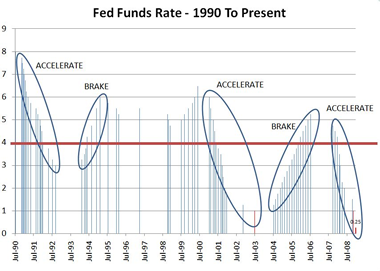
Go back to 1999-2000 and see what the Fed did. They are following the same pattern for 2005-06. If it ain't broke, the Fed will fix it... and good!
August 29, 2006 The Federal Reserve always acts on old information... and is the only cause of U.S. recessions.
December 5, 2006 Last spring I wrote about what I saw to be a sharp downturn in the economy in the "rustbelt" states, particularly Michigan.
March 28, 2007
The Federal Reserve sees no need to cut interest rates in the light of adverse recent economic data, Ben Bernanke said on Wednesday.
The Fed chairman said ”to date, the incoming data have supported the view that the current stance of policy is likely to foster sustainable economic growth and a gradual ebbing in core inflation”.

July 21, 2007 My guess is that if there is an interest rate change, a cut is more likely than an increase. The key variables to be watching at this point are real estate prices and the inventory of unsold homes.
August 11, 2007 I suspect that within 6 months the Federal Reserve will be forced to lower interest rates before housing becomes a black hole.
September 11, 2007 It only means that the overall process has flaws guaranteeing it will be slow in responding to changes in the economy... and tend to over-react as a result.
September 18, 2007 I think a 4% rate is really what is needed to turn the economy back on the right course. The rate may not get there, but more cuts will be needed with employment rates down and foreclosure rates up.
October 25, 2007 How long will it be before I will be able to write: "The Federal Reserve lowered its lending rate to 4% in response to the collapse of the U.S. housing market and massive numbers of foreclosures that threaten the banking and mortgage sectors."
November 28, 2007 FED VICE CHAIRMAN DONALD KOHN
"Should the elevated turbulence persist, it would increase the possibility of further tightening in financial conditions for households and businesses," he said.

"Uncertainties about the economic outlook are unusually high right now," he said. "These uncertainties require flexible and pragmatic policymaking -- nimble is the adjective I used a few weeks ago."
http://www.reuters.com/

December 11, 2007 Somehow the Fed misses the obvious.
fed_rate_moves_425_small.gif
[Image from: CNNMoney.com]
December 13, 2007 [from The Christian Science Monitor]
"The odds of a recession are now above 50 percent," says Mark Zandi, chief economist at Moody's Economy.com. "We are right on the edge of a recession in part because of the Fed's reluctance to reduce interest rates more aggressively." [see my comments of September 11]
January 7, 2008 The real problem now is that consumers can't rescue the economy and manufacturing, which is already weakening, will continue to weaken. We've gutted the forces that could avoid a downturn. The question is not whether there will be a recession, but can it be dampened sufficiently so that it is very short.
January 11, 2008 This is death by a thousand cuts.
January 13, 2008 [N.Y. Times]
“The question is not whether we will have a recession, but how deep and prolonged it will be,” said David Rosenberg, the chief North American economist at Merrill Lynch. “Even if the Fed’s moves are going to work, it will not show up until the later part of 2008 or 2009.
January 17, 2008 A few days ago, Anna Schwartz, nonagenarian economist, implicated the Federal Reserve as the cause of the present lending crisis [from the Telegraph - UK]:
The high priestess of US monetarism - a revered figure at the Fed - says the central bank is itself the chief cause of the credit bubble, and now seems stunned as the consequences of its own actions engulf the financial system. "The new group at the Fed is not equal to the problem that faces it," she says, daring to utter a thought that fellow critics mostly utter sotto voce.
January 22, 2008 The cut has become infected and a limb is in danger. Ben Bernanke is panicking and the Fed has its emergency triage team cutting rates... this time by 3/4%. ...

What should the Federal Reserve do now? Step back... and don't be so anxious to raise rates at the first sign of economic improvement.
Individuals and businesses need stability in their financial cost structures so that they can plan effectively and keep their ships afloat. Wildly fluctuating rates... regardless of what the absolute levels are... create problems. Either too much spending or too much fear. It's just not that difficult to comprehend. Why has it been so difficult for the Fed?

About Me

My photo
Michigan, United States
Air Force (SAC) captain 1968-72. Retired after 35 years of business and logistical planning, including running a small business. Two sons with advanced degrees; one with a business and pre-law degree. Beautiful wife who has put up with me for 4 decades. Education: B.A. (Sociology major; minors in philosopy, English literature, and German) M.S. Operations Management (like a mixture of an MBA with logistical planning)