READ ABOUT DETROIT AND SOLUTIONS TO ITS PROBLEMS. CLICK HERE.

Tuesday, January 23, 2007

Climate Rubbish

SEARCH BLOG: GLOBAL WARMING CORRECT

In a discussion about Climate Modelling at Real Climate (titled "The Physics of Climate Modelling"), here is my post regarding the Chinese paper (by Chinese physicists) of the strong possibility of global cooling and the reply by Real Climate's Gavin Schmidt.

Those darn Chinese are trying to use crude modeling to say that the next 20 years brings cooling instead of warming and that CO2 increases will not be that relevant.

Multi-scale analysis of global temperature changes
and trend of a drop in temperature in the next 20 years

http://www.springerlink.com/content/g28u12g2617j5021/fulltext.pdf

Obviously a Communist plot.

[Response: No, just rubbish. -gavin]

Comment by Bruce Hall — 22 Jan 2007 @ 7:25 pm

You have to hand it to Real Climate. They won't take rubbish from anyone... even the Chinese. Of course, they won't take a different point of view from anyone. Especially if it might endanger the anthropogenic-based-CO2-global-warming gravy train that seems to be arriving at government stations near you.

(Thanks to Dr. John Ray, Brisbane, Australia for source)

ALSO CHECK THIS OUT ... NEWS FROM THE RUSSIAN FRONT

Addendum

A further offline email exchange has convinced me that Gavin Schmidt, while an extremely intelligent and knowledgeable scientist, is not inclined to consider the perspective of those who don't align themselves with him, to wit:
I would actually expect the contrary. Dr. ABC is using well worn
talking points that have been dismissed in the mainstream for years.
This is not a genuine disagreement about anything substantial in
science. It is 'cuckoo' science - designed only to push real analysis
out of the nest and fool the onlookers (which it appears to have done).

If you are genuinely interested in what paleo-climate can and cannot say
about the present day situation, follow up on the links and let me know.
But Dr. ABC's arguments are just crap.
Obviously, I changed the name.
..

Monday, January 22, 2007

Departments of Transportation

SEARCH BLOG: TRAFFIC SIGNALS

Tired of traffic signals that work against you?

Contact your state's Department of Transportation and put some pressure on the system to get this problem fixed! If you live in an urban area, contact your county's DOT as well. And call your City Hall.

Do the "Search Blog" I recommended above. You'll see how much your government "cares" about you after you've paid your taxes. They really don't mind wasting your money or time... and damaging the environment to boot. After all, it's not "high visibility."

The Cost of "Fighting" Global Warming

SEARCH BLOG: GLOBAL WARMING

From Lubos Motl, physicist from Cambridge... this.

Ouch!

Australian Climate Views

SEARCH BLOG: ENVIRONMENT

Dr. John Ray posted this tomorrow... I'm just having a little fun with the date conventions.

There are several interesting items collected under this one link. (You may have to scroll to the top of the linked articles) Be sure to read the Chinese study on the coming GLOBAL COOLING... yup.

Over-Population

SEARCH BLOG: ENVIRONMENT

At what point is enough too much?

China decided some time ago that one child per family was enough... because they already had enough people. India has not yet come to that conclusion although its population is almost the same as China's.

Are we emptying the larder
as some think? This question has come up many times in the past and each time the answer by concerned scientists was that the world's ecosystem was about to collapse because of human pressure. The reality has always been that humans have either figured out how to obtain more food in a smarter way... for example fish farming... or have regulated local populations with famine and/or war.

India and China have shown that geographic constraints have not necessarily meant that the land could not support larger populations. And in the U.S., the population has grown to 300 million fairly obese citizens (and some thinner illegals) despite concerns of fewer individuals working in farming. We continue to hear reports of starvation in East Africa, but that's religious and political in origin.

So do we have a problem with over-population or not? Globally... no. Some areas... maybe. Some climatologists would like to see human population growth curtailed because they believe humans are going to cause the world to get warmer and some prime oceanfront property to disappear. But that is a debatable excuse for controlling human population. Besides, if that did happen, there would be more productive land for farming as the northern hemisphere experienced longer growing seasons. Moreover, in some nations, there is a trend toward declining population as greater life expectancy and greater wealth has refocused the population away from large families to pursue life's other pleasures. This is especially true in western Europe.

Still, there may actually come a time when enough is too much. We're just not there yet.

Al-Sadr Must Go

SEARCH BLOG: AL SADR

A week ago, I stated the obvious: it was time to eliminate Muqtada al-Sadr BAMN - by any means necessary.

It looks as if Iraq's Prime Minister Nouri al-Maliki has decided to face hard reality and withdraw his dubious support of al Sadr. Al Sadr is widely known to be the primary force behind sectarian violence in Iraq. It appears that the Bush administration has finally quit the pretense of simply providing "support" role to the Iraqi government. The can be no doubt that the administration's diplomatic, PR, image-conscious nonsense has been set aside and al-Maliki has been given an ultimatum: play ball or you're out. He is now playing ball.

Too little too late? We'll have to wait to see. Meanwhile, al-Sadr is probably twitching wildly trying to figure out how to save his butt and his power base. I've got a suspicion he may be able to do the former, but not the latter.
..

Sunday, January 21, 2007

Michigan Service Tax

SEARCH BLOG: TAXES

Also see:

Michigan Service Tax Concerns

More On Michigan Service Tax Proposal

Michigan Taxpayers To Receive More... Taxes [10/1/07 update]

Michigan is one of the few states that has not shared in the good economy of the past 3 or 4 years. The failing domestic automobile manufacturers have created failing automobile suppliers which have created failing ancillary support businesses which have created failing governmental budgets.

So how have governments responded? Well, the State of Michigan is looking to increase taxes. Gee, what a surprise!

The idea is to now tax services in addition to sales. Get a haircut and pay a service tax. Get a leak repaired and pay a service tax. Will we have to pay a tax to have our taxes prepared? That would be a real kick in the head.

Just a couple of questions:
  1. Is the administrative cost of collecting, reporting and submitting these new taxes going to be absorbed by businesses?
  2. Is the additional tax paid by consumers going to be absorbed by their budgets?
My guess is that the answer to both of these questions is "no." The results will be higher prices and lower volumes... and more companies that are struggling to survive shutting down.

The State believes it will not have to adjust its spending habits simply by putting more economic pressure on an already depressed economy. But that is pretty much the way government doesn't work all of the time.

Hey, I have an idea. How about a 6% sales tax on home sales. Oh, wait. Home sales are pretty much non-existent in Michigan, too. But in case a home is sold, how about a 6% sales tax and a 6% service tax (for agent services). That will fix the budget problems! After all, who could be a loser in that situation?

Rather than creating a whole new tax structure with whole new administrative burdens for both businesses and the state (don't you think there will be a whole new department just to administer this new tax?), perhaps a simple way is this:
Implement a two-year special, non-renewable, 1% increase in both the sales tax and income taxes. The government would have two years to work out a new budget and structure based on significant reductions in revenue (if the economy doesn't recover).
Otherwise, last one out, turn off the lights.

Saturday, January 20, 2007

Golf Etiquette Plays Well In Life

Being semi-retired, I have the option to take some time off during the day for a little exercise or recreation. Yesterday, I decided to go to the local golf dome and practice... a nice diversion from outside temperatures in the 20s (F).

The thing about golf is that it is at once an individual pastime and a social construct. Besides the rules of the game, there are rules of etiquette and courtesy. That's almost a lost part of our culture. Paramount is not talking or creating a distraction when your playing partner is preparing to swing at the ball. You do not talk, swing your club in his range of vision, walk around, wave your arms... you allow your playing partner the courtesy of focusing on the action of making the best swing he can.

Apparently, some people who play at golf haven't taken the aspect of courtesy to heart... especially at the practice range. I was at the assigned practice tee (they are assigned at the dome) when three men took position at the adjacent one... two older and one younger man. The younger man started hitting his practice shots and then began a non-stop, one-way explanation of how to swing the club. He was loud enough to completely disrupt my practice... one tries to think through the elements of a proper swing or analyze a mis-hit during practice... loud enough so that I couldn't focus on my practice.

After five minutes or so, I stopped, turned and just looked at him for a couple of minutes. He didn't seem to grasp that his loud prattling was a disturbance. So, I pointed out to him rather tersely that he could move away from the tee area to give his instructions to not disturb others. His response was a sarcastic "Is there some rule that says that?"

That's the thing about etiquette and manners: those that understand the etiquette and have the manners would never have to ask that question. Asking that question only shows that you are boorish, ill-mannered, selfish, discourteous, and uneducated.

I asked the golf dome operator to allow me to switch tees.


It occurs to me that this is the same phenomenon when people tailgate or cut in front of you when they drive. It's the same phenomenon when people block your view at an event in order to enhance their view. It's the same phenomenon when people talk loudly on their cell phone in a restaurant. It is a symptom of an uncultured, ill-mannered, poorly-taught society.

Perhaps something is lacking in our educational system... or in our homes.

Perhaps it reflects a society so focused on individual "rights" that it forgets about individual responsibility... to others.

Friday, January 19, 2007

Sad Day For Bloggers

SEARCH BLOG: MARTIN KELLY

Martin Kelly has decided to stop blogging from his home is Glasgow, Scotland.

He has written extensively in blogs for several years and is well known and respected around the world.

One can only hope that his circumstances will allow him to return to this arena in the future.

..

Thursday, January 18, 2007

Goodbye Hoover Dam?

SEARCH BLOG: GLOBAL WARMING

No, Hoover Dam has not sprung a major leak. Neither have the Tennessee Valley Authority dams. And China's Three Gorges Dam which is due to start generating hydroelectric power in 2008 has not run out of water. These hydroelectric dams are damning us all... according to an article in Scitizen.

What had sparked the reaction was my calculation that Brazil’s Balbina Dam was worse than fossil fuels in terms of greenhouse-gas emissions (Fearnside, 1995). A Canadian group had also shown that northern reservoirs can release greenhouse gases (Rudd et al., 1993). This was only the beginning of the long debate that continues to this day. Large emissions from water passing through the turbines of tropical dams have been have confirmed by direct measurements of methane release immediately below the Petit-Saut Dam in French Guiana (April et al., 2005) and the Balbina Dam in Brazil (Kemenes et al., 2006). Dr Philip M. Fearnside
Are you beginning to get the sense that no option for human civilization is either politically-correct or global warming-correct? Well, actually, this tells me that the U.S. should earn CO2 credits by shutting down hydroelectric plants and building old-technology coal-powered plants.

Are you beginning to get the sense that none of this is making a whole lot of practical sense?

The other day, I pointed out that a rather mundane elimination of traffic signal inefficiency would have real benefits for both the environment (not just CO2 reduction, but a host of toxic gases) and all of us individually by reducing our driving cost and time.

What I don't see from those who are demanding reductions in CO2 or other "greenhouse gases" are practical approaches. Rather it's all about creating penalties. Raise taxes. Create fees. Force uneconomical changes in the name of "risk management."

Okay, who is going to tell the Chinese that they can't start operating their new hydroelectric dam that was "clean" until this study said it wasn't?

(sssshhh... nuclear power the French were right)
..

Addendum:
Some related posts I came across after I posted the above.
http://climatesci.atmos.colostate.edu/2007/01/18/comment-on-climate-resets-doomsday-clock/#comments

http://mangans.blogspot.com/2007/01/doomsday-clock.html

Wednesday, January 17, 2007

Teachers Say No To The University

SEARCH BLOG: UNIVERSITY OF MICHIGAN and FREAKONOMICS

Detroit Mayor wants more charter schools for the city.

The problem is twofold:

  • The State has a cap on the number of charter schools
  • The Detroit Federation of Teachers (DFT) opposes changes related to charter schools
Here's how I see the problem: charter schools are a substitute for existing schools rather than a solution.

It's not that public schools are bad (which many in the city of Detroit are) or that charter schools are better (that may be the case for some). It is that the politics surrounding charter schools pits the old public schools against the new charter schools. It's an "all or nothing" proposition.

I have written several times about how the University of Michigan should put "its money where its mouth is." Charter schools are not what I meant since those enterprises are designed to "generate money where it mouth is."

Rather than competing with Detroit Public Schools, U of M... and all other area universities and colleges... should develop a voluntary, hands-on consulting relationship with individual Detroit schools... the key words here are "hands on" rather than "consulting". Simply "telling" the schools what the answers are is not the answer. Working with the schools is.

Detroit's teachers have it bad enough with a failing system. University charter schools will bury that system. Of course, the DFT needs to be visionary enough to accept a situation where it can adapt to working with outside agencies... and make appropriate changes to their political agenda.

*******

But let's not blame it all on the schools that can only do so much with what they are given. Perhaps it is time to own up to what a massive study of Chicago's schools revealed. In the book Freakonomics by Dr. Steven Levitt of the University of Chicago, his analysis of this study revealed some interesting and sobering facts.

The short version is this: "bad" schools are not necessarily bad because of class size or teacher's education or computer-student ratio. Bad schools share common traits such as gang problems, non-student interferrence, and lack of PTA funding... symptoms or indicators of underlying social issues. And then there are the startling correlations between student performance and parents' backgrounds and actions. One hint: among the factors that didn't make a difference in the study were:
  • the child's family being intact
  • the child's parents moving to a better neighborhood
  • the child attending "Head Start"
  • the child's parents read to him nearly every day
What does make a difference? I suggest you read the book. This is in chapter 5. But I'll give you a hint: one factor was the mother's age when her first child was born.

..

Tuesday, January 16, 2007

How To Reduce CO2 Emissions Now

SEARCH BLOG: CO2 and TRAFFIC SIGNALS

I've had forum discussions as well as private email exchanges with those who are concerned about CO2 increases in the atmosphere.

Some, but not all, are understanding of the situation enough to admit that the relationship of CO2 to climate change is complex because there are so many other potential factors... and the fact that CO2 increases have, historically, followed temperature increases... not vice versa. And then there is the matter of CO2 concentrations being much higher... as much as 16 times higher... in the past while earth was in cooling phases.

Be that as it may, most of the arguments to reduce CO2 fall into the "risk management" area. We can't afford to not reduce CO2 levels on the chance that it is the primary forcing factor in this climate change.

Fine. If you believe that reducing CO2 production immediately is critical, what should we do... now!

Well, here are some lifestyle changes that we could make:

  • Shut off unused rooms and close the heating vents in those rooms ... we do that now!
  • Replace standard light bulbs with spiral florescent bulbs ... we do that now!
  • Turn water heater temperature to a lower setting ... we do that now!
  • Turn winter heat setting to 67 degrees ... we do that now!
These are simple conservation efforts that we can implement with little effort or expense.

The next level of action becomes a little harder.
Replacing power plants that produce CO2
  • Use nuclear power instead? Well, that's something we can't do now! But conventional power plants are where the greatest CO2 production occurs.
  • Wind power? You all read about those rich, Democrat, environmentalists in Cape Cod who squelched that idea... would spoil the ocean view, you know.
Replace all vehicles with fuel-efficient vehicles:
  • Number of vehicles on the road: over 230 million
  • Median age of all vehicles: almost 9 years
That means it would take about 18 years to remove nearly all of the inefficient vehicles... if we stopped buying them now! Of course, much of the reduction would be offset by population and vehicle increases, but the rate of increase of CO2 production would be decreased gradually.

Replace all home heating and cooling systems with geothermal units.

Who will mandate that one? And they do need electricity from power plants to operate.
So, do we ignore the homeowner/consumer produced CO2, beyond turning down the heat and changing some light bulbs, and place all of the burden on businesses? Since so few of us own or work in businesses, that would work (feel the sarcasm here).

Here is something we can do now!
Contact your Department of Transportation and demand that their traffic engineers synchronize traffic signal progression! Have you ever read the city/highway EPA stickers on new vehicles ... something like 21 mpg city/29 mpg highway. That's because all of those extra hours you give up each week due to poorly timed signals also increases your cost of driving and CO2 production from unnecessary idling and acceleration. This can be corrected now!
If you want to make a big difference now, start raising the roof with your state, county and local Departments of Transportation and Traffic Engineering Departments. Poorly timed traffic lights are the single biggest, unnecesary producer of CO2 in the U.S.

..

We've Done Our Part

Click on image for larger view.

Monday, January 15, 2007

Foreign Criminals of the Day

SEARCH BLOG: IRAQ

Martin Kelly writes about "foreign criminals of the day" in his blog.

That is not the focus of this post. This is about what is occurring in Iraq.

The situation there is not quite like what happened in Russia when the old Soviet Union fell apart. But what is the same is that the collapse of the previous government provided a power-grab opportunity. In Russia, the power was grabbed by many in the former Soviet power structure, but underlying that was a "Soviet Mafia" power-grab. Corruption has been rampant and fairly public.

But Russia pales with the power-grabbing attempts in Iraq. With the entire power structure disbanded, the most corrupt elements in Iraq were set free to ply their trade without conscience. In addition to the thousands of criminals who were set free from prisons, the "protection" racketeers have had free reign to create their own "shadow governments" and "private militias". They play upon real or imagined religious differences among the populace to create animosity and fear and pit neighbor against neighbor so that they can "recruit" those who will depend on them for protection and leadership.

Most notorious is Muqtada al-Sadr. He brandishes a lethal mixture of distorted religion and mafia lack of conscience and has built his own private "army." He uses this with the cunning of a Hitler to create the fiction that he is a "great leader." He leads with the same evil and malice.

It was a major strategic error to have invited him into the rebuilding processes. He was a criminal and is a criminal. Whether or not he has a power base should have been irrelevant. The only reason he was included instead of being eliminated was that in today's "image conscious" world, the Bush administration did not want to give media ammunition to those who would call him "barbaric" or "unwilling to use diplomacy" or some such position of guilt-ridden criticism.

Using the term from a "diversity" group, al-Sadr should have been eliminated BAMN... by any means necessary. If there is to be a major improvement in the situation in Iraq, al-Sadr must be eliminated from the equation... BAMN.

In the world of conflict and power, there are two psychological weapons: warnings and examples. Warnings are often ignored; examples are heeded. al-Sadr is a true criminal who has been adept at making examples to consolidate his power. It's time to make an example of al-Sadr. Then others will heed the warnings.

..

Sunday, January 14, 2007

Situational Science - Addendum

SEARCH BLOG - GLOBAL WARMING

To help clarify for those who didn't pick up what I was saying in the prior post, this is from the NASA link at the right side of the page: NASA - Earth's Fidgeting Climate

The ant on the hour hand

"For the ordinary person, it's a common misperception that weather is not changing ... that last winter is about as cold as this winter and last summer is about as warm ... and the world is pretty much constant," Krabill said. "That's not true. The Earth has gone through and continues to go through cycles of warming and cooling. It's just natural."

This natural variability often shows an astounding degree of complexity, much of which remains poorly understood.

"We've only begun making (large scale) measurements in the last 100 to 150 years," Abdalati said. "And climatic processes happen on very different time scales. There are some, like ice ages, that are in the tens of thousands or hundreds of thousands of years long. An then there are atmospheric processes like weather, which happen on the scales of hours and days."

The Climate PuzzleOther climate cycles fall in between, such as the North Atlantic Oscillation mentioned above, which is thought to complete one cycle roughly every 20 to 30 years.

"And so you have all these processes mixed together that have been going on for thousands of years, and you're in the difficult position of trying to separate something very recent from the natural cycle without fully understanding what that natural cycle is," Abdalati said.

Left: Knowing where a relatively short interval of observation fits into the long-term pattern is a difficult challenge for scientists. A steady increase that appears to be a trend may be a trend, but it may also be a small part of a larger cycle.

Observing a system like climate that varies on several time scales -- some of which approach geological slowness -- could be likened to an ant watching the hands of a clock, "perhaps with the ant sitting on the hour hand," Abdalati added.

Seen in this context, scientists don't give much weight to the five-year snapshot of the ice on Greenland.

"You know, five years is a pretty short amount of time in glaciological terms," Krabill said. "To try to make inferences about 'Global Climate Change' in capital letters from a five-year period of time is a pretty risky business."

Other modern data sets are not much longer. The era of satellite observation is only about 30 to 40 years old -- a mere blink in climatological terms. And the widespread network of weather-measurement stations in the developed world is about 150 years old.

So, I guess "Anonymous" was right that I understated this issue as "not major." It doesn't deny that there has been recently observed global warming, but it does reinforce the need to understand that we don't really understand what is happening... and that those who haven't jumped on the anthropogenic-based-CO2-driven-climate-change-bandwagon are not necessarily "fringe skeptics."

What I have said and continue to say is:
  • over a short span, there is great uncertainty regarding the implications of global temperature change
  • any perceived relationship between longer term climate changes and human influences is still open to further investigation
There are very qualified scientists saying the same thing.
..

Situational Science

SEARCH BLOG: POLITICALLY CORRECT and GLOBAL WARMING

The major issue of "global warming" is not whether it is or is not occurring (although one could ask if a 30-year downward trend followed by the current 30-year upward trend is a "trend" or "oscillation"), but what are all of the human influences on any climate change and what can and should be done to manage it.

A couple of the issues I have "discussed" at other sites include questions about the accuracy of the data from decades ago which is being compare with today's data, the consistency of data being collected over the past decade or even day-to-day, and the influence of land use changes, as the human population has doubled, on regional climates... and, hence, the impact on the data that would have been gathered from those regions as the land uses changed.
Most comments in response to those questions are that the questions are totally irrelevant because there is a "consensus".

For those who failed English, "consensus" does not necessarily mean "unanimity" or even "agreement". The way it is used in this arena simply means "the judgment arrived at by most of those concerned "... in other words, it represents a majority of opinion.
Consensus, therefore doesn't necessarily mean "all the facts." In science, at best it means that there is "evidence." It also means that there is some degree of "disputing evidence." Those who dispute the "consensus" must do so on the basis of rigorous study, not faith such as those who want "intelligent design" considered as an alternative to evolution. The disputer or skeptics or minority must have measureable, test-worthy alternative positions.
This is not necessarily the case with economics or social sciences or politics. Here, "expert" opinion is sometimes all that is relied upon... by those who feel comfortable with that opinion. Selective facts are the basis for opinions and, often, policies. Thus, those who have selected facts from consensus positions are those who want to disregard other facts as they form their opinions. Here, in the political arena, the "consensus" on global warming is interpreted by some as "we must take immediate and drastic action now to avoid disaster within the next 50 years."

Some responses are even less well thought out than a simple dismal of the questions as being irrelevant. From the Economist's View:
*****

Bruce Hall;

I guess you're in favor of "situational science".

*****

Ah, "situational science"....

It's science if "my" scientists interpret data one way and situational science if "your" scientists interpret it another.

That's about the same as saying "peer reviewed" is only valid if I accept the pronouncements of "my" scientists, but "peer reviewed" means "irrational skeptics" if they are "your" scientists.

Let's not get into the "Intelligent Design" arena which is not a matter of scientific interpretation of data... or even different data sets... but rather "belief" versus "scientific methodology".

It's those kinds of insinuations that reflect the "religious ferver" of the "true believers" of anthropogenic-driven global warming... and leads to the next step of demanding that billions of dollars be spent in a unilateral (U.S./Europe - "developing" world exempt) effort to "undo" man-made global warming now... because we can't wait for the data to be thoroughly examined and move from the football-poll "consensus" approach to "scientific agreement." Remember, you are supposed to be addressing issues of "hard science", not economics as the basis for making economic decisions.

"Situational"... indeed!

*****
I'm fairly certain that the comment about "situational science" came as a result of the "Doonesbury" comics... see Jan. 14, 2007. It all goes back to my earlier post.
..

Saturday, January 13, 2007

Open Letter to Alan Mulally

SEARCH BLOG: AUTOMOBILE

The Detroit News writes that Ford Motor Company's restructuring is ahead of schedule. CEO Alan Mulally is quoted as saying:

Mulally has outlined a plan in recent weeks to merge several regional Ford divisions around the world into a single, global Blue Oval brand, according to interviews with Ford executives this week.

On Friday, Mulally hinted at his frustration at finding the Ford brand was actually six or seven different brands scattered around the world -- each with its own product lineup. He pointed to Ford of Europe's new Mondeo sedan, which was recently featured in the James Bond movie, "Casino Royale."

"Why aren't we driving that here?" he asked. "Hello! It's a great car."

Mr. Mulally is a sharp businessman, but he is new to the auto business. So I will offer two words for him: "Merkur" and "Contour".

The idea of using European designs and platforms in the U.S. is not new. Some European designs are quite fascinating. The European Focus is one of them. The trick is to really understand the differences in U.S. and European markets and then make sure that the "Americanization" of European cars doesn't result in a product that doesn't fit or excite. The Merkur was a "luxury" brand in Europe, but offered little more than an expensive upgrade to the Taurus. The Contour was an Americanization of the Mondeo that looked like a squeezed down Taurus or a bloated Escort. It was marketed as a family car, but was too small for American dimensions. It was a competent and unexciting misfit.

Let's hope that the consolidation of brands is done more intelligently this time.

Friday, January 12, 2007

Fervor Fever

SEARCH BLOG: GLOBAL WARMING and ECONOMY

In a recent post at Economist's View, I suggested that before everyone committed to spending hundreds of billions of dollars to reduce CO2 production because it causes global warming, that they look at the volumes of work that question both the causality connection between CO2 and climate change, and that they consider that the data itself may be incorrect or biased. I provided several links to Colorado University's CIRES effort.

The responses are typical of what one might expect from recent religious converts:

  • Mr. Hall, why don't you just can it?

    Sorry to be so rude but you're shouting in an empty room.

  • Bruce Hall is right about one thing, the NOAA has been political under the anti-scientic (sic) barrage of the Bush administration. This barrage has undermined the integrity of every public institution that relies on science to do its work....the EPA, NASA, NOAA, NIH, the list goes on.

    http://www.realclimate.org/

  • We got the answers from reading the peer reviewed science, Bruce. Over the years a multi-disciplinary scientific consensus built up that the earth is getting warmer; most of the warming observed over the last 50 years is attributable to human activities; the warming will continue and indeed accelerate as long as our greenhouse gas emissions continue. In short this is a problem and we ought to do something about it.

    The paper by Pielke (Sr.) that Bruce pathetically cites in hopes of stirring doubt about the validity of the overwhelming multi-disciplinary scientific consensus calls for improvements in methods of measuring the earth’s temperature. Great. Improvements are welcome. We can watch the temperature soar with increased accuracy.

    For a profile on Pielke Sr. and Jr. see http://sciencepolicy.colorado.edu/admin/announcement_files/1020-uploaded/announcement-1020-1906.pdf

    Of course the article tries to create a false choice. We need to adapt to the climate change that is unstoppable no matter what we do to try to prevent it and we need to try to prevent what we can.
My last response was:
Odd how "peer reviewed" only seems to apply to those who buy into anthropogenic global warming scenarios. Those who disagree or suggest examining data in a different light based on their "peer reviewed" work are deemed "climate skeptics."
Quran 2.39. But those who reject Faith and belie Our Signs, they shall be companions of the Fire; they shall abide therein.

Religous fervor.

Thursday, January 11, 2007

Clyde's Vision

SEARCH BLOG: IMMIGRATION and DIVERSITY

Apologies in advance for this long-winded and contentious post. Immigration and diversity are two really... really... volatile issues in American and European societies. Clyde Wilson, quoted below, is is a professor of history at the University of South Carolina. His views are toward one extreme... the opposite of those who see immigration as a process that strengthens America.

From Martin Kelly in Scotland quoting Clyde Wilson:

(Note: Martin left out the first two paragraphs which are shown here)
According to the census bureau a new “American” crossed the border to join us once every 27 seconds in 2006. The unpunished intention of our rulers to replace us with foreign coolie labour tells us that as a society we are completely lacking any sense of a past or a future. Nobody who has any conception of the work, wisdom, virtue, sacrifice, and heroism that went into the making of this country could possibly approve of the transformation that is taking place.

That is not too surprising, though. Since 1848 the descendants of the British colonists who created the U.S. have been a dwindling part of the population. How many Americans are there today with such an inheritance? One in twenty? One in fifty? In fact, those of us who fit that description are mostly despised “rednecks,” while late-comers glorify themselves as a “nation of immigrants.” Can there be any other example in history of a core population being replaced by newcomers while retaining its name? A country without cultural continuity can only be held together by abstractions—deceitful slogans without any human content—and by constant fear of enemies. Orwell had it right.

People who are ignorant of and indifferent to their background (and those who misrepresent it for present-time advantage) are barbarians—that is, people without a civilized culture. Our leaders view American society as a commercial enterprise in which profit and consumption are the only values. After all, a customer is a customer and yesterday is just a past opportunity for sales. Who worries about where the customer comes from? As a society we have lost sight of the truth that economic abundance is not a self-perpetuating technical trick but rests ultimately on mental and moral qualities. Mental and moral virtues are declining in power and the evidence is already there of the loss of prosperity that necessarily follows.

But a society without ancestors (bastards?) is not the worst of the American decline. The worst is a lost future. Our forebears felled forests, planted trees, built houses, fought wars in the consciousness that the benefits would accrue to their descendants more than to themselves.

A people who took any thought to the welfare of their grandchildren, much less future generations of their own blood, could not possibly tolerate the ongoing destruction of our human environment by politicians and plutocrats. Burke defined civilization as the awareness of the interconnection of past, present, and future. Conservatism was the preservation of the essence of civilization amidst the inevitable flux and chaos of existence.

But I can’t worry about that right now. I have to watch Oprah and then go to the mall. Only in America.

In an email exchange with Martin Kelly, here is some of what I wrote:
"Cultural values" are one of these somewhat ephemeral "riches" of a society that modern economics seems to conveniently ignore. What is the "profit" margin or a cooperative and friendly neighborhood? What is the cost of distrust. We know the former has value and the latter has cost, but cheap labor and cheap goods seem to be far more relevant to the economist's thought process (although I'm sure someone, somewhere has tried to quantify that). Nevertheless, we all sense when "cultural values" are strong and vibrant and when they are neglected and weak, whether or not we can place an economic value on them.

Perhaps the nature of what constitutes our "cultural values" is a little vague and that's why they are so difficult on which to find common perspective. The economist would look at U.S.A.'s overall Gross National Product or unemployment rate or stock market and say that things have never been so prosperous. Look how immigration has kept the price of products, despite such rare(?) abuses as meat from the Swift plants that used illegal aliens to contain costs, down to a level where even the poor can afford a good cut of beef. See how trade with China has freed people from the drudgery of those dingy factory jobs. Look how ethnic diversity has made our cities so vibrant with their Chinatowns and LIttle Vietnams and great Indian and Mexican restaurants and new mosques that nurture the spiritual side of our neighbors. See the richness of all of this change!

Yet so many feel an alienation with what they see around them. Will those new neighbors rally together for the common good if there is a threat, natural or political, to our nation? Will that vibrant economy provide social and emotional support to those who are weak and needy or simply focus on corporate profits and new casinos? I think that what may be slipping away is the Christian/Humanistic philosophy... the focus on others' welfare... that was brought to America by its UK ancestors. Sure, there are still neighborhood barbeques and there are still many who respond when a hurricane destroys a city. But, increasingly, there seems to be a cynicism and selfishness and "I got mine" attitude as commerce becomes the central, the core, value of our culture. Increasingly, "diversity" becomes "divergence."

Perhaps I overstate the issue.
Well, actually, I know I overstate the case on both sides. The "richness" of the change is superficial in many respects. The ethnic commercial districts are certainly positive factors in our cities. Last fall's trip to San Francisco demonstrated that magnificently. But the Mexican ghettos in the southwest and west attest to the destructive aspects of unmanaged immigration.

The U.S. always had immigrant groups that clustered for awhile and then disbursed and became "assimilated" into the general population. It was really a matter of survival for most. There were no efforts by the existing community to offer information in German or Polish. Learn English and fit in was the strategy... but maybe not so much now.

America is changing and it is difficult to know whether, in the long run, if it is for the better or the worse. One thing is for sure, it won't be the "culture" of the 19th and 20th centuries with its predominantly Western/Central European heritage... but it doesn't have to be fragemented, though it very well may be.

See here.

..
Where Did The Cold Go?

SEARCH BLOG: CLIMATE

Apparently New Zealand.

  • Rainfall: Well below normal in the north of both islands; above normal in the east, especially Canterbury
  • Wind: More frequent cold southerlies
  • Temperature: One of the coldest Decembers in the last sixty years
  • Sunshine: Sunnier than normal in the north of both islands
So, NOAA's fuzzy statement about global warming only means "part of the globe?"

Wednesday, January 10, 2007

GIGO

SEARCH BLOG: GLOBAL WARMING

From the blog Economist's View:

January 10, 2007

NOAA: Global Warming Contributed to the Warmer than Usual Temperatures in 2006

For the first time under the Bush administration, the NOAA acknowledges global warming is real.

I commented:

From Colorado University, Cooperative Institute for Research in Environmental Sciences

January 8, 2007
CIRES, NOAA to Double 3-D Global Climate Record
Scientists from CIRES and NOAA will build the first complete 20th Century database of global weather maps—a major next step to improving computer models of past and future climate.

*******

But you should read this from Dr. Roger Pielke, Sr., et al before you comment.

http://blue.atmos.colostate.edu/publications/pdf/R-321.pdf

"Nothing is ever as simple as it first seems."

GIGO

This Blogger Is Interesting Even If You Don't Understand Him

SEARCH BLOG: SCIENTIST and PHYSICS

I've added a link to another "blogspot" blog by Luboš Motl. It is called "the reference frame"; I just call it "Motl's Blog" on the links along the right side of this page.

He is what you might call an "eclectic physicist" although his professed passion is "string theory." I never got much farther than "silly string" so he doesn't always talk my language, but his language is interesting. Give it a try.

Oh, and how does he get all of that neat stuff pasted all over his blog? It's like an explosion in a picture studio. The bigger mystery is how he has time to write all of that stuff.
..

Tuesday, January 09, 2007

Conclusions from Climate Science

SEARCH BLOG: CLIMATE and GLOBAL WARMING

Yestereday, I introduced the weblog "Climate Science" written by Dr. Roger Pielke, Sr. of the University of Colorado.

Much of what is written is difficult for the average layman to decipher, but Dr. Pielke has summarized the conclusions for us here:

The Climate Science Weblog has clearly documented the following conclusions since July 2005:
  1. The needed focus for the study of climate change and variability is on the regional and local scales. Global and zonally-averaged climate metrics would only be important to the extent that they provide useful information on these space scales.
  2. Global and zonally-averaged surface temperature trend assessments, besides having major difficulties in terms of how this metric is diagnosed and analyzed, do not provide significant information on climate change and variability on the regional and local scales.
  3. Global warming is not equivalent to climate change. Significant, societally important climate change, due to both natural- and human- climate forcings, can occur without any global warming or cooling.
  4. The spatial pattern of ocean heat content change is the appropriate metric to assess climate system heat changes including global warming.
  5. In terms of climate change and variability on the regional and local scale, the IPCC Reports, the CCSP Report on surface and tropospheric temperature trends, and the U.S. National Assessment have overstated the role of the radiative effect of the anthropogenic increase of CO2 relative to the role of the diversity of other human climate climate forcing on global warming, and more generally, on climate variability and change
  6. Global and regional climate models have not demonstrated skill at predicting climate change and variability on multi-decadal time scales.
  7. Attempts to significantly influence regional and local-scale climate based on controlling CO2 emissions alone is an inadequate policy for this purpose.
  8. A vulnerability paradigm, focused on regional and local societal and environmental resources of importance, is a more inclusive, useful, and scientifically robust framework to interact with policymakers, than is the focus on global multi-decadal climate predictions which are downscaled to the regional and local scales. The vulnerability paradigm permits the evaluation of the entire spectrum of risks associated with different social and environmental threats, including climate variability and change.

Humans are significantly altering the global climate, but in a variety of diverse ways beyond the radiative effect of carbon dioxide. The IPCC assessments have been too conservative in recognizing the importance of these human climate forcings as they alter regional and global climate. These assessments have also not communicated the inability of the models to accurately forecast the spread of possibilities of future climate. The forecasts, therefore, do not provide any skill in quantifying the impact of different mitigation strategies on the actual climate response that would occur.

(Highlighting is mine)

Monday, January 08, 2007

Climate Science

SEARCH BLOG: CLIMATE

For those of you interested in climatology, you may want to visit this blog by Roger Pielke Sr., senior scientist at the Pielke Research Group, Colorado State University.

Then you can read my earlier post about a serious automotive advancement by General Motors and my not-so-serious comments.

..

150 MPG - Not Good Enough

SEARCH BLOG: AUTOMOBILE and CO2

From The Detroit News:

The awards ceremony was just a prelude to GM's stunning midday press conference, when Wagoner and Vice Chairman Bob Lutz showed off the Chevrolet Volt concept car.

The sporty Volt represents GM's most ambitious effort to close the gap with Toyota and Honda in alternative-fuel technology.

While Toyota and Honda dominate the market for hybrid-powered vehicles, GM is placing a big bet on the Volt's "e-flex" system that features a chargeable lithium-ion battery and a small gasoline engine that generates electricity.

Lutz said the Volt's future rests on improvements in battery technology, but said it was "reasonable" to expect a production version could be available by 2010.

He couldn't resist ribbing GM's critics in the environmental movement, some of whom lay the blame for global warming on the automaker in the documentary, "An Inconvenient Truth."

"A GM electrical vehicle is an inconvenient truth," Lutz said, with tongue firmly planted in cheek.

Well, there are just two things wrong with that:
1. The Volt, if it goes into production, will still use gasoline, and
2. The electricity used to recharge its batteries will come from power plants
You might well ask, why is that a problem if the car gets 150 mpg? It's not a problem as far as I am concerned, but you have to realize that this car will still produce CO2!

A small amount from the engine, you say. True, but unless it is plugged into an electric grid with a nuclear power plant, it will contribute to CO2 production where the electricity is being generated. And you all know what that means... global disaster! We've been assure of that by sources like RealClimate.org. I really like the picture at the top of their site that shows the sun really close to the earth... about to consume the earth in fire, so it seems. Very dramatic, don't you think? Sorry, I digressed.

Why can't someone just design the perfect car? Maybe solar powered, with optional mast and sails, that is amphibious if there is a river nearby.

Hmmmmmmmm.

Sunday, January 07, 2007

War In Iraq - Cost-Benefit Analysis

SEARCH BLOG: IRAQ and ECONOMICS

Yesterday, I commented that the discussion at Economist's View had gone into a rather strange proposition that we should leave Iraq immediately based on costs. My position was that wars are always political, not economic, and not subject to economic rationale.

One person commented:

i really don't see what you're driving at, but i will say, once again, that we can subject war, like so many aspects of life, to a rational cost-benefit analysis (now we're into economics). In order to do so, we need to be able to sum up the costs and the benefits. exactly what is your problem with trying to understand the cost side of the equation? that it might reveal just how deranged this whole little piece of adventurism is?
My "extreme economics" reply was:

For those who continue to insist that " will say, once again, that we can subject war, like so many aspects of life, to a rational cost-benefit analysis (now we're into economics)"... would you then say that if the war could be conducted without the death or injury to any U.S. soldier (from direct fighting... since there will always be non-combat injuries in any endeavor) that it would qualify as a highly successful war... on a cost-benefit basis?

If so, there are several military scenarios that would achieve that. However, I would hasten to speculate that those solutions would be condemned as "barbaric" by the rest of the world. Nevertheless, on a cost-benefit basis (from the soldier perspective) they would be a no cost-infinite benefit solutions.

And, on a time-cost basis, the effort could be conducted in a matter of days with no residual fighting in the area. That is a significant cost savings as well.

Are we getting the picture here? From a cost-benefit basis... relative to soldier deaths/injury/rehabilitation... a long-range nuclear solution is the most economic. The war is conducted by software and hardware... no ground, naval or air troops required.

Very cost-benefit effective. Objective (wipe out any potential enemy) achieved.

Now I'd say the political costs would be extremely high, but as demonstrated from previous posts, this is all about economics, so politics is irrelevant.

Hmmmmm.

So, am I advocating nuclear warfare? Of course not. I am proposing that economics and politics have different ways of dealing with the world and either taken to its extreme is likely to not make a lot of sense. Trying to apply business cost-benefit analysis to warfare is taking economics to its extreme... nonsense.

Saturday, January 06, 2007

The War in Iraq Costs Too Much - Let's Leave Now

SEARCH BLOG: IRAQ and IRAN

That's a pretty succinct summary of that proposition on the table at Economist's View.

Of all of the reasons to simply leave, that one seems a little hard to accept.

Wars are dirty things fought for many reasons... some noble and some shameful.

Sometimes the information available at the beginning of a war is revised by the end of the war... not because the information was lies at the beginning, but because it was wrong or partially wrong because good information was difficult to obtain.

Sometimes wars are won, but the peace is lost... not because the military is incapable, but because politics makes up impossible rules for the military to retain its victory.

Sometimes we are for the war before we are against it... we thought it would be like a TV mini-series that runs for a couple of weeks and then it's over, and now we are tired of the same plot.

Sometimes we believe we are being noble and self-sacrificing by going into war... and then we don't like the reality of the sacrifice and are willing to be less noble so that we can quit.

Sometimes we are philosophically against war of any kind... and all of the negative aspects of war gives us a sense of moral superiority to oppose it.
But of all of the reasons for getting out of a war, the crassest is that "it costs too much."

ADDENDUM

The ranting continues at Economist's Blog (90 comments at last count) and most of it has nothing to do with the original post about the VA having a difficult time facing it because of the number of soldiers being injured. The number of injuries from the war has been overstated in the original post and, conveniently, the fact that the VA will only have to treat a relatively small portion of the total injuries (because many are handled either in Iraq or at Walter Reed... has been ignored. However, addressing the personal insults addressed to anyone who doesn't believe that cost is the only consideration, I have posted the following there:

I see the steam is still billowing.

The point I was making about the VA is that it has a large budget, but the staff is stretched because so many veterans use the facilities for treatments that could be provided closer to their own homes by either hospitals, clinics or family doctors... if the VA had a system in place like medicare for those purposes.

Then more personnel would be freed up to work with soldiers who needed continued treatment... from Iraq who were among those not completely treated in Iraq... or those from any previous military-related injuries.

The rest of the ranting here is like listening to protesters who believe the louder they shout the more meaningful their sounds.

BTW, I'm satisfied that my military service was honorable and I can call myself patriotic. Even if you haven't done so and want to say that my support of the war effort is wrong, I won't call you unpatriotic. Your concern for what is happening is reasonable. But, while there are economic consequences surrounding war, it is not about economics... it is about politics... always has been and always will.

So trying to justify stopping a war because of economic consequences is blowing into the wind. War is about politics and will. If either of those falter, then the war is abandoned. If you are against the war, then it is enough to just say that and that your political efforts are aimed to end it immediately. There will be consequences, both economic and political in the long term for an immediate pull-out... and I don't believe even Nancy Pelosi will vote for that.

Friday, January 05, 2007

Class(ic) Struggles

SEARCH BLOG: TRIBALISM or DIVERSITY

Pat Buchanan offered this up yesterday (his site may be having problems - 1/5):

In the presence of [ethnic] diversity, we hunker down. We act like turtles. The effect of diversity is worse than had been imagined. And it’s not just that we don’t trust people who are not like us. In diverse communities, we don’t trust people who do(n't?) look like us.
Harvard professor Robert D. Putnam
Two years ago, I wrote a little piece on tribes... tribalism, if you will... and territorial imperative. It's one of those aspects of human organization that seems to be ingrained in us. It's partially about how people look, but even more about how they behave. People who do not share our behaviors are people we don't trust and don't want around us. So western Europeans distrust eastern Europeans (although they might look very similar naked) because behaviors (external manifestations of values?) are different.

Othello may have been an attractive curiosity to Venetians, but millions of illegal immigrants into southwestern U.S. are viewed as an invasion... and they know they are viewed with antagonism so that reinforces their behavior of ethnic isolation which reinforces the antagonism.

Unfortunately, the modern gospel of diversity that is so ubiquitously preached... pounded... at us in the press and other media, magnifies the differences. The old idea of assimilation has been pushed aside in favor of emphasizing differences. This simply plays into distrust... and bad social policies. Joining used to be a valuable goal. Now separation is seen as valuable... we need the (fill-in-the-blank) perspective.

Instead of a national identity, we seek divergence... and we get fragmentation.

Thursday, January 04, 2007

Freakonomics

SEARCH BLOG: ECONOMICS

Steven D. Levitt, professor of Economics at the University of Chicago, make economics interesting in a weird way in his book "Freakonomics" which was written with Stephen J. Dubner, a writer for the New York Times and The New Yorker.

My oldest son and his wife, Steven and Sara, who constantly challenge my thinking, gave me a copy for Christmas... and it is a really fine gift.

  • What do schoolteachers and sumo wrestlers have in common?
  • How is the Ku Klux Klan like a group of real estate agents?
  • Why do drug dealers still live with their moms?
Weird, but fun to read.

..

Wednesday, January 03, 2007

Teleparallel superspace in eleven dimensions coupled to supermembranes

SEARCH BLOG: PHYSICIST and ECONOMIST

After watching a "watered-down" explanation of how 11 dimensions elegantly explains ... well, everything, I was curious how physicists really talk about this mind warping concept. Naturally, there was a very clear abstract:

We present a superspace formulation of N=1 eleven-dimensional supergravity with no manifest local Lorentz covariance, which we call teleparallel superspace. This formulation will be of great importance, when we deal with other supergravity theories in dimensions higher than eleven dimensions, or a possible formulation of noncommutative supergravity. As an illustrative example, we apply our teleparallel superspace formulation to the case of N=1 supergravity in twelve dimensions. We also show the advantage of teleparallel superspace as backgrounds for supermembrane action.
Okay, maybe someone missed a dimension in the video I watched. But now that these physicists have determined that 12 dimensions really explain everything better than 11, there is no need for talking anymore about how things really work. No wonder everyone respects physicists and no one understands economists. I've already booked a cruise through the 7th dimension through Yahoo!

New Look for the New Year

I hope this revised look helps make the reading easier.

Taking a Bad Idea to the Next Level

SEARCH BLOG: ENVIRONMENT and CO2

Yesterday, I commented on what I perceived to be a bad economic idea... taxing CO2 production. While I am not "anti-tax" in the sense that I am against pooling resources for the local, state, or national interest... I am against the notion of taxes to achieve political agendas.

The idea of taxing CO2 is political to its core. As James Killus puts it: "Where do you get off deciding how much CO2 gets put in _our_ air?" In other words, I have a notion that you might be harming my world sometime in the future, so you have to give up living the way you do.

Well... why bother with taxes at all?? Let's get right down to business:

  • ban all natural gas (and propane) and oil furnaces
  • ban all natural gas (and propane) appliances
  • ban all combustion engines
  • ban all combustion power plants
  • ban all fireplaces, barbeques, and campfires
  • ban all excess people (China has a good policy) ... too much exhalation
  • ban all future paving and building on any undeveloped land
  • ban clearing any forest for other land use
  • ... feel free to add your own bad idea....
See, that will keep your CO2 out of my atmosphere!

And who said fascism is a bad form of government?

..

Tuesday, January 02, 2007

Bad Idea of the New Year

SEARCH BLOG: ECONOMY and ENVIRONMENT

From the Economist's View:

Almost everyone except the likes of ExxonMobil, US Vice President Dick Cheney, and their paid servants and deluded acolytes understands that when humans burn hydrocarbons, carbon dioxide goes into the atmosphere, where it acts like a giant blanket, absorbing infrared radiation coming up from below and warming the earth.

Likewise, almost everyone understands that while global warming might be a much smaller or larger problem than existing models suggest, this uncertainty is no excuse for inaction. ...

Finally, almost everyone agrees that governments, non-profit institutions and energy companies should be spending far more to develop technologies that generate non-carbon-emitting power, that remove it from the atmosphere to forests or oceans, and that cool the earth by reflecting more of the sunlight that lands on it.

Clearly, the world's rich countries should carry the burden of dealing with climate change. After all, they could take an easy, emissions-intensive path to industrialisation and wealth. Today, China, India and other developing countries cannot, and it would be unfair to penalise them for that. ...

Economists like to think of things in terms of prices. And when economists see behaviour that has destructive side effects, we like to tax it. Taxation makes individuals feel in their wallets the destruction they are causing. ...

But it has to be the right tax. An SUV going 10 miles in the city and burning a gallon of gasoline pumps about three kilograms of carbon into the atmosphere. Should the extra global warming tax be US$0.05 a gallon, US$0.50 a gallon, or US$1.50 a gallon? ...[T]he size of the tax hinges on a question of moral philosophy: How much do we believe we owe our distant descendants?
Wow. There are so many faulty assumptions, it should be apparent to almost everyone that this idea is unworkable. But just in case you don't see the problems, here is the short answer:
  • Almost everyone excludes a very significant portion of the scientific community that does not accept the notion of an anthropogenic climate change model
  • Almost everyone excludes a large portion of the economic community that believes taxation is not needed to cure a questionable problem.
  • Almost everyone excludes a large portion of the world that believes China and India don't require a free ride regarding any global actions that might be enacted.
  • Economists are generally not in the value judgment business regarding perceived destructive behavior and will often find that the law of unintended consequences rules over well-intentioned legislation and taxation (is outsourcing destructive behavior... ask those who lose their jobs?) Is hamstringing our economy going to solve a perceived global problem or only create a U.S. economic problem?
I suggest you check out the link in yesterday's post if you haven't done so already. That's the long answer.

Monday, January 01, 2007

Climate News from Cambridge, Mass.

SEARCH BLOG: GLOBAL WARMING

Passing thoughts along from Dr. John Ray who copied Dr. Lubos Motl.

Read THIS if you have time to actually think... and are inclined to do so. An interesting way to start the new year.

..

Rose Bowl


GO BLUE...

blew it....

Sunday, December 31, 2006

Goodbye 2006

Mileposts.

We like to know where we are. What progress have we made? What are things like now versus sometime past?

Year-ends and new years are points to plant mileposts.

Is our effort in Iraq showing more or less results? Is immigration a bigger or lesser issue? Is the world warmer or cooler than last year? Is the economy growing or facing disaster?

So many mileposts; so little agreement. Ah, that's why there are so many blogs.

Happy New Year.

Saturday, December 30, 2006

Saddam Gone... Legacy Lives On

SEARCH BLOG: HUSSEIN

Saddam Hussein standing on the gallows... a surreal video. No emotion, no defiance, just a strange look of curiosity? His life is over.

Perhaps Iraq will become a stable nation led by a government that serves rather than threatens. It won't be because of Hussein's legacy of violence and fear. It will be despite his legacy.

..

Michigan Proposal 2

SEARCH BLOG: AFFIRMATIVE ACTION

Michigan voters approved the removal of racial and gender preferences in college admissions by 58% to 42%. This was temporarily reversed by an agreement to delay implementation until the Fall of 2007. Yesterday, the 6th U.S. Circuit Court of Appeals overturned the lower court and said, in effect, no mas.

I would not be surprised if the challenges continue. It is far simpler to grant racial and gender preferences than address the root causes for lower educational performance that preferences try to overcome. It is time for universities to work with communities like Detroit to establish efforts that lead students to better preparation for college. At the same time, figure out ways to provide more aid for lower income students who are willing to prepare themselves.

The dysfunctional view of the world held by poor minorities has to be addressed. It is a view that is perpetuated by a subculture focused on immediate gratification rather than preparation. Perhaps it is because those who hold that view simply cannot see a better future, so the focus is getting whatever satisfaction can be obtained immediately. Perhaps it is a dysfunctional "pride" in clinging to a dysfunctional "culture." Perhaps it is too many single parents with too many children.

Whatever the reasons for poor academic preparation, it is time for universities and communities to provide "hands-on" programs for those who are economically disadvantaged but willing to do the work it takes to compete for entry and success at the college level.

This does not include "slipping in the back door" with preferences.

Friday, December 29, 2006

Uninvited Guest

SEARCH BLOG: ENVIRONMENT

We spent the day at my second son's home along with my two other sons and my brother's family. It was the last chance to spend time with my oldest before he and his wife head back to San Francisco.

It was pretty easy to see the tiredness in their eyes. Everyone wants to spend time with them including relatives in Ohio a few hours away. So, they have dutifully traveled and spent time with everyone possible... family and friends... until all they really want is to sleep in their own bed.

Tomorrow they have the 4-1/2 hour flight back and then a whole day to relax before they fly to Los Angeles for the Rose Bowl game. Did I mention they were tired already?

Well, they are out for yet a few more hours tonight visiting the last group of friends on their list, so my wife and I came home without them to find an uninvited guest in our screened porch... a red-tailed hawk. It had flown right through a screen panel adjacent to the house; I guess it was chasing a chipmunk or squirrel and wasn't paying a lot of attention. When we turned on the interior lights, it became confused and flew into the glass door that enters into the porch.

We watched to be sure it wasn't injured and then I slowly went into the porch. The hawk scooted into a corner trying to hide. I opened the screen door leading to the outside, but it immediately ran between the screen door and another screen wall... and refused to move. Not wishing to find out how sharp its talons were, I got a broom and moved to the opposite side of the screen door from the hawk. It shuffled a bit and then ran along the perimeter away from the screen door. I followed slowly and it ran along the perimter back toward the house. I followed slowly again. At this point it was getting a bit too rattled so it tried to fly up and away. But there is the matter of the ceiling. It didn't have enough speed to injure itself, so it settled down to the floor. The door opening to the outside was in front of it. A little step by me toward the bird was all it needed to rush out the door and fly away into the night.

We had our little excitement with a non-human neighbor and then an assessed the damage to the screen panel. It looks like about 1/2 hour of repair work and neither the panel nor the hawk will be the worse for wear.

Living in the suburbs makes it easy to forget that we share space with other animals trying to make a living. This was a small reminder.

..

Thursday, December 28, 2006

Mosquitoes, Netting, and DDT

SEARCH BLOG: ENVIRONMENT

In a recent exchange in Economist View, a young lady from Harvard named "anne" provided these words of wisdom in the middle of a debate about the use of DDT versus mosquito netting to control malaria in Africa:

The argument (that DDT is more effective than netting in controlling malaria) is comical, of course, but mosquitoes are many species and almost astonishingly adaptable and interestingly enough ecologists would be delighted to be rid of them for ecologists find them a rare creature for which nothing good can be said though they do what they do impressively indeed. But, when ranters rant about environmentalists who the heck cares to pay further attention.
My response was:
anne,

I see that you are logged in as "user@harvard.edu" so you are obviously bright. However, your responses are often not well thought through.

As "Movie Guy" indicated, the use of DDT is not only very effective against mosquitoes, but it is being considered for use again in areas of high malaria rates.

The idea of mosquito netting is fine, except that it requires a great deal of education and persistence. It might be a good secondary measure against mosquitoes, since not all mosquitoes are infected with malaria. However, to clear an area where there is a high incidence of malaria, an effective insecticide is most effective. DDT is the best and can be safely applied in a lower concentration than thought effective in the 60s.

Furthermore, while mosquitoes are a nuisance and can be deadly, they are part of the food chain and your statement: "ecologists find them a rare creature for which nothing good can be said though they do what they do impressively indeed" is just plain wrong.

The possibility of genetically modifying the particular type of mosquito that carries malaria (or yellow fever or west nile virus...) would result in a healthier environment while maintaining the food chain. But certain "environmentalists"... and I use the term with derision here... react without thinking to that concept as well. They are indeed comical in a grisly sort of way when one contemplates the unintended consequences of their arguments.
For further reading, check out Dr. John Ray's post... 2nd of 3 on December 28 (Australian date).

Additional reading suggested by Dr. Ray:
..

Wednesday, December 27, 2006

Old King Coal Was A Merry Old Soul

SEARCH BLOG: COAL and GLOBAL WARMING

This was passed on to me from my son, Kevin:

Newsweek Issues 2007
Published in MSNBC.com

Powering cars with coal might seem like a recipe for ecological disaster. But if fuel experts are right, a liquefied form of the notoriously dirty mineral will be providing much of the world with its transport fuel within the next two decades. The coal miner's equivalent of turning straw into gold, liquid coal enables cars, trains and even jets designed to burn oil to run on coal instead. And, says its cheering squad, it does so in a way that's green, economical and widely available.

With the world's largest coal reserves, the United States has enough coal to power the country for another century at least. Russia, China and India follow close behind. Advocates say coal blows away biofuels, the current darling of energy venture capitalists, in head-to-head comparisons of availability and efficiency. In the United States, for example, ethanol producers are already using up 14 percent of the country's annual corn crops but generating less than 2 percent of the country's fuel needs.

Liquid coal's environmental credentials stand up to questioning, too. Although old CTL plants (like existing ones in South Africa) are chronic polluters, nearly all the newest ones are models of eco-correctness. Underground carbon capture and sequestration (separation) technology can trap and bury the CO2 waste emissions, protecting the atmosphere from harm. With sequestration, powering a car with liquid coal is approximately 30 percent cleaner than using gasoline. Old King Coal is starting to look pretty new.

Now, this all sounds terrific. A plentiful supply of a widely available resource that can be used in a more environmentally friendly manner than the oil-based product it replaces, while also reducing energy dependency on unstable Middle East governments. Hmmm... too good to be true?

Of course it is too good to be true. Do you realize that this will do nothing to reduce CO2 going into the atmosphere when this fuel is burned? The only way we can save the earth from becoming an inferno is to immediately stop production of anything that remotely produces CO2.

We need an immediate 10% reduction in CO2 production. According to my calculations, if each of us simply stops breathing for 2.4 hours each day, we can individually make an immediate impact on man-made global warming.

Forget eco-friendly. Forget good economics. Forget security. That doesn't matter anymore!

CO2 is all that matters. Stop breathing... do it now! Before we all die... Floods, storms and droughts. Melting Arctic ice, shrinking glaciers, oceans turning to acid. The world's top scientists warned last week that dangerous climate change is taking place today, not the day after tomorrow.

Where is Dr. Kevorkian when we really need him?

Oh, sorry. Maybe I might have overstated the problem. You know how reading all of those warnings can get to a person after awhile.

..

Can"t Find It?

Use the SEARCH BLOG feature at the upper left. For example, try "Global Warming".

You can also use the "LABELS" below or at the end of each post to find related posts.

Blog Archive

Cost of Gasoline - Enter Your Zipcode or Click on Map

CO2 Cap and Trade

There is always an easy solution to every human problem—neat, plausible, and wrong.
Henry Louis Mencken (1880–1956)
“The Divine Afflatus,” A Mencken Chrestomathy, chapter 25, p. 443 (1949)
... and one could add "not all human problems really are."
It was beautiful and simple, as truly great swindles are.
- O. Henry
... The Government is on course for an embarrassing showdown with the European Union, business groups and environmental charities after refusing to guarantee that billions of pounds of revenue it stands to earn from carbon-permit trading will be spent on combating climate change.
The Independent (UK)

Tracking Interest Rates

Tracking Interest Rates

FEDERAL RESERVE & HOUSING

SEARCH BLOG: FEDERAL RESERVE for full versions... or use the Blog Archive pulldown menu.

February 3, 2006
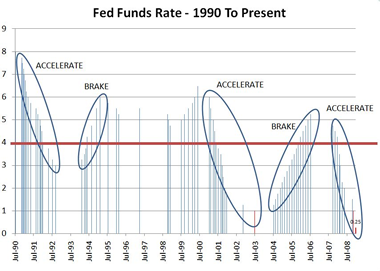
Go back to 1999-2000 and see what the Fed did. They are following the same pattern for 2005-06. If it ain't broke, the Fed will fix it... and good!
August 29, 2006 The Federal Reserve always acts on old information... and is the only cause of U.S. recessions.
December 5, 2006 Last spring I wrote about what I saw to be a sharp downturn in the economy in the "rustbelt" states, particularly Michigan.
March 28, 2007
The Federal Reserve sees no need to cut interest rates in the light of adverse recent economic data, Ben Bernanke said on Wednesday.
The Fed chairman said ”to date, the incoming data have supported the view that the current stance of policy is likely to foster sustainable economic growth and a gradual ebbing in core inflation”.

July 21, 2007 My guess is that if there is an interest rate change, a cut is more likely than an increase. The key variables to be watching at this point are real estate prices and the inventory of unsold homes.
August 11, 2007 I suspect that within 6 months the Federal Reserve will be forced to lower interest rates before housing becomes a black hole.
September 11, 2007 It only means that the overall process has flaws guaranteeing it will be slow in responding to changes in the economy... and tend to over-react as a result.
September 18, 2007 I think a 4% rate is really what is needed to turn the economy back on the right course. The rate may not get there, but more cuts will be needed with employment rates down and foreclosure rates up.
October 25, 2007 How long will it be before I will be able to write: "The Federal Reserve lowered its lending rate to 4% in response to the collapse of the U.S. housing market and massive numbers of foreclosures that threaten the banking and mortgage sectors."
November 28, 2007 FED VICE CHAIRMAN DONALD KOHN
"Should the elevated turbulence persist, it would increase the possibility of further tightening in financial conditions for households and businesses," he said.

"Uncertainties about the economic outlook are unusually high right now," he said. "These uncertainties require flexible and pragmatic policymaking -- nimble is the adjective I used a few weeks ago."
http://www.reuters.com/

December 11, 2007 Somehow the Fed misses the obvious.
fed_rate_moves_425_small.gif
[Image from: CNNMoney.com]
December 13, 2007 [from The Christian Science Monitor]
"The odds of a recession are now above 50 percent," says Mark Zandi, chief economist at Moody's Economy.com. "We are right on the edge of a recession in part because of the Fed's reluctance to reduce interest rates more aggressively." [see my comments of September 11]
January 7, 2008 The real problem now is that consumers can't rescue the economy and manufacturing, which is already weakening, will continue to weaken. We've gutted the forces that could avoid a downturn. The question is not whether there will be a recession, but can it be dampened sufficiently so that it is very short.
January 11, 2008 This is death by a thousand cuts.
January 13, 2008 [N.Y. Times]
“The question is not whether we will have a recession, but how deep and prolonged it will be,” said David Rosenberg, the chief North American economist at Merrill Lynch. “Even if the Fed’s moves are going to work, it will not show up until the later part of 2008 or 2009.
January 17, 2008 A few days ago, Anna Schwartz, nonagenarian economist, implicated the Federal Reserve as the cause of the present lending crisis [from the Telegraph - UK]:
The high priestess of US monetarism - a revered figure at the Fed - says the central bank is itself the chief cause of the credit bubble, and now seems stunned as the consequences of its own actions engulf the financial system. "The new group at the Fed is not equal to the problem that faces it," she says, daring to utter a thought that fellow critics mostly utter sotto voce.
January 22, 2008 The cut has become infected and a limb is in danger. Ben Bernanke is panicking and the Fed has its emergency triage team cutting rates... this time by 3/4%. ...

What should the Federal Reserve do now? Step back... and don't be so anxious to raise rates at the first sign of economic improvement.
Individuals and businesses need stability in their financial cost structures so that they can plan effectively and keep their ships afloat. Wildly fluctuating rates... regardless of what the absolute levels are... create problems. Either too much spending or too much fear. It's just not that difficult to comprehend. Why has it been so difficult for the Fed?

About Me

My photo
Michigan, United States
Air Force (SAC) captain 1968-72. Retired after 35 years of business and logistical planning, including running a small business. Two sons with advanced degrees; one with a business and pre-law degree. Beautiful wife who has put up with me for 4 decades. Education: B.A. (Sociology major; minors in philosopy, English literature, and German) M.S. Operations Management (like a mixture of an MBA with logistical planning)