READ ABOUT DETROIT AND SOLUTIONS TO ITS PROBLEMS. CLICK HERE.

Sunday, April 12, 2009

The Clocks Are Striking Thirteen

SEARCH BLOG: POLITICS

UPDATE

The post below was prior to the rescue of the captain of the Maersk Alabama. The end of the post pointed out that our tradition in dealing with pirates did not include FBI negotiators. The rescue was not a result of the FBI negotiators, nor a direct command given by President Obama because he was personally aware that Capt. Phillips' situation had progressed from "in danger" to "in imminent danger." Rather, the Navy officer in charge took standing orders allowing discretion to shoot the pirates if the hostage was in "imminent danger" and did so.

There are those who will mourn the pirates as victims of the "West." They will argue that the pirates were doing the only thing they could to defend themselves against the hostile force of a freighter carrying humanitarian food to African nations... including Somalia. And then there are those like Nick Davis who will argue:

Anti-piracy expert Nick Davis told Sky News: "They (the pirates) will learn from this. They're not going to stop piracy in any way, shape or form. They will up the ante, they will get better organised.

"The only people that would have been shot here are the foot soldiers. They're not the people that make the decisions and have the controlling interest.

"It's now going to fall back to the chain of command in the Somalian network of piracy, both ashore and in different countries, as to how they want to up the ante."

I guess arranging "protection" makes Davis an "expert." More likely it makes him an opportunist. Now he warns about the "ante" being upped. I think the Navy just upped the ante and the other side folded.

Perhaps it is time a few predators paid a visit to the "chain of command."

_________________________________


Forgive my confusion... and I'm certain there is a good answer... but what is the FBI doing negotiating with pirates off the coast of Africa?

Somali pirates in talks with elders and FBI over US hostage Robert Phillips

US warships track lifeboat containing pirates and captured captain

* Xan Rice in Nairobi
* guardian.co.uk, Sunday 12 April 2009 13.27 BST

Crew members of the Maersk Alabama

Crew members of the Maersk Alabama arrive in Mombasa, Kenya after overpowering Somali pirates and regain control of their ship. Photograph: Sarah Elliott/EPA

Negotiations between the FBI, Somali elders and four gunmen holding a US ship captain captive on a lifeboat in the Indian Ocean continued today as foreign helicopters circled a notorious pirate lair.

The lifeboat, which is being closely tracked by three American warships, is reported to be drifting closer to land, which US military officials fear would allow the pirates to escape with hostage Captain Richard Phillips.

His container ship, the Maersk Alabama, was briefly hijacked more than 300 miles off Somalia's east coast on Wednesday, but the all-American crew of 20 quickly regained control. Phillips, a 53-year-old former taxi driver, offered himself to the pirates as a hostage in order to safeguard his crew.

The pirates, who are armed with AK-47s and handguns, fired at a US Navy vessel that approached yesterday, but nobody was hurt and the boat withdrew. They have reportedly demanded safe passage back to Somalia and a ransom before Phillips is released.
What is the mission of the FBI?
The mission of the FBI is to uphold the law through the investigation of violations of federal criminal law; to protect the United States from foreign intelligence and terrorist activities; to provide leadership and law enforcement assistance to federal, state, local, and international agencies; and to perform these responsibilities in a manner that is responsive to the needs of the public and is faithful to the Constitution of the United States.

What authority do FBI Special Agents have to make arrests in the United States, its territories, or on foreign soil?
In the United States and its territories, FBI Special Agents may make arrests for any federal offense committed in their presence or when they have reasonable grounds to believe that the person to be arrested has committed, or is committing, a felony violation of U.S. laws.
Concerning arrests on foreign soil, FBI Special Agents generally do not have authority outside the United States except in certain cases where, with the consent of the host country, Congress has granted the FBI extraterritorial jurisdiction.
Which host country has made this arrangement? Okay, negotiating... not arresting, but how does the FBI get involved in a military operation during which pirates have shot at a navy vessel?

When does the UN come in and investigate the captain of the Maersk Alabama for international crimes and set up a multi-billion dollar relief fund for Somalian pirates?

On 16 February 1804 LT Stephen Decatur led 74 volunteers into Tripoli harbor to burn the captured American frigate The Philadelphia. British Admiral Lord Nelson called the raid "the most daring act of the age". Boatswains Mate Ruben James volunteered to go on the raiding party. James was seriously wounded during hand-to-hand combat. Despite his wounds, or perhaps because of them, James put himself between an attacking pirate and the commander of that raid, Decatur, who remained uninjured thanks to James. Ruben James recovered from his wounds and continued to proudly serve his Navy for another 32 years. Lieutenant Stephen Decatur's exploit in destroying the captured frigate USS Philadelphia, and Captain Richard Somers attempt with the fire-ship USS Intrepid to blow up enemy vessels in Tripoli harbor, set valorous examples for the young naval service.

In 1805 Marines stormed the Barbary pirates' harbor fortress stronghold of Derna (Tripoli), commemorated in the Marine Corp Hymn invocation "To the Shores of Tripoli." First Lieutenant O'Bannon is remembered for heroism in the battle for Derna. O'Bannon's Marines were the first U.S. forces to hoist the flag over territory in the Old World. The "Mameluke" sword, carried by Marines officers today, was presented to O'Bannon in 1805.

We have changed.
It was a bright cold day in April, and the clocks were striking thirteen.
George Orwell, "1984", first sentence
..

Trading Places With Asian Manufacturers

SEARCH BLOG: AUTOMOBILES

Not sure when this was written, but it is something I have discussed in the past.

Japan is not alone in this practice; Korea is just as bad and their companies are the latest automotive sharks in the U.S. waters.

I'm not sure we want to restrict our markets as much as we want them to free up theirs. The issue: they won't. Why? Because they understand the importance of building and protecting a manufacturing base for the health of their economies... something we don't as a financial and service market oriented economy.

[H/T Howard Jacobson]
Saving GM From Bankruptcy

By JERRY KROTH

The media constantly bombards us with one set of facts, but the other set doesn’t get much play. We hear about GM struggling, about bailouts, bankruptcy, and massive layoffs. And we hear about how Toyota and Nissan will fill the vacuum created by any GM or Chrysler bankruptcy.

But what we don’t hear about is very interesting: We don’t hear that last year Japan imported a whopping 8,000 Fords. You heard right! The Japanese bought 8,000 Fords, but Toyota sold two million of its automobiles here. And thousands more for Honda and Nissan.

And we don’t hear that the average GM car in the US costs about $25,000, but in Japan the same car costs $50,000. A big mark up, lots of restrictions. No one calls that protectionism, but that is what it is, and what it has been for years.

There is a social stigma in Japan for buying and owning an American car. The only folks who buy them are social undesirables and underground figures like the yakuza, the Japanese mafia.

If there was a law that required that Japanese and Korean car manufacturers would be allowed sell the same number of cars in the US that were imported into Japan and Korea—that the playing field was equalized—well, guess what would happen: GM, Ford, and Chrysler would start filling the vacuum created by the sudden absence of Toyotas, Nissans, and Hondas from American showrooms, that’s what would happen! Foreclosures and evictions in Flint would stop. Michigan would come back to life, and Toyota City would have to take it on the chin for a change.

A simple solution indeed! Let’s call it the Import-Export Fairness Act. Thousands of American jobs saved; thousands more created. Inner cities would start coming back to life. Sure the Japanese would yell, scream, and protest that they had to start letting their showroom dealers start selling Fords and Chevys at competitive prices. Maybe a trade war would start; maybe they’d cash in their T-bills, but it is just as likely that the bigwigs of Toyota and Honda would hurriedly ask Japanese parliamentarians to open up Japanese markets immediately allowing more American cars to be sold there and thus more Japanese cars could continue to be sold here. Otherwise they’d lose market share, big time!

I’d rather see Toyota lose market share to GM instead of the reverse.

It’s a thought. A thought for every UAW worker facing a layoff, every Michigander fearing loss of his job, pension, and home.

In the days of Jimmy Hoffa and Walter Reuther, a healthy strike by autoworkers and sympathetic truckers would shut our country down until we saw some real action. If now is not the time, well, when is?

Jerry Kroth is a professor at Santa Clara University in California and a former Detroiter.
Professor Kroth is not an economist, but that doesn't preclude him from make the case for the obvious.

..

Saturday, April 11, 2009

How Long Should Legislation Remain Law

SEARCH BLOG: LAWS and LEGISLATION

Yesterday's parody of President Obama's determination to circumvent existing immigration laws got me to thinking about our legislative process and the laws that remain on the books forever. A mildly humorous comment posted indicated that we all had to obey bad laws rather than listen to liberals. That's really not the point... even if there was some ironic truth to that. The real point is that our laws take on a "holy" aura simply because sometime, someone got a group of some others to vote his way on an issue.


Let's take the issue of immigration since our president seems to believe that the laws are simply unfair. Sometime, someone got some others to consider the impact of unrestricted access to our country on our communities, states and national interests. They agreed to various restrictions that favored the national and ethnic origins of the people who were already settled over the national and ethnic origins not significantly represented. Was that fair and reasonable? Maybe; maybe not. Regardless of the "fairness," the result was a dynamic nation that quickly rose to the top of the pecking order among nations.


Like-minded people with similar aspirations and a "tough love" approach to anyone who wanted to join the club: bring some skills or knowledge of value and learn and adapt to our ways. The Germans did it. The Italians did it. The Irish did it. The Polish did it. They privately kept their heritage and publicly embraced the American heritage. A melting pot, perhaps; but more of a big pot of stew where there were different flavors and identifiable ingredients while an enhanced overall flavor.


Somewhere along the way, it became politically correct to say those laws did not work and that process of assimilation was bad... evil. People from all over the world were allowed into the country and the original restrictive quotas were changed, but that was not sufficient. The laws discriminated against Mexicans who didn't want to go through the process. Because they could simply walk across an undefended border, the laws were obviously not meant to apply to them. They should simply be able to take up residence, maybe work and maybe not, and have all of the rights and privileges of any other citizen... they were de facto citizens who were entitled to the support and resources of the communities in which they found places to live.


As a result of successfully ignoring U.S. immigration laws and processes, 12 million... maybe more... illegal aliens from Mexico and Central America are now receiving support from our president to ignore their ignoring. We certainly can't hold them accountable for the fact that they ignored our laws and processes some time ago and punish them now. Let's change the law ex post facto. Unlike evidence which is not allowed if obtained illegally... fruit of the poisoned tree... the children of illegal aliens who happen to be born in the U.S. become citizens and then form the basis for keeping their parents in the U.S. ... at least that's the theory.


Depending on who happens to be in power, it appears that laws will either be enforced or circumvented or ignored.

I have a better idea. Let's create sunsets for our laws. This is obviously not an original idea. But it does have merits. Consider this:
  • Unfunded programs - implemented upon funding or rescinded after 2 years if not funded [including unfunded "mandates"]
  • Funded programs - 4 years and must be specifically funded, not funded by diversion of funds collected for other purposes
  • Commerce legislation - 15 years
  • Criminal legislation - 25 years
  • Treaties - 30 years maximum
  • National security legislation - 30 years
At the end of each appropriate time limit, current legislators would be called upon to renew the legislation or ignore it and allow the law to expire.

The effect would be two-fold:
  1. Elimination of unnecessary or inappropriate laws
  2. Minimizing time spent on passing new unnecessary and inappropriate laws
The maximum time for laws to be in effect would not preclude legislation to repeal any laws.

This would create automatic reviews of all major programs, policies, and agencies to determine whether they should continue and in what form. This would also force legislators to put their names to any legislation they want to continue and would render Supreme Court decisions regarding any specific laws moot if the laws were not renewed.

For example, if the present immigration laws and policies were passed in 1980, then under the national security limitation those laws and policies would have to be renewed in 2010. Public debate and an official vote to either continue as before, radically change, or eliminate all laws pertaining to controlling access to the United States would occur. Disregarding current laws would not be an option. Ex post facto changes and applications to persons in violation of existing laws would not be an option.

The only specific, unchanging legal document would be the Constitution/Bill of Rights/Amendments. Legislation would be tested against those documents.

So, whether you are for immigration reform or tax reform, sunset requirements should please you. Perhaps it is time for a Constitutional Amendment.

..

Friday, April 10, 2009

Obama to Push Tax Forgiveness Bill as One Priority

SEARCH BLOG: GOVERNMENT

By JULIA OVERSIGHT
Published: April 9, 2009

While acknowledging that the recession makes the political battle more difficult, President Obama plans to begin addressing the country’s taxation system this year, including looking for a path for tax evaders to become legal, a senior administration official said on Wednesday.

Mr. Obama will frame the new effort — likely to rouse passions on all sides of the highly divisive issue — as “policy reform that controls taxation and makes it an orderly system,” said the official, Cecilia Gotcha, deputy assistant to the president and director of intergovernmental affairs in the White House.

Mr. Obama plans to speak publicly about the issue in May, administration officials said, and over the summer he will convene working groups, including lawmakers from both parties and a range of taxation groups, to begin discussing possible legislation for as early as this fall.

Some White House officials said that taxation would not take precedence over the health care and energy proposals that Mr. Obama has identified as priorities. But the timetable is consistent with pledges Mr. Obama made to local groups in last year’s campaign.

He said then that comprehensive taxation legislation, including a plan to make legal status possible for an estimated 12 million tax evaders, would be a priority in his first year in office. Tax evading voters turned out strongly for Mr. Obama in the election.

“He intends to start the debate this year,” Ms. Gotcha said.

But with the economy seriously ailing, advocates on different sides of the debate said that taxation could become a polarizing issue for Mr. Obama in a year when he has many other major battles to fight.

Opponents, mainly Republicans, say they will seek to mobilize popular outrage against any effort to find more Cabinet positions for habitual non-taxpayer workers while so many taxpayers are out of tax reductions.

Democratic legislative aides said that opening a full-fledged debate this year on taxation, particularly with health care as a looming priority, could weigh down the president’s domestic agenda.

Debate is still under way among administration officials about the precise timing and strategy. For example, it is unclear who will take up the Obama initiative in Congress.

No serious legislative talks on the issue are expected until after some of Mr. Obama’s other priorities have been debated, Congressional aides said.

Just last month, Mr. Obama openly recognized that taxation is a potential minefield.

"I know this is an emotional issue; I know it’s a controversial issue,” he told an audience at a town meeting on March 18 in Costa Mesa, Calif. “I know that the people get real riled up politically about this."

But, he said, tax evaders who are long-time residents but lack legal status “have to have some mechanism over time to get out of the shadows.”

The White House is calculating that public support for fixing the taxation system, which is widely acknowledged to be broken, will outweigh opposition from voters who argue that tax evaders take tax reductions from taxpayers. A groundswell among voters opposed to legal status for tax evaders led to the defeat in 2007 of a bipartisan taxation bill that was strongly supported by President George W. Bush.

Administration officials said that Mr. Obama’s plan would not add new tax evaders to the American work force, but that it would recognize millions of tax evaders who have already been working here. Despite the deep recession, there is no evidence of any wholesale reduction of non-taxpayer workers, independent studies of census data show.

Opponents of legalization legislation were incredulous at the idea that Mr. Obama would take on taxation amnesty when economic pain for taxpayers is so widespread.

“It just doesn’t seem rational that any political leader would say, let’s give millions of tax evading workers permanent access to U.S. paid-in-full status when we have millions of taxpayers have been compliant,” said Roy Beck, executive director of NumbersUSA, a group that favors reduced taxation. Mr. Beck predicted that Mr. Obama would face “an explosion” if he proceeded this year.

“It’s going to be, ‘You’re letting them keep that tax reduction, when I could have that tax reduction,’ ” he said.

In broad outlines, officials said, the Obama administration favors legislation that would bring tax evaders into the legal system by recognizing that they violated the law, and imposing fines and other penalties to fit the offense. The legislation would seek to prevent future tax evasion by strengthening tax enforcement and cracking down on employers who hire tax evaders, while creating a national system for verifying the legal taxation status of new workers.

But administration officials emphasized that many details remained to be debated.

Opponents of a legalization effort said that if the Obama administration maintained the enforcement pressure initiated by Mr. Bush, the recession would force many tax evaders to return home. Dan Stein, the president of the Federation for American taxation Reform, said it would be “politically disastrous” for Mr. Obama to begin an taxation initiative at this time.

Anticipating opposition, Mr. Obama has sought to shift some of the political burden to advocates for tax evaders, by encouraging them to build support among voters for when his proposal goes to Congress.

That is why Representative Luis V. Gutierrez, a Democrat from Mr. Obama’s hometown, Chicago, has been on the road most weekends since last December, traveling far outside his district to meetings in local churches, hoping to generate something like a civil rights movement in favor of broad taxation legislation.

Mr. Gutierrez was in Philadelphia on Saturday at the Iglesia Internacional, a big local evangelical church in a former warehouse, the 17th meeting in a tour that has included cities as far flung as Providence, R.I.; Atlanta; Miami; and San Francisco. Greeted with cheers and amens by a full house of about 350 people, Mr. Gutierrez, shifting fluidly between Spanish and English, called for taxation policies to preserve family unity, the strategic theme of his campaign.

At each meeting, speakers from the community, mainly citizens, tell stories of loved ones who were overlooked or of delays and setbacks in the taxation system. Tax evaders have not been invited to speak.

Mr. Gutierrez’s meetings have all been held in churches, both evangelical and Roman Catholic, with clergy members from various denominations, including in several places Muslim imams. At one meeting in Chicago, Cardinal Francis George, president of the United States Conference of Catholic Bishops, officiated.

One speaker on Saturday, Jill Flores, said that her husband, Felix, a non-taxpayer from Mexico who crossed the border illegally, had applied for legal status five years ago but had not been able to gain it even though she is an American citizen, as are their two children. Now, Ms. Flores said, she fears that her husband will have to leave for Mexico and will not be permitted to return for many years.

In an interview, Mr. Gutierrez rejected the idea that the timing is bad for an taxation debate. “There is never a wrong time for us,” he said. “Families are being divided and destroyed, and they need help now.”

Jeff Xoomy contributed reporting.
Okay, so maybe he wasn't talking about getting tax evaders legalized. Put in another noun or phrase describing a person who has committed a crime. Does that make any more sense?

..

Thursday, April 09, 2009

March 2009 Temperatures

SEARCH BLOG: WEATHER

NOAA has published some of their data for March, 2009. Except for a couple of low records, not much unusual about temperatures.

The snow and ice records in the Lake Superior region will continue to contribute to lowering the water levels in the Great Lakes... as some people measure it... if you ignore the recovery during the last couple of years, despite the deepening of the shipping lanes that have allowed more water to flow out of the bigger lakes... as this 2005 report states.
In the past year, Lake Erie has risen a foot higher than its long-term average.

The other lakes, and the comparison to their long-term averages, are: Ontario, 11 inches higher than its long-term average; St. Clair, 8 inches higher; Superior, 1 inch lower; Lakes Michigan and Huron, 9 inches lower.

Lakes Michigan and Huron are so much lower than their long-term averages, according to a recent study, because of dredging decades ago.

The study, which was done for a Canadian civic group, found that a commercial navigation channel dug at the bottom of the St. Clair River caused the levels of the two lakes to drop a foot.
In fact, one might think that some people had a "global warming" agenda since they refuse to recognize that the lakes levels have done quite well despite man-made non-CO2 efforts that are draining them.
But back to temperatures...


Except if you look at the variance from average temperatures.

It was nice to know that in our area of Southeastern Michigan that the temperature was up to 2°F above normal. Of course that includes variances a lot closer to none.

Hey, what's a little rounding?

..

Those Investors Won't Invest

SEARCH BLOG: GOVERNMENT and BAILOUT

Previously I wrote...

Monday, March 23, 2009

They Are Called Taxpayers

SEARCH BLOG: BAILOUT

From The New York Times:

U.S. Rounding Up Investors to Buy Bad Assets
When I saw this headline, I couldn't help but think about an old western cattle drive. "Let's get them dogies to the slaughterhouse. Round 'em up; head 'em out."
The plan relies on private investors to team up with the government to relieve banks of assets tied to loans and mortgage-linked securities of unknown value. There have been virtually no buyers of these assets because of their uncertain risk.

As part of the program, the government plans to offer subsidies, in the form of low-interest loans, to coax private funds to form partnerships with the government to buy troubled assets from banks.

But some executives at private equity firms and hedge funds, who were briefed on the plan Sunday afternoon, are anxious about the recent uproar over millions of dollars in bonus payments made to executives of the American International Group.

Some of them have told administration officials that they would participate only if the government guaranteed that it would not set compensation limits on the firms, according to people briefed on the conversations. The executives also expressed worries about whether disclosure and governance rules could be added retroactively to the program by Congress, these people said.
Why would they think the government of Chris Dodd and Barney Frank would do that?
It appears that the investors the government was seeking don't think the government can be trusted.

WASHINGTON (AP) — The Treasury Department is making it easier for hedge funds and other private investors to participate in its plan for buying up banks' bad assets, an acknowledgment that the interest level so far has been lackluster.

Analysts said the move shows the program hasn't yet attracted enough large fund managers who may be wary of ending up on the wrong side of a congressional probe or public backlash.
Surprise, surprise.

..

Wednesday, April 08, 2009

General Motors And Bankruptcy

SEARCH BLOG: AUTOMOBILES

Doctors will tell you to take all 10 days of your antibiotics to be sure that the infection has been eradicated. Implicit in those instructions is the assumption that your pharmacist will give you the full 10 days of medicine that is required.

In the case of General Motors and Chrysler, they received just enough medicine to begin to address the problem... and then were told that the "pharmacist" wanted to see if they could heal themselves. It looks like GM and Chrysler will be seeking "alternative medicine."

The problem is that this "alternative medicine" may allow the "disease" to be spread to other parts of the economy.

GM preparing for bankruptcy

A source close to GM said company still hopes to meet Obama's June 1 deadline to reach concessions with unions and creditors but that bankruptcy is an option.


By Chris Isidore, CNNMoney.com senior writer

NEW YORK (CNNMoney.com) -- Preparations for a possible bankruptcy filing at General Motors have become "intense and earnest", according to a source familiar with the company's plans.

The source, who spoke on the condition of anonymity, said GM still hopes to win concessions from its creditors and unions that will allow it to avoid bankruptcy. But the June 1 deadline given to the company by President Obama and the Treasury Department to reach deals or go into bankruptcy has caused a pick-up in preparations, the source said.

"We're talking about what could be the largest industrial company to ever go bankrupt. The preparations better be intense and earnest," the source said. "The preparations are being made because there's a short time frame here."

GM owes about $28 billion to holders of its unsecured debt. It wants those creditors to agree to take an equity stake in the company in return for reducing that debt by at least two thirds.

An ad hoc committee representing GM bondholders have objected to this proposal due to the uncertain value of GM's stock going forward.

A person involved with that committee said Tuesday that the reports about bankruptcy preparations at GM did not change the creditors' views. This source added that there have been no formal talks between the bondholders and the company since Obama's deadline was set last week, but that the committee is eager to hold negotiations.

"We're very concerned about the state of the company and the possibility of bankruptcy," the source involved with the committee said. "We're still trying to work to try to get something done outside of bankruptcy, which is our hope."

0:00 /1:59GM dealer's optimism

The auto task force overseeing $13.4 billion in federal loans GM has already received declared last month that neither the company nor its competitor Chrysler LLC were viable under turnaround plans the companies submitted Feb. 17.

Chrysler was given only 30 days to reach a new alliance with Italian automaker Fiat. GM (GM, Fortune 500) was given 60 days to get creditors to agree to swap debt for equity, and to win further concessions from the United Auto Workers union. The government also forced GM Chairman and CEO Rick Wagoner to resign last week.

New GM CEO Fritz Henderson said at his first press conference last week that he would not have taken the job as CEO if he wasn't willing to take the company through the bankruptcy process, although he said he still preferred to reorganize the company outside of bankruptcy court.

Henderson also said the company would not wait the full 60 days to file for bankruptcy if it became clear it could not reach deals with the creditors and unions.

"If it's quite clear it can't be done, we'll move faster," said Henderson. "More time isn't going to help the process."

Shares of GM lost about 10% in midday trading Tuesday on the reports of bankruptcy preparations. The already battered shares have lost more than 40% of their value since President Obama raised the threat of bankruptcy on March 30. To top of page

..

Tuesday, April 07, 2009

Obama Seeks Control Not Reimbursement

SEARCH BLOG: ECONOMY

Pretty scary stuff [h/t Pat Dollard]


Here in the Southeastern Michigan area, we are painfully aware of the President Vladimir Obama's attempts to nationalize management of the private sector as exemplified with the firing of General Motors CEO Richard Wagoner, the dictating that Chrysler must make a deal with Fiat within 30 days, and that General Motors must be completely reorganized and without need of addition funds in 60 days.

The direction of this country is toward post WWII East Germany. It's just the beginning of the far, far, far left-wing agenda. Bill Ayers doesn't have to blow up any more federal buildings. He'll probably be invited to a victory dinner.

..

Monday, April 06, 2009

Congratulations North Carolina

SEARCH BLOG: SPORTS

2009 NCAA Men's Basketball Champions...

They started out the year as overwhelming favorites and, after a few bumps along the way, showed that they were a cut above all of the rest winning the NCAA Championship game by a large margin, determined in the first 10 minutes, 89 - 72.

To the Michigan State University basketball team, you achieved more than most would have imagined, including defeating two teams that held the number one ranking during the season. There should be immense pride in your accomplishments.

Basketball Championship Weather

SEARCH BLOG: WEATHER

Thousands of basketball fans have been spared being overcome by the effects of global warming in Michigan... as shown in this "weather cam" shot in Detroit.


It's Spring; yes it can.

UPDATE


Oh, oh. It might be getting warming...er.

..

NCAA Men's Basketball Finals

SEARCH BLOG: SPORTS


GO STATE!
From Yahoo!...

Heels, Spartans find themselves in more than game

AP – North Carolina head coach Roy Williams, left, and Michigan State head coach Tom Izzo chat before a television …

DETROIT – The bracket says North Carolina vs. Michigan State.

At times, though, the Tar Heels may feel like they're going up against something more than just another basketball team.

From the coach on down, the Spartans (31-6) know a win in the NCAA title game on a court 90 miles from their campus won't fix the state's economic freefall, won't put anybody back to work. But there will be 72,000 people in Ford Field, site of the Final Four, come Monday night. Most will be rooting for Michigan State.

And winning, as they say, can be contagious.

"When you go through hard times, you pray for something to get you out," Spartans guard Travis Walton said. "I'm sure they didn't pray for Michigan State to get to the Final Four or the national championship game, but they probably have been praying to have things to take their mind off of it."

Michigan ranks 51st out of 50 states (and District of Columbia) in the latest unemployment figures. Detroit is the hub of an auto industry on life support, a civic symbol of an economic system that has come off the tracks.

That's the backdrop for a game in which Michigan State finds itself a 7 1/2-point underdog against a Carolina team that has "national champs" practically inked across its uniforms.

Remember, this is the team that some thought could go undefeated this season when Tyler Hansbrough, Ty Lawson, Wayne Ellington and Danny Green all decided to return after a bad loss to Kansas at last year's Final Four.

Undefeated was never on coach Roy Williams' list of goals. Winning a championship, though? Always.

"If you thought it was easy, you don't know what you're talking about," Williams said. "It's college basketball. There hasn't been an undefeated team since '76, and there have been some really, really good teams. I think this year there were eight or 10 teams or 12, I haven't studied it, that could be playing Monday night."

But it will be North Carolina (33-4), the preseason No. 1 and top seed in the South Regional, against Michigan State, a less-hyped and more overlooked No. 2 seed out of the Midwest.

Though Michigan State coach Tom Izzo won't sell his team short — "you don't get this far on grit," he said — he also knows the deal. This is a rematch of a game North Carolina won 98-63 on Dec. 3 in the same building. Anyone who turned the channel, or turned the page, on that one gets a pass. Izzo certainly has.

Michigan State was exhausted (fourth game in seven nights), injured (Goran Suton was out and Delvon Roe was hurting) and not playing near its current level back then, though the coach figures if the Spartans had been in better shape, they still would have lost by 20.

"If we play good and they play good, we're losing. That's the way I look at it," Izzo said. "I mean, I don't look at that in the negative. They are the best team in the country and have earned that ranking probably over the last year and a half."

And, as both coaches acknowledge, the Spartans have a knack for taking opponents out of their 'A' game. See Michigan State's 82-73 win over Connecticut on Saturday.

"I mean, they're not exactly Charlie's Donut Team," Williams said.

Williams figures if North Carolina plays poorly in the rematch, it won't be because of the crowd.

This is a team that loves playing in hostile environments and succeeds at it, too.

The Tar Heels have gone 67-14 away from home in the four years since Hansbrough and the seniors arrived in 2005, the season after Carolina's last championship. Hansbrough has never lost to Duke at Cameron Indoor Stadium. He's 5-2 in other road games in the state of North Carolina, 3-0 in Maui, 6-0 in Florida and, yes, 1-0 at Ford Field.

"I've tried to forget that whole week," Izzo said. "In fact, if you ask me, 2008 never happened. I'm trying to move ahead to 2009."

Led by Kalin Lucas, the Big Ten player of the year, Walton, the Big Ten defensive player of the year, and steadily improving Raymar Morgan (18 points, nine rebounds in the win over Connecticut on Saturday), the Spartans are trying to close out 2009 with a flourish.

The game comes 30 years after Magic Johnson led MSU to its first championship in that historic meeting against Indiana State and Larry Bird. Like North Carolina, Michigan State is also going for its second title of the 2000s.

Mateen Cleaves led the 2000 title team. Though Izzo has been back to the Final Four three times since — for a total of five in 11 years — the Spartans haven't won another championship.

Getting this group a title is the real mission that concerns the coach.

"I mean, the state, this city, is very important to me," he said. "But the cause right now is for the Michigan State players to win a championship, and hopefully the repercussions from that will help a lot of people. It's a feel-good for a lot of people."

Williams, meanwhile, said he hasn't had time to discuss the country's economic situation since the Tar Heels beat Villanova 83-69 late Saturday night. It's simply not part of the scouting report.

"I do realize they have a cause. Well, we also have a cause, too," he said. "We want to win a national championship, period, the end. And if you would tell me that if Michigan State wins, it's gonna satisfy the nation's economy, then I'd say, 'Hell, let's stay poor for a little while longer.'"

..

Sunday, April 05, 2009

Detroit Needs Bankruptcy And Reorganization

SEARCH BLOG: DETROIT

General Motors has gotten all of the negative headlines recently, but in Michigan there is another entity that is chronically the most corrupt and mismanaged: Detroit.

  • The city, like General Motors, has been losing "market share" for decades.
  • The city, like General Motors, has had a series of dubious "leaders."
  • The city, like General Motors, neglected its "product."
  • The city, like General Motors, has needed government "bailouts."
  • The city, like General Motors, needs a bankruptcy proceeding and massive reorganization.
Over four years ago, during a relatively good economic time, I laid out the issues and what needed to be addressed:
What's the answer... the solution? The answer is that Detroit has been in decline for 1/2 a century and any turnaround must either be based on a total change in government... or a turnaround will take at least 1/2 century given current government processes. The solutions are myriad... and painful.
  • confiscation of vacant and abandoned property
  • rezoning from residential to public and forced buyouts - creation of green zones
  • closing of 20% of schools, renovation of the rest, and a takeover by the state
  • reduction by 30% of government employees and state supervised restructuring of departments and processes
  • creation of tax-free "enterprise parks"
  • establishing a tax structure that is "competitive" with suburbs
Of course, no such action was contemplated or taken and the situation continued to deteriorate. Detroiters continued to elect a mayor and council full of corruption and nepotism. Hey, what's the big deal? Everyone does it!

Last year I wrote:
It is time for change...
  • change at the state level to fiscal responsibility and pro-business policies
  • change at the city level to addressing problems rather than cultivating racial power
  • change at the personal level to realizing that "stupidity has its own rewards" and not being so damn stupid
What's the likelihood of such change? Somewhere between zero and zilch.

That makes it even more likely that ultimately the city will have to be split up into new, manageable pieces. As I also wrote in 2005:
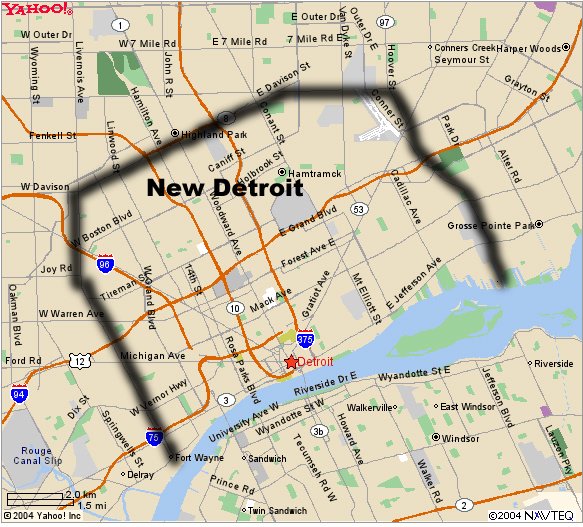
Another radical approach would be to reduce Detroit to a 5 mile radius from the foot of Woodward Ave and then create several new cities along the outer ring or let existing cities annex adjacent areas. This would create a more manageable central area that could focus on high-end businesses and more affluent residents. The outer areas would be more traditional smaller cities that could focus on small business and the needs of its residents.

What do economists call that... creative destruction?
What has happened since then?
Crowd gasps at deficit


Financial manager shares plan for cuts


By CHASTITY PRATT DAWSEY

FREE PRESS EDUCATION WRITER

Surprise, disgust and un­comfortable confrontation marked the meeting Thursday night when the state-appoint­ed emergency financial man­ger for Detroit Public Schools discussed a historic $305.8­million deficit and stood up to board members who want more power than the law al­lows under a state takeover.
Occasional gasps broke the silence in a crowd of more than 100 people as Robert Bobb de­scribed how Detroit Public Schools racked up the deficit.
“Could that number change next week?” Bobb asked. “Ve­ry well could. We’re still work­ing.”
Bobb outlined his plan to close up to 50 schools and lay off thousands of workers over the next two years in his first public presentation since he took over the $1.1-billion bud­get last month.
He said he will present the school closure plan next week. DPS has shuttered more than 65 schools since 2005, and cur­rently has nearly 200 schools open with about 95,000 stu­dents. Demographers project the school system could drop down to 65,000 students with­in five years.

Unemployment in Michigan was at 12% in January, 2009, and rising. Unemployment in Detroit was at 22% and rising. Nothing is improving; everything is deteriorating. Yet Detroit plods on in its old way.
Conyers’ son and niece got jobs, too
Brother’s hiring causes a storm


By M.L. ELRICK and JOE SWICKARD

FREE PRESS STAFF WRITERS
Three relatives of Detroit City Council President Monica Conyers — including a son and her brother — received city jobs after Conyers took office.
Conyers hred her teenage son, John Co­nyers III, as a legislative assistant under a 1-year contract, at a rate of $15 an hour, city records show. It’s unclear whether he served the full year. The contract ended last June.
Her niece, Ellen Conyers, a lawyer, was hired around 2007 in the Mayor’s Office of Neighborhood Commercial Development. Her salary was $63,000 in 2008.
But it was the hiring of Monica Conyers’ brother, Reginald Esters, that ignited the latest controversy enveloping the City Council president.
Amru Meah, director of the city’s build­ing department, said Conyers lobbied him to hire Esters, a convicted felon.
Conyers denies trying to influence her brother’s hire.
Esters was fired for what building offi­cials characterized as chronic absentee­ism. He has a court hearing April 17 on four felony weapon charges.

The residents of this city apparently don't give a damn. It is time that Detroit, like General Motors, gets taken by its collective nose and marched into bankruptcy and reorganization... into a much smaller city.

If not, the only answer will be liquidation.

..

Saturday, April 04, 2009

Normal Weather For March 2009

SEARCH BLOG: WEATHER

It was variable; it was normal.

At last... a month that wasn't below normal!


But that doesn't mean the winter was "normal"... or "average" or "typical." Joe D'Aleo at Icecap summarizes a fairly "atypical" winter. That doesn't stop the media from continuing to print stories about not enough ice ... on the Great Lakes. That, despite the fact that Lake Superior was much frozen over this winter... a fairly rare occurrence.

I guess it takes two months [June, 2008] out of 14 that squeeze out a fraction of a degree over "normal" to get the locals ranting about global warming again.

..

Friday, April 03, 2009

Why GM Needs To Reorganize

SEARCH BLOG: AUTOMOBILES

  • Buick
  • Cadillac
  • Chevrolet
  • GMC
  • Hummer
  • Oldsmobile
  • Pontiac
  • Saturn
General Motors has seven current American brands, plus SAAB and Opel in Europe. The question is ... why?

One of the "legacy costs" that doesn't get talked about much is "branding." In order to understand why GM has so many brands, you have to understand a little about automotive history.

In the first half of the 20th century, when the boom of auto manufacturers was occurring, a Buick was a Buick... a car that had a few options and a few colors. Manufacturers created "new" cars by having a different nameplate... like Pontiac or Oldsmobile... which were either brands that had been absorbed into the corporation or identities given to an existing car that had somewhat differentiating sheetmetal and options... like the Edsel.

It wasn't until after World War II that corporations like GM began to create different cars within individual brand... Chevy 210 and Bel Air... models.


This changed the game for marketing. Now the "low priced" brand could sell a "loaded" version that competed with the "higher price" brand... while still have a standard or "stripped" version that retained the low price image of the brand.

Then came the brilliant idea to not only differentiate versions of the cars... models..., but to introduce whole new cars into the brand... like the Chevy Corvair.

Why not a different type of vehicle under the model nameplate... all under the same brand?

Now that there were different model nameplates under the brand, each representing a different type of vehicle, why not add new vehicles under the model? Why not have a Corvair car and truck?

So, in this example, the Chevrolet brand had the Chevrolet and Corvair vehicles, both of which included cars and trucks, and then the models became the different trim levels or configurations. What had originally differentiated brands now differentiated models within the brand. One brand was taking on the purpose of multiple brands within the corporation.

The logical consequence of this was that there was an explosion of models and configurations and options within each brand... and confusion about what a brand really was. Was it the Chevy Cimmaron and the Cadillac Cavalier?

Marketing took over. Engineering was a function of making minor changes to make one vehicle look like 5 brands and 15 models. It became a jumble. And the brand focus was hidden by the fog of models and configurations and trim levels.

This was not without consequence.
  1. Overhead grew within the corporation. Each brand had to have its own staffs and sales organizations and dealership network.
  2. Engineering resources were diffused. As much effort was placed on brand and model differentiation as basic quality and innovation... maybe more. It was better to do 20 things so-so than 3 things superlatively.
  3. Real outside competition was ignored. Those pesky foreign manufacturers were an annoyance more than a wake-up call. The in-house brands were too busy competing for each others' customers to worry about some "Toy-autos."
  4. Finance staffs focused on "leveraging" and "commonality." All the company had to do was re-badge and profits would come rolling in.
  5. Accountants convinced CEOs that by extending models for five years or seven years instead of three or four years that tooling costs per vehicle would be much less and... logically... profits per vehicle would be much higher.
So engineering and innovation were stifled behind the smokescreen of Marketing and Finance. Product got old and stale and dull. Foreign manufacturers focused on long-term strategies of quality and innovation... and stuck to their stories... and prospered.
Now General Motors has a half a dozen brands with dozens of models and more dozens of configurations and options for a market share of 1/3 what they had when they had 5 brands... each with a car and one with a truck. Does anyone see the problem?
If you go back and read yesterdays post, The Reorganized General Motors, perhaps you will understand not only why GM needs to reorganize, but the manner in which they need to do so.
The credit crisis has only served to force their hand in an undisciplined and politically-laden manner, but it was inevitable that GM would have gradually reorganized anyway... given their continued eroding share of the U.S. automotive market.
..

Thursday, April 02, 2009

Alternative Energy


Start video and then click on small rectangle next to SHARE icon to see in full screen mode. Use [Esc] to return.

Let's see... thousands of very expensive and unreliable windmills blighting the landscape and affecting local environments while killing off birds or... some nondescript buildings "burning" some water. Oh, let's go with the windmills because... because... hmmmmmmm.

But, if you are like some people who hide under an umbrella when they hear the words "nuclear" or "fusion" [sorry, Ford], then maybe this holds promise... unless they fear "chemistry."

Navy Chemist May Have Rediscovered 'Cold Fusion'

Thursday, March 26, 2009

Twenty years ago this week, a pair of previously unknown scientists stunned the world by announcing they'd done the impossible by achieving nuclear fusion in a lab flask at room temperature.

Martin Fleischmann and Stanley Pons quickly became celebrities as the news media hailed them for discovering a cheap source of nearly limitless power. But it all fell apart as other scientists couldn't duplicate their results, and the pair later admitted they'd made mistakes in the experiments.

Now a U.S. Navy researcher, speaking on the anniversary of their announcement and in the same city where they made it, thinks Fleischmann and Pons may have been right.

In a paper presented on Monday, chemist Pamela Mosier-Boss told the annual convention of the American Chemical Society in Salt Lake City that her team had gotten "very significant" evidence of some sort of nuclear reaction.

"To our knowledge, this is the first scientific report of the production of highly energetic neutrons from an LENR device," said Mosier-Boss, a researcher at the Navy's Space and Naval Warfare Systems Center in San Diego, in a press release.

Highly energetic neutrons, which Mosier-Boss' team detected using special neutron-trapping plastic, are emitted from atoms splitting apart — or fusing together — and indicate that a serious nuclear reaction is going on.

"LENR" stands for "low energy nuclear reaction," which in this case happens in a lab flask containing palladium chloride mixed with deuterium, or "heavy water" made with a special form of hydrogen — the same setup Fleischmann and Pons used.

When an electrode was dipped into the flask and the power switched on, Mosier-Boss said, odd patterns of triple neutron strikes would appear on the adjacent plastic receptor.

Fleischmann and Pons' results centered on unexplainable excess heat resulting from the reaction. Mosier-Boss didn't get that, but the neutrons are even more significant.

"People have always asked 'Where's the neutrons?'" Mosier-Boss said in the press release. "If you have fusion going on, then you have to have neutrons. We now have evidence that there are neutrons present in these LENR reactions."

Nuclear fusion occurs at the center of stars, which fuse hydrogen nuclei together to create helium. It creates enormous amounts of energy, but it takes huge amounts of heat to happen at all.

Humans have so far generated the necessary heat only by detonating fission-based atomic bombs, which heat up cores of special two-neutron hydrogen to create a second, fusion-based explosion — a hydrogen bomb.

Decades of efforts to create controlled nuclear fusion, which could power reactors endlessly using cheap, abundant hydrogen, have so far been fruitless.

..

Politically Incorrect Free Speech

SEARCH BLOG: POLITICS

I don't think he can say that... can he?

Click on picture for larger view.

[Henry Payne in The Detroit News]

..

The Reorganized General Motors

SEARCH BLOG: AUTOMOBILES

The presumption is that General Motors will eventually... soon... go into bankruptcy proceedings, but not necessarily liquidation.

What will GM look like? First, here is what GM's automotive brands look like via the GM website.

This does not show the European Opel brand.

There are also a variety of automotive related brands such as GMAC that fall under the corporate umbrella.

While GM has a vast worldwide organization, the US is, by far, its largest... and it's automotive operations are the bulk of that.

GM has somewhere around 6,000+ dealers. It is organized around four primary brand groups:
  • Chevrolet
  • Buick - Pontiac - GMC
  • Cadillac
  • Saturn
Under bankruptcy, this is a highly probably brand structure:


While Buick, Pontiac, GMC, and Hummer would be disbanded, SAAB might be an opportunity for sale. Arguably, General Motors would try to save the Buick brand. It has a stellar reputation for quality and reliability even if generally boring.
“Buick has ranked among the top 10 nameplates each year since the study was last redesigned in 2003, while Jaguar has moved rapidly up the rankings,” said David Sargent, vice president of automotive research at J.D. Power and Associates.
Regardless, the accounting numbers may make that difficult. GM achieves a lot of per-unit component savings by having its various brands share underpinnings. Eliminating Buick, Pontiac, and Saturn will increase the per-unit component cost for Chevrolet and Cadillac. Regardless, the government may push for a "minimalist" organization:
  • Chevrolet
  • Cadillac
The best GM could hope for would appear to be:
  • Chevrolet
  • Buick - Cadillac
This would mirror the Ford Motor Company organization:
  • Ford
  • Lincoln - Mercury
The bankruptcy proceeding would push the cost of reorganization to dealers and suppliers. Buick - Pontiac - GMC dealers would lose their franchises and may not receive compensation.
If Buick can be salvaged, the strongest of the Buick - Pontiac - GMC dealers could be converted to Buick - Cadillac... as long as they did not infringe on existing Cadillac dealerships. Otherwise, Buick would be absorbed into existing Cadillac dealerships. Conceivably, several thousand communities will be affected.
Suppliers will see significant volume drops in component sales to GM. They may, however, have difficulty extracting higher per-unit prices.

Internally, GM will slash administrative positions... up to 50% of its present salaried organization... within a short time. Design and engineering will be affected, but because of so much component commonality among its existing brands, reducing the number of brands will have less opportunity for staffing reductions... primarily in sheet metal and interior design and selected engineering.

GM will be saddled with an significant amount of hard assets... manufacturing and assembly plants... that are idle and draining cash. Some may be candidates for sale, but in the present economy and industry production overcapacity, these may end up white elephants. GM will still incur state tax liabilities from these assets.

The union will be gutted. Bankruptcy will allow GM to break its contracts and permanent firings will replace buyouts.

Retirees? Hard to say. Pensions are partially funded, but the government may have to take over funding and administration.

What will be the case is certain:
  • Significant diminishing of GM corporate
  • Massive investment losses by dealers and suppliers
  • Essential destruction of the United Auto Workers
  • Retirees dependent on the government for replacement of pensions
What also will be certain is that all of those affected will not forget who didn't prevent this.

..

Wednesday, April 01, 2009

Democratic Party Suicide

SEARCH BLOG: ECONOMY

Bill and I talked about this the other night... how long before Obama dooms his opportunity for a second term?

Bill was under the impression that the General Motors situation would be his undoing... neither pleasing the left or the right wingers. I'm not so sure. I think there has to be two or three major blunders... and I think they will happen because of Obama's conviction that the U.S. voters and taxpayers strongly support his energy and climate notions... and are willing to pay the price for them.

Polls are unreliable sources of information for politicians to run a country. People will say what they think is the correct response to questions until it comes time to write the check. But when the reality comes that voters and taxpayers are going to pay much more for much less... the responses change... big time.

Obama is on shaky ground with many of his supporters because of the General Motors handling. He is neither all the way in nor all the way out. He is just enough in to claim that he tried and just enough out to be ineffective in accomplishing anything more than wasting money. But there are enough Obama supporters who will say that he did the best anyone could given the situation... whether that is factual or not.

The single action that will be the suicide of the Democratic Party will be the passage of the Cap and Trade... or Cap and Tax... or Cap and Scam... legislation. There is simply no good that can come out of this.

  • It will have no effect on climate, the red herring used to justify the legislation.
  • It will slap every consumer in the face with enormous energy costs that are wholly unnecessary, destructive, and avoidable.
  • It will place U.S. manufacturers at an enormous disadvantage to Third World competitors.
  • It will destroy more jobs than the supposed "green" jobs it creates and suppress the economy for decades.
  • It will replace reliable energy sources with unreliable energy sources that have no access to the energy grid without even more costs.
  • It will not achieve energy independence.
  • It will replace the efficiency of the marketplace with the inefficiency of centralize control.
Other than that, it will have no effect on U.S. businesses and citizens... and no effect on the Democratic Party.

It is obvious that Obama is nothing more than a "mouthpiece" for Nancy Pelosi and Harry Reid. His schedule of television appearances, as Bill points out, is so extensive that he has no time to lead... to understand and direct appropriate actions. Obama reflects the two central tenets of the Democratic Party marionette masters:
  • Tax
  • Spend
It has always worked for the Democratic Party in the past because they were able to convince enough non- or low-productive voters that they were better off with this approach. It will not work with Cap and Whatever because everyone loses. It is the logical extension of the Democratic Party under Obama, Pelosi, and Reid... leading to an illogical and destructive conclusion.

..

Can"t Find It?

Use the SEARCH BLOG feature at the upper left. For example, try "Global Warming".

You can also use the "LABELS" below or at the end of each post to find related posts.

Blog Archive

Cost of Gasoline - Enter Your Zipcode or Click on Map

CO2 Cap and Trade

There is always an easy solution to every human problem—neat, plausible, and wrong.
Henry Louis Mencken (1880–1956)
“The Divine Afflatus,” A Mencken Chrestomathy, chapter 25, p. 443 (1949)
... and one could add "not all human problems really are."
It was beautiful and simple, as truly great swindles are.
- O. Henry
... The Government is on course for an embarrassing showdown with the European Union, business groups and environmental charities after refusing to guarantee that billions of pounds of revenue it stands to earn from carbon-permit trading will be spent on combating climate change.
The Independent (UK)

Tracking Interest Rates

Tracking Interest Rates

FEDERAL RESERVE & HOUSING

SEARCH BLOG: FEDERAL RESERVE for full versions... or use the Blog Archive pulldown menu.

February 3, 2006
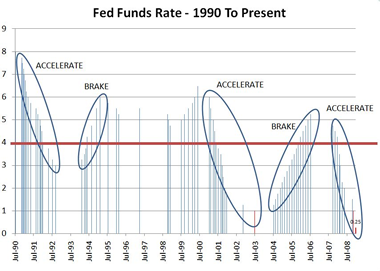
Go back to 1999-2000 and see what the Fed did. They are following the same pattern for 2005-06. If it ain't broke, the Fed will fix it... and good!
August 29, 2006 The Federal Reserve always acts on old information... and is the only cause of U.S. recessions.
December 5, 2006 Last spring I wrote about what I saw to be a sharp downturn in the economy in the "rustbelt" states, particularly Michigan.
March 28, 2007
The Federal Reserve sees no need to cut interest rates in the light of adverse recent economic data, Ben Bernanke said on Wednesday.
The Fed chairman said ”to date, the incoming data have supported the view that the current stance of policy is likely to foster sustainable economic growth and a gradual ebbing in core inflation”.

July 21, 2007 My guess is that if there is an interest rate change, a cut is more likely than an increase. The key variables to be watching at this point are real estate prices and the inventory of unsold homes.
August 11, 2007 I suspect that within 6 months the Federal Reserve will be forced to lower interest rates before housing becomes a black hole.
September 11, 2007 It only means that the overall process has flaws guaranteeing it will be slow in responding to changes in the economy... and tend to over-react as a result.
September 18, 2007 I think a 4% rate is really what is needed to turn the economy back on the right course. The rate may not get there, but more cuts will be needed with employment rates down and foreclosure rates up.
October 25, 2007 How long will it be before I will be able to write: "The Federal Reserve lowered its lending rate to 4% in response to the collapse of the U.S. housing market and massive numbers of foreclosures that threaten the banking and mortgage sectors."
November 28, 2007 FED VICE CHAIRMAN DONALD KOHN
"Should the elevated turbulence persist, it would increase the possibility of further tightening in financial conditions for households and businesses," he said.

"Uncertainties about the economic outlook are unusually high right now," he said. "These uncertainties require flexible and pragmatic policymaking -- nimble is the adjective I used a few weeks ago."
http://www.reuters.com/

December 11, 2007 Somehow the Fed misses the obvious.
fed_rate_moves_425_small.gif
[Image from: CNNMoney.com]
December 13, 2007 [from The Christian Science Monitor]
"The odds of a recession are now above 50 percent," says Mark Zandi, chief economist at Moody's Economy.com. "We are right on the edge of a recession in part because of the Fed's reluctance to reduce interest rates more aggressively." [see my comments of September 11]
January 7, 2008 The real problem now is that consumers can't rescue the economy and manufacturing, which is already weakening, will continue to weaken. We've gutted the forces that could avoid a downturn. The question is not whether there will be a recession, but can it be dampened sufficiently so that it is very short.
January 11, 2008 This is death by a thousand cuts.
January 13, 2008 [N.Y. Times]
“The question is not whether we will have a recession, but how deep and prolonged it will be,” said David Rosenberg, the chief North American economist at Merrill Lynch. “Even if the Fed’s moves are going to work, it will not show up until the later part of 2008 or 2009.
January 17, 2008 A few days ago, Anna Schwartz, nonagenarian economist, implicated the Federal Reserve as the cause of the present lending crisis [from the Telegraph - UK]:
The high priestess of US monetarism - a revered figure at the Fed - says the central bank is itself the chief cause of the credit bubble, and now seems stunned as the consequences of its own actions engulf the financial system. "The new group at the Fed is not equal to the problem that faces it," she says, daring to utter a thought that fellow critics mostly utter sotto voce.
January 22, 2008 The cut has become infected and a limb is in danger. Ben Bernanke is panicking and the Fed has its emergency triage team cutting rates... this time by 3/4%. ...

What should the Federal Reserve do now? Step back... and don't be so anxious to raise rates at the first sign of economic improvement.
Individuals and businesses need stability in their financial cost structures so that they can plan effectively and keep their ships afloat. Wildly fluctuating rates... regardless of what the absolute levels are... create problems. Either too much spending or too much fear. It's just not that difficult to comprehend. Why has it been so difficult for the Fed?

About Me

My photo
Michigan, United States
Air Force (SAC) captain 1968-72. Retired after 35 years of business and logistical planning, including running a small business. Two sons with advanced degrees; one with a business and pre-law degree. Beautiful wife who has put up with me for 4 decades. Education: B.A. (Sociology major; minors in philosopy, English literature, and German) M.S. Operations Management (like a mixture of an MBA with logistical planning)