READ ABOUT DETROIT AND SOLUTIONS TO ITS PROBLEMS. CLICK HERE.

Wednesday, December 08, 2004

Education Failure: We're no worse than...

Latvia!

In a Program for International Student Assessment survey comparing math skills, the U.S. proudly outshone such stellar educational competition as Uruguay, Thailand, Mexico, Indonesia, and Tunisia! That's the good news.

The bad news is that the richest country in the world was no better than mediocre, being outclassed by Hong Kong, Finland, South Korea, Netherlands, and Liechtenstein... big time!

Remember all of those high-paying, outsourced manufacturing jobs that are going to be replaced by intellectual-capital jobs? Well, apparently, that is not going to happen in the U.S. At least, not significantly more than it will happen in Uruguay or Latvia.

The problem with big-picture economics is that ideas are not always related to reality. There is a sequence that must be followed in order to go from A to C after B... A being manufacturing jobs, B being jobs outsourced, and C being new intellectual-capital jobs. I ask this (rhetorical) question: with the intellectual skills being displayed by today's U.S. students, what is the likelihood that they will take us from B to C?

Oh, there will always be the top-performers who will do well... even better relative to the general population. But what happens to the millions of Uruguay-level workers when the manufacturing sector has been shipped off to China or India or Vietnam because intellectual capital is not a factor for those jobs?

If you haven't read it, go back and read this.

Tuesday, December 07, 2004

Relationships: Lest we forget

December 7, 1941

Forgive... but never forget.

Americans are a forgiving people. But too often with forgiveness comes forgetting. Forgetting the sacrifices. Forgetting the lives lost or changed forever. Forgetting the lessons learned. Forgetting what our parents or grandparents did for us. Forgetting what we owe our children... and what they owe their children. Forgetting that liberty is dear and not cheap.

We are Americans first and foremost... not Irish-Ameicans, African-Americans, Arab-Americans, Mexican-Americans, Asian-Americans... Americans. When we forget that, we will not be forgiven by the rest of the world.

Monday, December 06, 2004

Excessive Spending: Miscellaneous Thoughts

I have previously posted concerns about the budget deficit and negative trade balance. Here are some things to consider. You draw your own conclusions, if you can.

  • U.S. dollar continues to fall versus foreign currencies as a result of less confidence in the U.S. dollar... which will:
    • make imported goods more expensive... including oil
    • make U.S. travel more attractive to foreigners
    • increase foreign ownership of U.S. real estate and corporations [I said previously that the trade deficit was a concern, ultimately, about who controls the U.S. assets]
    • increase the risk of inflation
    • increase U.S. corporate earnings (in U.S. dollars) from overseas operations
  • China accounted for more than 1/2 of the total non-oil trade deficit which is a result of both importing lower-cost Chinese products and outsourcing production and support of U.S. made products
  • Jobs are leaving the U.S. for the lowest cost source and there are serious disagreements about the impact of this trend for the U.S.
  • U.S. miltary expenditures are more than these combined:

    Russia* 65.0
    China* 47.0
    Japan 42.6
    United Kingdom 38.4
    France 29.5
    Germany 24.9
    Saudi Arabia 21.3
    Italy 19.4
    India 15.6
    South Korea 14.1
    Brazil* 10.7
    Taiwan* 10.7
    Israel 10.6
    Spain 8.4
    Australia 7.6
    Canada 7.6
    Netherlands 6.6
    Turkey 5.8
    Mexico 5.9
    Kuwait* 3.9
    Ukraine 5.0
    * 2001 Funding

Sunday, December 05, 2004

Politics: Democracy is not natural

Territorial Imperative.

I've written quite a bit about how the instinct of territorial imperative drives human behavior.

Some recent examples:

  • Ukraine - democratic elections overturned because of fraud
  • Afghanistan - 15 candidates for president claim voting irregularities... 15???!
  • Canadians believe U.S. CIA will "steal" Romanian elections???!
Of course, in Iraq, there is concern about the minority Sunni population, who have been responsible for a lot of the recent fighting, not having a legitimate chance to vote because there is fighting going on.

Children do not share instinctively. Infant democracies or democracies in waiting have difficulties because the children... er, factions... do not want to share power. It is better to be Lord of the Manor than have manners.

So, should the U.S. give up trying to influence or force countries into democracies? Not necessarily. But perhaps it is time to quit talking about democracies and use the term "representational government". The U.S. is, in fact, not a true democracy and does not promote true democracy. We directly vote in representatives (but not the president who is voted in by representatives in the "electoral college") who then vote their conscience or lack thereof in running the country... and that may not reflect the will of the people who elected them.

Then why the big concern about voting fraud if the guy who is elected can do what he wants anyway? Well, why go to the doctor when you're sick if you're going to die someday anyway? If the voters don't have a chance to fairly elect someone who may actually represent them instead of oppress them, then we have a good old dictatorship. Not too many dictators do a good job of representing the will of the people.

The representative form of government is the only chance for ordinary people to have a chance that their government will be for them instead of against them. So, even if voting is dangerous, even if voting is not perfect, the chance to vote and change the policies of the government is important... and it is the first step for the children to learn to really share. People who already have that privelege should help others gain that same privelege.

Friday, December 03, 2004

Excessive Spending: Guilty

I've gone off on the government for excessive spending and trade imbalance. Now I'm guilty of contributing.

Well, it's Christmas, dammit!

We finally replaced our 15-year-old TV with a new big screen digital light projection (DLP) monster. It is way too expensive for anything smaller than a pickup truck. In fact, now that I think about it, my first new car cost $500 less than this TV. Of course, that was 1968. My first house cost less than the pickup truck I bought two years ago. Of course, that was 1972. I still think that White Castles should be 10 for a buck.

I have a sore back from helping the truck driver get it into the house. But, surprisingly, this monster was pretty much plug and play.

We had so many choices that it only took about 9 months to finally decide. Naturally, none of the available choices were Made In USA. We settled on a futuristic looking set from Samsung, affectionally called the "Kirk" model by people who spend too much time on this stuff. Of course, now we have to get other things to work with the set. That's another matter.

Fortunately, I have three sons who are all experts in their own minds about anything technical. Well, they are pretty good at it... better than me, anyway. So, I'm going to let them figure out the S-Video and Componenet Video set-ups. Meanwhile, I did manage to get my 35-year-old, partially inoperative, speaker cabinets hooked up and working with it. Every once in awhile, the system controller goes into protect mode with those speakers shaking the wall. Then I shut down and restart the system and continue listening.

Now one of my sons and his girlfriend have pretty much taken over the TV. They assure me it's for a school project. So that gives me plenty of time to write this.

I guess that spread over 15 or 20 years the new TV isn't that big of an expense. It'll be obsolete by then... but so will I. Then I'll just go visit one of my sons and watch his whole-wall 3-D system or whatever technical magic he spends too much on.

Thursday, December 02, 2004

Relationships: What friends are for

Yesterday, I wrote about my life-long friend; a good man who did a bad thing.

I don't use the word "friend" freely. I have many "associates" whose company I enjoy, but few people who I care to call a friend. I reserve the term friend for people who have shared emotional bonds of support and trust over a period of time.

Some of those people are like the friend who is now in trouble. Some are people with whom I have worked and shared experiences both good and bad. What is constant is that we continue to care about each other, even though the circumstances that brought us together have long since disappeared.

My friend who is in trouble is like a brother to me... one that I have chosen (I dearly love my blood-related brothers, too). So, I could not simply hear the news of his trouble and just feel sorry for him. I telephoned him... a very difficult call to make. He was home alone and said he would be for a week or so. We talked frankly about his situation without castigation. I'm certain it was difficult for him... a strong mixture of regret and humiliation. But he didn't try to make excuses... he didn't have to with me and he knew that. What he knew was that I called because I cared about him and was concerned for him. He knew that, too.

We talked for about an hour. I told him that I would come to be in court for him... either to provide a testament to his good character or just to be there and let him know that his bad judgment didn't lessen my belief that he was a good man. When you choose to be a friend to someone, you don't walk away because they failed themselves. While you don't have to condone what they did to fail themselves, you can let them know that you care. If you don't or can't, perhaps you were not really friends afterall.

Wednesday, December 01, 2004

Relationships: Disappointment

Sometimes we find out things about people who are close to us that cause us to feel shock, bewilderment, disbelief... but most of all disappointment.

I learned yesterday that a friend of mine... someone I've known since the 5th grade... someone who was like a brother to me... was arrested for embezzlement. This is not some sleazy, drinking, drug-abusing, wife-beating guy. This is a guy who loves his wife and children, a guy who takes care of his elderly mother, a guy who attends church regularly, a guy who gives up expensive vacations so that his family needs are met.

But somewhere along the line he got lost. He couldn't say "no" to all of the requests for his time and money. He got buried by others' wants and needs. He equated love with giving things... being the perfect husband and father and son... instead of being what he could be and saying "no" when he had to.

Now his life is ruined and he can't help anyone... even himself. That knot in my gut is disappointment... that a good man got lost and no one was there to help him.

Tuesday, November 30, 2004

Politics: Not-so-free speech

Irony:

\"i-r€-nE\ n, pl -nies [L ironia, fr. Gk eirOnia, fr. eirOn dissembler] 1 : the use of words to express the opposite of what one really means 2 : incongruity between the actual result of a sequence of events and the expected result
(c)2000 Zane Publishing, Inc. and Merriam-Webster, Incorporated. All rights reserved
In an effort to gain military recruiters access to universities, the U.S. passed legislation that withheld federal funds from universities that barred recruiters.
In a 2-1 ruling, a three-judge panel of the 3rd U.S. Circuit Court of Appeals in Philadelphia, Pennsylvania, said a 10-year-old federal law that allows the government to block such funds violates the schools' First Amendment right to prohibit on-campus recruiting in response to the Pentagon policy [of banning openly gay men and women].
What is the point here? Ostensibly it is about the military's policy about homosexuals. But that's really a red herring.

The issue is free speech. The universities want to use the U.S. Constitution's First Amendment...
Congress shall make no law respecting an establishment of religion, or prohibiting the free exercise thereof; or abridging the freedom of speech, or of the press; or the right of the people peaceably to assemble, and to petition the Government for a redress of grievances.
to support the contention that military recruiters should not have the right to peacefully meet with students and freely speak about military careers... because the military does not allow homosexuals to join the military service and speak freely about their sexual orientation.

Two sides using the argument for constitutional right of free speech while taking action to deny others that right... irony.

Monday, November 29, 2004

Education Failure: Anonymous writes

Here's a simple idea that might help:

http://www.marginalrevolution.com/marginalrevolution/2004/11/paying_for_perf.html

Why not... as the article says, a lot of parents do that so let's have a portion of the salaries that would go to administrators of failing districts redirected to students who pass tests.

I can see it now. Those teachers who really hate the administrators will make sure all of their students pass the tests... even if they have to write the answers on the chalkboard.

It could work if the tests are administered in SAT or ACT fashion, but it might get out of hand if the "student mafia" gave the teacher "an offer he couldn't refuse".

Education Failure: One Child Left Behind

Nichole Christian writes in today's Detroit Free Press:

In truth, Chris had abandoned education long before a bullet tore through his abdomen five months ago. My family will not admit it without prompting, but he was a dropout in training, failed more by us than any of his teachers.

On the days Chris did show up for class at Chadsey High School -- one of three he drifted in and out of before his death -- it was more to be seen by friends and "females."

Shame over his struggle to read, going back to grade school, kept Chris as far as he could get from classrooms. His problem only worsened over time, growing up in a home where books were just as baffling for his guardians, my 83-year-old grandmother and my late grandfather.

Back on November 9, I wrote:
Perhaps it is time for:
  • having pay for performance for administrators... rather than pay for failure
  • limiting the percentage of funding for administration versus instruction and facility expenses
  • integrating social services into the school process
  • involving universities and businesses in the education process... not just "advising" school administration or providing cash donations
  • developing a "peace corp" program approach for failing districts
  • "nagging" parents into becoming involved... including visits by social services and the "benevolent association of police officers"
  • creating "boot camp schools" for students who are disruptive or just won't try
  • involving newspapers and broadcasting media in creative ways
Ms. Christian grieves the loss of her cousin. Such losses are tragedies... especially because they don't have to happen. They happen because of the choices that people make... that we allow people to make. As long as education is a choice, there will be children like Chris who fail and are failed. Children should not have a choice... they should have an education.

Our system of "rights" has become a system of "license"... not balanced by a system of "responsibility".

Our children have the license to do as they wish regarding education... and some die as a result. But we have protected their rights... sure we have.

Sunday, November 28, 2004

Education Failure: Education or Failure... Either Or

Educational achievement is one significant indicator of potential economic success. CNN reported the following:

Nearly 50 percent of Asians hold a college degree or more, compared with 30 percent of whites, 17 percent of blacks and 11 percent of Hispanics.
But the statistics need to be examined before one makes assumptions about the "intelligence" of an ethnic or racial group.
  • A high percentage of Asian immigrants had college degrees
  • A high percentage of Hispanic immigrants were poor and poorly educated
  • A high percentage of Blacks were poor or from single parent families
After the statistics have been examined, one can draw the conclusion that the data tell us absolutely nothing about intelligence... only that some groups have a much greater need to focus on education to overcome significant discrepancies in their earnings potential and what they can contribute to our society.

It is a really nice effort toward improving the self-esteem of poorly educated groups to say how important "ethnic diversity" is to our society. But quite honestly, having a lot of poorly educated people who do not contribute to the overall well-being of our society is really not made up by their contributions in the area of music, food and cheap labor.

At some point, the sheer weight of their ignorance will become overwhelming... such an anchor on the rest of society that social systems will start failing. Think about how those that are the source of cheap labor or no labor create a drag on any effort to improve health systems... they can't pay for hospitalization or doctor care and they can't qualify for jobs that have health insurance... so society eats the cost of health care. Likewise, they don't contribute much to the general fund for running our government at all levels... no income, no taxes.

And then we are supposed to make special accommodations for the less-than-qualified so that they can "have an opportunity be included".... Even that approach seems to backfire. Richard H. Sander, UCLA law professor described as "a soft-spoken former VISTA volunteer who for years has studied housing discrimination and championed efforts to fight segregation in Los Angeles" has concluded that:
law school affirmative action programs often draw African Americans to tougher schools where they struggle to keep up, leading many to earn poor grades, drop out and fail their state bar exams.
Well, duh. Common sense reigns at last. Law schools attempt to do what no college football coach in his right mind would do... bring in mediocre players into a premier league and expect them to be successful. If the students are not prepared... whether for law school or football... they simply will not do well competing and may, in fact, have a worse experience than if they competed at an appropriate level.

Until those groups who have failed to embrace education as the top priority for their children do so, their children are destined to have a much more difficult time competing as adults for the rewards of education.

Saturday, November 27, 2004

Excessive Spending: Trade Deficit

As our ANNUAL trade deficit hovers around $0.5 TRILLION dollars, the U.S. finds itself assailed by the World Trade Organization for trying to protect its domestic producers against "dumping"... the practice of selling goods in the U.S. for less than it sells in the originating country.

This time-honored practice of dumping goods is intended to undermine competitiors by making it impossible for them to make a profit while at the same time, keeping the dumper's factories going full tilt.

The Japanese are renowned for their efforts in this arena. It exports products at or below cost for awhile to gain a foothold while weakening competitors in their target country. Meanwhile, it blocks all attempts by those competitors to gain a foothold in Japan by requiring unit by unit product inspections and piles of paperwork. It works:for example, Japan imported $6 billion of automotive products while exported $63 billion in 2002 - see code 781 on those links (the bulk of the imported automobiles came either from Germany or from Japanese-owned factories in the U.S. -- Japan imported BMWs and Toyotas... but virtually no Fords or Chevys).

But the U.S., in its attempts to prevent unfair competition, is now blasted for "illegal" legislation... the Byrd amendment which fines imports that are being dumped and gives the fines to the companies that are being harmed by the dumping.

So, there you have it. If countries use the U.S. as a dumping ground... that's "free trade", but if the U.S. tries to protect it's home industries... that's illegal.

In a recent conversation with my oldest son, I suggested that the U.S. consider an additional, flat 10% "port security processing fee" on all imported goods. This would cover the cost of 100% "security" inspections and personnel that are now highly necessary to ensure against dangerous terrorists and smuggling.

Think we don't need those inspections. Read here.

The objectionable Bryd amendment should then be repealed. After all, in international trade, it's not what you do, it's what you call it.

Friday, November 26, 2004

Excessive Litigation: Lawsuits

One of my "mandates" was to address the issue of excessive litigation which affects not only doctors and our health care, but virtually every possible human interaction.

While researching "outrageous lawsuits", I came upon several sites that were dedicated to the subject. The first one I looked at must have been built with intentional irony: while providing examples of outrageous lawsuits, there were Google Ads along the side for law firms specializing in getting "quick cash" or "class action" lawsuits. But it had some mind-numbing examples of where common sense is replaced with nonsense.

Another site had examples of warning labels intended to avoid lawsuits... some real winners here.

California may not have a monopoly on outrageous lawsuits, but they get plenty. Perhaps it is because of their "West Wing" view of the law.

Okay, you've had your laughs (if you clicked on the links). But, it's not all that funny. Sen. Mark Hillman of Colorado testified before the Colorado state senate that litigation cost over $700 for every man, woman and child in the U.S. You think you don't pay it? The costs of litigation go right back into the cost of products and services... better believe it.

Of course, lawsuits are legitimate means of resolving differences that cannot be resolved in other ways. Daimler Chrysler (DCX) just lost a $105.5 million lawsuit; they will appeal. Two things are obvious to the reader:

  • $98 million for punative damages is a lot of damage
  • a product meeting all legal requirements for safety is not protected from the judicial process
Maybe DCX could have made the seats stronger. Maybe by making them stronger the seats could have caused other types of injuries in another type of accident (as DCX claimed). The appeals process will address these things, but juries are inclined to sympathize with families over corporations... and it is difficult to find the truth in conflicting "facts".

There are, of course, situations where individuals or corporations have been deliberately cheating others or causing harm. I suppose if DCX deliberately designed their seats so that they were dangerously flimsy, DCX should be punished to the tune of $98 million. The jury should have:
  • looked at comparative seat designs of all major minivan competitors including whether or not competitors' seats were designed to perform in the same manner for the type of accident in question.
  • seen evidence that the DCX design did not meet or exceed all Federal safety standards.
  • received data from insurance companies that DCX seats failed more often in similar accidents than major competitors... and that more passengers were injured as a result.
If the DCX product met all safety standards and performed as well or better than competitors, then the jury should have decided for the defendant, DCX. If I had been a juror, I would have expected to see such evidence and would have decided according to the evidence... as the evidence dictated.

The DCX lawyers should have provided evidence that their product was as good or better than most competition and met safety standards. If they did not, DCX has either inept representation or an inferior product. If they did, the jury wrongfully awarded money to the plaintiff... who should have sued the jerk who drove into them at twice the speed limit.

But in today's climate of excessive litigation, it is not necessarily who is wrong that is sued, but rather who can pay.

Wednesday, November 24, 2004

Happy Thanksgiving

Indeed!

Relationships: It's out there

Generally, if you want information on a subject, you can do a simple Google (or Yahoo or MSN or Dogpile or... you get it) search on a few keywords and you have more to read than you could want.

But what if you don't have anything in mind at all? I mean, what if you simply "let your fingers do the walking" on the keyboard and your brain is disengaged? You know, type in some random combination of letters.

I tried "achine". That's not a real word that I know of but, I ended up with pages of URLs. How about "flobar" or "gwist" or "toblast"? Yup, lots of information... that I'd never read. But they all make sense to someone.

Isn't the Internet fabulous? You could spend you whole life typing in random things and still never run out of stuff to read. Ummm... maybe that isn't so wonderful.

Maybe golf is better. I played 9 holes today with Seyed "M.H." [I need to keep that private], another gentlemen who saw me on the first tee and asked if he could join. In the process of playing nine holes, I learned that:

  • He was born in India and moved to what is now Pakistan after the British partitioned that off
  • He is 80-years old and hardly has any wrinkles, plus a pretty good grip on his handshake
  • He was married in 1949 and has five sons, but his wife died four years ago and he almost gave up golf and everything else when that happened... but now he plays three times a week.
  • He has five sons, two of whom are doctors, and one that is a banker and a grandson that is a doctor. The oldest son is 54.
  • He told me that "Seyed" means his family traces their lineage back to Mohammed.
  • He just got back from Washington, D.C.
  • He uses a riding cart because his knees are bad
  • He hits virtually every tee shot in the fairway and about as long as I do
  • He also putts pretty well, but some of his chip shots go haywire
  • He plans to play well into December... something most Michigan players don't do
I could have spent the two hours at my computer typing in random letters and getting random pages of information. But I went outside, got some exercise, had a random meeting with another person, and learned some things that simply aren't on the Internet... and it all made sense.

Tuesday, November 23, 2004

Business: Outsourcing Outsourced

The Detroit News ran a special section about job losses due to outsourcing. It described how jobs were being moved from one low income nation to another as companies searched for labor rates as close to zero as possible.

There is a certain Fellini quality to this storyline. People at subsistence levels of income were being displaced by people at slavery levels of income... 45-cents per hour! All in the name of "competition". The articles highlighted one Chinese girl who was thrilled with her 45-cents per hour.

Yet, there was something surreal about the pictures that went along with the stories. The Latin American people who were displaced were living in squalor; the Chinese girl was nicely dressed and riding on her motor scooter. The people who were making "too much" money had virtually nothing; the girl with "slave wages" was apparently just fine.

I'm not a currency expert, but I'm beginning to think that there is something slightly irrational about the way money operates within a nation and on the international scene. A nice apartment in India may cost $100 per month; a similar apartment in a U.S. city may run $1,000 per month... where you can't even get in the door for $100.

The point is that if the currency does not reflect comparable value, then one must ask what the currency is reflecting. There is no way that a girl earning 45-cents per hour should be able to afford food, clothing, housing and a motorscooter unless the internal currency valuation is completely disconnected from the external currency valuation.

The question then becomes: if the currency is not valued correctly, why is that the case? Is the dollar valuation incorrect or is the social order of another country creating this disconnect or what...? Somewhere, the valuation system is askew.

Economists argue that there may be some undervaluation of third-world currencies, but that in the case of China, for example, the Yuan has actually risen versus the dollar (despite the official exchange rate being held constant since 1995???).

I guess the issue is too complex for mere common sense.

Monday, November 22, 2004

Environmental Extremism: Limitless Energy Beneath Our Feet

On November 7, I wrote that nuclear power was the only reasonable alternative to oil consumption as an energy source for the 21st century. I still stand by that position. At least for the 1st half of the 21st century.

But what about other sources of energy... not storage media such as hydrogen gas or batteries... but SOURCES OF ENERGY?

Last week on the The West Wing, there was an interesting story line around alternative fuel advocates meeting with the administration. Each advocate took turns sniping at the others' weaknesses in the hope of becoming the long-term favorite. There was solar, wind, ethanol and hydrogen power advocates.

Solar and wind power are direct energy sources captured and converted directly to electricity. Ethanol and hydrogen are storage media for energy that has been converted from other sources that require large amounts of energy to produce.

The key is to create processes that efficiently convert large amounts of direct energy into electrical power. At present, there are limitations to our ability to convert large amounts of direct energy to electricity.

The virtually limitless amount of clean, geothermal energy available worldwide makes this energy source worth pursuing as a PERMANENT ALTERNATIVE to either oil or nuclear power. Geothermal energy would facilitate the non-polluting production of hydrogen fuel or electricity for battery-powered vehicles for our transportation needs.

Solar, wind and even small-scale geothermal energy could be used as local sources of power to augment a vast network of geothermal energy. Geothermal energy is available now for your home.


Sunday, November 21, 2004

Humor: Lose-Win

Win the battle and lose the war... and vice-versa.

Michigan loses to Ohio State in "The Game" and it doesn't really matter that much. Michigan still gets a share of the conference championship and still gets to go to the Rose Bowl. That's because it's competition ended up with poorer season performances... not by much... but enough.

We all have "a bad day"... and that's okay as long as that is the exception. It's the continual "bad days" that is the problem. Then it is time for reassessment and change.

But, you know, it's not always the losing or winning that counts. Sometimes, its just the fact that you got through the "bad day".

Saturday, November 20, 2004

Relationships: Win-Lose

Territorial Imperative
The rules of survival have changed and mankind is trying to adapt to the change. The question is can mankind overcome the most basic survival instinct, inbred over millions of years by countless species to survive, by using the same advantages that provided increasing mastery over the earth? [10/10]

Pacers in brawl with Palace fans
{ALSO CHECK OUT POSTS OF 10/9 and 11 and 11/15}
Excessive Spending
...the trade deficit does one thing that leaves me just a little paranoid... especially at 1/2 trillion dollars per year... and that is the issue of control. Somewhere in the equation of getting goods for cash is the part that says Cash = Control. Cash becomes the power to influence, the power to compete, and the power to control. [11/6]
Greenspan warns about nation's trade deficit
{ALSO CHECK OUT POST OF 11/4 and 19}
These "insights" are no more than dispassionately observing and continuously widening one's field of vision. Identifying problems is simple; implementing solutions... actions, policies, laws... that actually work is not so simple.

It's not that there are no solutions... it's just that most "solutions" are win-lose propositions. Why? Because so many "problems" are nothing more than competition for territory, power, wealth, and ideological control... generally win-lose propositions. Sometimes, compromise doesn't work... especially if one competitor sees an offer of compromise as "weakness" and "opportunity".

"Win-win"
takes a lot more effort than "win-lose"... especially if most of our systems and institutions are oriented to the latter. Ask the Democrats if you don't accept that proposition.

Friday, November 19, 2004

Excessive Spending: Is the Piper calling?

House OKs increase in debt limit

...the debt limit bill would pump up the federal borrowing cap to $8.18 trillion. That is 70 percent the size of the U.S. economy....
Back on November 6, I wrote about the dangers of excessive spending and my concern that both the budget and trade deficits would be a problem for us.

Yesterday, Rachel Beck, national business columnist for the Associated Press, wrote about the loss in value of the dollar versus other currencies.

There are many reasons for that decline. Most recently, pressures are coming from investors' nervousness that President Bush and his administration would do little to stem the dollar's slide.

U.S. Treasury Secretary John Snow on Monday said the United States would like the dollar to strengthen, but he repeated his position that international currency markets should be left to set its value.

Also weighing on the dollar are the huge U.S. trade and budget deficits....

There are indications that foreigners are starting to pull back their investments, which is worrisome given that they own about 48 percent of Treasurys and 24 percent of U.S. corporate debt, according to The Bond Market Association.

Former U.S. Treasury Secretary Robert Rubin suggested in a speech last week that unless politicians in Washington get serious about reducing the federal deficit, an acceleration of the dollar's decline could be far reaching.

What does this mean for the U.S.?
  • Inflation - cost of imported goods will increase. This will suppress sales of imported goods or goods with imported content... a lot of what is sold today
  • Unemployment - as inflation and interests rates rise... in response to inflation... the economy could slow down again
  • Higher taxes - as foreign investors move away from U.S. notes and bonds, the U.S. government must make up the revenue difference somewhere
Is there good news in this?
...there are plenty of economists who believe the sinking dollar is good news. One is Stephen Roach of Morgan Stanley, who thinks that the declining dollar will provide "long overdue restraint to interest-rate sensitive and asset-driven spending of American consumers and businesses."

That, in turn, will rebuild national savings, which will thereby reduce the large current account and trade deficits.

It sounds good. That is, if it works.

I think what that means is that if and when the U.S. government and/or foreign governments/investors decide that it's time for the U.S. to get responsible about its spending habits, there will be a whole new set of winners and losers in the economy.

If you have a lot of cash and little debt, then you will be able to take advantage of a lot of opportunities. But if you are like the U.S. government, you may find things tight for awhile.

Can"t Find It?

Use the SEARCH BLOG feature at the upper left. For example, try "Global Warming".

You can also use the "LABELS" below or at the end of each post to find related posts.

Blog Archive

Cost of Gasoline - Enter Your Zipcode or Click on Map

CO2 Cap and Trade

There is always an easy solution to every human problem—neat, plausible, and wrong.
Henry Louis Mencken (1880–1956)
“The Divine Afflatus,” A Mencken Chrestomathy, chapter 25, p. 443 (1949)
... and one could add "not all human problems really are."
It was beautiful and simple, as truly great swindles are.
- O. Henry
... The Government is on course for an embarrassing showdown with the European Union, business groups and environmental charities after refusing to guarantee that billions of pounds of revenue it stands to earn from carbon-permit trading will be spent on combating climate change.
The Independent (UK)

Tracking Interest Rates

Tracking Interest Rates

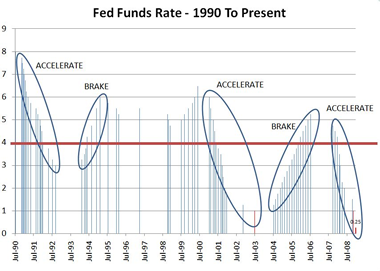
FEDERAL RESERVE & HOUSING

SEARCH BLOG: FEDERAL RESERVE for full versions... or use the Blog Archive pulldown menu.

February 3, 2006
Go back to 1999-2000 and see what the Fed did. They are following the same pattern for 2005-06. If it ain't broke, the Fed will fix it... and good!
August 29, 2006 The Federal Reserve always acts on old information... and is the only cause of U.S. recessions.
December 5, 2006 Last spring I wrote about what I saw to be a sharp downturn in the economy in the "rustbelt" states, particularly Michigan.
March 28, 2007
The Federal Reserve sees no need to cut interest rates in the light of adverse recent economic data, Ben Bernanke said on Wednesday.
The Fed chairman said ”to date, the incoming data have supported the view that the current stance of policy is likely to foster sustainable economic growth and a gradual ebbing in core inflation”.

July 21, 2007 My guess is that if there is an interest rate change, a cut is more likely than an increase. The key variables to be watching at this point are real estate prices and the inventory of unsold homes.
August 11, 2007 I suspect that within 6 months the Federal Reserve will be forced to lower interest rates before housing becomes a black hole.
September 11, 2007 It only means that the overall process has flaws guaranteeing it will be slow in responding to changes in the economy... and tend to over-react as a result.
September 18, 2007 I think a 4% rate is really what is needed to turn the economy back on the right course. The rate may not get there, but more cuts will be needed with employment rates down and foreclosure rates up.
October 25, 2007 How long will it be before I will be able to write: "The Federal Reserve lowered its lending rate to 4% in response to the collapse of the U.S. housing market and massive numbers of foreclosures that threaten the banking and mortgage sectors."
November 28, 2007 FED VICE CHAIRMAN DONALD KOHN
"Should the elevated turbulence persist, it would increase the possibility of further tightening in financial conditions for households and businesses," he said.

"Uncertainties about the economic outlook are unusually high right now," he said. "These uncertainties require flexible and pragmatic policymaking -- nimble is the adjective I used a few weeks ago."
http://www.reuters.com/

December 11, 2007 Somehow the Fed misses the obvious.
fed_rate_moves_425_small.gif
[Image from: CNNMoney.com]
December 13, 2007 [from The Christian Science Monitor]
"The odds of a recession are now above 50 percent," says Mark Zandi, chief economist at Moody's Economy.com. "We are right on the edge of a recession in part because of the Fed's reluctance to reduce interest rates more aggressively." [see my comments of September 11]
January 7, 2008 The real problem now is that consumers can't rescue the economy and manufacturing, which is already weakening, will continue to weaken. We've gutted the forces that could avoid a downturn. The question is not whether there will be a recession, but can it be dampened sufficiently so that it is very short.
January 11, 2008 This is death by a thousand cuts.
January 13, 2008 [N.Y. Times]
“The question is not whether we will have a recession, but how deep and prolonged it will be,” said David Rosenberg, the chief North American economist at Merrill Lynch. “Even if the Fed’s moves are going to work, it will not show up until the later part of 2008 or 2009.”
January 17, 2008 A few days ago, Anna Schwartz, nonagenarian economist, implicated the Federal Reserve as the cause of the present lending crisis [from the Telegraph - UK]:
The high priestess of US monetarism - a revered figure at the Fed - says the central bank is itself the chief cause of the credit bubble, and now seems stunned as the consequences of its own actions engulf the financial system. "The new group at the Fed is not equal to the problem that faces it," she says, daring to utter a thought that fellow critics mostly utter sotto voce.
January 22, 2008 The cut has become infected and a limb is in danger. Ben Bernanke is panicking and the Fed has its emergency triage team cutting rates... this time by 3/4%. ...

What should the Federal Reserve do now? Step back... and don't be so anxious to raise rates at the first sign of economic improvement.
Individuals and businesses need stability in their financial cost structures so that they can plan effectively and keep their ships afloat. Wildly fluctuating rates... regardless of what the absolute levels are... create problems. Either too much spending or too much fear. It's just not that difficult to comprehend. Why has it been so difficult for the Fed?

About Me

My photo
Michigan, United States
Air Force (SAC) captain 1968-72. Retired after 35 years of business and logistical planning, including running a small business. Two sons with advanced degrees; one with a business and pre-law degree. Beautiful wife who has put up with me for 4 decades. Education: B.A. (Sociology major; minors in philosopy, English literature, and German) M.S. Operations Management (like a mixture of an MBA with logistical planning)