READ ABOUT DETROIT AND SOLUTIONS TO ITS PROBLEMS. CLICK HERE.

Friday, June 13, 2008

Canada Says Suck It Up

SEARCH BLOG: OIL and NUCLEAR POWER

Those crazy Canadians, eh? Here in the U.S., we presume they are all wacko environmentalists and Labatt's drinkers who watch hockey 11 months out of the year [and spend one month walleye fishing]. They aren't going to mess around with "da great white nort."

That's a quaint image, but wrong. In case you haven't heard, Canada is a major supplier of oil and lumber to the U.S. [do they cut down the trees and then drill between the stumps?] Sure, they hunt and fish a lot, too. But Canadians don't appear to be afraid to use their natural resouces [and unnatural ones, too].

The last week I was perusing the Detroit Free Press and came upon an article that demonstrates that point:

There is a map included that is interesting:

The refinery is downstream from a nuclear waste facility. Looks like the water flowing into Lake Erie will be supercharged with radioactive oil spills... or not.

Meanwhile, in the U.S., there is still haggling over the use of Yucca Mountain in the middle of nowhere. Back in 2004 I wrote:
Well, what about the waste? The environmentalists want us to believe that burial of wastes in hundreds... thousands... of feet of rock leaves us in danger. Sorry, that's simply not true (147 page pdf file from the Nuclear Regulatory Commission - Risk Insights Baseline Report - April, 2004). Now there are those who say that the Yucca Mountain nuclear burial site cannot guarantee, absolutely, 100%, that no radiation will escape into the biosphere. That's correct. There are no absolute guarantees of anything. The question is: does the very minimal risk of a minimal amount of radiation in the atmosphere sometime in the next 10,000 years outweigh the risks of continuing to burn fossil fuels at an increasing rate over the next century?
First I say the French are correct and then I say the Canadians are correct. I'd better watch out for Homeland Security.

..

Thursday, June 12, 2008

Golfing Michigan

SEARCH BLOG: GOLF

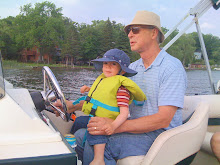
It's a beautiful day in Michigan... the kind of day we anticipate and enjoy greatly... mid-80s, sunny, nice breeze, and golf.

It's 7:30 am and I'll be out the door soon. My neighbor and I join a group of retirees who play different courses around the area. As seniors, we never have to pay more than $30 which suits us all just fine. The level of our game doesn't justify a $200 greens fee.

Michigan has an abundance of nice courses. It's one of those hidden treasures. For a state that is associated with automobile manufacturing and an unattractive urban center, the greater part of this state is a recreation paradise. Water is a big part of that. There are more boats per capita than just about any other state.

So, while we have to put up with cold winters [some like that for skiing, snowmobiling, and ice fishing], the summers are terrific. Come on up and check it out.

..

Another Debate Is Over

SEARCH BLOG: RELIGION and ISLAM

Looks like the girlie Catholics are complaining that the holy warriors of Islam have taken over the religious discussion:

It's because they have no real intentions on making any concessions (churches in Saudi Arabia, freedom to worship, convert etc.). We must bow to their demands, and that's the end of it. HT Weasel Zippers
See, all you have to do is say "the debate is over" and you win... especially with "true believers."

..

Wednesday, June 11, 2008

Hillary's Last Gambit?

SEARCH BLOG: POLITICS

It's not possible, is it? Could she still have a chance?

Is Obama's candidacy constitutional?
..

Does CO2 Cause Lack Of Sunspots?

SEARCH BLOG: SUNSPOTS

Scientists not sure why Sun ‘continues to be dead’

My guess is that this is just another phenomenon like hurricanes, floods, droughts, and snow in Baghdad, that can be traced back to human-generated CO2 increases.

Fortunately, the Carbon Tax proposed by Rep. John Dingell, et al, will probably cause sunspots to return soon... maybe not in as many numbers as before, but before the sun goes out forever.

Meanwhile, earth remains in a cooling phase oddly coincidental with the sunspot decrease. This proves that CO2 is driving climate change since it causes sunspot decreases which have been linked to a cooling climate.

No longer can we just talk about global warming attributed to anthropogenic CO2 increases. We must now speak about Climate Change... either warming or cooling caused by driving SUVs.
The debate is over!

..

Tuesday, June 10, 2008

A Coffee Carafe That Works

SEARCH BLOG: TECHNOLOGY

We had this $40 stainless steel coffee carafe that was okay. It kept coffee warm for a couple of hours. After that, we had to jolt the coffee in the microwave [in a cup of course]. But the lever on the lid broke recently so I decided to research our next carafe. Did I say that I like coffee... a lot?

We settled on an Alfi carafe made in Germany [that last unit was made in China]. Our oldest son was looking for Father's Day, birthday, anniversary gifts for us, so we said get that carafe. We got it late yesterday and tried it today. I never realized that a carafe could work so well. Six hours after I poured the coffee in the carafe it was steaming hot. After eight hours, with only one cup remaining in the carafe, the coffee was still pleasantly hot... although maybe not steaming hot. The quality of the carafe is obviously far superior to the old one.

For a coffee addict like me, there couldn't have been a better gift.

..

Carbon Tax Proposal

SEARCH BLOG: TAXES

Recently, I included a subtle link to the following proposal by Rep. John Dingell of Michigan.

What do you think?

Summary of Draft Carbon Tax Legislation Representative John D. Dingell

The earth is getting warmer and human activities are a large part of the cause. We need to act in order to prevent a serious problem. The world’s best scientists agree we need to reduce greenhouse gas emissions by 60-80 percent by 2050 in order to limit the effects of global warming and this legislation will put us on track to do just that.

This is a massive undertaking, and it will not be easy to achieve, but we simply must accomplish this goal; our future and our children’s futures depend on it.

In order to get to this end we need to have a multi-pronged approach. In addition to an economy wide cap-and-trade program, which would mandate a cap on carbon emissions, a fee on carbon is the most effective way to curb emissions and make alternatives economically viable.

Below you will find a summary of the carbon tax legislation I am working on. I invite you to comment on the proposal. Once I have received your comments, I will look at ways we can address the ideas and concerns brought to my attention by the American people.

We must remember we all have a common goal and are in this fight together. I look forward to hearing from you.

The legislation I am proposing would impose the following:

A tax on carbon content:

  • $50 / ton of carbon (phased in over 5 years and then adjusted for inflation)
    • Coal, including lignite and peat
    • Petroleum and any petroleum product
    • Natural gas

A tax on gasoline:

  • .50/ gallon of gas, jet fuel, kerosene (petroleum based) etc…(added to current gas tax) (phased in over 5 years and then adjusted for inflation)
    • Exemption for diesel – The fuel economy benefits of diesel surpass even its emissions benefits; it provides about a thirty percent increase in fuel economy and a twenty percent emissions reduction
    • Biofuels that do not contain petroleum are exempt. Biofuels blended with petroleum are only taxed on the petroleum portion of the fuel.

**The .50 gas tax is in addition to what is derived from the per ton carbon tax in the previous bullet.

Phase out the mortgage interest deduction on large homes. These homes have contributed to increased sprawl and longer commutes. Despite new homes in and of themselves being more energy efficient, the sheer size, sprawl and commutes lead to dramatically more energy use – or to put it more simply, a larger carbon footprint.

Specifically, the proposal:

  • Phases out the mortgage interest on primary mortgages on houses over 3000 square feet.
    • Exemptions for historical homes (prior to 1900) and farm houses.
    • Exemptions for home owners who purchase carbon offsets to make home carbon neutral or own homes that are certified carbon neutral.
    • An owner would receive 85% of the mortgage interest deduction for homes 3000-3199 square feet
    • 70% for homes 3200-3399 square feet
    • 55% for homes 3400-3599 square feet
    • 40% for homes 3600-3799 square feet
    • 25 % for homes 3800-3999 square feet
    • 10% for homes 4000-4199 square feet
    • 0 for homes 4200 square feet and up

See an example of how the changes in the mortgage interest deduction would work.

Where will the revenue go?

First and foremost, the Earned Income Tax Credit will be expanded. This helps lower income families compensate for the increased taxes on fuels.

  • Expansion of the Earned Income Tax Credit
    • Zero Children:
      • max earned income level from $5,590 to $7000
      • Phase-out from $7000 to $9000
    • One Child:
      • Max earned income level from $8390 to $10,000
      • Phase-out from $15,390 to $17,000
    • Two or More:
      • Max earned income level from $11,790 to $15,000
      • Phase-out from $15,390 to $18,000

The revenue from the gas tax goes into the high way trust fund, with 40 % going to the mass transit and 60 % going to roads. The revenue from the tax on jet fuel goes into the airport and airway trust fund.

Finally, the revenue from the fee on carbon emissions will go into the following accounts:

  • Medicare and Social Security
  • Universal Healthcare (upon passage)
  • State Children’s Health Insurance Program
  • Conservation
  • Renewable Energy Research and Development
  • Low Income Home Energy Assistance Program
I'm sure Rep. Dingell would love to hear from you. Please comment if you have any strong feelings about this. Here are mine:
Name: Mr. Bruce Hall
Do you support a cap-and-trade system? NO to cap-and-trade
Do you approve of the idea of a carbon tax? NO to carbon tax
Comment:
The 1960s and 1970s were the beginning of a new ice age and then the naturally occurring climate oscillations moved to the warm side. Then the 1990s became the Global Warming age and we were going to be flooded with rising oceans. Now it is becoming painfully obvious to those who actually follow the data that we are beginning a cooling phase... one that started at least 5 years ago.
http://wattsupwiththat.wordpress.com/2008/06/06/rss-global-temperature-also-cooler-in-may/
This despite obvious attempts to restate the historical temperatures:
http://www.theregister.co.uk/2008/06/05/goddard_nasa_thermometer/print.html
Actually, the climate has cooled since the 1930s.
http://hallofrecord.blogspot.com/2008/05/telling-tall-tales-with-trends.html
While I must presume sincere concern for the climate on your part, I must also conclude that your schedule precludes actually reading much about it. This proposed legislation is no more than a massive tax and income redistribution scheme that even the Soviets would have blushed to propose. Rather than move outside your area of expertise, you should be focusing on the onerous legislation that is killing the domestic auto industry.


..

Monday, June 09, 2008

Check Out Icecap

SEARCH BLOG: CLIMATE

For those of you who are interested in cutting through the BS about what this or that weather even means with regard to climate, you might try ICECAP. Included in that site is a blog by Joseph D’Aleo who is a certified consultant meteorologist and was the first Director of Meteorology at the cable TV Weather Channel. His blog has many notable guest authors.

Today, for example, he dispels the notion that "global warming" is causing tornadoes and flooding in the central states.

..

The iPhones Are Coming; The iPhones Are Coming

SEARCH BLOG: TECHNOLOGY

I've got to hand it to Apple. They know how to create product excitement. But never having owned an Apple product, I can't attest to the real value of their products versus their competitors.

The new 3G iPhone goes on sale today. My two younger sons are eagerly awaiting the opportunity to purchase one. Given that I have a couple of antique [in cell phone years] cell phones that are already on their second set of batteries [and those may need replacement soon], I may consider going to the opposite end of the spectrum with an iPhone.

Actually, it is more for my wife who cannot travel more than 5 miles without internet withdrawal. When we travel, I have to bring my laptop and we must stay at places that offer wi-fi. So many blogs to read; so little time to read them.
My wife and I are probably like a lot of couples who have children whose ages are in the 20s and 30s. We don't actively seek new technology, but can be sold on a product... after it has been thoroughly vetted by our children. All it takes is "this stinks" from them to immediately end any consideration of a product. On the other hand, a "this is great" allows further consideration... after a careful weighing of the costs, probable use, and identification of specific benefits that we simply "must have."

So, it is possible that we may eventually become iPhone customers... or not. I might find it useful as a device to get internet access for my laptop... if it can serve that function. Looking at a small screen and trying to type on a keyboard the size of a Hershey's miniature candy bar does not seem either functional or appealing. It might come in handy in an emergency, but certainly not for constant use as a primary interface.
I could see value if there was a foldable, standard-sized keyboard that I could whip out and use with the iPhone... not one of those flat, Mylar types, but one that gives some tactile feedback. Maybe that's available at a reasonable price.
I recognize that my wife and I are not the target demographic for the iPhone. Still, it could be an interesting upgrade from our old single-function cell phones.

ADDENDUM

This is what I had in mind:

A Bluetooth keyboard for the iPhone?

by Stephen Chinnadorai on Jan 22, 2008 at 03:25 PM

Bluetooth Keyboard with SmartphoneThe Macworld Expo is like CES - so many products to see that you forget about most of the smaller ones. But sometimes, the smallest products are the coolest and most innovative out there. Macworld picked up on something quite special: The $100 BTKeyMini from MacAlly. It’s a small, portable, foldable Bluetooth keyboard - something that many of you will have seen before in the past. So what’s so special about the BTKeyMini? A writer at Macworld had a talk with one of the MacAlly representatives, and apparently when the BTKeyMini arrives in March, it will be compatible with iPhone. If this is true - it will be a first. You will be able to use it in any iPhone application where the normal touch-screen would be used as a keyboard input.

UPDATE

Actual available date is July 11; prices start at $199.

..

Sunday, June 08, 2008

The Economics Of Diesel

SEARCH BLOG: DIESEL

I have to admit that the fuel efficiency of diesel engines along with the technology advances that have cleaned up those engines have made them seem particularly attractive as a choice for vehicles of all sizes. But there is more to the story.

Friday morning, on CSPAN's Washington Journal, Peter Coy of Business Week, answered questions from callers around the country. Other than his "folk science" wisdom about global warming, I found his answers informative and sometimes surprising. Most of us are aware of the surging demand for oil products around the world. Some of us may be aware of the various governments that subsidize gasoline for their citizens... a practice that keeps demand artificially high.

While $0.12... yes, that's a zero... per gallon gasoline in Venezuela may not generate much demand from a global perspective, when you add in subsidies in India, China, the Middle East Arab nations, and Indonesia, you get a large percentage of the world's population paying much less than the free market price of this product. So, despite the cost of gasoline in Europe or the U.S., demand in other parts of the world keeps growing rapidly.
Mr. Coy pointed out that we now have sufficient supplies of ethanol for blending into gasoline here in the U.S. and he would favor dropping tariffs on Brazilian ethanol. But it isn't the absence of ethanol that is the problem. It is the use of ethanol in the formulation of gasoline that affects the price of diesel fuel... and the price of diesel fuel is affecting everything else.

Diesel is in strong demand partly because China is using more to run factories and generate power. Most recently, the Sichuan earthquake has increased the use of diesel generators. Meanwhile, more cars in Europe are running on diesel. And in both the U.S. and Europe, tighter sulfur standards have reduced the amount of diesel that can be produced from a barrel of crude.

The result: Refiners are fighting over crude supplies even at today's high prices because they can still make plenty of money by turning the crude into sought-after diesel. As of May 27, a barrel of diesel was going for about $32 more than a barrel of Light Louisiana Sweet crude oil, according to Platts, the energy and metals information unit of The McGraw-Hill Companies. In contrast, gasoline is plentiful, so the price spread for gasoline over crude was just $6. "The diesel is in control," says John Kingston, director of oil for Platts.

The ethanol boom is the strangest factor in the tight diesel market. Refiners don't need to produce as much gasoline now that they're blending lots of ethanol into it. Less gasoline makes for less hydrogen, which is a by-product of gasoline refining. So there's less hydrogen to use in producing low-sulfur diesel, says Phil Verleger, head of the PKVerleger consulting firm in Aspen, Colo. One more example of the law of unintended consequences.

So, let's get this straight. The government mandates low sulfur diesel fuel and the use of ethanol in gasoline to reduce the consumption of oil... and supposedly reduce the price of gasoline... but the use of ethanol reduces the necessary hydrogen from the refining process needed to produce diesel fuel which, along with the need for more oil to produce low-sulfur diesel fuel, increases oil consumption and drives up the price of gasoline.
Hell, let's just blame it on global warming.
..

Friday, June 06, 2008

Climate Bill Fails

SEARCH BLOG: CLIMATE and POLITICS


Senators Byrd and Kennedy have medical excuses.

Senators McCain and Obama apparently do not want to be forced to back up their campaign rhetoric.

..

Filed Under Huh?

SEARCH BLOG: DUH

Filed under: we need to rethink our strategy.

"SAN FRANCISCO -- The nation's top nuclear weapons design lab has laid off hundreds of workers, raising concerns about a brain drain and stirring fears that some of these highly specialized scientists will sell their expertise to foreign governments, perhaps hostile ones.

Because of budget cuts and higher costs, Lawrence Livermore National Laboratory laid off 440 employees May 22-23. Over the past 2 1/2 years, attrition and layoffs have reduced the workforce of 8,000 by about 1,800 total."


What happened to the notion that the U.S. could outsource all of those old industrial jobs and focus on our future of being the intellectual leaders of the world... with all of the attendant scientific and engineering jobs?
File under: with friends like this, who needs enemies?
"Other Michiganders endorsing Obama were Detroit Mayor Kwame Kilpatrick, National Education Association board member Joyce Lalonde, Michigan AFL-CIO Secretary-Treasurer Tina Abbott and Michael Tardif, a Detroit political consultant with ties to Mayor Kilpatrick."

Hey, didn't Obama just get rid of Rev. Wright. Now he has picked up Mayor Wrong!
Filed under: I didn't know the world worked that way.
"Because if we are willing to work for it, and fight for it, and believe in it, then I am absolutely certain that generations from now, we will be able to look back and tell our children that this was the moment when we began to provide care for the sick and good jobs to the jobless; this was the moment when the rise of the oceans began to slow and our planet began to heal; this was the moment when we ended a war and secured our nation and restored our image as the last, best hope on Earth."

See, if you hope and work for change and provide universal health care and jobs to everyone, then global warming will stop and war will be over. Perhaps another clarification will follow... because I'm not sure what IT entails. But it sounds so nice.
..

Thursday, June 05, 2008

Driving Climate Change

SEARCH BLOG: CLIMATE

Politicians have an innate sense about how things work.

When it comes to climate change, politicians have identified the key elements needed to prevent runaway global warming.

  • CO2 Cap and Trade - this will reduce CO2 by funneling money into the pockets of government and Cap and Trade funds
  • Mandating more ethanol - this will reduce CO2 by making vehicles less fuel efficient than burning straight gasoline
  • Tax increases - unless the remote possibility that someone might complain actually happens, but less money for driving means ... more money for the government? Maybe we could just have a Carbon Tax instead of higher fuel taxes. No one would notice that.... Hey, I said the Carbon Tax without the increased gasoline tax.
As I said, politicians have an inane sense about how things work.

..

Driving Interest Rates

SEARCH BLOG: FEDERAL RESERVE

The economy is big, it is complex, and it doesn't show it's hand right away. It is the financial version of climate.

Every once in awhile, some major event will create a disruption in both systems. A volcano erupts; oil prices skyrocket. When that happens, we have a choice: try to enact emergency measures to counter the event or sit back and wait until a new state of balance is achieved. Of course, some events... an asteroid impact or a world war... completely change the system.

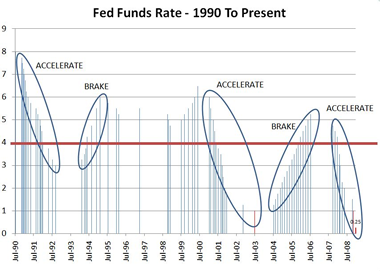
The Federal Reserve has chosen to try to address every fluctuation in the economy as if it were a major event. It is possible that the housing market collapse, followed by the banking crisis, concomitant with the run-up of oil prices is the financial equivalent of a small asteroid impact. But if we examine the sequence of events, we can see that the Fed may have overreacted several times in this decade... causing or greatly contributing to the very situations it then tried to correct with further reactions.

Imagine driving a car the way the Fed drives interest rates. The first step is to remain very close to the vehicles ahead. That way you know instantly when something is happening and can react very quickly. If the vehicle ahead slows down, you slam on the brakes and, if the vehicle ahead speeds up, you slam on the accelerator. The people behind you do the same thing. You put a lot of wear on your brakes and you use a lot more gasoline than you might have to, but you get to where you are going.

Of course, the choice to back off and allow a larger space between your car and the vehicle ahead is rarely considered. The minor slowdowns and increases in speeds that now cause you to overreact would simply manifest as increases and decreases in spacing while your speed held fairly steady. If you did have to change speed, it would be gradually and a small amount. And you might find out that those mysterious traffic jams caused by "rubberbanding" suddenly go away.
Sure, driving interest rates is a lot more complex than driving a car... or is it?

[click image to enlarge]

..

Wednesday, June 04, 2008

Will Interest Rates Go Up Soon?

SEARCH BLOG: FEDERAL RESERVE

The "I" word is back in the Federal Reserve's vocabulary.

Ben Bernanke may have come to the conclusion that he didn't really accomplish much by lowering the Fed funds rate to 2%, so don't be surprised to see the rates go up to 3% sometime soon. 4% still seems like a good long-term target... without the constant yo-yo approach.

The world seems to think that 2% is just a tad low and reacted well to the news that further cuts were not going to happen. I suspect they suspect near-term rate increases.

Just don't go overboard like last time... too much, too fast. Remember that a 4 pp increase is just that whether the starting point is 2% or 5%. Too much, too fast just creates turmoil rather than stability.
..

Telling Tall Tales With Trends - Verse 2

SEARCH BLOG: CLIMATE

If you have been a regular reader of this blog, you know that I have had a "show me" attitude when it comes to climate change. Computer models are insufficient... even if there is a modest correlation for a short time with measured temperatures... especially since the "trend" of change is punctuated with regular oscillations that are significantly greater than the calculated overall change.

When it comes to CO2 as the major driving force behind annual or decadal changes in local, regional, or global temperature changes, count me as a complete unbeliever. The correlation is simply not even in the realm of plausible. Especially with the data showing CO2 increases after temperature increase... not the other way around. [There are many posts regarding CO2 on this blog if you really want to spend a lot of time... just do a search on CO2]

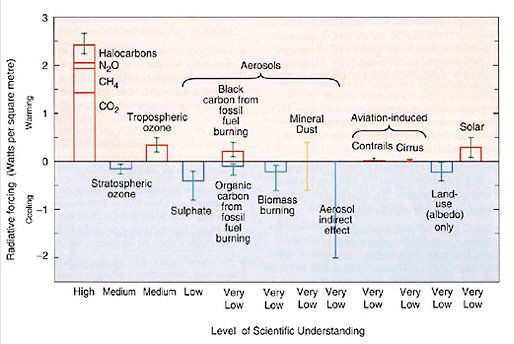
While scientists come up with all sorts of possible explanations about climate variations, the real answer is that they simply don't have enough information to definitively show what causes climates to vary... and why the variation is so inconsistent from one region of the world to another. [Check out the chart near the end of the right column.]

Blame it on ocean currents or land use or volcanoes or whatever. The earth has a highly dynamic environment that can be influenced by a variety of unpredictable changes. One good super-volcano and we might have an ice age. But in less geologically chaotic circumstances, it would seem that longer term changes are most likely caused by variations in the heating system.

Over at Anthony Watt's blog, he has a post about how there seems to be a downward trend in the activity of the heating system. As I pointed out in Verse 1, you have to be very careful about declaring a trend... and the shorter the history, the less likely the trend will be meaningful.

So, let's not bring out the old "the ice age is coming" posters quite yet.

..

Tuesday, June 03, 2008

Universal Health Care

SEARCH BLOG: POLITICS

How will Obama address this?

..

Shades Of 1980

SEARCH BLOG: ECONOMY

Gasoline prices tripled. Manufacturing was tanking. Housing construction was at a standstill. Inflation was rampant. Mortgage rates were over 15%.

We now have the first three again.

Reuters wrote:

United States manufacturing declined in May for the fourth consecutive month while inflation surged to the highest in four years, heightening fears of stagflation.
Hmmm.

..

Europeans Prefer Obama

SEARCH BLOG: POLITICS

This via An Englishman's Castle
.

"So based on the data, people who HATE America prefer Barak Obama. That says it all."
..

Monday, June 02, 2008

Adjusting To The New World Order

SEARCH BLOG: ECONOMY and POLITICS

Last year, I wrote a series of posts about the proposed, then enacted, then repealed Michigan Service Tax [see links at bottom of the right column]. This was an ill-conceived and ill-timed venture into bleeding a sick patient... 18th century medicine for 18th century economics.

The State then "compromised" by jacking up the existing business tax so that businesses were often being charge several multiples of their previous taxes. Ditto.

Meanwhile, the State was alternately projecting deficits and surpluses based on various accounting surprises. Regardless, the approach was the same: increase budgets during a severe state economic recession. During all of this, my position remained the same: the State needed to budget according to the situation... cut the budget by 5%. Do what any business does when things get tough... do more with less... or at least do the same with less.

That's a difficult and foreign concept to governments. Governments have commitments! So do individuals and businesses. The difference is that governments too often see every program as a necessary commitment. Individuals and businesses understand that there are times when some spending simply has to stop or be reduced significantly. When a government fails to understand that, it comes in conflict with its residents and businesses. When that happens, residents and businesses leave.

That result is the opposite of the stated goal of this state's government.
Today's Detroit News ran the following headline: Michigan braces for another messy fight over budget, taxes
The fiscal experts say the national economic drop-off, skyrocketing gas prices, declining housing industry, lucrative tax credits and restructuring of the domestic auto industry will sock the struggling state -- leaving the treasury $472 million short of tax revenue projections made just five months ago.

As a result, lawmakers will try to make ends meet as they negotiate a deal over the next several weeks for the budget year that begins Oct. 1.

All sides have vowed not to raise taxes again this year. But spending for schools and colleges, municipal governments, job training and nursing programs, and Medicaid as well as tax breaks for filmmakers, the working poor and business all will be on the table.

...

"We won't be able to do the $600 million increase in spending the governor has proposed, but I want to see some modest increase, especially in higher education and community colleges and programs to help the less fortunate."
It's time to set priorities. It is also time to closely examine our assumptions. It is definitely time to set conditions upon any aid being provided. I'll give a "for example."
Rather than give scholarships or grants or other forms of educational aid without conditions, offer up loans [as available] that can be partially forgiven if the student completes the degree or program... and works in Michigan or for a Michigan company for a minimum of two years.

One of the biggest problems with the present government strategy of supporting universities and students with gifts of money is that the students leave the state to work elsewhere. We pay and other states benefit. At a minimum, the State should get its money back from the students if they leave for another state.
The point is that it's time for government to be more businesslike. Government has spent far too much trying to be coddling parents to its people rather than a steward of the commonwealth.

..

Can"t Find It?

Use the SEARCH BLOG feature at the upper left. For example, try "Global Warming".

You can also use the "LABELS" below or at the end of each post to find related posts.

Blog Archive

Cost of Gasoline - Enter Your Zipcode or Click on Map

CO2 Cap and Trade

There is always an easy solution to every human problem—neat, plausible, and wrong.
Henry Louis Mencken (1880–1956)
“The Divine Afflatus,” A Mencken Chrestomathy, chapter 25, p. 443 (1949)
... and one could add "not all human problems really are."
It was beautiful and simple, as truly great swindles are.
- O. Henry
... The Government is on course for an embarrassing showdown with the European Union, business groups and environmental charities after refusing to guarantee that billions of pounds of revenue it stands to earn from carbon-permit trading will be spent on combating climate change.
The Independent (UK)

Tracking Interest Rates

Tracking Interest Rates

FEDERAL RESERVE & HOUSING

SEARCH BLOG: FEDERAL RESERVE for full versions... or use the Blog Archive pulldown menu.

February 3, 2006
Go back to 1999-2000 and see what the Fed did. They are following the same pattern for 2005-06. If it ain't broke, the Fed will fix it... and good!
August 29, 2006 The Federal Reserve always acts on old information... and is the only cause of U.S. recessions.
December 5, 2006 Last spring I wrote about what I saw to be a sharp downturn in the economy in the "rustbelt" states, particularly Michigan.
March 28, 2007
The Federal Reserve sees no need to cut interest rates in the light of adverse recent economic data, Ben Bernanke said on Wednesday.
The Fed chairman said ”to date, the incoming data have supported the view that the current stance of policy is likely to foster sustainable economic growth and a gradual ebbing in core inflation”.

July 21, 2007 My guess is that if there is an interest rate change, a cut is more likely than an increase. The key variables to be watching at this point are real estate prices and the inventory of unsold homes.
August 11, 2007 I suspect that within 6 months the Federal Reserve will be forced to lower interest rates before housing becomes a black hole.
September 11, 2007 It only means that the overall process has flaws guaranteeing it will be slow in responding to changes in the economy... and tend to over-react as a result.
September 18, 2007 I think a 4% rate is really what is needed to turn the economy back on the right course. The rate may not get there, but more cuts will be needed with employment rates down and foreclosure rates up.
October 25, 2007 How long will it be before I will be able to write: "The Federal Reserve lowered its lending rate to 4% in response to the collapse of the U.S. housing market and massive numbers of foreclosures that threaten the banking and mortgage sectors."
November 28, 2007 FED VICE CHAIRMAN DONALD KOHN
"Should the elevated turbulence persist, it would increase the possibility of further tightening in financial conditions for households and businesses," he said.

"Uncertainties about the economic outlook are unusually high right now," he said. "These uncertainties require flexible and pragmatic policymaking -- nimble is the adjective I used a few weeks ago."
http://www.reuters.com/

December 11, 2007 Somehow the Fed misses the obvious.
fed_rate_moves_425_small.gif
[Image from: CNNMoney.com]
December 13, 2007 [from The Christian Science Monitor]
"The odds of a recession are now above 50 percent," says Mark Zandi, chief economist at Moody's Economy.com. "We are right on the edge of a recession in part because of the Fed's reluctance to reduce interest rates more aggressively." [see my comments of September 11]
January 7, 2008 The real problem now is that consumers can't rescue the economy and manufacturing, which is already weakening, will continue to weaken. We've gutted the forces that could avoid a downturn. The question is not whether there will be a recession, but can it be dampened sufficiently so that it is very short.
January 11, 2008 This is death by a thousand cuts.
January 13, 2008 [N.Y. Times]
“The question is not whether we will have a recession, but how deep and prolonged it will be,” said David Rosenberg, the chief North American economist at Merrill Lynch. “Even if the Fed’s moves are going to work, it will not show up until the later part of 2008 or 2009.”
January 17, 2008 A few days ago, Anna Schwartz, nonagenarian economist, implicated the Federal Reserve as the cause of the present lending crisis [from the Telegraph - UK]:
The high priestess of US monetarism - a revered figure at the Fed - says the central bank is itself the chief cause of the credit bubble, and now seems stunned as the consequences of its own actions engulf the financial system. "The new group at the Fed is not equal to the problem that faces it," she says, daring to utter a thought that fellow critics mostly utter sotto voce.
January 22, 2008 The cut has become infected and a limb is in danger. Ben Bernanke is panicking and the Fed has its emergency triage team cutting rates... this time by 3/4%. ...

What should the Federal Reserve do now? Step back... and don't be so anxious to raise rates at the first sign of economic improvement.
Individuals and businesses need stability in their financial cost structures so that they can plan effectively and keep their ships afloat. Wildly fluctuating rates... regardless of what the absolute levels are... create problems. Either too much spending or too much fear. It's just not that difficult to comprehend. Why has it been so difficult for the Fed?

About Me

My photo
Michigan, United States
Air Force (SAC) captain 1968-72. Retired after 35 years of business and logistical planning, including running a small business. Two sons with advanced degrees; one with a business and pre-law degree. Beautiful wife who has put up with me for 4 decades. Education: B.A. (Sociology major; minors in philosopy, English literature, and German) M.S. Operations Management (like a mixture of an MBA with logistical planning)