READ ABOUT DETROIT AND SOLUTIONS TO ITS PROBLEMS. CLICK HERE.

Monday, June 30, 2008

Going Home

SEARCH BLOG: FAMILY

Leaving Orlando and returning to Detroit... same day... 20° cooler. Ahhhhhhh!

My nonagenarian mother is traveling with us and will stay in the great, cool north for a month while visiting with us, my brother, and my sister. Somehow, her energy levels increase dramatically for this annual visit.

..

Sunday, June 29, 2008

Stock Market Says...

SEARCH BLOG: ECONOMY

R word.
From Google
When the writing on the wall is being done with a jackhammer, it is tough to not take notice. Here in Michigan, unemployment reached 8.5% last month. Home prices are 3% below the 2000 index baseline. Gasoline is over $4.00 per gallon.

Meanwhile, Obama thinks that more taxes might be better. Michigan's governor tried that and failed in a union state. And both Obama and McCain think that adding mega-billions in cost to energy, heating, and transportation is a small price to pay for maybe... possibly... could... might happen [which it isn't] global warming.

Aren't our leaders just grand?

..

Saturday, June 28, 2008

Family Reunion

SEARCH BLOG: FAMILY

It's the second weekend of summer. The temperatures are in the lower 80s and mostly sunny. Michigan is a great place to be. Our pontoon boat awaits us.

So, we are hopping on a plane to Orlando for a family reunion. A large portion of my wife's family lives there, so we thought that would be easiest place to get together. I would have preferred the second weekend of the new year. But kids are out of school now which is an issue for some of the family.

So, we will take our air-conditioned plane to an air-conditioned terminal where we will rent an air-conditioned car to travel to an air-conditioned home. We've declined the river trip in a raft even though the information says that there are very few alligators and snakes generally keep to themselves. We will go to the beach where I will seek out an establishment that sells cold beverages. And I will avail myself of the backyard pool belonging to my wife's sister.

The forecast for Orlando says high temperatures around 90° and lows about 75°. Not too bad except for the high humidity after the daily thunderstorms.
I'm not ready for living in the sub-tropics... and I don't see that happening to Michigan in the next 1,000 or so years... regardless of what James Hansen's manipulated data says. Orlando is a nice place to visit... even for a few days in the summer. But I think I prefer to limit my visits there from November through March. Then the golfing is much better than in Michigan.

..

Friday, June 27, 2008

Oh, Canada

SEARCH BLOG: OIL and POLITICS

Canada is just across the river. The Canadians have always been good, friendly neighbors and the border is more of a formality than a real boundary for the people who live on either side.

That may change soon [HT Instapundit.com (v.2)]:

Here's what Rick George, chief executive of Suncor Energy Inc., Canada's largest single oil sands producer, said this week, reflecting rising frustration with the wave of American anti-oil sands policies:

"We are down to very limited amounts of spare capacity," he said. "Mexico is in very steep decline. The North Sea is in decline. Venezuela is likely to slip from here. There are problems in Nigeria, Russia. The world will absorb this oil one way or the other. If the U. S. doesn't take it, then we will develop other markets."

...

Canada's oil is now exported almost exclusively to the United States because it's dependent on the reach of pipelines. Of the 2.7 million barrels produced daily, 1.6 million is sold to Americans and 15,000 to 25,000 goes to non-U. S. markets, through a Kinder Morgan Energy Partners oil pipeline from Alberta to the West Coast.

That picture could soon change.

Yes, Obama may actually bring us the change he keeps talking about. You'll be sorry....

..

Thursday, June 26, 2008

None Of The Above

SEARCH BLOG: POLITICS

I received one of those poll phone calls the other night. Usually, I just say "no thanks" and that is that. But I decided to go along with it out of curiosity.

After the first few minutes, I was pretty sure it was a poll being run for the Obama campaign, but I tried to be as forthright and accurate as possible. The problem was that many of the questions were really multiple issue statements that one couldn't answer with a single choice. I tried to make that clear to the person asking the questions and she seemed to be trying to capture the essence of my comments... although I'm not sure she understood colloquialisms such as being "between a rock and a hard place" when trying to choose either Obama or McCain.

At the end, I tried to make it perfectly clear. I simply said that the McCain - Obama choice was like trying to pick either Jimmy Carter or Barry Goldwater... really tough choices. That probably meant nothing to the person asking the questions. So, I tried again by saying that when it came to economics or the environment, my choice of candidates was "none of the above." McCain has, in my opinion, a realistic understanding of foreign affairs [despite the reference to 100 years in Iraq by the pollster] while Obama has the understanding of a basket weaver... apologies to basket weavers everywhere.

I can only take solace in these two thoughts:

  1. An Obama presidency and a Democrat Congress will be the single greatest disaster to hit the U.S. political arena since Jimmy Carter and spell the end of Nancy & Co.
  2. A McCain presidency would be for 4 years, after which we could go back to the drawing boards.
So, this November, I'll just show up to vote, grit my teeth until one or more breaks, and make a really bad choice. Then go home and vomit.

..

Wednesday, June 25, 2008

Obama - McCain: What's Your Plan?

SEARCH BLOG: ENERGY

Recently, James [John 14:6] Hansen of NASA/CO2 fame went ballistic against oil company executives because they didn't buy into Hansen's misguided and mistaken connection between climate and CO2.

James Hansen, one of the world's leading climate scientists, will today call for the chief executives of large fossil fuel companies to be put on trial for high crimes against humanity and nature, accusing them of actively spreading doubt about global warming in the same way that tobacco companies blurred the links between smoking and cancer.
Unfortunately, too many politicians also have "seen the light" with regard to climate and CO2: a perfect political issue to hitch their wagon. The fact that more and more data show that Hansen and related computer models are not only wrong, but wrong directional against observed changes has not had the least effect on the Hansens of the world.

So, as we go into the 2008 political frenzy, the big climate and energy question should be: Obama... McCain, what's your plan? If Obama/McCain agree with Hansen, then they will want to dedicate their every effort to shut down...
  • oil production,
  • coal-fired electrical plants,
  • all forms of automobiles that use either petroleum products or generate battery charges from coal/petroleum/natural gas powered generating plants,
  • home heating and air conditioning systems,
  • any form of electrical lighting other than solar or wind powered,
  • any type of manufacturing [including solar cells, windmills, tidal wave generators] that requires the use of fossil-fuel related power, and
  • any agricultural endeavors that require the use of fertilizers made from petroleum products and equipment powered by fossil fuel products.
I believe that leaves only nuclear power as a viable alternative ... but there won't be anything to use that power since everything else has some connection to the evil oil, coal, or natural gas industries. We could try to get to geothermal energy sources, but that might require using fossil fuel for equipment.

I think I get the picture that Hansen has in mind...


Or maybe he is just trying to follow an old federal government buddy of his...


What do you think, Sens. Obama - McCain?

Further reading here.

..

Tuesday, June 24, 2008

Trading Oil Dependence For Battery Dependence

SEARCH BLOG: MANDATES and POLITICS

In May, I wrote:

But well beyond the technical issues are the marketplace issues. For example, if the only feasible solutions for achieving 2015 mandates for CAFE are small hybrid cars or small diesel-powered cars, the government is, in effect, directing automobile manufacturers to provide a more costly, less beneficial product to its customers... and take the blame for the reduction of choices. If, for example, the automobile companies do plan for higher volumes of hybrid cars or diesel-powered cars, will the government guarantee that the supply of nickel and lanthanum needed to make the nickel-metal hydride batteries will be sufficient to cover a volume increase of 5-10 times current volumes? Will the government guarantee that a sufficient supply of clean, low-sulfur diesel fuel will be available at a price competitive with gasoline so that European diesels can be used ... presuming the government allows their use?

That's the trouble with government mandates. All of the risk is borne by the manufacturers and none by the government.
Whether new hybrids will use nickel-metal hydride batteries or lithium ion batteries doesn't make much difference... except that lithium ion batteries guarantee that the U.S. will trade foreign oil dependence for foreign battery dependence.

From the Detroit Free Press:

Alexander Karsner, U.S. Department of Energy assistant secretary of energy efficiency and renewable energy, said Friday that while domestic battery supply was a concern, it shouldn't be overstated, in part because much of the research that created today's hybrid batteries originated in U.S. labs. [at U.S. taxpayer expense]

"Our challenge is to see that it is produced and deployed here so that it is available to us and our strategic interest," Karsner said. Domestic battery production "is an area that requires intensive ... consistent interest, both throughout the remainder of this administration, and into the next."

Yes, but earlier in the report, this was noted:

U.S. automakers and battery companies lobbied Congress for a provision in last year's energy bill to provide loans and loan guarantees to firms that want to set up battery production. But Congress hasn't provided any money for the loans, and appears unlikely to pass many funding bills in the remainder of its term.

So Congress can mandate, but Congress can also refuse to accept any responsibility. It looks like the only guarantee coming out of this Congress is a guarantee to royally ---- things up.

..

Monday, June 23, 2008

Who Is To Blame For High Oil Prices?

SEARCH BLOG: OIL

Yesterday's post was dedicated to Bill O'Reilly's thoughts about EOPIs [Evil Oil Price Increasers]. Today, you can play the game, too. Just fill in the blanks [you can use a grease pencil on your computer screen].

Percent of gasoline price increase from $2.00 to $4.00 per gallon:

  • Evil Oil Companies ______________________________

  • Federal Reserve actions weakening the dollar____________

  • Congress limiting U.S. oil exploration/drilling ____________

  • Increased worldwide demand _______________________

  • Evil Automobile Companies ________________________

  • State governments "boutique" gasoline blends ___________

  • State and Federal gasoline taxes _____________________

  • Government refusal/impediments to new refineries ________

  • Evil Muslim gasoline station owners __________________

  • Political instability in Africa and Middle East ____________

  • Nationalization of Venezuelan oil ____________________

  • Evil oil traders_________________________________

  • Reader's Choice ________________________________
We know which Bill O'Reilly picks... how do your picks look?

..

Sunday, June 22, 2008

O'Reilly and Oil

SEARCH BLOG: ECONOMICS and OIL

My wife loves to listen to Bill O'Reilly on Fox. But even she gave out a long whhhhhaaaat? when Mr. O started to talk about how the government needed to limit oil company earnings and how oil companies were taking advantage of the marketplace. They are monopolies! he protested. Just like pharmaceutical companies... they get to print money. [whoa, what just happened to Pfizer here in Michigan?]

So, Mr. O, where were you when the price of oil was $20 a barrel and oil exploration wasn't even worth the effort as an investment? Did you demand that government do something? Our energy future was being threatened and you said nothing.

Now states and the federal government make more per gallon of gasoline than any of the oil companies. Shouldn't you be demanding some kind of limits on government "windfall profits?" Mr. O, you are sounding a lot like another Mr. O who is running for president.

He seems to think that Exxon sets the world price for oil, too. He seems to think that the Saudi princes and Hugo Chavez work for Exxon, too. He seems to think that Nancy Pelosi and Barbara Boxer and Harry Reid are forced by Exxon to vote against increasing the supply of oil, too.
The new socialist, Mr. O, wrote this in May:
  • All American made vehicles must get 30MPG by 2010 or pay a major tax surcharge to the government [Sure, make 'em elsewhere... maybe China?... and put U.S. workers out of a job... eh, do people have to be forced to buy more fuel-efficient vehicles when they make their purchase decisions? Are you planning to buy a Bentley, Mr. O?].
  • Oil and commodity speculators must put up 50% of their transactions in cash. That would weed out some of the gamblers who are manipulating the market. [They have to pay whether the price goes up or down, Mr. O]
  • American oil companies must supply the federal government with a written explanation every time they raise the price of gas and oil. [But since the price is market-driven rather than by oil companies placing a price tag on each barrel, nothing will ever get written]
  • Americans would be asked to cut back at least 10% on leisure driving and not to buy gas at all on Mondays. [Everyone should line up for gas on Tuesday morning instead... and who hasn't cut back driving, anyway?]
I'm beginning to think that I won't have to hear Fox News in the background anymore... at least when Bill O'Reilly is on the air.

Happy Birthday, dear.

..

Saturday, June 21, 2008

2008 Cold and Wet So Far

SEARCH BLOG: CLIMATE

Anyone in the U.S. [and probably Canada] looking at their winter and spring heating bills already knew that their contribution to anthropogenic CO2 increase was greater than usual with no apparent results in warming.


That cold, snowy/wet weather simply set the stage for June which has seen continued cold air pouring in from Canada mixing with the normally warm air from the south and drenching the water-logged central states with rain storm after rain storm.

But, someone will blame it on global warming. Eh, excuse me... excuse me... but wasn't it just last year that droughts were being blamed on global warming? I'm getting the picture that weather is being blamed on global warming.

Eh, excuse me... excuse me... but didn't I read where global temperatures are falling again?

Related reading.

..

Friday, June 20, 2008

Oil Now Or Never?

SEARCH BLOG: OIL

Most arguments against efforts to expand drilling for oil in the U.S. and its offshore waters revolve around "we won't get any oil for 10 years" so it won't help us now. That kind of sophistry is transparent: if there is no immediate gratification, then we shouldn't bother planning and working for the future... and having some control over that future.

One only has to read opinions and news from around the world [as in this sampling from Google] to see the danger in that thinking:

Xinhua
- Jun 19, 2008
- 9 hours ago
¡¡CARACAS, June 19 (Xinhua) -- Venezuelan President Hugo Chavez said Thursday that his country will suspend oil supply to European countries if new EU ...

Boston Globe
- Jun 20, 2008
- 6 hours ago
"Clearly, drilling is not the solution to our oil dependence, but any serious energy proposal has to be comprehensive and include more oil supply and ...

CNBC
, USA
- Jun 18, 2008
- Jun 18, 2008
With anticipation mounting over this weekend's oil summit in Saudi Arabia, the White House now says it doesn't expect the Saudis to announce a supply hike. ...

ABC Online
- Jun 20, 2008
- 7 hours ago
Even if the law does pass, the oil companies face supply constraints through equipment and skills shortages. Mr Arden says even if major oil companies do ...
..

Oil Choices

SEARCH BLOG: OIL

Yesterday, I wrote about President Bush wanting Congress to loosen oil drilling restriction and some of the domestic issues regarding oil supply and gasoline production. Here are a couple of articles I am linking to without comment. See if you can figure out the story behind the stories.

In other news, China has decided to eliminate some subsidies on fuel. See if you can figure out the story behind the stories.
..

Thursday, June 19, 2008

Drilling For Oil

SEARCH BLOG: OIL

President Bush wants Congress to get off its collective behind and allow oil exploration and drilling in our offshore waters. [It's all over the news, so you don't need a link] That's a good first step. It's not the entire answer with regard to oil and gasoline supplies.

The purpose of drilling for more oil is to ensure that global supply meets or slightly exceeds global demand. If we pull oil out of U.S. territory and ship it to China while production elsewhere goes down, nothing is accomplished for consumers in the U.S. The price of oil is not set in Texas.

The issue goes well beyond the raw supply numbers [which tend to be somewhat opaque and variable depending on the source of the data]. I suspect that there is more than enough supply and too much uncertainty driving prices. Nevertheless, when you look at the cost of gasoline, the real problem lies beyond the cost of a barrel of oil.

From the Boston Globe:

S.D. county approves rezoning for new oil refinery

Yes, the voters approved, but:

Hyperion's next big hurdle is a lengthy air quality permit application being reviewed by the South Dakota Department of Environment and Natural Resources.

"It's going to be a long road before anything's done on it," project opponent Jason Quam said of the refinery.

See, if you can increase the number of approvals exponentially, nothing will ever get done.

But let's assume that the refinery actually gets built. That's the second step. Now the U.S. EPA and individual states have to approve all of the various blends that the refinery can and must produce. There's the Christmas holly blend, and the Valentine's chocolate blend, and the Easter jelly bean blend, and the 4th of July .... How does that work for you? Here's how it works for the U.S.:
Abstract
The US Clean Air Act allows individual states to implement their own clean fuel programs to address local or regional air quality concerns. These regulations have led to a proliferation of fuel blends known as “boutique fuels.” For each of the three grades of gasoline, more than 15 types of boutique fuels are currently in use, leading to about 45 different fuel blends in use nationally. These fuels are costly to produce, but they also segment the market and increase the market power of refiners. Using measures that differentiate gasoline regulation in a given state from those in neighboring states, we find that both cost and market segmentation significantly affect wholesale gasoline prices. In particular, the greater the regulatory “distance” between a state and its neighboring states, the higher the wholesale price in that state. Simulations suggest that for some states regulating a single boutique fuel nationally may lead to a counter-intuitive outcome: gasoline prices may decline, even though a larger share of their market will be under regulation.
Load gun; shoot foot. Higher fuel prices as easy as 1,2,3:
  1. Restrict oil supply
  2. Delay needed refineries
  3. Fragment production at refineries into less economical volumes
..

Wednesday, June 18, 2008

Is Detroit Dying?

SEARCH BLOG: DETROIT

Headlines from the Detroit Free Press:

DPS [Detroit Public Schools] expects a $400-million shortfall
Situation is likely to worsen if enrollment drops below 100,000
3 years ago, I wrote that:
The city is too strategically located to be abandoned entirely. But it has not yet reached its nadir. Detroit's present population is about 900,000. When it reaches about 750,000, there will be imminent threat of collapse. The state will be forced to step in. At that point, there will be significant opportunities to remake Detroit into a model city.
Nothing in the past three years has changed that.
  • The school system is nearing the point of collapse. The city's government is inept and corrupt.
  • The only decent and honest mayor in the past 3+ decades, Dennis Archer, left in disgust and Kwame Kilpatrick was immediately elected by the residents of the the city... a testament to their unbridled stupidity and racism.
  • Vast tracts of the city are uninhabited or uninhabitable.
  • The governor of Michigan, Jennifer Granholm, has too many problems of her own to get involved in Detroit's fiasco.
  • And Michigan's economy is no longer able to subsidize the city.
So, overall collapse is nearer.

What's to be done with a city that has no present or discernible future? While I gave possible approaches in my 2005 post, the reality is that until Michigan's economic and political/budgetary mess is fixed, there are no fixes for Detroit... just more of the same.

..

Tuesday, June 17, 2008

Intelligent Design

SEARCH BLOG: RELIGION

This post will offend those who see the world through the eyes of their faith. That's not my intent, but it is the likely outcome. This post is not about the truth of faith or religion or a higher power. It is about the attempt to equate positions of faith with positions of science.

Pat Dollard posted this about Gov. Bobby Jindal and Intelligent Design.

Gov. Jindal skirts the issue of teaching I.D. in public schools by mumbling about wanting his children to be exposed to the best thinking and not wanting the schools to withhold facts because of political correctness. Well, Gov. Jindal, the fact is that I.D. is an article of faith. It cannot be scientifically verified in the same manner as evolution. As I commented on Dollard's site:

Intelligent Design is an article of faith… with no discernible basis in anything but faith. If you want to believe [in] that, fine. But to argue that it should be part of an educational curriculum opens the door to every other belief about the nature of the world and man.

Evolution is called a theory, but those who say “only a theory” simply do not understand that all scientifically verifiable “theories” start out that way… and may retain the title of theory long after verification has occurred.

There are more than enough questions about the universe than the origin of man through the evolutionary process… which is a certainty. If your faith wants to say that man’s evolutionary process is one ordained by design, that’s an article of faith. It is not verifiable… it can only be a matter of conjecture since the “existence” of God cannot be verified scientifically. One can only address, scientifically, that which is verifiable… that which is open to scrutiny.

So, if you… and Gov. Jindal… insist that Intelligent Design should be taught in public schools, then I insist that the Hindu version of the universe be taught as a legitimate alternative to both evolution and ID.

The fact is, I insist that neither I.D. nor the Hindu version of the origin of the universe be taught as anything more than non-verifiable, religious belief... on an equal footing... or not at all in public schools.
After all, how far removed is that from "the will of Allah?"
Faith and morality don't rely on scientific proof for value in the lives of those who hold them. But that which is outside of the realm of science does not belong as part of a science curriculum. Our design may seem intelligent or it may be just fortuitous... the right place at the right time [given the demise of predatory dinosaurs that were beginning to exhibit signs of intelligence].
The fact that we are intelligent [or at least some are intelligent] enables us to distinguish between science and belief.
..
Monday, June 16, 2008

Summer Is Almost Here... Almost

SEARCH BLOG: WEATHER

After missing the last round and playoff of the U.S. Open because a storm knocked out our electricity and cable, I was really looking forward to a nice warm day on the golf course tomorrow.

Damn!


..

Powerless

SEARCH BLOG: ENERGY

We had a 10-15 minute storm come through the area on Sunday early in the afternoon. By mid-evening, power had been restored, but cable/internet was out. Fortunately, there was no damage, and since we had a houseful of guests and a outdoor cookout that continued after the brief interruption, life went on pretty much as normal despite the lack of electricity.

The storm was similar to those that have come through recently. A layer of cold air over warm, instead of vice versa, creates a cell or front of strong horizontal winds and a sudden drop in temperature - about 20° F. We didn't see or hear of tornados, and the power stayed on through the storm... then went off as the weather cleared. We presume it was due to a weakened tree falling on a main power line since most of the utilities in this area are underground.
This was our first interruption in power lasting more than a few seconds since the infamous northeast grid failure. We've thought about purchasing a small generator for these occasions, but the power system around here is fairly reliable. Even major storms rarely cause problems lasting more that several hours. But as we move into the future where it gets more and more difficult to convince a global-warming believing Congress, the EPA, and state and local governments to build either fossil fuel or nuclear power generating plants, I suspect that longer and more widespread outages will begin to occur.
Like gasoline, when electric power problems begin to hit the population in its pocketbooks or causes significant inconveniences... such as loss of cable, internet, refrigeration, lights, cooling and heating, and sump pumps, not to mention traffic lights and hobbled medical facilities... we may see the same reaction toward government that is happening now because of refusal to allow drilling in known reserves.
It is fairly obvious that the inability to maintain known resources at a level that meets the needs of growing populations does not bode well for a smooth transition to pie-in-the-sky "alternatives."

p.s. It's now about 24 hours since we lost power/cable/internet. This post is going up the old-fashioned way: dial-up connection.

..

Sunday, June 15, 2008

Speculation

SEARCH BLOG: OIL

Much has been made of the term speculator. In April, I printed an email from Sen. Carl Levin [D-MI] that said, in part:

"On September 17, 2007, I introduced the Close the Enron Loophole Act (S.2058). This legislation would help to prevent price manipulation by directing the CFTC and electronic exchanges to police energy commodity trading. This bill would help prevent excessive speculation and price manipulation by providing the CFTC with the authority needed to monitor and regulate electronic exchanges, something it already does with futures exchanges like the NYMEX. I worked to insert language from the Close the Enron Loophole Act into the Farm Bill that was passed by the Senate on December 14, 2007 (H.R.2419). Before it can be signed into law, the Farm Bill must be reconciled with similar legislation passed by the House of Representatives. If this measure were to be enacted by Congress and signed into law, it would significantly strengthen the federal government’s ability to police our energy markets."
Go back a little farther to November, 2006 when I wrote:
Clarity of thought requires clarity of speech. If we use terms intended to obfuscate, we begin to think in obfuscated terms. Our arguments become transparently weak or false. The good will and support you might have gained and sustained with honest, clear language will be lost.

The next time you hear "they just don't understand", consider that the speaker might not understand... how to think and speak clearly... how to communicate and defend what he actually means.
From Investopedia:
[speculator] "A person who trades derivatives, commodities, bonds, equities or currencies with a higher-than-average risk in return for a higher-than-average profit potential. Speculators take large risks, especially with respect to anticipating future price movements, in the hope of making quick, large gains."
From Merriam-Webster online dictionary:
[manipulate] "1: to treat or operate with or as if with the hands or by mechanical means especially in a skillful manner 2 a: to manage or utilize skillfully b: to control or play upon by artful, unfair, or insidious means especially to one's own advantage 3: to change by artful or unfair means so as to serve one's purpose"
While one does not preclude the other, neither does one necessitate the other.

Speculators are simply specialized investors who are willing to take much higher risks than common investors... such as you and me. They bet the short-term trends. For prices to go up, someone has to be willing to buy and someone has to be willing to sell. Other investors... you and me... are also speculators, but just not as risk-tolerant.

From Wikipedia:
"The economic benefits of speculation

Let's consider some of the principles that explain the causes of shortages and surpluses and the role of speculators. When a harvest is too small to satisfy consumption at its normal rate, speculators come in, hoping to profit from the scarcity by buying. Their purchases raise the price, thereby checking consumption so that the smaller supply will last longer. [is this "bad" speculation?] Producers encouraged by the high price further lessen the shortage by growing or importing to reduce the shortage. On the other side, when the price is higher than the speculators think the facts warrant, they sell. This reduces prices, encouraging consumption and exports and helping to reduce the surplus. [is this "good" speculation?]

Another service provided by speculators to a market is that by risking their own capital in the hope of profit, they add liquidity to the market and make it easier for others to offset risk, including those who may be classified as hedgers and arbitrageurs.

If a certain market - for example, pork bellies - had no speculators, then only producers (hog farmers) and consumers (butchers, etc.) would participate in that market. With fewer players in the market, there would be a larger spread between the current bid and ask price of pork bellies. Any new entrant in the market who wants to either buy or sell pork bellies would be forced to accept an illiquid market and market prices that have a large bid-ask spread or might even find it difficult to find a co-party to buy or sell to. A speculator (e.g. a pork dealer) may exploit the difference in the spread and, in competition with other speculators, reduce the spread, thus creating a more efficient market.

Some side effects

Auctions are a method of squeezing out speculators from a transaction, but they may have their own perverse effects; see winner's curse. The winner's curse is however not very significant to markets with high liquidity for both buyers and sellers, as the auction for selling the product and the auction for buying the product occur simultaneously, and the two prices are separated only by a relatively small spread. This mechanism prevents the winner's curse phenomenon from causing mispricing to any degree greater than the spread.

Speculative purchasing can also create inflationary pressure, causing particular prices to increase above their true value (real value - adjusted for inflation) simply because the speculative purchasing artificially increases the demand. Speculative selling can also have the opposite effect, causing prices to artificially decrease below their true value in a similar fashion. In various situations, price rises due to speculative purchasing cause further speculative purchasing in the hope that the price will continue to rise. This creates a positive feedback loop in which prices rise dramatically above the underlying value or worth of the items. This is known as an economic bubble. Such a period of increasing speculative purchasing is typically followed by one of speculative selling in which the price falls significantly, in extreme cases this may lead to crashes. Overall, the participation of speculators in financial markets tends to be accompanied by significant increase in short-term market volatility. This is not necessarily a bad thing, as heightened level of volatility implies that the market will be able to correct perceived mispricings more rapidly and in a more drastic manner." [oil price correction?]
Sen. Levin's arguments imply that speculation is equated with manipulation and, therefore, oil price increases are due to manipulation which must be managed by the government.
The next time you hear "they just don't understand", consider that the speaker might not understand... how to think and speak clearly... how to communicate and defend what he actually means.
Maybe our senators also should sue Saudi Arabia for not pumping as much oil as we want to consume because our senators won't let domestic companies have access to U.S. oil reserves.
Oh, wait, they are already on that. Good job!
..

Saturday, June 14, 2008

Dancing With The Supremes

SEARCH BLOG: LAW

Supreme court ruling on right to trial puts Guantánamo future in doubt

Just one question: does this mean they get a jury of their peers?
..

Iceland Is Correct

SEARCH BLOG: GEOTHERMAL

These days, you have to be a believer in global warming or peak oil or market manipulation or you are considered a heathen. You can't look at issues with a cold eye and say "your ideal is based on wrong assumptions." One of those assumptions is that if you oppose some forms of alternative energy as not being reliable and sufficient, then you are a lackey for the oil cartel or the nuclear power companies.

For the near future, my bet is that nuclear power and coal are the only wide-spread alternatives to oil and natural gas that make any economic sense whatsoever. But that doesn't mean we can't selectively use other alternative such as solar and wind power as local, stop-gap solutions. To me, however, the really viable long-term solution for the entire world's energy needs is geothermal.

The following two extracts are from U.S. government studies done 31 years apart. The conclusions are quite similar; the effort to make use of the studies are the same... none. Still, you may want to read this post. By the time you finish, you may understand my reasoning.

From 1976 - ABSTRACT

This study is concerned with U.S. geothermal resources, their potential for
commercial utilization by electric utilities between now and the year 2000, and
their impact on the utility industry.

The geothermal resources that are expected to be economic for near-term electrical use in the United States are almost all in moderate to high temperature hydrothermal systems, located in the western states. Known hydrothermal systems lie in geographically narrow, continuous tectonic belts marked by faults, volcanism, and earthquakes. Most undiscovered hydrothermal resources can be expected to lie in the same belts, which pass through the service areas of a number of major and many smaller western utilities.

USGS estimates of the resources in identified hydrothermal systems were extrapolated to the ndiscovered resources marked by hot springs, and further to the blind resources between hot spring areas within the tectonic belts. The resulting estimate of the total hydrothermal resource to a depth of 10,000 ft. is about 100,000 MWe for 30 years with about one-half in undiscovered blind resources, one-fourth in undiscovered hot spring resources, and one-fourth in identified systems.

Water rates and direct capital costs for geothermal power plants were evaluated as functions of resource temperature, together with costs and expected flowrates for geothermal wells. Combining these results with the temperature distribution of identified hydrothermal systems, a current supply curve for geothermal energy was made. This shows an estimated 20,000 MWe for 30 years potentially producible with current technology from identified resources for direct capital
costs of $800/KW or less.

The projected supply curve shows an estimated 30,000 to 60,000 MWe for 30 years potentially available at $800/KW or less, in 1976 dollars, taking account of estimated undiscovered resources and probable technical advances.

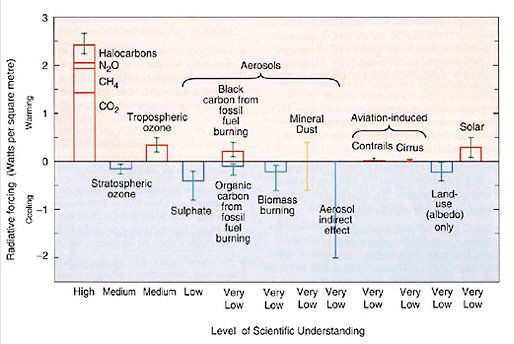
[click on image for larger view]
1/3 of a century later...
This new representation comprises 126 GW of resource potential nationally: 89 GW across all resource types in the Western regions and 37 GW mostly from coproduced potential in the non-Western regions. The total represented capacity is nearly the same for the Western regions as used in previous recent DOE Office of Energy Efficiency and Renewable Energy (EERE) Government Performance and Results Act (GPRA) benefits assessments. However, the Western region mix among specific resources is different. The updated supply features significantly lower levelized cost of energy (LCOE) for hydrothermal resources and somewhat lower LCOEs for EGS than used previously. Further, the inclusion of a significant amount of relatively low-cost coproduced resource further accentuates these cost differences and contributes to a significant increase in the total amount of geothermal resource that is likely to be technologically and economically.
The estimate of 100+ GW in 1976 is about the same as the 126 GW in 2007. So, in 1/3 century, the government has made slight improvements in the estimates... but not much effort in the development of this resource.

In 2004, I wrote:
The virtually limitless amount of clean, geothermal energy available worldwide makes this energy source worth pursuing as a PERMANENT ALTERNATIVE to either oil or nuclear power. Geothermal energy would facilitate the non-polluting production of hydrogen fuel or electricity for battery-powered vehicles for our transportation needs.

Solar, wind and even small-scale geothermal energy could be used as local sources of power to augment a vast network of geothermal energy. Geothermal energy is available now for your home.
Did you miss that last link? That's the sneaky part that applies to you and several billion other people. There is more to geothermal energy than tapping the Yellowstone basin [as some commenters interpret my posts]. But the reality is that clean, energy independence is just waiting for us to act upon a couple of studies.
Iceland is correct [don't let Homeland Security know that I wrote this].
..

Can"t Find It?

Use the SEARCH BLOG feature at the upper left. For example, try "Global Warming".

You can also use the "LABELS" below or at the end of each post to find related posts.

Blog Archive

Cost of Gasoline - Enter Your Zipcode or Click on Map

CO2 Cap and Trade

There is always an easy solution to every human problem—neat, plausible, and wrong.
Henry Louis Mencken (1880–1956)
“The Divine Afflatus,” A Mencken Chrestomathy, chapter 25, p. 443 (1949)
... and one could add "not all human problems really are."
It was beautiful and simple, as truly great swindles are.
- O. Henry
... The Government is on course for an embarrassing showdown with the European Union, business groups and environmental charities after refusing to guarantee that billions of pounds of revenue it stands to earn from carbon-permit trading will be spent on combating climate change.
The Independent (UK)

Tracking Interest Rates

Tracking Interest Rates

FEDERAL RESERVE & HOUSING

SEARCH BLOG: FEDERAL RESERVE for full versions... or use the Blog Archive pulldown menu.

February 3, 2006
Go back to 1999-2000 and see what the Fed did. They are following the same pattern for 2005-06. If it ain't broke, the Fed will fix it... and good!
August 29, 2006 The Federal Reserve always acts on old information... and is the only cause of U.S. recessions.
December 5, 2006 Last spring I wrote about what I saw to be a sharp downturn in the economy in the "rustbelt" states, particularly Michigan.
March 28, 2007
The Federal Reserve sees no need to cut interest rates in the light of adverse recent economic data, Ben Bernanke said on Wednesday.
The Fed chairman said ”to date, the incoming data have supported the view that the current stance of policy is likely to foster sustainable economic growth and a gradual ebbing in core inflation”.

July 21, 2007 My guess is that if there is an interest rate change, a cut is more likely than an increase. The key variables to be watching at this point are real estate prices and the inventory of unsold homes.
August 11, 2007 I suspect that within 6 months the Federal Reserve will be forced to lower interest rates before housing becomes a black hole.
September 11, 2007 It only means that the overall process has flaws guaranteeing it will be slow in responding to changes in the economy... and tend to over-react as a result.
September 18, 2007 I think a 4% rate is really what is needed to turn the economy back on the right course. The rate may not get there, but more cuts will be needed with employment rates down and foreclosure rates up.
October 25, 2007 How long will it be before I will be able to write: "The Federal Reserve lowered its lending rate to 4% in response to the collapse of the U.S. housing market and massive numbers of foreclosures that threaten the banking and mortgage sectors."
November 28, 2007 FED VICE CHAIRMAN DONALD KOHN
"Should the elevated turbulence persist, it would increase the possibility of further tightening in financial conditions for households and businesses," he said.

"Uncertainties about the economic outlook are unusually high right now," he said. "These uncertainties require flexible and pragmatic policymaking -- nimble is the adjective I used a few weeks ago."
http://www.reuters.com/

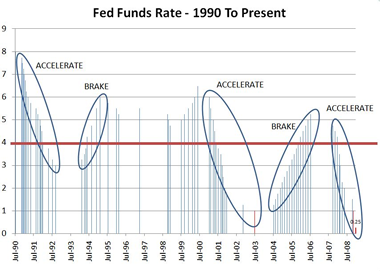
December 11, 2007 Somehow the Fed misses the obvious.
fed_rate_moves_425_small.gif
[Image from: CNNMoney.com]
December 13, 2007 [from The Christian Science Monitor]
"The odds of a recession are now above 50 percent," says Mark Zandi, chief economist at Moody's Economy.com. "We are right on the edge of a recession in part because of the Fed's reluctance to reduce interest rates more aggressively." [see my comments of September 11]
January 7, 2008 The real problem now is that consumers can't rescue the economy and manufacturing, which is already weakening, will continue to weaken. We've gutted the forces that could avoid a downturn. The question is not whether there will be a recession, but can it be dampened sufficiently so that it is very short.
January 11, 2008 This is death by a thousand cuts.
January 13, 2008 [N.Y. Times]
“The question is not whether we will have a recession, but how deep and prolonged it will be,” said David Rosenberg, the chief North American economist at Merrill Lynch. “Even if the Fed’s moves are going to work, it will not show up until the later part of 2008 or 2009.”
January 17, 2008 A few days ago, Anna Schwartz, nonagenarian economist, implicated the Federal Reserve as the cause of the present lending crisis [from the Telegraph - UK]:
The high priestess of US monetarism - a revered figure at the Fed - says the central bank is itself the chief cause of the credit bubble, and now seems stunned as the consequences of its own actions engulf the financial system. "The new group at the Fed is not equal to the problem that faces it," she says, daring to utter a thought that fellow critics mostly utter sotto voce.
January 22, 2008 The cut has become infected and a limb is in danger. Ben Bernanke is panicking and the Fed has its emergency triage team cutting rates... this time by 3/4%. ...

What should the Federal Reserve do now? Step back... and don't be so anxious to raise rates at the first sign of economic improvement.
Individuals and businesses need stability in their financial cost structures so that they can plan effectively and keep their ships afloat. Wildly fluctuating rates... regardless of what the absolute levels are... create problems. Either too much spending or too much fear. It's just not that difficult to comprehend. Why has it been so difficult for the Fed?

About Me

My photo
Michigan, United States
Air Force (SAC) captain 1968-72. Retired after 35 years of business and logistical planning, including running a small business. Two sons with advanced degrees; one with a business and pre-law degree. Beautiful wife who has put up with me for 4 decades. Education: B.A. (Sociology major; minors in philosopy, English literature, and German) M.S. Operations Management (like a mixture of an MBA with logistical planning)