READ ABOUT DETROIT AND SOLUTIONS TO ITS PROBLEMS. CLICK HERE.

Tuesday, March 11, 2008

Hurry Up Warming

SEARCH BLOG: WEATHER

For those of you who pine for "the good old days," I'd have to say that this winter has been a prime example of those "good old winters" where snow piled up for the duration and the furnace hummed incessantly.

In Michigan it began with heavy snowfalls in November and, with a brief respite in December, continued on through the present. January and February were constantly colder than normal. Here it is in mid-March where our normal high temperatures move from the mid-40s to the high-40s and this is what we've experienced:


For the first 10 days, we have had one day with the high above normal. It looks as if we may have a couple of days near normal this week before it cools down again.

The local newpapers run stories about fuel supplies running low for utility companies and the thousands more people who are seeking heating assistance for their homes because of the abnormally cold winter.


Yet, alarmists tell us that warmer weather will doom us all... except it isn't happening. Soon, the tune will change and the alarmists will say they had to exaggerate in order to unite the world in an effort to save us from pollution... or overpopulation... or peak oil.


Sure ....

..

Investment Concern

SEARCH BLOG: STOCK MARKET

The economy has exhaled a bit and, of course, that is cause for concern. One can never say with 100% confidence that what has happened in the past will continue in the future. Still, a downturn in the stockmarket has inevitably led to a rebound that surpasses previous levels.

This chart from Yahoo! Finance shows the long-term history of the Dow Industrial average.


The trend after the great depression has been a long upward trend with a notable pause for the decades of the 60s, 70s and the beginning of the 80s. Then the market became popular... note the trading volume at the bottom of the chart.

This particular chart shows the DJIA values on a logarithmic scale... changes show the percent changes even though the values are absolute levels. So the vertical change from 2,000 to 4,000 is the same a from 8,000 to 16,000... 100%. Even with the big drop in 2002-03, the Dow's value hardly rippled from the trend line.

Sure, we feel uncomfortable with the 17% drop in the past 6 months. That's wiped out all of the gains for the past 12 months. But that's the point, it is only 12 months.


It could be just another "correction" or it could be something more fundamental given the banking and housing problems, the decline of heavy industries, and the complete absence of any rational energy policy.

If you have a portion of your investments in "cash", your paper losses haven't been as bad as some aggressive equity positions. Of course, you could have a big position in oil or gold or foreign currency and having a great time.
Just remember that when portions of the economy get too far out of balance, the see-saw has a way of changing directions again. There will be a recovery, but the economic mix may be changing more rapidly than we imagine.
..

Monday, March 10, 2008

Automobile Choices

SEARCH BLOG: AUTOMOBILES

We have been planning to purchase a new automobile. The process has taken a little longer than we planned because we have had to decide what is most important to us. The government would assume it is miles-per-gallon. True, mileage efficiency is an important consideration, but hardly the only one.

Let's say we get a vehicle that averages 22 mpg and we go 15,000 a year and gasoline averages $3.50. Our fuel cost is roughly $2,400. If we select a vehicle that averages 25 mpg our fuel cost is reduced to about $2,100. That's $300 per year or about 85 extra gallons for the money.
We checked out two models that matched those descriptions and found that the insurance costs for the higher mileage vehicle was $200 per year more than the lower mileage one. It seems that occupant safety has a bearing on insurance premiums and the larger vehicle was considered safer by the insurance company.
That reduced our savings with the higher mileage car to $100 per year... or less than 30 gallons... two fill-ups.
Then we considered the monthly payments which differed by about $100 per month or $1,200 per year for the higher trim models as normally configured. However, we discovered that so many features that were standard on the higher-priced vehicle were optional on the lower-priced one that to make them almost equivalent made the monthly price difference negligible... the higher-priced one had some features that were not necessarily available on the lower-priced one.
The real kicker was that the incentives on the higher priced vehicle were substantially greater than the lower-priced one which pretty much sealed the deal.
Our intention was to buy the vehicle, but we decided to lease it instead. We read that in a couple of years, there will be a new engine available that is supposed to increase mileage by 20%... or about 4 mpg. Plus there will be a whole new vehicle design. Perhaps we will buy then.
I wrote to the manufacturer to suggest that they make available their European diesel engines for this vehicle. That would really entice me to buy the car... a Taurus... [18/28 new EPA]
So, we are off to pick up our newly-leased Taurus Limited... with its very nice ergonomics, safety and standard features... including, I guess, the kitchen Sync.
My wife is still grumbling about the colors offered.
..

Sunday, March 09, 2008

Drawing Economic Lines

SEARCH BLOG: ECONOMY

Fed expands lending to tackle liquidity crisis

By Krishna Guha in Washington

Published: March 7 2008 13:36 | Last updated: March 8 2008 00:18

A deepening sense of financial crisis yesterday spurred the US Federal Reserve into new emergency action to try to ease strains in the credit markets – and convinced investors that another major interest rate cut is on its way.

Plan for a Healthy America

“We now face an opportunity — and an obligation — to turn the page on the failed politics of yesterday's health care debates… My plan begins by covering every American. If you already have health insurance, the only thing that will change for you under this plan is the amount of money you will spend on premiums. That will be less. If you are one of the 45 million Americans who don't have health insurance, you will have it after this plan becomes law. No one will be turned away because of a preexisting condition or illness.”

— Barack Obama, Speech in Iowa City, IA, May 29, 2007


Yesterday, I wrote about China as an unethical trading partner. Regardless, the U.S. ignores these "minor problems" because there is so much "benefit" from trade with China... and other "low cost" sources.
  • Consumers get less expensive goods... "subsidized" by China
  • Importers get to purchase components or whole products for sale without using expensive American labor
  • The U.S. government has a customer for its debt
Yes, it appears to be a win-win-win. Then why do so many feel so uneasy about the arrangement?

Perhaps this is why.


PFFFT!

Ah, see, if the economy gets bad enough and the dollar gets weak enough, the U.S. manufacturers that have been significantly reduced in size and capacity will be positioned to export goods to foreign countries that still protect their own markets with hefty trade barriers. Huh?

Don't worry. In the end, our government will simply raise taxes on the top 1% of income earners and corporations so that it can provide the benefits you would have if you had a good job in the manufacturing sector that has been going away. And if you can't pay for your home anymore, the Federal Reserve will yo-yo interest rates once again to "fix" your problems.

So, who's to blame: Republicans or Democrats or corporate and finance manipulators or politicians or economic advisors?
Answer: yes.

There is no free lunch [even for Opus] and the Chinese are not "subsidizing" us.

But the one thing the government will not do... because, well, I just don't know.
What I do know is that this particular government inaction imposes a significant trade imbalance on this country, contributes to the decline of the dollar, hurts domestic manufacturers, and hits us all in the pocketbook.
The U.S. is still, by far, the largest economic machine in the world. The machine was built on and grew by being a producer nation. Now we are deluding ourselves into thinking that we can simply be a consumer nation... a service economy... and all will be well. The biggest consumer of all is the Federal government... but politicians of all stripes want us to believe that it is going to be the biggest provider... whatever we need... whatever we want... come one, come all.
It will swallow our problems for us... it will swallow us.
..

Saturday, March 08, 2008

China Unethical? Surprise!

SEARCH BLOG: CHINA and UNETHICAL

Thursday, The Astute Bloggers [among others] posted an article about how China stole technology from Korea's LG Corporation so that they could compete with LG in the world market for plasma screens.

"Prosecutors in Seoul, Korea, indicted an ex-LG employee for spying for a Chinese company in a case they say cost the South Korean economy more than $1 billion. The Chinese company, Changhong-Orion PDP-Chaihong, reportedly paid the LG manager $300,000 per year, an apartment and a car (he was still collecting his LG salary) in exchange for copying 1,182 files from the LG network and giving it to the Chinese company...

The company then used that stolen data to copy LG's plasma display panel production technology. Changhong-Orion PDP-Chaihong plans to start making plasma panels with the stolen technology starting in December."
And we should be surprised... why?

Here are some posts about that subject going back awhile:
No need to say more.

,,

Friday, March 07, 2008

Global Warming Payola

SEARCH BLOG: GLOBAL WARMING

John Tierney writes an interesting column at the NY Times. There is a little "widget" that links to his blog in the right column, but use the link above to access this particularly interesting perspective on who is funding whom with regard to global warming.

..

Measuring Weather and Climate

SEARCH BLOG: WEATHER and CLIMATE

I have been attempting to get summarized daily data for all locations and all states from NOAA to update an analysis of record minimum temperatures. The problem is that the data, going backward, stops with November, 2006 and I want to update back through January, 2005. A very helpful contact at NOAA indicated that they are running a computer full time to populate the database with the detailed records, but it is slow going.

I'm not sure why that should be necessary or how/where data was previously available... perhaps because the records were not computerized in the past.
For example, you can get copies of the actual records at COOP stations by going here. This is an example of a daily record for December, 2007 at one of those sites.


The data is manually collected and then submitted and somehow tabulated. It is reasonable to assume that NOAA has a small army of transcribers who enter the data into computer records and those records are then used by their Pantheon of Climate to describe, in fractions of degrees, how our part of the world is warming... presumably after the raw data has been "corrected" as described by Steven McIntyre here.

I just thought you might want to know a little more about the system that is behind legislation and decisions that may cost this nation trillions of dollars in the next few decades.
It may be adequate or it may be hopelessly antiquated for the purpose it is now being used. The trouble is, we will probably never really know for sure.
What concerns me about this system is that it relies on human observation and human recording [even if the weather station equipment itself has nice, digital displays]. Perhaps some of the trillions of dollars ought to be used for an automated recording system linked to a central system that requires humans only to verify the instrument accuracy and proper station siting... separate major issues.
Satellites may be the way that is accomplished, ultimately. But that remains to be seen.
ADDENDUM

This presentation shows the impact of improper siting and maintenance on weather stations and the data from those stations.

..

Thursday, March 06, 2008

Harvard Of The West

SEARCH BLOG: EDUCATION

The University of Michigan is sometimes called "the Harvard of the West."

Let's hope the University of Michigan doesn't take that too seriously.

..

Democrat... Not Necessarily Democratic Party

SEARCH BLOG: POLITICS

The Democrats have an unusual situation on their hands. When George Bush won the electoral vote over Al Gore despite Gore having won the overall popular vote, there were cries of anguish about how un-democratic the process was. The people's voices were not heard! Now the Democrats have their own version of that election looming.

Will the people's voices be heard or will the Democrats' Electoral College [super-delegates] work out some back room deals that override the popular count?
Republicans, meanwhile, are on the sidelines now. They have their candidate, whether or not the choice of just Republicans. There was always a hint that the voting was tainted by cross-over voting by Democrats to get someone who they thought was less of a challenge in November, but that was never proven [a tactic that Rush Limbaugh advocated for Republican voters in Ohio and Texas].
So the Republicans can watch as their two potential challengers slug it out in a vitriolic battle of words.
Some have suggested that the Democrat ticket in November will have both current candidates and the only question is which one will be on top: will it be Madam presidential candidate or Mr. presidential candidate? Given the lack of love lost between Clinton and Obama, I'd love to see that ticket happen.
Would each be honored... honored... honored... to serve as vice-president with the other? Maybe not.
Meanwhile, the Detroit area's last snowfall made this the 14th snowiest winter on record in this area. Some snow is expected Friday and Saturday which could move us closer to the old record.
The picture posted yesterday was of the half a foot or so that greeted us in the morning.
..

Wednesday, March 05, 2008

Oil

SEARCH BLOG: OIL

If you have the time, follow these links:

  • Opec spurns Bush and keeps output on hold
  • By Javier Blas and Ed Crooks in Vienna

    Published: March 5 2008 07:42 | Last updated: March 5 2008 14:57

    Opec agreed on Wednesday to leave its production levels unchanged, spurning calls from US President George W Bush for the oil producers’s group to do more to help the US economy.

  • U.S. Energy Policy or Lack Thereof

As Algernon Sidney wrote:
God helps those who help themselves.
..

Are We Warm Yet?

SEARCH BLOG: WEATHER

I must keep reminding myself: warming = bad; cooling = good.


Actually, the sun just came out.


..

Travel Summary

SEARCH BLOG: TRAVEL

Yesterday, I commented on traffic signal progression problems we encountered in a couple of locations during our recent trip. As promised, here are a few other observations from the trip.

Roads:

  • If at all possible, stay off I-76 in western Pennsylvania. This is a disgrace, especially since it is a toll road and should be in far better condition. There are sections that are unsafe at the posted speeds... far too narrow, winding, and poorly surfaced for an interstate... and large trucks act as if turning on their signals two seconds prior to shifting lanes immediately in front of you gives them the right-of-way. We will definitely look for an alternative route the next trip out east.
  • Any freeway around Washington, D.C. The roads are in very good condition, but the merging and diverging of highways seems to be a problem for drivers and traffic will stop for no apparent reason... even on a weekend.
  • I-95. Roads get progressively worse as you head south away from the Federal government. Hmmm. But no real problems until you get to Georgia and northern Florida.
  • Jacksonville. Go around it. There was a 17-mile backup on I-95 due to construction... and no real time traffic signs.
  • Georgia - I-75. Be prepared to shift lanes, swerve, and stop... although Georgians drive faster than anyone in the East... and little foreign cars tailgate trucks as if the drivers were trying to commit suicide.
  • I-59/I-24 from Chattanooga. A pleasant and scenic drive. Gets hilly, but have your passenger be ready with a camera.
  • Kentucky interstates. No problems. We expected problems around Louisville on a Monday morning and traffic moved smoothly.
  • Ohio I-75. Cincinnati drivers will speed even in the presence of a police car. Drive a large pickup truck for your own protection. Dayton is a mess. Southbound traffic was stopped for miles and the radio station reported that no cause had been reported. North of Dayton... as boring a stretch of road as you'll find in the east.
  • Michigan. Fast, but watch for potholes.
Gasoline:
  • Expensive in Michigan [20-25 cents more than Ohio]
  • Expensive in Virginia
  • Cheap in Ohio, Tennessee, and Georgia [relatively].
  • Expensive in Florida [20-25 cents more than Georgia]
Drivers:
  • Worst: truckers in western Pennsylvania and Georgia... any lane at high speeds... tailgating and cutting off
  • Worst mix: Covington and Cincinnati... biggest speed differential between fastest and slowest
  • Most law abiding: Tennessee... and the highway patrol made sure of it
  • Slowest: those with white hair in Florida and old pickups in Tennessee
Motels:
  • Expensive on the east coast
  • Cheap in Georgia and Tennessee
  • Not much difference in quality among them
Food:
  • Depends on where you go... can't generalize
  • Worst food we experienced was a buffet in Georgia... inedible.
  • Best food was in small Italian restaurant in Virgina and a great sushi place in downtown Orlando. Carlos Arroyo [Orlando Magic/Detroit Pistons] was at the sushi restaurant... apparently if it was good enough for us, it was good enough for Carlos.
Of course, that was just one trip and yours might be different.

..

Tuesday, March 04, 2008

Big Ben Strikes Out

SEARCH BLOG: FEDERAL RESERVE

The Federal Reserve Chairman, Ben Bernanke, officially reached the panic stage:

Ben Bernanke on Tuesday called on banks to forgive chunks of mortgage loans issued to troubled borrowers, as the chairman of the Federal Reserve suggested the US housing crisis was far from over and required a “vigorous response”.

The remarks by Mr Bernanke contributed to a sharp fall in US shares in morning trading. They also underscored the extent to which policymakers are increasingly tilting towards more dramatic solutions to halt the cascade of home foreclosures, which is at the root of the US economic slowdown. [source]
This is the culmination of the Federal Reserve's misguided attempts to manage the economy over the past decade. The irony of trying to protect the banking system by manipulating interest rates is that the Fed has cause large portions of the banking system to be on the brink of failure.
See the litany in the column to the right.
..

Government Enforced Fuel Consumption

SEARCH BLOG: SIGNAL PROGRESSION

Over the past 3 years, I have commented several times about how the government forces us to waste fuel simply because it does a rotten job with traffic signal progression... sequencing lights so that traffic on main thoroughfares will keep moving.

If you do the suggested search above, you will see that I have written letters and even had email exchanges with traffic engineers [one of whom was particularly responsive and did correct a situation on a stretch of city road 8 lanes wide where it was stopped inappropriately by a signal from a business park].

The way I evaluate signal progression is that traffic traveling at, or within a few miles per hour of, the posted speed on a main urban thoroughfare should have uninterrupted flow under normal conditions. Obviously, there are situations outside of normal, such as accidents, that cannot be controlled.

On our recent trip, I found examples of well-timed lights and very poorly timed lights. Here are a few observations:
  • Surprisingly, Washington, D.C. had fairly well timed lights. We came in, at the posted speeds, on Canal Road to M Street to 16th and only stopped a couple of times. I had expected a real mess. The Federal government must take care of itself [I noticed the roads were in excellent condition as well].
  • The Reston Parkway coming off the Dulles Toll Road was a complete snafu. The lights were set up to stop traffic progression at every signal. 50 chimpanzees could have done a better job.
  • Orlando, Florida and suburbs. There is obviously no traffic engineer in the employ of that county. This area also gets the award for the longest signals in the country... there was one red light that lasted a full 4 minutes with no traffic crossing! That was a pretty backup.
So, while the federal government imposes all sorts of mileage and emissions regulations on automobile manufacturers, it still lavishes billions of dollars on states and communities that fail to use even the most basic logistical strategies in keeping traffic moving.

And guess who gets to pay for the failure twice in the form of taxes poorly spent and wasted fuel? And guess which industry gets blamed for too much CO2?

..

Monday, March 03, 2008

Travel Extremes

SEARCH BLOG: TRAVEL

We arrive back to Michigan late this afternoon. A most interesting trip with amazing luck when it came to the weather.

Every place we went in the north warmed up just as we got there and then got socked with nasty weather right after we left. We're not especially fond of heat and humidity so we welcomed the "cold wave" that hit Florida in the middle of our stay... I had a golf course all to myself because it was so "bitterly cold" at 55° and sunny. Finished 18 holes in 2-1/2 hours... and even got a discount!

Tennessee was sunny and in the 60s for our brief stay there. And today was in the 40s with rain when we returned... nearly all of the snow has been washed away.

While the trip was devoted to visiting relatives scattered around the eastern third of the U.S., it also reacquainted me with how differently we live just a few hundred miles apart.

There were the modest small towns in eastern Pennsylvania with homes going back 200 or more years. There was the wealth of Washington D.C. and northern Virginia and the obvious benefits associated with proximity to the seat of Federal power. There was the overcrowding and unplanned growth of central Florida. And, finally, there was the beauty of the countryside and scraping by in central Tennessee.
We had the opportunity to join our nephews at the archery range as they practiced for some Boy Scout award and then watch them eat all of the profits at an all-you-can eat buffet. We visited the Wilbur Chocolate Company and watched the women dip the pretzels in the dark chocolate [we did purchase some of their dark chocolate treats].

Our oldest son happened to have an engineering conference scheduled in Washington D.C. while we were in the area, so we picked him up at Dulles and let our GPS system [I call it Suzy because of the sultry female voice] guide us to his hotel just past Georgetown.
Suzy did have problems when we missed a veer to the right and she had to "recalculate." She sent us down some dark street that dead ended into a one-way street coming at us... this happened a few times during the trip and one time it thought we were going the wrong way up an interstate and rapidly kept repeating "recalculating" frantically... it was actually a private road alongside the interstate.
We have many relatives living in central Florida, among them both of our mothers. We spent several days touring an "independent living" facility for my mother who will go there when she sells here house. My wife's mother liked it as well, but was not ready to give up her independent "independent living" quite yet.

My older brother and sister along with children and grandchildren and great-grandchildren live in adjacent properties in rural central Tennessee. The rolling hills still have the tobacco farms [even though Tennessee just banned smoking in all restaurants]. We were also surprised to see vineyards, but the area really is suited to them. There were also wild turkeys... the real kind, not the stuff in the bottle... though Jack Daniels was not far away.
My older brother has severe rheumatoid arthritis which has led to several significant infections and surgeries. I'm going to bet that, like ulcers, some researcher is going to discover that this so-called auto-immune disease is really caused by a very difficult to detect bacteria or virus.
So, the road trip is over and we're back to the land of cool weather and rain. But winter is not done yet with us. It looks as if abnormally cold weather will be back for a week.

Welcome home.

..

Sunday, March 02, 2008

Home Soon

SEARCH BLOG: TRAVEL

Yesterday, Florida and Georgia; today Tennessee and Kentucky. Tomorrow we will arrive back in Michigan.

It's a most interesting country. This trip covered just about 1/4 of it in a very cursory way. But it has given me grist for a couple of posts... at the least. One will certainly be a list of best and worst that we came across.

Georgia earned at least three mentions... but we'll get to that.

The weather was extraordinarily kind to us with bad weather always just behind us. And we should be arriving back to the warmest day since an early January anomaly... but then it gets colder than normal again. Good things can't last forever.

Okay, just one: Georgia had the most highway construction and the cheapest gas.

..

Saturday, March 01, 2008

Travel

On the road again... will post and moderate comments as possible.

..

Friday, February 29, 2008

February Cold

SEARCH BLOG: GLOBAL WARMING

Snow and cold. I wrote about that yesterday... so this is a footnote.

The western part of Michigan's lower peninsula such as Grand Rapids already had record snowfall for February... not counting what falls today. Not so much as Concord, NH, but enough to keep the snowblowers well lubricated.

Our area had 4 days during the entire month with the high temperature above normal; you can work out the converse of that.

We may reach normal highs by Sunday and stay that way for Monday. Then back to the freezer with highs at least 10 degrees below normal as the first week of March comes our way.

Where's that global warming when you need it?

..

Leap Year

SEARCH BLOG: FAMILY

Our oldest son and daughter-in-law are celebrating their 2nd anniversary today... having been married on Feb. 29, 2000. Sure, it's just a technicality, but why not take advantage of it?

No doubt they will allot some time for a nice dinner, maybe a movie, and some quiet time. They've just moved into a new home and boxes are piled everywhere. Straightening that out will take a little energy. My daughter-in-law recently started a new job and is winding her way through the maze of new working relationships and corporate processes. Navigating that maze will take a little energy. We just shipped them a 240 pound grill so that my son can throw something good on it when we show up. Moving and assembling that will take a little energy.


Still, they are young... so I believe they will find a reserve of energy for each other.

Happy 2nd [8th] anniversary.

..

Thursday, February 28, 2008

Let It Snow

SEARCH BLOG: GLOBAL WARMING

Winter cold is expected. Snow is expected. So those who point to cold weather and snow as evidence that there is no global warming are simply guilty of the same errors that those who point to summer hot weather and little rain as evidence of global warming.

Weather is variable.
What should not be variable is the way weather is measured. Moving weather stations from grassy fields to asphalt lots or roof tops or surrounded by buildings or airport runways means that measuring the variability of weather has been compromised by the variability of measurement itself.
This has been covered before.
Then what can be determined as factual?
The crux of the matter.
It is a fact that:
  • CO2 concentrations have increased in the past 200 years and, in parts of the earth, growing seasons have extended somewhat concomitantly [look it up] but not necessarily proof of causality
  • The surface of the earth has been modified significantly by human activity contributing to different patterns of weather
  • The sun's activity has varied as general weather patterns have changed and now the sun is in a period of relative inactivity associated with colder weather on earth
  • Ocean circulation patterns have shifted from time to time changing landmass weather patterns and there has been a recent significant change in the Pacific Ocean.
  • Wind patterns affect Arctic and Antarctic snow and ice accumulation and there have been significant changes recently with ice being driven out of the north polar region and then a re-accumulation of ice exceeding previous levels.
  • Computer models have been far too simplistic to capture the dynamics of either weather or climate patterns and have been shown incapable of predicting the future with any certainty
  • Politicians and special interests have acted precipitously and in their own self interests in a attempt to form massive new bureaucracies and industries on spurious and indefensible data.
  • Dubious schemes threaten to siphon billions or even trillions of dollars out of western economies in an effort to save earth from a non-existent threat.
So, in the context of the larger picture, record cold and record snowfalls these last two winters is really of little concern or consequence. Spring will come followed by summer. When it is finally warm enough to stay outside comfortably, the doomsayers will fill the streets with their placards and warn us of the impending doom about to be brought down on us all because we have the audacity to live.

Meanwhile, another winter storm from Canada is bringing... guess what... more snow and cold. Expected... like heat waves and hurricanes in summer.
So, for 6 months we are now allowed to talk about global cooling... to be fair and balanced.

[Normal High 40°]

..

Can"t Find It?

Use the SEARCH BLOG feature at the upper left. For example, try "Global Warming".

You can also use the "LABELS" below or at the end of each post to find related posts.

Blog Archive

Cost of Gasoline - Enter Your Zipcode or Click on Map

CO2 Cap and Trade

There is always an easy solution to every human problem—neat, plausible, and wrong.
Henry Louis Mencken (1880–1956)
“The Divine Afflatus,” A Mencken Chrestomathy, chapter 25, p. 443 (1949)
... and one could add "not all human problems really are."
It was beautiful and simple, as truly great swindles are.
- O. Henry
... The Government is on course for an embarrassing showdown with the European Union, business groups and environmental charities after refusing to guarantee that billions of pounds of revenue it stands to earn from carbon-permit trading will be spent on combating climate change.
The Independent (UK)

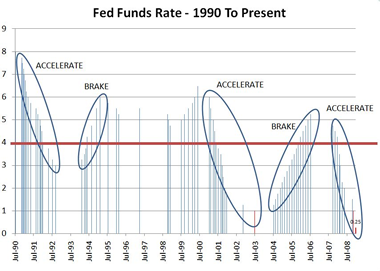
Tracking Interest Rates

Tracking Interest Rates

FEDERAL RESERVE & HOUSING

SEARCH BLOG: FEDERAL RESERVE for full versions... or use the Blog Archive pulldown menu.

February 3, 2006
Go back to 1999-2000 and see what the Fed did. They are following the same pattern for 2005-06. If it ain't broke, the Fed will fix it... and good!
August 29, 2006 The Federal Reserve always acts on old information... and is the only cause of U.S. recessions.
December 5, 2006 Last spring I wrote about what I saw to be a sharp downturn in the economy in the "rustbelt" states, particularly Michigan.
March 28, 2007
The Federal Reserve sees no need to cut interest rates in the light of adverse recent economic data, Ben Bernanke said on Wednesday.
The Fed chairman said ”to date, the incoming data have supported the view that the current stance of policy is likely to foster sustainable economic growth and a gradual ebbing in core inflation”.

July 21, 2007 My guess is that if there is an interest rate change, a cut is more likely than an increase. The key variables to be watching at this point are real estate prices and the inventory of unsold homes.
August 11, 2007 I suspect that within 6 months the Federal Reserve will be forced to lower interest rates before housing becomes a black hole.
September 11, 2007 It only means that the overall process has flaws guaranteeing it will be slow in responding to changes in the economy... and tend to over-react as a result.
September 18, 2007 I think a 4% rate is really what is needed to turn the economy back on the right course. The rate may not get there, but more cuts will be needed with employment rates down and foreclosure rates up.
October 25, 2007 How long will it be before I will be able to write: "The Federal Reserve lowered its lending rate to 4% in response to the collapse of the U.S. housing market and massive numbers of foreclosures that threaten the banking and mortgage sectors."
November 28, 2007 FED VICE CHAIRMAN DONALD KOHN
"Should the elevated turbulence persist, it would increase the possibility of further tightening in financial conditions for households and businesses," he said.

"Uncertainties about the economic outlook are unusually high right now," he said. "These uncertainties require flexible and pragmatic policymaking -- nimble is the adjective I used a few weeks ago."
http://www.reuters.com/

December 11, 2007 Somehow the Fed misses the obvious.
fed_rate_moves_425_small.gif
[Image from: CNNMoney.com]
December 13, 2007 [from The Christian Science Monitor]
"The odds of a recession are now above 50 percent," says Mark Zandi, chief economist at Moody's Economy.com. "We are right on the edge of a recession in part because of the Fed's reluctance to reduce interest rates more aggressively." [see my comments of September 11]
January 7, 2008 The real problem now is that consumers can't rescue the economy and manufacturing, which is already weakening, will continue to weaken. We've gutted the forces that could avoid a downturn. The question is not whether there will be a recession, but can it be dampened sufficiently so that it is very short.
January 11, 2008 This is death by a thousand cuts.
January 13, 2008 [N.Y. Times]
“The question is not whether we will have a recession, but how deep and prolonged it will be,” said David Rosenberg, the chief North American economist at Merrill Lynch. “Even if the Fed’s moves are going to work, it will not show up until the later part of 2008 or 2009.”
January 17, 2008 A few days ago, Anna Schwartz, nonagenarian economist, implicated the Federal Reserve as the cause of the present lending crisis [from the Telegraph - UK]:
The high priestess of US monetarism - a revered figure at the Fed - says the central bank is itself the chief cause of the credit bubble, and now seems stunned as the consequences of its own actions engulf the financial system. "The new group at the Fed is not equal to the problem that faces it," she says, daring to utter a thought that fellow critics mostly utter sotto voce.
January 22, 2008 The cut has become infected and a limb is in danger. Ben Bernanke is panicking and the Fed has its emergency triage team cutting rates... this time by 3/4%. ...

What should the Federal Reserve do now? Step back... and don't be so anxious to raise rates at the first sign of economic improvement.
Individuals and businesses need stability in their financial cost structures so that they can plan effectively and keep their ships afloat. Wildly fluctuating rates... regardless of what the absolute levels are... create problems. Either too much spending or too much fear. It's just not that difficult to comprehend. Why has it been so difficult for the Fed?

About Me

My photo
Michigan, United States
Air Force (SAC) captain 1968-72. Retired after 35 years of business and logistical planning, including running a small business. Two sons with advanced degrees; one with a business and pre-law degree. Beautiful wife who has put up with me for 4 decades. Education: B.A. (Sociology major; minors in philosopy, English literature, and German) M.S. Operations Management (like a mixture of an MBA with logistical planning)