READ ABOUT DETROIT AND SOLUTIONS TO ITS PROBLEMS. CLICK HERE.

Sunday, May 11, 2008

Happy Mothers Day

SEARCH BLOG: HOLIDAYS

My mother soon will be 91 and my wife's mother is 86. That means that we have only a few years left to express our appreciation directly to them. We don't wait for a special day to let them know that we love them. But it is always nice to have another excuse to send them a gift and a card.

No one really can know how much our mothers have contributed to our lives, how much they have sacrificed, how much they have done. Yet, being a parent makes one understand that mothers never think about that. Their children are their lives and future and nothing is more important to them.

Children appreciate and love their mothers, but the relationship can never be equal or totally reciprocal... nature never designed it to be that way.

We give special honor to our mothers this day. By our actions, we can honor them every day.

..

Saturday, May 10, 2008

Automobile Companies' Mandates To Government

SEARCH BLOG: MANDATES

Suppose automobile companies had the opportunity to establish mandates that the Federal government had to follow and fund without recourse. What might these mandates be?

  • Government must fund all research required to meet government mandates
  • Government must make any technological advances, that allow government mandates to be met, available without licensing fees or restrictions regardless of patents or other legal protections
  • Governments must delay the implementation of any mandate if it conflicts with another mandate due to lack of implementable technologies
  • Government must guarantee the supply of components, used in the technologies required to meet government mandates, will be available to meet the demand
  • Government must guarantee that each vehicle built to meet government mandates can be sold at a profit
  • Government must guarantee that once a technology is used to meet government mandates there will be complete legal protection for the automobile companies for the use of that technology
You can probably come up with several of your own.
The government now expects the automobile companies to meet government mandates at no cost to the government, no risk to the government, and to pay taxes to the government if any profits are made. The point is that if the mandate process were reversed, automobile companies would have no burden for meeting government mandates, incur no risk for the use of technologies needed to meet government mandates, and would be guaranteed reasonable profits for producing the vehicles that meet government mandates.
But that's unreasonable. Nowhere does a free market provide such protection and guarantees.
Who said anything about a free market?
..

Friday, May 09, 2008

His Rights Were Protected

SEARCH BLOG: TERRORISM

From the BBC:

A former Kuwaiti detainee at the US camp at Guantanamo Bay carried out a recent suicide bombing in northern Iraq, the US military has said.

A spokesman for US Central Command told the Associated Press that Abdullah al-Ajmi took part in an attack in Mosul on 29 April that killed several people.

There's a story to spin in there someplace. How about one of these?
  • Political pressure overruled good judgment and several people were killed as a result
  • Several people were killed in order to grant U.S. citizen legal protections to a terrorist
  • The information indicating that the killer was a terrorist was correct, but it was politically incorrect to believe it
  • The killer acted that way because he was enraged about the Iraqi invasion of his country
  • If President Bush hadn't started the war for oil, none of this would have happened
  • It doesn't matter that much because the people who were killed were Arabs and Muslims by an Arab Muslim
Maybe it is just as simple as these are the pirates of the modern world... lawless and stateless... and there is only one way to deal with them... and all of the spin and justifications for every other excuse or course of action is self-delusion.

..

Thursday, May 08, 2008

Is The Economy Getting Sached?

SEARCH BLOG: OIL

Can you connect the dots?

CNN - January 2, 2008 - It's been rumored Goldman Sachs has over $80 billion in the market, although the investment bank declined comment for this story.


CNN - May 7, 2008 - Oil hit record settlement and trading highs Tuesday after a Goldman Sachs analyst said crude prices could reach $150 to $200 within the next six months to two years.


I don't know if you can connect the dots, but... if not, I think Goldman Sachs has a bridge they'd like to sell you. In the meantime, they're doing quite a business pumping up the price of oil [and gas]... pun intended.
I tend to be skeptical about many things, but there has been enough massive financial manipulation going on the past decade to warrant the suggestion that you re-read this.
..

Wednesday, May 07, 2008

ABC News Not As Smart As A 5th Grader

SEARCH BLOG: GLOBAL WARMING

Unfiltered propaganda from ABC News:

Koalas are threatened by the rising level of carbon dioxide pollution in the atmosphere because it saps nutrients from the eucalyptus leaves they feed on, a researcher said Wednesday.
Just a couple of thoughts:
  • Koalas have been around for at least 20 million years.
  • CO2 levels remain at geologically low levels... even with the minuscule increases in the past century.
  • CO2 is not a "pollutant" regardless of the Supreme Court's interpretation of science.
"Koalas produce one young each year under optimal conditions, but if you drop the nutritional value of the leaves, it might become one young every three or four years," Hume said.

Hugh Tyndale-Biscoe, a marsupial physiologist, described Hume's predictions of declining koala numbers as speculative but credible.

Credible? Maybe... possible... a lot of things are possible. But despite their cute appearance, koalas must be rugged little creatures having been on earth for at least 10 times as long as modern humans. During that 20 million or more years, isn't it just as credible to hypothesize that they have had to adapt to changing conditions several times? Isn't it just as credible to think that they are capable of adapting to changing conditions in the future?

Wasn't there recent reporting about storms being caused by global warming... or was it cooling... or was it politics? I'm sure 5th graders would know the difference... and the facts.

More on credibility below.

..

You're Not Going To Believe This

SEARCH BLOG: POLITICS and ECONOMY

I received this forwarded email:

Tighten your belts!! The House Speaker is at it AGAIN....

Thought you had heard it all? not quite!!

Adding a tax to your retirement is simply another way of saying to the American people, you're so stupid that we're going to keep doing this until we drain every cent from you.

That's what the Speaker of the House is saying. Read below...............

Nancy Pelosi wants a Windfall Tax on Retirement Income.

You aren't going to believe this.

Madam speaker Nancy Pelosi wants to put a Windfall Tax on all stock market profits (including Retirement funds, 401Ks and Mutual Funds!).

Alas, it is true - all to help the 12 Million Illegal Immigrants and other unemployed Minorities! Boy, are we in trouble... This woman is frightening. She said...' We need to work toward the goal of equalizing income in our country and at the same time limiting the amount the rich can invest.'

When asked how these new tax dollars wou ld be spent, she replied, 'We need to raise the standard of living of our poor, unemployed and minorities. For example, we have an estimated 12 million illegal immigrants in our country who need our help along with millions of unemployed minorities. Stock market windfall profits taxes could go a long way to guarantee these people the standard of living they would like to have as 'Americans'.'

This lady is out of her mind.

What does www.snopes.com say about this? FALSE!

I'm not a Nancy Pelosi fan by any stretch of the imagination. Some of the stuff she supports makes the nonsense above sound credible... but I'm incredulous.

So I guess the only thing that rings true about the email what the statement, "You're not going to believe this."

..

Tuesday, May 06, 2008

Gasoline Taxes Or Not

SEARCH BLOG: POLITICS and GASOLINE

I find the idea of three senators who are currently part of a U.S. Congress that has recently voted for higher mandatory automobile mileage requirements and, at the same time, remain opposed to increasing the domestic supply of oil and then argue about keeping or suspending a gasoline tax that is less than 20¢ per gallon... for lack of a better word... disingenuous.

While I agree with Sen. Obama's take, I'm sure we have different reasons. Sen. Obama simply likes taxes as a way for the government to manage the way society should operate. I think that if the federal government is going to pay for the Interstate Highway System, then a small tax is appropriate. Of course, parts of that system are toll roads which may be more appropriately pay-as-you-go... an alternate approach to taxing everyone. One could argue, however, that we all benefit from from better traffic flow due to non-toll roads, including the more efficient movement of goods transported by trucks.

Sen. Clinton and McCain simply miss the point. It's not the 20¢ per gallon that is riling people. It is the constricted supply that is allowing the price of this commodity to rise rapidly.

It is constricted supply caused by a Congress that believes their rules and regulations and mandates have no unintended consequences.
Astute Blogger [Sen. Schumer's name again] and Coyote Blog have some further thoughts about that.

..

Monday, May 05, 2008

Changing History Is Easier Than Changing Facts - Verse 2

SEARCH BLOG: CLIMATE CHANGE

Anthony Watts published the following two charts on May 2. The first chart shows the period between 1980 and 1998 as rough at the long-term U.S. average and cooler than the 1930s. Then the data was reworked to show the same period at roughly 0.5° above the long-term average... ending slightly higher than the 1930s.

NASA’s original data: 1999

NASA's 1999 version

NASA’s reworked data: 2007

NASA's 2007 version

ICECAP had mentioned something similar without the graphics. In the ICECAP story, "The two revisions of the IPCC surface record each successively lowered temperatures in the 1950s and the 1960s. The result? Obviously more warming – from largely the same data."

First we have weather monitoring equipment that is biased toward warmer readings because they are poorly located. Then we have have those biased readings adjusted upward?
Playing fast and loose with data... whether lowering historical temperatures or raising more recent ones... is not only intellectually dishonest, it is perpetuating a massive fraud on the world... one that will cost trillions of dollars.
But there are some federal government present and former employees who are benefiting from these adjustments... with one even writing the praises of the other.

..

Sunday, May 04, 2008

Congress: We'll Save You - Chapter 2

SEARCH BLOG: POLITICS and AUTOMOBILES

I received this email the other day:

Friends,

Yesterday I unveiled new legislation that will help us grow the new Michigan economy.

I've called it the "New BIG THREE Act" because it's all about new jobs, new investments and new alternative fuels. It's about our hometown Michigan industry, Michigan jobs and Michigan's economic future.

My plan comes in direct response to the federal governments new corporate average fuel economy (CAFE) rules, which are an $85 billion unfunded mandate on the auto industry - and just the auto industry.

My bill will help match new federal government actions with the federal government's CAFE demands.

Our auto industry has been struggling and is working on successfully completing their turn-around plans. What they need, and what our economy needs, is a productive plan from Washington, not just an expensive mandate.

By investing in alternative fuel technology, we will not only create high-paying jobs, but also help families deal with rising gas prices. Like you, I can't believe the price we're paying at the pump. Having more fuel-efficient cars available will be one great way to help ease that pain. It will also help make us safer, by reducing our dependence on Middle East oil.

I've included some of the media coverage of my bill below. I'll hope you'll take a look at it.

You can read the bill online here, and you can learn more about my legislation to grow the new Michigan economy here.

I'm going to keep fighting everyday for new Michigan jobs and a stronger Michigan economy for our families.

Sincerely,

Congressman Joe Knollenberg

Joe Knollenberg talks to WJR's Paul W. Smith about new legislation designed to help the auto industry. Listen here.

The Oakland Press: Knollenberg unveils 'Big' plan

Detroit Free Press: Knollenberg aims to help automakers and economy

The Associated Press: U.S. Rep. Joe Knollenberg proposes auto industry fuel economy plan


WWJ News Radio 950: Congressman: Help For Automakers


Detroit News: Knollenberg proposes $1.2 Billion aid for Big 3
I sent this to Rep. Knollenberg:
Dear Representative Knollenberg:

Your efforts to assist the automobile industry are commendable; however, the federal government tends to create both obstacles and market dislocations whenever it attempts to force the markets in specific directions.

I agree that whenever the federal government mandates technological changes, it should either fund the efforts required to meet the mandates or its should provide an implementable solution. In the case of mileage mandates, the government's plan is: 1) we are here; 2) a miracle happens; 3) the mandates are met.

But well beyond the technical issues are the marketplace issues. For example, if the only feasible solutions for achieving 2015 mandates for CAFE are small hybrid cars or small diesel-powered cars, the government is, in effect, directing automobile manufacturers to provide a more costly, less beneficial product to its customers... and take the blame for the reduction of choices. If, for example, the automobile companies do plan for higher volumes of hybrid cars or diesel-powered cars, will the government guarantee that the supply of nickel and lanthanum needed to make the nickel-metal hydride batteries will be sufficient to cover a volume increase of 5-10 times current volumes? Will the government guarantee that a sufficient supply of clean, low-sulfur diesel fuel will be available at a price competitive with gasoline so that European diesels can be used ... presuming the government allows their use?

That's the trouble with government mandates. All of the risk is borne by the manufacturers and none by the government.

It is well and good to say the government should be responsible, but history shows that government simply sets the rules and lets everyone else deal with the consequences. You may recall those early 1980 cars that kept stalling because the government mandated the use of engine control modules before they were adequately tested and a quality supply was available. What happens when the government realizes that significant increases in nickel mining will pose environmental hazards and tells automobile companies to use lithium-ion batteries that have a propensity to explode?

The government should get out of the mandate business! Has anyone in the government actually followed how the marketplace is reacting to higher-priced fuel? Has anyone in the government actually figured out that denying oil and natural gas drilling permits requires the U.S. to import increasing amounts of those commodities resulting in a greater trade deficit and a weakened strategic position? Has anyone in the government studied the concept of a free market?

Thank you for your efforts to help the automobile industry. The greatest help would be to have the government go on extended vacation.

Sincerely,

Bruce Hall
I didn't point out the obvious: if the mileage mandates are going to cost $85 billion and the aid proposed by Rep. Knollenberg amounts to $4.7 billion [research and tax credits], that leaves about $80 billion to be funded by... the customers who buy vehicles... you, brothers and sisters!

..

Saturday, May 03, 2008

Money Makes You An Expert On Everything

SEARCH BLOG: AUTOMOBILES

It was bound to happen. As soon as Kirk Kerkorian buys up some stock in a company, a supernatural process occurs that transfers a priori knowledge of that company's industry and what changes that company should make.

From the Detroit Free Press:

Less than a week after stressing that billionaire Kirk Kerkorian's Tracinda Corp. would remain a passive investor in Ford Motor Co., a top adviser for the casino mogul, Jerry York, is already recommending changes for the Dearborn automaker.

In an interview with the trade magazine Automotive News, York said he thinks Ford should sell the company's Swedish Volvo brand, which lost $151 million through March, as well as the Mercury brand, which has been languishing for decades. U.S. sales of Mercury have fallen from 528,033 to 168,422 last year....

While he said Mulally did not tell him of his plans, York told the magazine: "I think you'll see that he'll put Volvo on the market within the next year and a half."

Stockholders are entitled to their opinions and significant stockholders do gain the attention of boards of directors. Regardless, any actions regarding brands and models will not be a result of Kerkorian and York's meddling. What is expressed by York is simply a manifestation of what sharks do: rip apart their prey.

Friday, May 02, 2008

Congress: We'll Save You

SEARCH BLOG: GASOLINE

Politics is truly the art of the impossible. You can have your cake and eat it, too. You can have a market demanding small cars and have cheap gasoline, too. So sayeth Congress.

It is interesting to note that, in response to certain congressional members' inspiration, executives from automobile manufacturers are not especially keen about the idea of reducing or eliminating federal gasoline taxes. After all, Congress has mandated that automobile manufacturers produce extremely fuel-efficient vehicles [read between the lines: very small cars], so just why would manufacturers want Congress to take an action that would make it more difficult to sell those vehicles?

Higher gasoline prices are already shifting the automobile market to smaller vehicles... without mandates or meddling from Congress. Congress, however, simply can't stand to be irrelevant. It must do something... even if that means screwing things up.
Congress, please don't bother to save us.

..

Congressional Hypocrisy

SEARCH BLOG: GOVERNMENT

In a stunning display of hypocrisy, the U.S. Congress attempted to lay the blame of rising food costs on farmers. As CNN reported:

The criticism levied by the Joint Economic Committee, led by Sen. Charles Schumer, D-N.Y., transcended party lines. Rep. Jim Saxton, R-N.J., a ranking member of the committee, called for "genuine reform" of the "nightmare of wasteful, outdated [farm] subsidies."

Richard Reinwald, a bakery owner from Huntington, N.Y., blamed rising wheat prices on farmers "growing crops for fuel and not food."

The meeting of the Joint Economic Committee followed comments on Tuesday from President Bush, who referred to a farm bill currently in legislation as "bloated" and incapable of significantly reducing food prices.

Let's look at the arguments.
  • Congress is strongly suggesting that farmers have a primary duty to provide food cheaply as opposed to making the best living they can as farmers.
  • Congress is also strongly suggesting that subsidies paid to farmers are the doing of the farmers... as opposed to Congress. These are often subsidies to not plant crops.
  • Congress is also strongly suggesting that farmers are growing crops for fuel rather than food for humans... the same Congress that has mandated a six-fold increase in ethanol from... food crops, perhaps?
  • Is Congress also implying that farmer should absorb the higher cost of gasoline and diesel fuel which have been increasing partially because of legislation passed by Congress to restrict drilling for oil in addition to massive hurdles established for new refineries which have caused the cost of diesel fuel used in farm equipment to skyrocket?
Just as Congress has screwed up the possibility of U.S. energy independence and now seeks to place the blame on automobile manufacturers and oil companies, so too does this same Congress seek to disrupt and manipulate markets for crops and blame farmers.

Isn't this the same Senator Schumer that berated General Petraeus and said that the "surge" was not having an impact on al Qaeda? Isn't this the same Senator Schumer who wrongly blamed Gen. Wrightman for the Veterans Administration problems when Congress was cutting funding?
Perhaps the real problem is that there are people such as Senator Schumer in Congress who don't seem capable of drawing a straight line between two dots or being able to identify what the result of such an action is.
..

Thursday, May 01, 2008

Weather - February Through April 2008

SEARCH BLOG: WEATHER

Over the past few months, I have been tracking the local weather versus "normal" and comparing that to NOAA's charts. The April data is not yet available from NOAA, but I will be interested to see whether the summary depicts this region as "near normal" or "above normal."

For February and March, Michigan had temperatures from 2° to 6° below the 1971-2000 average and yet the NOAA charts depicted that as "near normal." The local temperatures that I tracked were about 4° below that average.

For April, the local temperatures were 1.3° above the 30-year average, thanks to a very pleasant stretch of highs in the 70s... which subsequently dropped to highs in the 50s... below average. If NOAA's summary indicates that is anything more than "near normal," I would be very suspicious of their categorizations.

Overall, for February through April, the local temperatures were about 2.5° below the long-term average. Will that be "near normal?"

May is not exactly starting out balmy.

But it may end up an "average" day for this time of the year.

..

Wednesday, April 30, 2008

Federal Reserve Should Hold 'Em

SEARCH BLOG: FEDERAL RESERVE

I have commented more about the Federal Reserve over the past year than should be necessary in a decade, but the Fed just can't get it right.

Let's hope that the Fed decides to hold rates where they are, which may be a little too low already. There is far too much manipulation in the financial world these days... and none of it has done more than enrich a few self-serving manipulators. We don't need the Fed adding injury to injury. Sure, it's supposed to protect the banking structure. Okay, make sure the banks are following good business practices, not speculating because funds are federally insured and other such nonsense.

Repeat after me: there is no free lunch! Sure, everyone loves to borrow money with 0% interest, but the cost is there somewhere. Pay less interest; pay more for inflation. Charge less interest; charge up inflation [have you noticed the price of petroleum products... and a lot of other things... lately?]. Charge and pay too much interest; shut down the economy.
Ultimately, the Fed needs to find a moderate rate and hold it. Then let the economy sort itself out.
Tuesday, March 18, 2008

How Low Will It Go?

Friday, March 14, 2008

Economics Dumb-0-Dumb


ADDENDUM

Fed cuts rates again and hints at pause
Central bank cuts rates for seventh time since September, but sees less risks of slowdown, suggesting this may be last cut for a while.


4% is the number... rock steady.

..

Tuesday, April 29, 2008

Eliminate Mileage Mandates

SEARCH BLOG: GASOLINE

Several posts on this blog discuss the cost of gasoline and the government's role in creating market problems and then creating bureaucracies to "manage" the problems it helps to create.

So far, the two main issues have been:

  • Restricting drilling for oil and natural gas forcing the U.S. to be more reliant on foreign sources of energy
  • Expanding government regulations regarding automobile mileage and CO2
Now that it is obvious to everyone that the government has no intention of letting market forces act as the agent of change, it is time for the government to quit pussy-footing around and do what is done in Europe: add taxes of $3 or more per gallon of gasoline. At that point, all other government actions... mileage and CO2 regulations, restrictions on drilling for oil, and subsidies for alternative fuels... will be moot and can be eliminated because the cost of implementing the government's policies will be borne directly by consumers without the government being able to divert attention and blame to vehicle manufacturers and oil companies.
The marketplace would immediately react by making a run on the smallest possible vehicles available... like these [click images for source].


The U.S. would be like Europe... or California.
Now that would be a blow to politicians who would have to stand up to their constituents and explain why the government has to be involved at all in the marketplace. It would also create issues with regard to why many other taxes would have to remain in force [and the supporting bureaucracies]. It would also highlight issues with regard to the plethora of regulations that create additional costs for manufacturers and consumers.

Cost of gasoline
(U.S. Dollars per Gallon)
Date___ Belgium France Germany Italy Netherlands UK _ US
4/20/98 3.43___ 3.44__ 3.25___ 3.48_ 3.56_______ 4.04 1.21
4/21/08 8.62___ 8.34__ 8.58___ 8.32_ 9.51_______ 8.17 3.73

Look at tax opportunity! Gas is practically being given away in the U.S.

Of course, our government would do exactly what those in Europe do... raise the taxes and keep all of the onerous regulations. That's what governments do best.

..

Monday, April 28, 2008

Kerkorian - The Kevorkian Of The Auto Industry?

SEARCH BLOG: AUTOMOBILES

Sharks smell blood and move in... even if the wounded creature is strong.

Kirk Kerkorian is an investment shark. He looks for companies that have been temporarily weakened, but are showing signs of recovery... such as Ford Motor Company which reported earnings of $100 million for the first quarter. Then he strikes. He tries to bite off just enough of the company so that he can control or strongly influence near-term decisions. He is looking for a quick meal and is not concerned whether or not the company may survive after his foray. In fact, he senses that dismantling a company may provide more financial sustenance than allowing it to recover and continuing to nibble at the trough of profits.

He has made two attempts; first he went after Chrysler and then General Motors. Now he is after Ford Motor Company.

He is not concerned whether his gambit will work. He is only concerned with getting the stock price to run up quickly so he can sell at a tidy profit.

The fact the the extended Ford family owns 40% of the voting stock through their Class B shares pretty much precludes Kerkorian from doing much more than being a colossal nuisance... and getting a quick profit bite by manipulating the stock. That's okay with most sharks.
As shown by Chrysler and General Motors, the auto companies are not about to be guided into corporate suicide by inviting the shark to take over.

..

Recycling

SEARCH BLOG: WOOD and FUEL

Having spent the better part of the weekend hauling branches and sections of about a dozen tree trunks from the fallen ash trees at our summer cottage and the neighbor's property, I can attest that my physical conditioning is not quite the same as it was 40 years ago. Nevertheless, the miracle-in-a-bottle pills have reduced my discomfort to mere stiffness rather than pain in every joint.

It is a shame to have lost the ash trees to the Asian import Emerald Ash Borer, but it wasn't a total loss. The brother of one of our neighbors had a tree cutting service and so our neighbor negotiated a better price as long as he could have a large portion of the cut wood which will be used this winter for fuel... and that we would contribute muscle power as needed to bring the trees down and clean up the debris.

Our neighbor will split the wood and share it with my son who stays at the cottage and my son's friend who lives next door. In return, my son's friend, his father, and brother, pitched in to clear branches and move trunk sections along with my son and me. The wood cutter also kept several cords of cut wood for winter fuel.

This was a clear example of neighbors facing the same problem and working together on a voluntary basis to solve that problem in the most efficient, cost-effective manner possible. It had the side benefit of getting to know neighbors better and realizing that we were fortunate to have such good people next door.
While the loss of the trees is a sad event... they were over 40-years old... the fact that the wood will be recycled to provide heat for at least a couple of years and that better relationships came out of the effort does mitigate the loss. We will look for new trees to plant along the property line with our son's friend's home... after they tear down the fence.
Fortunately, not all of the trees on the property were ash, so we will still have the beauty and shade of an oak, maple and American elm [quite rare after the Dutch elm beetle infestation of the 70s].
I'm sure we'll all be getting together one of these weekends when the warm weather returns to have a cookout, a few beers, and a lazy trip around the lake in our pontoon boat.

..

Sunday, April 27, 2008

Oofdah Weather

SEARCH BLOG: MINNESOTA and OOFDAH

This story
from ABC News reminds me of the 5 winters where I spent a lifetime in Grand Forks, ND.

It could be Old Man Winter's last gasp in Minnesota.

snow
Vehicles travel on U.S. Highway 71 near Bemidji, Minn. as heavy snow falls around on Friday, April 25, 2008. A spring snow storm is expected to bring a foot of snow or more to portions of northwestern Minnesota by Saturday evening.
(AP Photo/Bemidji Pioneer, Eric Stromgren)
More Photos
Winter isn't officially over until the polar bears return to Canada.

..

Saturday, April 26, 2008

Chinese Killer

SEARCH BLOG: CHINA


This tiny import from China is known as the Emerald Ash Borer. It is killing millions of beautiful, hardwood ash trees in the midwest. It is suspected of entering the U.S. on infested shipping crates of imported goods from China where it is part of the ecosystem and has natural enemies. It has no such enemies in the U.S.

This weekend, we must watch as about a dozen ash trees on our property are cut down at the cost of hundreds of dollars... reducing the economic and aesthetic value of that property by much more.

Another reason why China has become my favorite trading partner.

..

Friday, April 25, 2008

Whether The Weather Is Withering

SEARCH BLOG: WEATHER and GIGO

Michigan finally enjoyed above average temperatures [highs in the 70s] this last week. Prior to the warming spell, the landscape looked as if it were still mid-winter. Birds and squirrels were still huddled in their sheltered spots and eagerly taking the nuts or other treats we left out for them. Now that warmer weather has finally arrived, insects are appearing and the birds are everywhere scouring for them. The normally early-blooming daffodils have sprung up and are blossoming brilliantly.

As usual, this CO2 global-warming skeptic fails to see the harm this warmth has delivered.
But the real reason for this post is to highlight some work by Anthony Watts regarding weather stations. After all, the data that has driven this global warming scare is derived from these weather monitoring stations. If you judge, with a faulty thermometer, whether you have a fever or are just slightly warmer than usual, your judgment could be severely impaired and you could be running off to the doctor for some very expensive and unnecessary treatments.

In the comments to a recent post on Anthony Watts' site, I asked him if he had a picture of a weather monitoring station that represented the "ideal"; i.e., placement and surroundings that represented the area. He provided a link to this [which also includes other pictures of the site]:


As you can see, aside from the protective fence, there are no artificial objects or paved surfaces or trees or buildings that would provide biased input.
Corvallis, OR, operated by the soon to be retired George Taylor, the OFFICIAL STATE CLIMATOLOGIST OF OREGON, is a good example of a CRN1 station.
Unfortunately, as Anthony often points out, this situation is the exception to the rule. More often than not, this is the way a site looks [from his post of 4-21-08]:
"Today I surveyed a sewage treatment plant, one of 4 stations surveyed today (though I tried for 5) and found that for convenience, they had made a nice concrete walkway to allow servicing the Fisher-Porter rain gauge, which needs a paper punch tape replaced one a month.

Here is what you see in visible light:

Here is what the infrared camera sees:

Note that the concrete surface is around 22-24°C, while the grassy areas are between 12-19°C

This station will be rated a CRN5 by this definition from the NOAA Climate Reference Network handbook, section 2.2.1:

Class 5 (error >~= 5C) - Temperature sensor located next to/above an artificial heating source, such a building, roof top, parking lot, or concrete surface.”

Now a caveat: There had just been a light rain, and skies had been overcast, it had just started to clear and you can see some light shadows in the visible image. Had this rainfall and overcast not occurred, the differences between grass and concrete temperatures would likely be greater. Unfortunately I was unable to wait around for full sun conditions. The air temperature was 58°F (14.4°C) according to my thermometer at the time.

Here is another view which shows the NOAA sensor array, the sky, and the evidence of recent rainfall as evidenced by the wet parking lot:

Why NOAA allows installations like this I’ll never understand. And this station is a USHCN climate station of record, used in who knows how many climate studies."

Why, indeed! GIGO.

One other note: the warm weather reference at the beginning of this post is projected to dissipate in a trough of colder than normal weather next week. Too bad. I was just getting the rust off my golf game.

..
Can"t Find It?

Use the SEARCH BLOG feature at the upper left. For example, try "Global Warming".

You can also use the "LABELS" below or at the end of each post to find related posts.

Blog Archive

Cost of Gasoline - Enter Your Zipcode or Click on Map

CO2 Cap and Trade

There is always an easy solution to every human problem—neat, plausible, and wrong.
Henry Louis Mencken (1880–1956)
“The Divine Afflatus,” A Mencken Chrestomathy, chapter 25, p. 443 (1949)
... and one could add "not all human problems really are."
It was beautiful and simple, as truly great swindles are.
- O. Henry
... The Government is on course for an embarrassing showdown with the European Union, business groups and environmental charities after refusing to guarantee that billions of pounds of revenue it stands to earn from carbon-permit trading will be spent on combating climate change.
The Independent (UK)

Tracking Interest Rates

Tracking Interest Rates

FEDERAL RESERVE & HOUSING

SEARCH BLOG: FEDERAL RESERVE for full versions... or use the Blog Archive pulldown menu.

February 3, 2006
Go back to 1999-2000 and see what the Fed did. They are following the same pattern for 2005-06. If it ain't broke, the Fed will fix it... and good!
August 29, 2006 The Federal Reserve always acts on old information... and is the only cause of U.S. recessions.
December 5, 2006 Last spring I wrote about what I saw to be a sharp downturn in the economy in the "rustbelt" states, particularly Michigan.
March 28, 2007
The Federal Reserve sees no need to cut interest rates in the light of adverse recent economic data, Ben Bernanke said on Wednesday.
The Fed chairman said ”to date, the incoming data have supported the view that the current stance of policy is likely to foster sustainable economic growth and a gradual ebbing in core inflation”.

July 21, 2007 My guess is that if there is an interest rate change, a cut is more likely than an increase. The key variables to be watching at this point are real estate prices and the inventory of unsold homes.
August 11, 2007 I suspect that within 6 months the Federal Reserve will be forced to lower interest rates before housing becomes a black hole.
September 11, 2007 It only means that the overall process has flaws guaranteeing it will be slow in responding to changes in the economy... and tend to over-react as a result.
September 18, 2007 I think a 4% rate is really what is needed to turn the economy back on the right course. The rate may not get there, but more cuts will be needed with employment rates down and foreclosure rates up.
October 25, 2007 How long will it be before I will be able to write: "The Federal Reserve lowered its lending rate to 4% in response to the collapse of the U.S. housing market and massive numbers of foreclosures that threaten the banking and mortgage sectors."
November 28, 2007 FED VICE CHAIRMAN DONALD KOHN
"Should the elevated turbulence persist, it would increase the possibility of further tightening in financial conditions for households and businesses," he said.

"Uncertainties about the economic outlook are unusually high right now," he said. "These uncertainties require flexible and pragmatic policymaking -- nimble is the adjective I used a few weeks ago."
http://www.reuters.com/

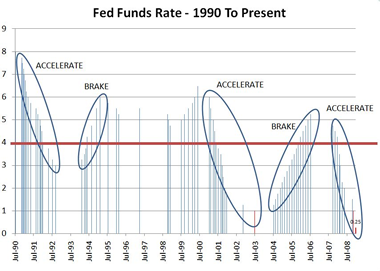
December 11, 2007 Somehow the Fed misses the obvious.
fed_rate_moves_425_small.gif
[Image from: CNNMoney.com]
December 13, 2007 [from The Christian Science Monitor]
"The odds of a recession are now above 50 percent," says Mark Zandi, chief economist at Moody's Economy.com. "We are right on the edge of a recession in part because of the Fed's reluctance to reduce interest rates more aggressively." [see my comments of September 11]
January 7, 2008 The real problem now is that consumers can't rescue the economy and manufacturing, which is already weakening, will continue to weaken. We've gutted the forces that could avoid a downturn. The question is not whether there will be a recession, but can it be dampened sufficiently so that it is very short.
January 11, 2008 This is death by a thousand cuts.
January 13, 2008 [N.Y. Times]
“The question is not whether we will have a recession, but how deep and prolonged it will be,” said David Rosenberg, the chief North American economist at Merrill Lynch. “Even if the Fed’s moves are going to work, it will not show up until the later part of 2008 or 2009.
January 17, 2008 A few days ago, Anna Schwartz, nonagenarian economist, implicated the Federal Reserve as the cause of the present lending crisis [from the Telegraph - UK]:
The high priestess of US monetarism - a revered figure at the Fed - says the central bank is itself the chief cause of the credit bubble, and now seems stunned as the consequences of its own actions engulf the financial system. "The new group at the Fed is not equal to the problem that faces it," she says, daring to utter a thought that fellow critics mostly utter sotto voce.
January 22, 2008 The cut has become infected and a limb is in danger. Ben Bernanke is panicking and the Fed has its emergency triage team cutting rates... this time by 3/4%. ...

What should the Federal Reserve do now? Step back... and don't be so anxious to raise rates at the first sign of economic improvement.
Individuals and businesses need stability in their financial cost structures so that they can plan effectively and keep their ships afloat. Wildly fluctuating rates... regardless of what the absolute levels are... create problems. Either too much spending or too much fear. It's just not that difficult to comprehend. Why has it been so difficult for the Fed?

About Me

My photo
Michigan, United States
Air Force (SAC) captain 1968-72. Retired after 35 years of business and logistical planning, including running a small business. Two sons with advanced degrees; one with a business and pre-law degree. Beautiful wife who has put up with me for 4 decades. Education: B.A. (Sociology major; minors in philosopy, English literature, and German) M.S. Operations Management (like a mixture of an MBA with logistical planning)