READ ABOUT DETROIT AND SOLUTIONS TO ITS PROBLEMS. CLICK HERE.

Tuesday, December 09, 2008

Sacrificial Lambs

SEARCH BLOG: AUTOMOBILES

NEW YORK (Associated Press) - Shares of U.S. automakers surged sharply in premarket trading Monday as Congress appears to be leaning closer to throwing the companies a financial lifeline, but attached to a potential aid package are growing calls _ including from a key senator _ for the chief executives to step down.

General Motors rose nearly 22 percent, while Ford gained nearly 18 percent.

Sen. Chris Dodd, D- Conn., chairman of the Banking Committee said Monday on ABC's "Good Morning America" that overhauling the top management of Ford, Chrysler LLC and GM is necessary as a gesture of good faith with the American public.

Several analysts are speculating that GM, and Chrysler and Ford will receive the funding, but with additional strings attached. Key Banc analyst Brett D. Hoselton said in a research note Monday that there's a 50 percent chance the federal government will grant aid, providing Senate Republicans get onboard.

That's a bit open ended... especially the part that goes "overhauling the top management of Ford, Chrysler LLC and GM is necessary...."
It seems pretty obvious that GM and Chrysler need to dip into the trough, but I'd like to see Ford Motor Company and their CEO, Alan Mulally who has done an exceptional job in a tough situation, be able to thumb their noses at the penance plan by not using any of the Federal money. Of course, that will depend a lot on whether the $700 billion largesse to the financial institutions begins to loosen up the credit and the economy in the next six month.
Congress has been making the domestic auto industry the economic goat for the government's misguided and disastrous meddling into the housing credit market and mandating excessive automobile regulations. Now it wants to make the auto manufactures' CEOs sacrificial lambs.
I'd also like to see Toyota and Honda do a little arm twisting in Alabama when the massive financial incentive period there runs out by hinting at the need to move to another state that wants to give them billions of dollars in new incentives. That would be poetic justice for the ultimate hypocrite, Sen. Shelby.
..

Monday, December 08, 2008

The Latest Economic Goat

SEARCH BLOG: AUTOMOBILES

Yeah, stupid goat....

..

Natural Gas Prices

SEARCH BLOG: ENERGY

Not long ago, predictions were that natural gas prices would go up for consumers by 20%. Now this:

The December contract for natural gas delivery at the Henry Hub expired in trading on November 24 at $6.89 per MMBtu, gaining nearly 46 cents per MMBtu during its tenure as the near-month contract. At $6.89 per MMBtu, the December 2008 contract expired 32 cents or 4 percent below the expiry of the December 2007 contract. This marks the lowest level for the expiry of a December contract since the December 2003 contract expired at $4.86 per MMBtu.


Wellhead Prices
So the question is: will these lower wellhead prices result in lower consumer bills... or will prices be jacked up anyway?

ADDENDUM

The answer appears to be yes:

Consumers Energy Heating Costs Climb 7%

While gas prices drastically dip down, heating costs keep climbing.

"Now we're estimating they'll increase about 7 percent this winter," said Dan Bishop of Consumers Energy.

Bishop says in December 2007 they were charging $7.78 per thousand cubic feet and this December that number jumps to $8.17.

"Last winter our typical customer paid about $150 per month during the winter, we're estimating that, that same customer may pay about $160 a month this winter, that's do to the fact that natural gas prices were a little bit higher than they were," Bishop said.

But Bishop says the percentage increase was initially expected to reach double digits, but he says simple supply and demand softened the blow.

"Natural gas suppliers have increased supplies to the overall market and there has been a slight reduction in terms of demand," Bishop said.

Not a real surprise.

..

Sunday, December 07, 2008

Not Quite Ready For The News

SEARCH BLOG: WEATHER

It's an ill wind that blows no good... but I really don't want to go out to get the newspaper.

..

From Pearl Harbor To Victory By Japan

SEARCH BLOG: HISTORY

On December 7, 1941, Japan attacked the U.S. naval base at Pearl Harbor. Four years later, Japan surrendered. The U.S. responded by...

Total U.S. assistance to Japan for 1946-1952 was roughly $15.2 billion in 2005 dollars, of which 77% was grants and 23% was loans. Most of these funds were provided through GARIOA grants.
Japan responded by:
Japan repaid $490 million of the total postwar assistance. [source - p2]
By 2006...

TOKYO (AP) - Toyota announced an ambitious plan yesterday to boost global sales to 9.8 million vehicles in 2008 - driving home a message of stellar success as its troubled U.S. rivals are closing plants and scaling back production.

Japanese automaker Toyota Motor Corp. already surpassed Ford Motor Co. as the world's No. 2 automaker in annual global vehicle sales in 2003.

And the latest plan shows Toyota is readying to overtake General Motors Corp. as No. 1. GM sold 9.2 million vehicles worldwide in 2005, the second-largest volume in the company's history.

2008...

Toyota said its net income fell to 353.7 billion yen ($3.2 billion), in the quarter, compared with 491.5 billion yen in the period a year earlier.

While their overall results were hardly comparable to the $15.5 billion loss reported by General Motors and the $8.7 billion loss by the Ford Motor Company, Toyota still proved vulnerable to the sharp shift by American consumers from large vehicles into smaller, more fuel-efficient cars.
Times have changed... and by the way... there certainly has been a lot of concern about lending money to the American automobile manufacturers while there was very little concern about giving money to Japan when it was on the brink.

Just strikes me as a little masochistic... especially in light of the fact that Toyota has had over 50 years of a "safe harbor" Japanese market... less than 10% of the market belonging to foreign manufacturers over that time.

..

Saturday, December 06, 2008

Are We There Yet?

SEARCH BLOG: ECONOMY

Those of you who visit here often have, no doubt, noticed my "downward spiral" from prosperity that I published in March... approximately 9 months before economists recognized that a recession was in play and 4 months before the Federal Reserve was still insisting that inflation was our worst possible problem.

Where are we now? That's debatable, but let me hazard a guess...


Somewhere between there and there... almost nowhere.

..

Friday, December 05, 2008

Congressional Logic

SEARCH BLOG: AUTOMOBILES and POLITICS

WASHINGTON — As the Senate banking committee debated a potential rescue package for American automakers, the committee chairman, Senator Christopher J. Dodd of Connecticut, suggested that it would be difficult for lawmakers to approve a financial lifeline for the three companies.
That's really quite interesting. Congress is willing to let the U.S. manufacturers have $25 billion for research to meet Congress' arbitrary CAFE requirements... even though it will cost closer to $100 billion... but will not approve a $25 billion loan for those same companies to stay in business.
If A, then B
If B, then not A
Congressional logic. The epitome of moot.

..

Cold Continues

SEARCH BLOG: WEATHER

Here in Michigan, we skipped November and went directly to December. That means we are now in January.

Of course, the savings from not having Christmas are going directly into home heating. Where are those climate models when you need them?

..

Thursday, December 04, 2008

Banks Cut Out The Crap

SEARCH BLOG: ECONOMY

"Multitasking" was the buzzword for the 90s. Perhaps "core business" will be recalled as the buzzword for the 00s.

LONDON — The financial crisis hit hard among investment banks across Europe on Thursday, particularly in London.

Statement From Credit Suisse (credit-suisse.com)

Credit Suisse announced plans to cut 5,300 jobs, or 11 percent of its global work force, and the Japanese giant, Nomura, which acquired Lehman Brothers’ European business, said it planned 1,000 job cuts at its London office.

Germany’s Commerzbank will eliminate 1,200 jobs in London and shut Dresdner Kleinwort’s merger advisory unit in the city, adding to the hundreds of thousands of jobs financial institutions already cut worldwide.

“The cuts need to be seen in context with plans to reduce risk weighted assets and signal a refocusing on simpler products and a move to adjust risk,” said Matthew Clark, an analyst at Keefe, Bruyette & Woods in London.

Banks are focusing on the more traditional businesses, including wealth management, and abandoning riskier operations as the credit crisis and the resulting economic downturn intensified. HSBC, Europe’s biggest bank, said on Monday it would cut 500 jobs at its British banking business and Standard Chartered, a British bank that makes most of its profit in Asia, announced 200 cuts in Hong Kong.
Imagine that! Banks are now considering getting out of hedge scams and going back to traditional houses of finance and commerce. Wow!
Maybe the U.S. auto manufacturers can get a loan the old-fashioned way... from banks.
..

The Constitution Is Only A Piece Of Paper

SEARCH BLOG: POLITICS

Logic 101:

  • If A, then B
  • If B, then not A
or... you can't get there from here.

You should read this.

..

Wednesday, December 03, 2008

Economists Recognize The Obvious

SEARCH BLOG: ECONOMY

Last January 7, I wrote:

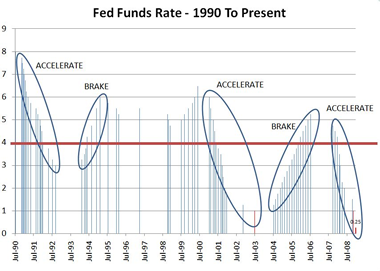
I've summarized what's going on regarding the Fed on my blog, but it boils down to two things: they enabled the housing bubble by making interest rates way too low and then they trapped too many people in financially untenable situations because they raised rates over 4 pp. At the end of last summer I posited that the Fed needed to take rates down immediately to 4%. They took them down gradually to 4.25%, but that simply allowed the situation to fester and make the decrease of interest rates far less effective. At this point, the Fed can do little right. Lower rates below 4% and the dollar crashes; don't lower rates and recession is probably assured. Pick your poison. 4% was the right target; the Fed process was simply inept.

The real problem now is that consumers can't rescue the economy and manufacturing, which is already weakening, will continue to weaken. We've gutted the forces that could avoid a downturn. The question is not whether there will be a recession, but can it be dampened sufficiently so that it is very short.

Of course, I'm looking at things from a very biased mid-western viewpoint. Perhaps things are rosy in the southeast.

Want a massive upswing in the economy? Cut corporate taxes by 75% and government spending by 5%. Okay, that won't happen.
And, of course, that didn't... and we were in a recession.

Economists, with the aid of 20-20 hindsight now say the recession began last December. I think it may have been the 18th, but maybe one of those brilliant academicians can pinpoint it to the hour.
Where were those economists when the Fed was still fretting about inflation being the biggest problem? That was July... 2008! You know, 7 months into a recession the economists didn't recognize.
I wonder if those are the same economists telling Congress to let our automotive industry go under? Answer: it's not no.

..

Tuesday, December 02, 2008

The Ford Story: A different route - Ford on the credit crunch, recession and more fuel efficient vehicles | Ford Vehicles

SEARCH BLOG: AUTOMOBILES

Ford Motor Company set up an interesting website to tell their specific perspective about the request for a "bridge loan" from Congress. Click on the link below.

The Ford Story: A different route - Ford on the credit crunch, recession and more fuel efficient vehicles | Ford Vehicles

Posted using ShareThis
..

Should Automobile Executives Leave For Loan

SEARCH BLOG: AUTOMOBILES and POLITICS

It has been pointed out ad nauseum that without the $100 billion government CAFE mandate the automobile manufacturers would not be faced with a financial crisis... even with $25 billion approved for research and development of vehicles that can meet those mandates that the government is willing to provide. That still leaves the automobile manufacturers $75 billion in the hole. Then, even if they used the other $25 billion loan toward the mandates, that would leave them $50 billion in the hole... and not address the current need for operating cash because the financial markets are so screwed up.

So how about the government getting out of the mandate business? How about the government getting out of the automobile business? How about the government getting out of the energy business? How about the government minding its own business? No, that won't happen.

Instead the government is on the verge of telling the automobile manufacturers that if they want a $25 billion loan to get them through the larger financial credit mess

... a mess facilitated by the government and Wall Street, not created by the automobile manufacturers
... the autombile manufacturers need to fire their top management and turn the planning over to the government.

This from a government trillions of dollars in debt... totally the fault of the politicians that run the government that wants to run the automobile companies. The inmates are running the asylum.


Create the problem; prevent a rational solution; demand control. Insane.

There is not one politician involved in this inquisition that could have done the job of Alan Mulally who has placed Ford in a position where it may not even need any of the government funds... unless the economy just goes to hell. Yet they sit in judgment.


The U.S. government takes pride in being an adversary of the U.S. automobile manufacturers... unlike other governments and their industries [there is an intro commercial before you see the linked article].
..

Monday, December 01, 2008

November 2008 Temperatures Versus Normal

SEARCH BLOG: WEATHER

At the beginning of the month, this area was projected to be warmer than normal. The weather did not cooperate with the forecasting models.

  • There was nothing remotely "normal" about this month; after a brief "Indian Summer," we moved directly into winter
  • The monthly average temperature was 3.1°F below the 30-year average
2008 continues to be cooler than the long-term average. This is no surprise to anyone except those who insist that this is the "XXth warmest year on record."

It looks as if December will continue the trend. The normal high for December 1 is 41° and the normal low is 28°. Our forecast...

..

Sunday, November 30, 2008

Desperately Seeking Sunshine

SEARCH BLOG: WEATHER

Just before evening, the sun poked through the clouds that had covered the area for the last two weeks and lit the top of the trees so that they looked like they were covered with orange leaves... even though the branches were bare.


The small patch of snow at the right was left over from a week ago.

Winter started the 2nd week of November. It will be a long one this year.

ADDENDUM

And the brief teasing of sunshine is over.

..

Saturday, November 29, 2008

Individuals Make War Not Governments

SEARCH BLOG: ECONOMICS

I understand the desire of bloggers to have catchy post titles, hence the title of this post. I was actually doing a title parody of a post at Carpe Diem: People and Businesses Trade, Not Countries.

It's a simple, but overlooked point: Countries don't trade, individual American consumers make voluntary decisions to buy products produced by foreign companies (e.g. check the country of origin on the tags/labels on your clothes), and individual American businesses voluntarily buy from, and sell to, foreign firms and consumers. Most of the discussion about trade focuses on aggregate trade statistics at the "country level," like reports of a $56.5 billion U.S. trade deficit in September, a $700 billion U.S. trade deficit for 2007, a $195 trade deficit with China this year, or a $14 billion trade surplus with Netherlands this year.

Like Walter Williams points out, those aggregate trade data can disguise the fact that it was individual American consumers and businesses making voluntary decisions on buying and selling products every day that result in some country-level trade deficit or surplus when trade data between the U.S. and other countries is aggregated at the end of a month, quarter or year.

Bottom Line: People trade, not countries. Therefore, any restrictions on trade in the form of protectionism hurt American people, i.e. U.S. consumers, and the workers and shareholders of U.S. businesses. A tariff on Japanese-made products is not a tariff on the country of Japan,it is really a tax on American consumers and businesses who voluntarily decide to buy products made by Japanese producers.
Of course, the title is perfectly accurate because a "country" is composed of individuals including those who run businesses... but the title is somewhat misleading when the author tries to equate actions of individuals with those of multinational corporations and governments [yes, comprised of individuals].

My responses to the article and some other comments about the article. This:
Countries don't trade, but governments facilitate trade through treaties that are either enforced or not.

When you go to the store to purchase an item, you probably don't look at the country of origin. You don't look for the "made with child labor" label. You don't read the "prices kept low through currency manipulation" disclaimer. You don't read the part of the owner's manual that tells you "designed by carefully copying quality products."

Individuals do NOT engage in trade... well, 99.9999% don't... they purchase available products. Small businesses do NOT engage in trade... they purchase available products from suppliers. Large corporations with resources to specifically source as they want DO engage in trade. Governments that award contracts based on price DO engage in multinational sourcing... DO engage in trade.
And this:
For those who wish to equate purchases at a local store with arranging for large volumes of goods to be brought in from other countries for distribution, sale, or incorporation into a larger product/assembly, then I concede the concept that individuals trade. But beyond such superfluous and meaningless comparisons, the argument is specious.

Qi, trade does not necessarily enrich all. The Chinese, for example, have siphoned billions... perhaps trillions... of dollars from U.S. companies through intellectual theft... THEFT. You can call that trade if you wish, but counterfeiting and intellectual property theft is just another form of Barbary pirating.

Economists want to view the world through "principles" of trading and thereby lose credibility with those who truly understand the actual interchanges.

Now, if placing boundaries around what is considered acceptable is "an infringement on my freedom allowing to choose who I want to trade with," perhaps your freedom should be re-examined.

Going back to the original point; individuals make purchases or exchange their labor or knowledge for payment... a micro form of "trade" in a loose semantic way. But trade, in the sense of transactions impacting nations, is far upstream of those individual purchases which are "an infringement on my freedom allowing to choose who I want to trade with" by driving out of business through unethical practices [by our standards and laws] those local and national businesses with whom they compete.

But you might save a buck at Wal-Mart as a result.
Further reading here.

... and individuals fire weapons and fly planes and sail ships... not governments.... Governments don't make war.

..

Friday, November 28, 2008

Screw Middle America

SEARCH BLOG: POLITICS

Now that the 2008 elections are over, I have had a chance to evaluate some of the political dynamics that were in play.

Democrats:

  • Effectively used slogans to generate enthusiasm for old programs and policies
  • Convinced uncritical voters that things would be changed the way they personally wanted even if what was said had no relationship to what they wanted
  • Helped create economic problems and then claimed only they could solve the problems by being allowed to take charge
  • Opposed U.S. military actions, but claimed that it was their prodding that enabled the U.S. to be in a position to leave the Middle East in a stable situation
Republicans:
  • Could not express a clear view of their plans for the future; McCain tried to out-Democrat the Democrats
  • Tried to satisfy disparate religious and business factions that had no real common base
  • Ignored the problems of the U.S. industrial and consumer sectors in favor of the financial sector
  • Failed to communicate well how specific foreign policy and military spending in the Middle East was beneficial to Americans allowing the Democratic Party to point to money spent in Iraq when the U.S. economy was faltering
The Democratic Party was able to portray George Bush as incompetent and out of touch because he simply could not communicate a convincing message about America despite military success in Iraq and Afghanistan.
When the economy began to deteriorate, the Republicans tried to ignore the situation and convince the public that there was no problem and that the Republicans policies were responsible for great prosperity... a fatal strategic error that had turned the first George Bush out of office and would do the same to his son's party.
I did and still do hold the position that Nancy, Harry, and Barack are equivalent to sideshow carnival hacks... like the carnival barkers of old they are able to draw a crowd and get them to pay their money. The problem is that the Republican leadership is long on market and military principle and short on pragmatism.

The Republican leaders claim to believe in free trade and open markets, but conveniently ignored the currency manipulations and treaty violations of the Asian governments as long as cheap goods and stock prices were riding high. When the financial sector abuses began to emerge as bad loans and a potential for investment firms to fail, the Republicans first tried to ignore the problem and then came up with a call for an emergency $700 billion for unspecified use by the financial sector.

As the Bush administration winds down, the Republicans have continued to show a general insensitivity to the plight of the consumers and even more so the industrial sector... especially the automotive manufacturers which represents one of the few major heavy industries remaining based in the U.S. Meanwhile the Democratic Party is seizing the opportunities to expand the involvement of the federal government in the industrial sector by tying any loans to equity positions and a say in the way the businesses are run...
something that private credit institutions do not do... and something not required of the financial institutions that are scheduled for 60 times the amount of money that the automotive companies are asking for... $700 billion plus an additional $800 billion... $1.5 trillion versus $25 billion!
And the no-strings-attached money hasn't begun to get the credit markets back in shape.

The Republicans give the party line that they are being fiscally responsible and free-marketers when it comes to the automotive manufacturers, but conveniently ignore that for the financial sector. The Democratic Party has reluctantly supported the notion of a $25 billion loan for the automotive manufacturers... as long as they get to call the shots for future vehicle plans... and because the unions would blow a metaphorical head gasket if the Democrats don't come through with money to save jobs.

So, from where I sit, the Republicans have taken care of their buddies in the financial firms while being content to work out high-profit deals with foreign companies and governments. Meanwhile, the Democrats have been focused on their broken social and dubious environmental engineering programs and will use them against businesses and individuals who don't toe the line.

I don't see either party standing up for middle America... the businesses and individuals who are responsible, bill-paying, tax-paying, ethical, and law-abiding... the strength of America.
Nevertheless, I'm willing to listen to arguments to dissuade me of that notion.
Step right up to the microphone.

..
Thursday, November 27, 2008

Thanksgiving

SEARCH BLOG: HOLIDAYS

We can all find something for which we can be thankful... even when economic times are difficult.

Our best wishes for a Happy Thanksgiving Day.

..

Wednesday, November 26, 2008

Lansing Michigan Mayor Speaks Out

SEARCH BLOG: AUTOMOBILES

No pulling punches here.

Now Is The Time To Bankrupt Old Energy and Old Transportation

SEARCH BLOG: ECONOMY and POLITICS

If your goal is change, you make your move when what you want to change is weakest.

The Democratic Party has vowed to change our energy and transportation sectors into what I call the "California Model." More specifically, the San Francisco Model. This is built on the assumption that humans should be restricted:

  • in their power to manage their environment,
  • to small geographies... preferably high-density urban settings,
  • and to minimal energy consumption.

    This is accomplished by erecting barriers to:
  • electricity production
  • fuel production
  • vehicle production
until the San Francisco Model is met. This Model requires:
  • non-fossil fuel sources of electricity
  • non-fossil fuel sources of fuel
  • vehicles that do not use fossil fuels
I agree with these goals. We've given people more than two centuries with freedom of choice and that hasn't worked. It's time for change.

Then what's the issue here; why are some other people so reluctant to change? Two words: the means. At issue is whether the means justify the ends. Should the means include "bankrupting coal?" Should the means include artificially restricting supply of fuel? Should the means include forcing manufacturers and consumers to use technologies that are very expensive and possibly unmarketable at a price necessary to cover costs?

At present, every alternative source of energy and fuel requires massive governmental or business subsidies. Every alternative source of energy to fossil fuels is either erratic, unreliable, or far more expensive. Nuclear power is as or more reliable than fossil fuels for electricity production, but does not meet the San Francisco politically correct test... and it has been an expensive alternative.

It appears that either bankrupting or the threat of bankrupting old energy and old transportation is the preferred means to achieve the San Francisco Model. While this might be an economic inconvenience for tens of millions of non-San Franciscans, it can be effective in achieving the ends.

ADDENDUM

Well, it doesn't take long for a "good" idea to get around. From The New Republic:
As it turns out, a recession isn't a bad time to get started on climate legislation. Even if Congress raced to pass a cap-and-trade bill in 2009, it would take some time--likely a few years--just to set up a complex new regulatory regime. Moreover, as David Wheeler, a climate-policy expert at the Center for Global Development, points out, an economic slump actually offers a prime opportunity to start trading: If Congress sets the initial economy-wide cap at pre-recession levels, then pollution permits will be exceedingly cheap as long as the economy--and hence energy use--is still shrinking. (Indeed, the downturn in Europe has caused the price of carbon to hit rock-bottom levels.) This would give companies time to learn the system and plan for the future without being assailed right away by high prices.
... a complex new regulatory regime ... now that's the ticket to prosperity.

..

Can"t Find It?

Use the SEARCH BLOG feature at the upper left. For example, try "Global Warming".

You can also use the "LABELS" below or at the end of each post to find related posts.

Blog Archive

Cost of Gasoline - Enter Your Zipcode or Click on Map

CO2 Cap and Trade

There is always an easy solution to every human problem—neat, plausible, and wrong.
Henry Louis Mencken (1880–1956)
“The Divine Afflatus,” A Mencken Chrestomathy, chapter 25, p. 443 (1949)
... and one could add "not all human problems really are."
It was beautiful and simple, as truly great swindles are.
- O. Henry
... The Government is on course for an embarrassing showdown with the European Union, business groups and environmental charities after refusing to guarantee that billions of pounds of revenue it stands to earn from carbon-permit trading will be spent on combating climate change.
The Independent (UK)

Tracking Interest Rates

Tracking Interest Rates

FEDERAL RESERVE & HOUSING

SEARCH BLOG: FEDERAL RESERVE for full versions... or use the Blog Archive pulldown menu.

February 3, 2006
Go back to 1999-2000 and see what the Fed did. They are following the same pattern for 2005-06. If it ain't broke, the Fed will fix it... and good!
August 29, 2006 The Federal Reserve always acts on old information... and is the only cause of U.S. recessions.
December 5, 2006 Last spring I wrote about what I saw to be a sharp downturn in the economy in the "rustbelt" states, particularly Michigan.
March 28, 2007
The Federal Reserve sees no need to cut interest rates in the light of adverse recent economic data, Ben Bernanke said on Wednesday.
The Fed chairman said ”to date, the incoming data have supported the view that the current stance of policy is likely to foster sustainable economic growth and a gradual ebbing in core inflation”.

July 21, 2007 My guess is that if there is an interest rate change, a cut is more likely than an increase. The key variables to be watching at this point are real estate prices and the inventory of unsold homes.
August 11, 2007 I suspect that within 6 months the Federal Reserve will be forced to lower interest rates before housing becomes a black hole.
September 11, 2007 It only means that the overall process has flaws guaranteeing it will be slow in responding to changes in the economy... and tend to over-react as a result.
September 18, 2007 I think a 4% rate is really what is needed to turn the economy back on the right course. The rate may not get there, but more cuts will be needed with employment rates down and foreclosure rates up.
October 25, 2007 How long will it be before I will be able to write: "The Federal Reserve lowered its lending rate to 4% in response to the collapse of the U.S. housing market and massive numbers of foreclosures that threaten the banking and mortgage sectors."
November 28, 2007 FED VICE CHAIRMAN DONALD KOHN
"Should the elevated turbulence persist, it would increase the possibility of further tightening in financial conditions for households and businesses," he said.

"Uncertainties about the economic outlook are unusually high right now," he said. "These uncertainties require flexible and pragmatic policymaking -- nimble is the adjective I used a few weeks ago."
http://www.reuters.com/

December 11, 2007 Somehow the Fed misses the obvious.
fed_rate_moves_425_small.gif
[Image from: CNNMoney.com]
December 13, 2007 [from The Christian Science Monitor]
"The odds of a recession are now above 50 percent," says Mark Zandi, chief economist at Moody's Economy.com. "We are right on the edge of a recession in part because of the Fed's reluctance to reduce interest rates more aggressively." [see my comments of September 11]
January 7, 2008 The real problem now is that consumers can't rescue the economy and manufacturing, which is already weakening, will continue to weaken. We've gutted the forces that could avoid a downturn. The question is not whether there will be a recession, but can it be dampened sufficiently so that it is very short.
January 11, 2008 This is death by a thousand cuts.
January 13, 2008 [N.Y. Times]
“The question is not whether we will have a recession, but how deep and prolonged it will be,” said David Rosenberg, the chief North American economist at Merrill Lynch. “Even if the Fed’s moves are going to work, it will not show up until the later part of 2008 or 2009.”
January 17, 2008 A few days ago, Anna Schwartz, nonagenarian economist, implicated the Federal Reserve as the cause of the present lending crisis [from the Telegraph - UK]:
The high priestess of US monetarism - a revered figure at the Fed - says the central bank is itself the chief cause of the credit bubble, and now seems stunned as the consequences of its own actions engulf the financial system. "The new group at the Fed is not equal to the problem that faces it," she says, daring to utter a thought that fellow critics mostly utter sotto voce.
January 22, 2008 The cut has become infected and a limb is in danger. Ben Bernanke is panicking and the Fed has its emergency triage team cutting rates... this time by 3/4%. ...

What should the Federal Reserve do now? Step back... and don't be so anxious to raise rates at the first sign of economic improvement.
Individuals and businesses need stability in their financial cost structures so that they can plan effectively and keep their ships afloat. Wildly fluctuating rates... regardless of what the absolute levels are... create problems. Either too much spending or too much fear. It's just not that difficult to comprehend. Why has it been so difficult for the Fed?

About Me

My photo
Michigan, United States
Air Force (SAC) captain 1968-72. Retired after 35 years of business and logistical planning, including running a small business. Two sons with advanced degrees; one with a business and pre-law degree. Beautiful wife who has put up with me for 4 decades. Education: B.A. (Sociology major; minors in philosopy, English literature, and German) M.S. Operations Management (like a mixture of an MBA with logistical planning)