SEARCH BLOG: FEDERAL RESERVE for full versions... or use the Blog Archive pulldown menu in the right column.
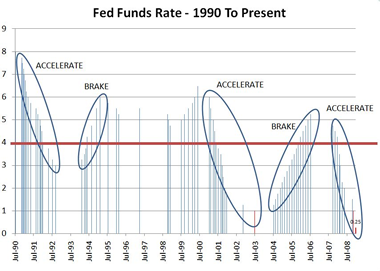
February 3, 2006 Go back to 1999-2000 and see what the Fed did. They are following the same pattern for 2005-06. If it ain't broke, the Fed will fix it... and good!August 29, 2006 The Federal Reserve always acts on old information... and is the only cause of U.S. recessions.
December 5, 2006 Last spring I wrote about what I saw to be a sharp downturn in the economy in the "rustbelt" states, particularly Michigan.
March 28, 2007 The Federal Reserve sees no need to cut interest rates in the light of adverse recent economic data, Ben Bernanke said on Wednesday.
The Fed chairman said ”to date, the incoming data have supported the view that the current stance of policy is likely to foster sustainable economic growth and a gradual ebbing in core inflation”.
July 21, 2007 My guess is that if there is an interest rate change, a cut is more likely than an increase. The key variables to be watching at this point are real estate prices and the inventory of unsold homes.
August 11, 2007 I suspect that within 6 months the Federal Reserve will be forced to lower interest rates before housing becomes a black hole.
September 11, 2007 It only means that the overall process has flaws guaranteeing it will be slow in responding to changes in the economy... and tend to over-react as a result.September 18, 2007 I think a 4% rate is really what is needed to turn the economy back on the right course. The rate may not get there, but more cuts will be needed with employment rates down and foreclosure rates up.
October 25, 2007 How long will it be before I will be able to write: "The Federal Reserve lowered its lending rate to 4% in response to the collapse of the U.S. housing market and massive numbers of foreclosures that threaten the banking and mortgage sectors."
November 28, 2007 FED VICE CHAIRMAN DONALD KOHN
"Should the elevated turbulence persist, it would increase the possibility of further tightening in financial conditions for households and businesses," he said. "Uncertainties about the economic outlook are unusually high right now," he said. "These uncertainties require flexible and pragmatic policymaking -- nimble is the adjective I used a few weeks ago."
http://www.reuters.com/
December 11, 2007 Somehow the Fed misses the obvious.

[Image from: CNNMoney.com]
December 13, 2007 [from
The Christian Science Monitor]
"The odds of a recession are now above 50 percent," says Mark Zandi, chief economist at Moody's Economy.com. "We are right on the edge of a recession in part because of the Fed's reluctance to reduce interest rates more aggressively." [see my comments of September 11]
January 7, 2008 The real problem now is that consumers can't rescue the economy and manufacturing, which is already weakening, will continue to weaken. We've gutted the forces that could avoid a downturn. The question is not whether there will be a recession, but can it be dampened sufficiently so that it is very short.
January 11, 2008 This is death by a thousand cuts.
January 13, 2008 [
N.Y. Times]
“The question is not whether we will have a recession, but how deep and prolonged it will be,” said David Rosenberg, the chief North American economist at Merrill Lynch. “Even if the Fed’s moves are going to work, it will not show up until the later part of 2008 or 2009.”
January 17, 2008 A few days ago, Anna Schwartz, nonagenarian economist, implicated the Federal Reserve as the cause of the present lending crisis [from the
Telegraph - UK]:
The high priestess of US monetarism - a revered figure at the Fed - says the central bank is itself the chief cause of the credit bubble, and now seems stunned as the consequences of its own actions engulf the financial system. "The new group at the Fed is not equal to the problem that faces it," she says, daring to utter a thought that fellow critics mostly utter sotto voce.
January 22, 2008 The cut has become infected and a limb is in danger. Ben Bernanke is panicking and the Fed has its emergency triage team cutting rates... this time by 3/4%. ...
What should the Federal Reserve do now?
Step back... and don't be so anxious to raise rates at the first sign of economic improvement.
Individuals and businesses need stability in their financial cost structures so that they can plan effectively and keep their ships afloat. Wildly fluctuating rates... regardless of what the absolute levels are... create problems. Either too much spending or too much fear. It's just not that difficult to comprehend. Why has it been so difficult for the Fed?
6 comments:
LOL...Fox is just as biased as MSNBC and has been pushing its preferred candidates. I do not see Palin as being any more passionate than Dr. Paul or Newt Gingrich. I do not see how Gingrich's sacrifice of substance for style is helpful to any candidate wishing to be seen as serious or credible. His willingness to disregard principle and say anything for temporary gain is why so many have turned against him.
And I see nothing conservative about big government politicians like Gingrich, Palin, Romeney, or Santorum. Note that with one exception no candidate is talking about real cuts in spending or is doing anything to stop the meddling of the state with constitutionally protected individual rights. Voters have seen that there is no difference between the two parties and that Obama is as bad as Bush was. If the parties are not careful they could see a huge slide that even their electoral regulatory barriers at the state level cannot stop.
What exactly do conservatives say when Obama attacks Iran as most of the GOP candidates advise or uses huge stimulus efforts, similar to those that most of them voted for, to give a temporary boost to the economy? How does an unprincipled candidate like a Newt or Romney argue that he is a real alternative to Obama?
The choice for fiscal conservatives is obvious. Sadly, they are too stupid to take it.
Thanks for reinforcing my point: no candidate represents the "ideal" from all perspectives.
Romney is the "big business" guy; Santorum is the the call to Christianity guy; Palin is the NRA gal; Gingrich is the get my idea across guy; Paul is the leave me alone guy.
They have elements of what those who call themselves conservative want, but then again conservatives don't all want the same things. Hence, the "ideal" Republican.
Romney is the "big business" guy; Santorum is the the call to Christianity guy; Palin is the NRA gal; Gingrich is the get my idea across guy; Paul is the leave me alone guy.
Nonsense. Ron Paul is the ideal candidate because he will leave Americans alone to follow their own desires and goals without much meddling from government. That is far more business friendly than the statism of Romney. It is far more friendly to religious freedom than the meddling of Santorum. He is actually far more friendly to the Second Amendment than Palin. And his ideas are much better than anything that Gingrich has ever come up with because Gingrich has no depth, logic, or character.
I think that the rejection of Dr. Paul will lead to a major collapse of the Republican Party even if it manages to get its version of a big-government President. None of the candidates understand economics, which is why none of them have a plan to cut spending or to do anything meaningful. Dr. Paul has written on economics for decades, understands law and the constitution better than any of the rest, including Obama, and has a better grasp of history than the so-called history teacher who wants to be the GOP candidate.
The reason why young people are attracted to his message has little to do with the fact that he is genuine and consistent, although those matter a great deal, but because the offers them a lens through which they can see reality as it is and understand what they see better than the presstitutes in the old media or the empty suits that they rely on for their analysis.
They have elements of what those who call themselves conservative want, but then again conservatives don't all want the same things. Hence, the "ideal" Republican.
I do not understand how anyone who uses the label conservative can believe that it is all right to spend trillions on nation building and policing the word. I do not see how anyone who uses the label conservative can vote for any candidate who promises business as usual and has no credible way to deal with the deficits and government expansion. I I do not see how anyone who uses the label conservative can accept the state's violation of the Bill of Rights and the Constitution. If conservatives actually applied the ideals that they profess to believe in they would reject all of the candidates other than Dr. Paul. Lucky for the party hacks who feed off the public trough most 'conservative' voters are hypocrites who reject the principles on which conservatism was supposed to depend on.
As Mark Steyn said: "An hour later a weird goofy gnome in a baggy suit two sizes too big came out and started yakking about the Federal Reserve, fiat money, and monetary policy “throughout all of history.” And the crowd went bananas!"
The problem is that too many other people see him just that way... "a goofy gnome in a baggy suit two sizes too big...."
He has difficulty as a public speaker... an issue when communication is a big part of the job.
But that was the whole idea of the post. There is not one candidate who can step up yet and excite the whole Republican party [I'm including the conservative wing]. While Paul may be a means to a fiscal end for many, in the general election he would be trounced. The country won't accept the pendulum crashing into one wall only to swing back and crash into another... despite the logic and rhetoric you bring to the table.
Libertarianism is still fringe politics in the U.S. Fiscal conservatism is okay with most voters as long as it is done intelligently. Wisconsin's backlash shows how not to do it. November will not see the election of the President of the Republican Party. To try to elect the President of the Conservatives really won't fly. Has to be more to the story than money and isolationism isn't it.
The problem is that too many other people see him just that way... "a goofy gnome in a baggy suit two sizes too big...."
It is not a problem at all. Many people are supporters of big government and depend on benefits they get from its existence. I expect them to oppose anyone who argues that government is too big and that it has to be cut down in size and influence.
He has difficulty as a public speaker... an issue when communication is a big part of the job.
I do not believe the evidence supports your conclusions. His ideas excite people and his events have more people than the other candidates. Many cross state lines to try to hear him speak and give him money to spread his message. The men and women who serve in the military certainly like his message. They contribute more than they do to all of the other GOP candidates combined.
There is not one candidate who can step up yet and excite the whole Republican party [I'm including the conservative wing]. While Paul may be a means to a fiscal end for many, in the general election he would be trounced.
The polls have him in a statistical tie with Obama. He does as well as Romney and better than the three little pigs.
The country won't accept the pendulum crashing into one wall only to swing back and crash into another... despite the logic and rhetoric you bring to the table.
Crashing? What are you talking about? Dr. Paul wants a smaller government but $1 trillion in cuts is not a big deal. That would still leave the budget near historical highs. Even his balanced budget proposal is not extreme because spending would be at Clinton era levels. He wants to end the foreign wars and bring back the troops from the Middle East, South Korea, Germany, and the more than 100 other countries where the military is now stationed. His call for more individual liberty is certainly not extreme. In fact, nothing he is calling for is extreme because all of his proposals are based on the ideas in the Constitution.
Libertarianism is still fringe politics in the U.S.
Not really. Many people in the US agree with libertarians on most of the issues. They just don't know it because people on the extreme left and right have misrepresented what libertarians stand for.
Fiscal conservatism is okay with most voters as long as it is done intelligently. Wisconsin's backlash shows how not to do it.
Wisconsin was about politics, not principle. Governor Walker tried to end the unions when he should simply have allowed competition to them and went to common law principles that would have done the job instead.
November will not see the election of the President of the Republican Party. To try to elect the President of the Conservatives really won't fly. Has to be more to the story than money and isolationism isn't it.
The story is about liberty. And none of the candidates are isolationists, least of all Dr. Paul. He supports free trade and commercial engagement with all nations. That is hardly the position of an isolationist.
Post a Comment