READ ABOUT DETROIT AND SOLUTIONS TO ITS PROBLEMS. CLICK HERE.

Wednesday, December 06, 2006

Scholarship?

SEARCH BLOG: EDUCATION

The Detroit Free Press reports:

Gov. Jennifer Granholm's plan to increase the Michigan Merit Award scholarship to $4,000 for students who complete at least two years of college cleared a big hurdle Tuesday and was headed for final approval in the state House.

The full $4,000 would be paid only to students who complete either two years of a four-year degree program, or earn a two-year associates degree at a community college. The first $2,000 would be given during the first two years.

Granholm has said that paying half of the scholarship after two years of college will discourage students from dropping out.

The scholarship would also be available to students who don't score well on the state high school graduation test but who maintain at least a 2.5 grade point average in college (out of 4.0).

Just two thoughts:
  1. This is not exactly a scholastic award for high achievement.
  2. This is not exactly a grant for economic need.
Oh, well....

..

Tuesday, December 05, 2006

University Adjusts to Racial Preference Ban

SEARCH BLOG: AFFIRMATIVE ACTION

Wayne State University, an institution of nearly 35,000 students located in Detroit, Michigan, is attempting to deal with Proposition 2 which was passed in the November elections and banned racial preferences for university admissions.

The Detroit Free Press reports that the WSU law school will change its admissions policy to reflect the new law, but would have certain exceptions:

• Adversity, such as attending a low-performing K-12 school (most Detroit schools) or experiencing prejudice or discrimination (what would Homer Simpson say?).

• Being a Detroit resident (80% black).

• Being a member of a Native American tribe (??? not many in the Detroit area).

So, if you are a member of Detroit's 80% black majority and went to one of Detroit's badly performing schools, then you get special preference for law school admission... in violation of the law?

I really don't have an issue if a Detroit-based college that gets funding support from Detroit wants to offer admission preference to Detroit's citizens. WSU does not qualify for that. It is a state supported university where the only preference should be for state residents.

Why jump through such hoops? Rather than such convoluted "exceptions" simply offer the following:
  • scholarships for academic achievement (coming in from high school and for high-performing university students)
  • financial aid for students from low-income families
The reality is, in the instance of Wayne State University, that most of the students will be from Detroit or its immediate suburbs and a high percentage will be black... and many of the Detroit residents will be from low-income families.

The difference between my proposal and WSU's proposal: mine is based on merit and need; WSU's is based on race and questionable sociology.

Incidentally, WSU has many privately-funded scholarships that are available to specific ethnic groups that are independent of admissions policy and are perfectly legal.

..

Economic Downturn

SEARCH BLOG: RECESSION and STAGFLATION

Last spring I wrote about what I saw to be a sharp downturn in the economy in the "rustbelt" states, particularly Michigan. More recently, I have brought back the term "stagflation" ... a nasty combination of stagnation and inflation that occurs when the dollar falls and causes the price of imports to rise rapidly at the same time industrial output and employment fall. I remember how things were at the beginning of the 80s, but don't believe that the Federal Reserve will let the economy get that far out of hand (16+% mortgage rates).

Nevertheless, some cracks are beginning to appear despite calm talk from Washington.

At Economist's View, there is a post entitled Is GDP Growth Below Stalling Speed?

It talks about the possibility of a recession and and economy that is at "stalling speed." Let's hope that is the worst of it. We really don't want the flight from the dollar (which many believe is beginning to happen because our huge trade deficits are causing a loss of confidence in the international community) to lower the economy to "falling speed."

I know that trade deficits are supposed to be a only good thing because ... well, they just are according to our friends at Cafe Hayek and similar sites. The deficit probably was not much of a problem when it hovered around $100 million annually, but it is now at nearly 7 times that and cumulatively over $1 trillion with China, alone.

But too much of good thing may not be a good thing. Especially if China gets a little uneasy with holding that much U.S. currency and goes to something like the Euro which has been appreciating rapidly versus the dollar. That will be just another push toward a lower dollar and higher inflation.

Oh, it's probably much ado about nothing.

..

Monday, December 04, 2006

Zigging When Others Zag

SEARCH BLOG: POPULAR WISDOM or OIL or RESEARCH

Recently, I wrote about the dangers of "popular wisdom" ... something being repeated often enough so that it becomes the "truth." That is not to say that "accepted" theories are wrong because they have acquired the status of "popular wisdom." Only that we must look at ideas with a critical eye. If you are interested in another piece of information regarding the above linked article... try this one. This is not "popular" wisdom. Also recommended for your edification.

Much of the world is focused on the political and social unrest in the Middle East and the "clash of cultures" between the Muslims and the rest of the world. Yes, there are plenty of Islamic nutjobs running around and they are a problem that needs to be addressed in the near term. But the reality of the Middle East is that the Islamic nations and their fanatics have only two supports... oil and religion... and oil will cease to be as significant of a support within two generations. The Middle East Islamists, berift of oil, have little to offer the rest of the world except a distorted version of religion... and that will ensure their failure. The world will move forward while they lose the one source of income that sustains them now.

If for no other reason, removing economic support for Islamists is reason enough to push forward with more nuclear and clean-coal powered electric generating plants... which will allow expanded use of electric-hybrid or other, non-petroleum dependent automotive technologies (such as hydrogen fuels which require large amount of electricity to generate hydrogen gas).

Focusing only on military and diplomatic solutions is self-defeating... we've been doing that for 1/2 a century.
Three major universities in Southeastern Michigan are facing the reality that their futures are tied to that area's future and making more of their research results available to businesses. This is a start, but really just miniscule. A greater symbiotic relationship needs to be developed between our great universities and our businesses. Let's hope that pirated or counterfeited versions don't end up in China next week... after all, our business and universities have been subsidizing China's industrialization with our research and development efforts for decades... they just haven't been paying for it.

I think you get the idea... just because "everyone" thinks something is truth or "we've always done it that" way is accepted... you can zig when the world is zagging.

..

Sunday, December 03, 2006

Physicists and Economists

SEARCH BLOG: ECONOMIST or PHYSICIST

Recently there was angst among economists (see Econophysicists and High Powered Economics as well as Hanson, Caplan, & Knight) that they were not as understood or accepted as physicists.

Well... the pronouncements of physicists are not necessarily that well understood or accepted. Sure everyone talks with great familiarity about the speed of light or the theory of relativity or black holes... but, come on, who really understands that stuff? It boils down to "really fast" or "really big" or "stuff disappears"... some such thing. Oh sure, physicists will toss pages of Sanskrit or some other squiggles at us and tell us this is all the proof we need... and we bow down before them in awe of their intellectual presence.

For example, my 27-year-old son (who is brilliant in his own right) has rather wide-ranging interests and loves to ask, "Dad, have you heard about... (fill in the esoteric nouns)." Recently, he offered up this one... Going for a blast into the real past ....

Sure, that's why physicists get more respect than economists. Nobody understands quantum physics and everybody understands economics, so who can argue with a physicist? Anyone can argue with an economist.

..

Saturday, December 02, 2006

News and Nous

SEARCH BLOG: LANGUAGE

I'm presuming readers of this and other blogs have at least one thing in common (besides having access to the Internet): a large appetite for the news. We want to know the new things that have happened. We'll ask "what's new" or "was neu ist" or some such question; "inquiring minds want to know...."

The last two days, I have focused on the use of language... or perhaps its misuse... in the realm of news and information. It has been said ad nauseum that "knowledge is power." I'm sure that is partially correct, but in today's world it seems that "the news" is power. The news is what we could call "marketed knowledge." After all, what good is knowledge if it doesn't lead to power of some sort? That doesn't mean political or military power, although it certainly can lead to that. It can mean acquiring prestige and honor among peers. And being first to tell... first to make the news... is often the difference between power and parroting.

Bloggers seldom make the news... are the first to tell. Bloggers seldom acquire power from what they write; their goal is more to share opinions about what is considered "the news." What readers seek from bloggers is perspective... applying their intelligence, intellect... their minds to statements presented as knowledge or fact by "the News."

The last couple of days, I have given my perspective about issues making the "news" circuit... affirmative action, global warming, the economy and economists... but with the emphasis on how the misuse of language colors the news.

Why? Because it interests me and I hope it interests you.

..

Friday, December 01, 2006

Heating Up Global Warming

SEARCH BLOG: CLIMATE or POLITICALLY CORRECT

Yesterday I talked about how euphemisms are used to make a contentious position seem reasonable. There is another phenomenon used by special interest groups to gain political strength: using contentious language to make reasonable actions seem deficient and derelict. To wit:

It seems that mere "climate change" was not going to be bad enough, and so now it must be "catastrophic" to be worthy of attention.

The increasing use of this pejorative term - and its bedfellow qualifiers "chaotic", "irreversible", "rapid" - has altered the public discourse around climate change.

This discourse is now characterised by phrases such as "climate change is worse than we thought", that we are approaching "irreversible tipping in the Earth's climate", and that we are "at the point of no return".

I am no great follower of the disciples of human-caused global warming (climate change) although I readily accept human-caused environomental change. That puts me in a distinct minority. Recently I wrote one reason why:

The following chart from Dr. Christopher R. Scotese shows the trend ending at the current estimated average temperature of earth (arrow is pointing to it if you can't read the chart).

It may interest you to know that California has passed climate control legislation and is suing automobile manufacturers for having products that produce carbon dioxide and cause global warming.

I see a couple of points:

  1. We are presently at the lower end of the temperature range (which fluctuates naturally throughout earth's geological past)
  2. Change has happened quickly in the past without the aid of automobiles
Other reasons include a generally:
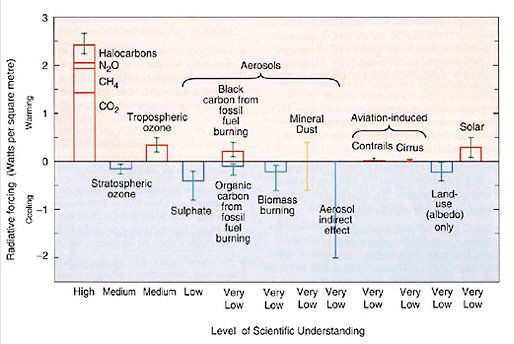
  • incomplete understanding of earth's weather versus climate system (or even just the weather system)
  • incomplete understanding of earth eco-system and its capacities to self-regulate
  • incomplete understanding of extraterrestrial (yes... external to earth) phenomenon that affect both weather and climate (such as the sun's influence and how to predict what that will be)
Popular wisdom is not always truth.

For those of you who are ABSOLUTELY, POSITIVELY, UNEQUIVOCALLY CERTAIN that my skepticism is STUPID, ASININE, BLIND, FOOLISH... ... Read This.

..

Thursday, November 30, 2006

Clarity of Thought and Speech

SEARCH BLOG: POLITICALLY CORRECT

"Politically correct"... a euphemism meaning to use euphemisms to avoid offending people.

I've seen a lot of changes in 6+ decades. But the rise of deliberate obfuscation in our communications seems to be an effort to convince listeners or readers that we mean one thing when we may mean the opposite.

One of the more notorious examples (and I want to make clear that the following is an example) has been the use of the term "diversity" in the context of reducing racial discrimination or expanding opportunities for minorities and women. Instead of simply saying "our goal is to increase the number of black men and all women into positions of advantage and power," the discussion centered around not being "diverse enough."
  • We can't promote the most qualified if they "aren't diverse enough"
  • We can't accept the best students if they "aren't diverse enough"
  • We can't use this group of jurors because they "aren't diverse enough"
The obfuscations are used to make actions that are politically unpalatable... overt racial and gender discrimination... to a large portion of listeners or readers more acceptable. If we say what we actually mean, we will create a reaction opposite to that which we want. Therefore, we say what sounds "enlightened" or "reasonable" so that those who oppose will sound "barbaric." We can justify unreasonable actions by couching them in language that sounds reasonable. We can deny fairness to all to achieve advantage to some.

So rather than addressing the root causes of problems... the "politically correct" approach is to simply deride and discredit anyone who questions your "politically correct" actions as uneducated or unenlightened or, in this example, a racist or misogynist.
Clarity of thought requires clarity of speech. If we use terms intended to obfuscate, we begin to think in obfuscated terms. Our arguments become transparently weak or false. The good will and support you might have gained and sustained with honest, clear language will be lost.

The next time you hear "they just don't understand", consider that the speaker might not understand... how to think and speak clearly... how to communicate and defend what he actually means.

Wednesday, November 29, 2006

No Respect

SEARCH BLOG: ECONOMISTS

Two of my favorite blogs are Cafe Hayek and Martin Kelly... not because what is written there always agrees with my perspectives, but because they constantly challenge the "obvious" and do so with integrity.

Recently Martin Kelly had a posting regarding a post at Cafe Hayek... are you following here? The gist (my interpretation) of the Cafe's post was that economists don't get the same kind of respect that physicists get. The gist of Kelly's response was that physicists deal with repeatable and verifiable facts which in turn lead to extrapolations that can be tested (theories)... whereas economists always seem content to disagree with each other (not a completely fair observation, but with a large element of fact).

I believe the task of the economist is far more difficult that that of a physicist. A physicist can build upon verified observations and testing to improve knowledge. An economist must deal with human behavior and institutions that are constantly changing and where the rules of interaction are, at best, chaotic. What appears reasonable and verifiable based on a small slice of human interaction considered to be economic in nature may well be just a "special case" situation that can be explained any number of ways... not just by the dynamics of trading or consuming.

That said, while I respect the knowledge and expertise at Cafe Hayek, I don't always agree with the conclusions reached there... I don't always disagree either. As I said in a previous post... these are my opinions backed up with data and other expert opinions. Data can be equivocal and experts can be mistaken... you decide.

Today I left a comment at Cafe Hayek on a post titled "A Yen for Understanding." If you are inclined to read discussions about the economy, trading practices, and who wins or loses... read the post and subsequent comments including mine.

As Martin Kelly says,

The explanation for this lack of deference is quite simple.

Economics contains no universal absolutes such as E=MCSquared.

E=MCSquared is true at all times and under all circumstances; 'comparative advantage' is not.

P.S. The Economist's View has the same topic as Cafe Hayek today. We'll call it the Economist's Lament.

Tuesday, November 28, 2006

More Theory Versus Reality

SEARCH BLOG: EDUCATION FAILURE

The public face of institutions often varies from their private actions. We could call that "marketing." Something on the order of calling club soda "Miracle Water" because it can remove some stains from clothing.

For years, the University of Michigan publically has led the charge for the underdog... we need a "diversity" program... call it affirmative action or whatever. The not-so-subtle message here: the University is intellectually, socially, and ethically superior to the rest of society.

Unfortunately (for the University), the data doesn't seem to support that.

At the nation's 50 flagship universities, students with the same academic qualifications received different amounts of financial help based on income, 1995-'03:
  • Average grant to students whose families earn more than $100,000 grew 86 percent. In 2003, the amount of aid for these families amounted to $257 million.
  • Average grant for students with family incomes of less than $20,000 increased 29 percent. In 2003, the amount of aid for these families equaled $171 million.
  • The University of Michigan received a grade of C for access. It received a B for minority access, but an F for low-income access.
  • The F grade for low-income access was based on only 13.5 percent of U-M students receiving Pell grants, compared with 33.9 percent of all state students receiving such federal aid in 2004. That was a much larger disparity than the 28 percent of U-M students receiving Pell grants in 1992 compared with 30.6 percent statewide.
    Source: Education Trust
  • About two years ago, I wrote to Mary Sue Coleman, President of UM, regarding the University's public posturing versus the opportunity for real action. The lesson: the lesson was not learned, apparently.

    Oh, UM is a great institution... two of my sons have advanced degrees from there and are grateful that their mom and dad helped them toward that. But greatness doesn't necessarily mean perfection... or even close.

    Maybe it is time to put the University's money where its mouth is.

    ..

    Monday, November 27, 2006

    Theory Versus Reality

    SEARCH BLOG: ECONOMICS and RESEARCH AND DEVELOPMENT

    Economic theory is a powerful tool and results in creative ways to address old problems. But sometimes theory seems to run amok in the harsh light of reality. Some thoughts about economic theory and economic reality.... If you are too impatient, just go to the end of this post.

    Trade Promotes Peace (Cafe Hayek 11/20/06)
    Back in 1748, Baron de Montesquieu observed that "Peace is the natural effect of trade. Two nations who differ with each other become reciprocally dependent; for if one has an interest in buying, the other has an interest in selling; and thus their union is founded on their mutual necessities."
    Okay, then my thought about attempting to normalize relations with Iran as a step toward Middle East peace (and North Korea just to get our troops out of South Korea?) should begin with dropping all trade sanctions and granting most favored nation status... if we want to be good economists?
    Selling body parts is a good economic idea (Cafe Hayek 11/20/06)
    It is against federal law to receive anything of value in return for donating a kidney. The result is the following kind of absurd kidney gymnastics reported by Forbes: (quote followed)....

    What a bizarre definition of ethics (not allowing people to sell body parts). Try and explain that one to your kids. I can't.
    Okay, then it's all about individual decisions by well informed people like this Pakistani farmer... "I pant. I cannot run. I cannot pick up heavy things," said Allah Yar, a 50-year-old farmer who has suffered poor health for seven years since selling a kidney. He needed to pay off a $3,000 loan, but got only $1,200 for his kidney, meaning he remains in debt.

    Sitting nearby, Mohammed Akram, a brick kiln worker, sold his kidney to pay off his father's debt.

    "I cannot work like I did before. I cannot walk. I cannot run," Akram, 22, said. "I did this for my father but destroyed myself."

    Safety regulations are costly and ineffective (Cafe Hayek 11/15/06)
    Sam (Peltzman) found that mandatory seat belts did indeed cause more accidents. But this effect was roughly the same as the effect in the opposite direction, that accidents were less harmful. So the net number of fatalities of drivers was unaffected by the law. Sam found some evidence that the effect of the law might be to reduce driver fatalities. Unfortunately, because drivers were more reckless, there were more accidents involving pedestrians and cyclists. So their death rate due to cars increased. Total deaths were unchanged. (ditto for airbags)
    I won't attempt to answer that. I let the data speak to it. From the NHTSA/DOT:
    • In 2001, the estimated economic cost of police-reported crashes involving drivers between 15 and 20 years old was $42.3 billion.7
    • Safety belts saved more than 12,000 American lives in 2001. Yet, during that same year, nearly two-thirds (60 percent) of passenger vehicle occupants killed in traffic crashes were unrestrained.12
    • Research has shown that lap/shoulder belts, when used properly, reduce the risk of fatal injury to front-seat passenger car occupants by 45 percent and the risk of moderate to critical injury by 50 percent. For light truck occupants, safety belts reduce the risk of fatal injury by 60 percent and moderate-to-critical injury by 65 percent.13
    • Safety belts should always be worn, even when riding in vehicles equipped with air bags. Air bags are designed to work with safety belts, not alone. Air bags, when not used with safety belts, have a fatality-reducing effectiveness rate of only 12 percent.14
    • Safety belt usage saves society an estimated $50 billion annually in medical care, lost productivity, and other injury-related costs.15
    • Conversely, safety belt nonuse results in significant economic costs to society. The needless deaths and injuries from safety belt nonuse account for an estimated $26 billion in economic costs to society annually.16 The cost goes beyond the lost lives of unbuckled drivers and passengers: We all pay - in higher taxes and higher health care and insurance costs.
    Economic theory... like many theories taken past their legitimate purview... may fail the "real world" litmus test. I'll admit that I express opinions as my own, not as part of an academic discipline... but I use data and expert opinions as much as possible to support my own opinions. Economists might think twice about straying too far with opinions that are not necessarily economic at their core.

    For views differing somewhat from Cafe Hayek try: Economist's View
    and specifically this, for example. There are those who question how good it is to let China "subsidize" us through "free trade" and "globalization". It may well be that we are subsidizing China and India and other competitors.

    Sunday, November 26, 2006

    Trading (Thoughts) Freely

    SEARCH BLOG: CHINA and TRADE

    I noticed a post at Cafe Hayek directed at me and those who share similar thoughts about trade issues and I invite you to check out Dr. Don Boudreaux' site. He is Chairman of the Economics Department at George Mason University and I have the utmost respect for his academic credentials and that university (where one of my sisters-in-law is a professor in another department). George Mason could be considered the "Michigan of the Mid-Atlantic" except there is a decidedly more "conservative" tendency than that found at UM.

    Dr. Boudreaux wonders why...

    A frequent commentor here at the Cafe, Bruce Hall, is convinced that American trade with China ultimately will hurt Americans.

    I can't figure out why, though, Mr. Hall is worried. His comments, along with his posts at his blog Hall of Record, suggest that he fears that Chinese government policy -- for example, the alleged undervaluation of the Chinese yuan -- threaten American economic prosperity.

    I don't doubt that there are benefits for some... maybe many... as a result of importing products from China. Wal-Mart and its customers are doing just fine by them.

    This is my response...

    I continue to appreciate your efforts to educate me; however, I will also continue to distinguish between trade that is open and equitable and countries whose trade practices are designed to weaken U.S. (and other) manufacturers in order to strengthen their own.

    U.S. manufacturers have had to deal with counterfeiting, theft of proprietary information, currency manipulation and being locked out of lucrative markets by various tactics such as the Japanese requiring individual "safety inspections" of each vehicle destined for their country from the U.S. (the U.S. only requires certification of a model, not individual vehicles)... among the methods used to ensure that "free trade" is only a figment of the academics imagination.

    I guess we'll see how far the subsidies go when the dollar continues to slide. I know, that will just improve the position of our manufacturers for exporting... all of those flat screen TVs that are not made in the U.S. among the other high tech items no longer made here.

    But I do enjoy your site and, in a perfect world, might actually agree with you most of the time. But then, economists don't necessarily agree with each other, so....

    It's not about China because they are Chinese (or Japanese because they are Japanese), it's about the trade practices and results that are undermining whole segments of our economy. Yes, I suppose we could be a nation that produces nothing but ideas, but somehow I don't believe that will do us a lot of good in a world where our ideas seem to be pirated rather than paid for. As long as we only look at the price of the product rather than the price of trade the way it is practiced, I think we will be blind to the long term dangers... which may include not just the weakening of U.S. manufacturing capabilities, but significant weakening of the dollar and perhaps longer-term "stagflation".

    Yes, my concerns could be unfounded, but I have seen and read enough in over 30 years of business to understand that the expression "all is fair in love and war" should also include "and free trade"... with the same irony.

    ..

    Saturday, November 25, 2006

    Middle East Solutions - Outside The Box

    SEARCH BLOG: MIDDLE EAST

    I recently sent the following to a prominent Democrat from the Clinton administration:

    Your recent blog post about Iraq and Sen. McCain certainly drew great interest judging by the number of comments. I was not surprised that there was no mention about the role that Iran is and will be playing in Iraqi politics and conflict for the foreseeable future.

    Perhaps there is one opportunity that has not been explored by either Democrats or Republicans: normalizing relations with Iran. Certainly that would be an extremely difficult and problematic effort, but the reality of the Middle East is that Iran is the hub of politics and the greatest military power next to the U.S. in that area. Recognizing Iran's interest in any political solution in Iraq is paramount and necessary before any lasting political and military solution can be realized. Obviously, it is politically incorrect to say this in Washington, but something that a professor from a California university could say to some influential colleagues in Washington.

    The military reality is that no nation on earth can successfully challenge the U.S. in warfare. The reality also is that the U.S. military cannot establish peace and democracy in any nation that does not want it badly enough... because the military is not organized nor equipped to do that... except at extraordinary cost.
    Just something to think about....

    *****
    In a less serious vein...

    My wife is extremely ... extremely ... interested in politics. The television is one stream of political commentary after another. I have to seek respite at my computer to avoid it. But, I have to admit, she keeps our discussions interesting.

    Recently, she offered up her own solution to the Middle East... and threw in our "immigration crisis" to boot. To wit: give a 150 mile wide strip of land along the border with Mexico... stretching from the Pacific Ocean to the Gulf of Mexico... to Israel as a replacement "homeland". Let Lebanon, Jordan, and Palestine split up the old Israel.

    Why does she believe this is a good solution? Well, the Muslims will be happy to get back the land that the Israelis "stole" (let's not get into 3,000 years of history). The Israelis get a new homeland (New Israel?) that is removed from the traditional enemies. The U.S. gets a really effective solution to its illegal immigration problem.

    What about the holy sites... Jerusalem... the Wailing Wall...? Her solution is... let Disney build some replicas... better than the original... with rides for making money. Okay, that is a bit of a stretch for something that is a real stretch.

    *****
    ..

    Friday, November 24, 2006

    No Problems With The Economy

    SEARCH BLOG: DEBT

    The "no problem" crowd at Cafe Hayek insists that we are all benefiting from "free trade" with China... and anyone who thinks otherwise is a discredited "mercantilist".

    Okay... here is the latest Debt Service Ratio from the Federal Reserve... the percentage of household disposable income required to cover debt (I've shown 2nd quarter by year for brevity). Remember that is a national average... so if 10-15% of the people are causing the increase... then the increase is magnified considerably for them. If everyone is sharing in that increase... then we are seeing a structural change in our economy.

    Yr/Qtr Percent
    80q2 11.16
    81q2 10.73
    82q2 10.75
    83q2 10.57
    84q2 10.76
    85q2 11.38
    86q2 11.95
    87q2 12.27
    88q2 11.92
    89q2 11.90
    90q2 11.96
    91q2 11.80
    92q2 11.12
    93q2 10.83
    94q2 10.95
    95q2 11.60
    96q2 11.94
    97q2 12.12
    98q2 12.04
    99q2 12.29
    00q2 12.51
    01q2 13.19
    02q2 13.29
    03q2 13.55
    04q2 13.46
    05q2 14.07
    06q2 14.40
    Apparently, the "free traders" are not feeling your pain. Perhaps it is just a coincidence that as China increases its share of manufacturing for products consumed in the U.S., that consumers in the U.S. have had an increasing portion of their income going toward debt servicing? Well, maybe. Perhaps it is just that we've all become spendthrifts in past decade.... Or maybe our "disposable income" is not keeping up with the cost of living.

    But things are going really well in China.

    Hmmmm. Well, to be fair, let's admit that there is uncertainty about the statistical correlation between outsourcing jobs or simply importing more products that we used to produce. Data is hard to come by. Still, closing a factory in Kentucky or Ohio in order to produce the product in Mexico or China seems to have an intuitive correlation. Others say that there is a net increase in employment from not doing the work ourselves. Let's leave it there for now. But as Ben Benanke says:

    "Quantitatively, outsourcing abroad simply cannot account for much of the recent weakness in the U.S. labor market and does not appear likely to be an important restraint to further recovery in employment," Fed Governor Ben Bernanke said in a speech Tuesday at Duke University's Fuqua School of Business.

    But Bernanke added that the effects of outsourcing should not be ignored, saying job losses cause "significant hardships for affected workers." He agreed that jobless benefits and worker training were helpful, adding that policy makers should also try to get the economy growing faster and find ways to ease the sting of health-care costs.

    "To say that the U.S. economy benefits from trade is not to say that every individual American worker or family benefits, or that the structural changes induced by trade are not disruptive," Bernanke said.

    Thursday, November 23, 2006

    Thanksgiving

    SEARCH BLOG: THANKSGIVING

    I wish all of you a wonderful Thanksgiving Day... including those of you outside of the U.S.

    Our sons are adults and two of the three are married. They now have Thanksgiving obligations to their wives' families... or girlfriend's family, too. My younger brother and his family also join us. Yet, somehow we are able to arrange a time when we all can gather for the traditional turkey dinner, talk, board games, and football. This year we've added another 8' table and have two turkeys to prepare... Hollywood would be proud of this production. We have other brothers, sisters, and our mothers who can't be here, but we know they are with others in our extended family, so we are grateful that they have a similar setting to share the tradition of the day.

    My wife is the engine that pulls this train. She starts grocery shopping about 5 days before and continues until the last minute. No effort is spared. I'm still amazed, although after 40 years of marriage, I should be accustomed to it.

    We are thankful to be so fortunate to share such a wonderful time with our family... and we hope that you are also as fortunate.

    Wednesday, November 22, 2006

    Individuals, Unions, Corporations, and Governments

    SEARCH BLOG: DYSFUNCTIONAL

    If I want to do something (example: sell my body parts), for whatever reason, why should I be prohibited from doing so?

    If something makes perfect economic sense for my country (example: develop clean coal power using large, readily available coal deposits), why should unions have the power to make it economically infeasible?

    If businesses benefit from the protection, stability, and marketplace that the U.S. offers, should they be able to make decisions (example: shifting production to China) that harm the economic welfare of communities within those states?

    • Should individuals decide or should governments regulate?
    • Do countries trade or do corporations (businesses) trade?
    • Can individuals bargain effectively or are unions needed for power?
    • Can selfish individual decisions lead to overall community benefit?
    I've had some online conversations/emails at Cafe Hayek and with Martin Kelly on various topics where I seem to hold positions that involve some kind of government or community action and the response is frustration with either the ineffectiveness or stupidity of the government/community.

    The heart of the issue is whether there is a place for regulation or restriction of individual or business decisions. From my perspective, individuals are almost always limited in their decisions by external forces... if nothing else by the choices available which often may be from bad to worse depending on that individual's means.

    Then there is the short-term versus long-term decision. Why should an individual choose a course that has only a chance of improving the situation for his yet unborn grandchildren when a more expedient course definitely will benefit him now?

    Realistically, there are choices that an individual may want that are unavailable to him because of choices that other individuals make. I want free, unlimited solar power provided to everyone by the government; you want profit now for providing me with petroleum products. I want to decide how my money is used; the government taxes me for my existence in this country. This dynamic tension is in play everywhere and most all of the time. It both restricts and strengthens individuals and groups... whether unions, businesses, governments or communities.

    What is key is the process by which this interplay of interests is managed. The choices are anarchy to collectivism. History has shown that these extremes are ineffective beyond a very short time. Effective individuals need freedom to be their most effective; less effective individuals need some protection by either law or banding together against dominant individuals who would abuse them.

    The issue is how can these competing forces most effectively be balanced for the most positive results? How do we prevent dysfunctional choices regardless of source?
    Tuesday, November 21, 2006

    Got Coal?

    SEARCH BLOG: COAL

    Environmental extremists chant "global warming" with every CO2-ladened exhalation (although they don't consider the cessation of breathing as a legitimate alternative).

    They would have mankind become "green"... use bicycles, wear only cotton and wool, and eat only brussel sprouts... or some such lifestyle. They are convinced that humans are bringing about environmental catastrophe by 1) using current technology and 2) by not using future technology.

    Here's a thought... how about revisiting past technology? I don't mean wood-burning stoves... although they are getting better. I could mean nuclear technology... because it is significantly better. I do mean coal... because it conjures up images of black snow and ruined landscapes....

    Am I kidding? Well, just a little. Coal is the most abundant energy resource available for most of the world's population (map). It is readily mined with available technology. It can be used in the most rudimentary equipment.

    But it is DIRTY. Well, yes, there is that. But look what's coming. Clean coal?

    Nevertheless, some people will not be convinced.

    And that is natural. Once you've seen the bad side of something, it's hard to believe it might have a good side. Coal and Nuclear energy have already shown their bad side. Will they have a chance to show their good side?

    ..

    Monday, November 20, 2006

    Religion, Faith, Belief, Believers

    CLICK LABEL: RELIGION AND SOCIETY

    Humans are unique... as far as we know... in having the brain capacity to create religions. Perhaps a few other creatures with relatively large brains... the whale family, elephants, the great apes... have religious thoughts, but it seems unlikely without the development of language and abstraction.

    Religion is the result of human efforts to explain the universe and their position in that universe... in the absence of proof. Perhaps some efforts are the result of one person such as L. Ron Hubbard, but for the most part, religions build upon previous religions which were built upon people who believed certain explanations about things they could not otherwise explain.

    Now this is sure to infuriate about everyone who subscribes to a particular religion. Some will immediately argue that man does not create religion, but religion is given to mankind by God. Belief argues for this. Empirical evidence and history, however, argue against this.

    Regardless of how religions begin, each has one thing in common with the rest... articles of faith. If you wish to belong to those who consider themselves followers of a particular religion, then you accept the articles of faith... the combined beliefs... of the religion. You are a believer... you have accepted the Truth.

    That's the easy part.

    *****

    It's not that religion... faith... belief... are so bad, it's the believers that screw things up.

    Sunday, November 19, 2006

    China in 2025

    SEARCH BLOG: CHINA

    I have written several times that what we get on the cheap now we will pay for later. These from the BBC:

    Meanwhile, despite government protests that all is well in the U.S., foreclosures are accelerating, housing sales and prices are plummeting, and manufacturing areas like Michigan are shutting down.

    Oh, an then there is the long-term health of the dollar... what's China to do with $2 trillion... cash?

    I hope our children and grandchildren will think we are as smart as some of us do about creating our greatest economic competitor... China.

    ..

    Saturday, November 18, 2006

    The Economy - Federal Reserve Version

    SEARCH BLOG: FEDERAL RESERVE

    In summary, inflation spurred by strong economic growth has resulted in higher foreclosures which can be controlled by raising interest rates. While pockets of the economy are doing poorly, outsourcing design, engineering, and production overseas will bring recovery. All in all, we expect everything to be cushy (so enjoy your soft landings).

    And, by the way, things are going just as well in Europe...
    Somehow, the view from the top always looks better.
    ..

    Can"t Find It?

    Use the SEARCH BLOG feature at the upper left. For example, try "Global Warming".

    You can also use the "LABELS" below or at the end of each post to find related posts.

    Blog Archive

    Cost of Gasoline - Enter Your Zipcode or Click on Map

    CO2 Cap and Trade

    There is always an easy solution to every human problem—neat, plausible, and wrong.
    Henry Louis Mencken (1880–1956)
    “The Divine Afflatus,” A Mencken Chrestomathy, chapter 25, p. 443 (1949)
    ... and one could add "not all human problems really are."
    It was beautiful and simple, as truly great swindles are.
    - O. Henry
    ... The Government is on course for an embarrassing showdown with the European Union, business groups and environmental charities after refusing to guarantee that billions of pounds of revenue it stands to earn from carbon-permit trading will be spent on combating climate change.
    The Independent (UK)

    Tracking Interest Rates

    Tracking Interest Rates

    FEDERAL RESERVE & HOUSING

    SEARCH BLOG: FEDERAL RESERVE for full versions... or use the Blog Archive pulldown menu.

    February 3, 2006
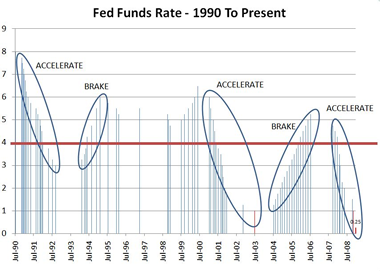
    Go back to 1999-2000 and see what the Fed did. They are following the same pattern for 2005-06. If it ain't broke, the Fed will fix it... and good!
    August 29, 2006 The Federal Reserve always acts on old information... and is the only cause of U.S. recessions.
    December 5, 2006 Last spring I wrote about what I saw to be a sharp downturn in the economy in the "rustbelt" states, particularly Michigan.
    March 28, 2007
    The Federal Reserve sees no need to cut interest rates in the light of adverse recent economic data, Ben Bernanke said on Wednesday.
    The Fed chairman said ”to date, the incoming data have supported the view that the current stance of policy is likely to foster sustainable economic growth and a gradual ebbing in core inflation”.

    July 21, 2007 My guess is that if there is an interest rate change, a cut is more likely than an increase. The key variables to be watching at this point are real estate prices and the inventory of unsold homes.
    August 11, 2007 I suspect that within 6 months the Federal Reserve will be forced to lower interest rates before housing becomes a black hole.
    September 11, 2007 It only means that the overall process has flaws guaranteeing it will be slow in responding to changes in the economy... and tend to over-react as a result.
    September 18, 2007 I think a 4% rate is really what is needed to turn the economy back on the right course. The rate may not get there, but more cuts will be needed with employment rates down and foreclosure rates up.
    October 25, 2007 How long will it be before I will be able to write: "The Federal Reserve lowered its lending rate to 4% in response to the collapse of the U.S. housing market and massive numbers of foreclosures that threaten the banking and mortgage sectors."
    November 28, 2007 FED VICE CHAIRMAN DONALD KOHN
    "Should the elevated turbulence persist, it would increase the possibility of further tightening in financial conditions for households and businesses," he said.

    "Uncertainties about the economic outlook are unusually high right now," he said. "These uncertainties require flexible and pragmatic policymaking -- nimble is the adjective I used a few weeks ago."
    http://www.reuters.com/

    December 11, 2007 Somehow the Fed misses the obvious.
    fed_rate_moves_425_small.gif
    [Image from: CNNMoney.com]
    December 13, 2007 [from The Christian Science Monitor]
    "The odds of a recession are now above 50 percent," says Mark Zandi, chief economist at Moody's Economy.com. "We are right on the edge of a recession in part because of the Fed's reluctance to reduce interest rates more aggressively." [see my comments of September 11]
    January 7, 2008 The real problem now is that consumers can't rescue the economy and manufacturing, which is already weakening, will continue to weaken. We've gutted the forces that could avoid a downturn. The question is not whether there will be a recession, but can it be dampened sufficiently so that it is very short.
    January 11, 2008 This is death by a thousand cuts.
    January 13, 2008 [N.Y. Times]
    “The question is not whether we will have a recession, but how deep and prolonged it will be,” said David Rosenberg, the chief North American economist at Merrill Lynch. “Even if the Fed’s moves are going to work, it will not show up until the later part of 2008 or 2009.”
    January 17, 2008 A few days ago, Anna Schwartz, nonagenarian economist, implicated the Federal Reserve as the cause of the present lending crisis [from the Telegraph - UK]:
    The high priestess of US monetarism - a revered figure at the Fed - says the central bank is itself the chief cause of the credit bubble, and now seems stunned as the consequences of its own actions engulf the financial system. "The new group at the Fed is not equal to the problem that faces it," she says, daring to utter a thought that fellow critics mostly utter sotto voce.
    January 22, 2008 The cut has become infected and a limb is in danger. Ben Bernanke is panicking and the Fed has its emergency triage team cutting rates... this time by 3/4%. ...

    What should the Federal Reserve do now? Step back... and don't be so anxious to raise rates at the first sign of economic improvement.
    Individuals and businesses need stability in their financial cost structures so that they can plan effectively and keep their ships afloat. Wildly fluctuating rates... regardless of what the absolute levels are... create problems. Either too much spending or too much fear. It's just not that difficult to comprehend. Why has it been so difficult for the Fed?

    About Me

    My photo
    Michigan, United States
    Air Force (SAC) captain 1968-72. Retired after 35 years of business and logistical planning, including running a small business. Two sons with advanced degrees; one with a business and pre-law degree. Beautiful wife who has put up with me for 4 decades. Education: B.A. (Sociology major; minors in philosopy, English literature, and German) M.S. Operations Management (like a mixture of an MBA with logistical planning)