READ ABOUT DETROIT AND SOLUTIONS TO ITS PROBLEMS. CLICK HERE.

Wednesday, August 15, 2007

Abusing The Law

SEARCH BLOG: LAWSUITS

A story buried in the back of section one had the title: D.C. judge presses his $54M lost pants case. In case you missed it the first time around, the row was about a missing pair of pants.

A judge who lost a $54 million lawsuit against a dry cleaner over a missing pair of pants continues to press his suit.

Roy Pearson, a District of Columbia administrative law judge, filed a notice of appeal Tuesday with the D.C. Court of Appeals.

I'm trying to think of any circumstance that justifies $54 million... or $5.4 million... or $0.54 million... or even $5.4 thousand for a pair of pants.

It is obvious that this judge is abusing the law, the courts, and the owners of the dry cleaners.

Should the appeal be rejected... which it no doubt will be... the judge should be forced to pay all of the legal costs borne by the dry cleaners... plus a reasonable penalty of say... $54 million.
..

Tuesday, August 14, 2007

Steve McIntyre Explains GISS Temperature Adjustments

SEARCH BLOG: GLOBAL WARMING

For those of you who would like a condensed version of the recent temperature adjustments made to the database used to "prove" global warming, look at this link.

Some of you may have been unable to get information from Steve's site, Climate Audit, because there was a "denial of service" attack that put his site out of service for awhile. Believers don't like deniers presenting facts.

..

This Chery Not A Cherry

SEARCH BLOG: CHERY and CHINA

First food, then medicines, then tires, now this.

But it looked good....


More like sour grapes

..

Monday, August 13, 2007

Federal Reserve Getting Nervous?

SEARCH BLOG: FEDERAL RESERVE

If you search this blog on the Federal Reserve, you'll read some less-than-complimentary comments about the way the Fed tends to create more problems than it solves as it seeks to protect the banking system from inflation [although the press releases always indicate it is some vague "public" that is being protected].

Now there is speculation that the Fed's hand might be forced into lowering interest rates because of "mismanagement" in the mortgage business.

What has happened in the financing/mortgage business is the same thing that happened to tech stocks... greed and manipulation.
Easy money allowed unscrupulous, greedy mortgage "brokers" to package bundles of bad mortgages to greedy "investors" who could only see the dollar signs... "tech stocks can only go up"... and screw up the housing market for everyone else.
Now the Fed realizes that it has to step in to prevent the system from imploding. The problem is the system is still in place for a repeat performance.
That reminds me of government efforts that granted amnesty to foreigners illegally in the U.S. without controlling the underlying situation. Play, rewind, repeat... play, rewind, repeat....

..

Tiger's World

SEARCH BLOG: GOLF


[source]

No surprise who won the PGA Championship yesterday.

..

Sunday, August 12, 2007

Hot PGA Championship

SEARCH BLOG: GLOBAL WARMING

As one who enjoys playing golf [but often plays "flog"], I noticed the constant graphics on the broadcast of the PGA Championship being played in Oklahoma. 101 degrees; heat index 109 degrees.

Here's the "normal" and "record" temperatures for Tulsa.

Sure, most of us won't step out on a golf course when it is 100 degrees, but the "normal" August high temperature in Tulsa is around 93-94 degrees, so 100 is an expected variance. You might also note when those high temperature records were set in Tulsa!

Another subtle "proof" of global warming?

I recall playing golf in Phoenix early one September when the temperature reached 105. Even riding in a cart and drinking a bottle of cold water per hole was barely enough to keep me going.

Those PGA guys are good!

..

Money for Expertise

SEARCH BLOG: GLOBAL WARMING

This has been making the rounds in the blogging world:

Newsweek says "the denial machine is running at full throttle" and is a "well-funded campaign by contrarian scientists."

How well-funded? Newsweek cites Exxon Mobil (NYSE:XOM) "giving $19 million over the years to the Competitive Enterprise Institute (CEI)" to produce what eminent climatologist Sen. Jay Rockefeller is quoted as calling "very questionable data" on climate change.

No mention is made of the $3 billion contribution to the global warming crusade by Virgin Air's gazillionaire owner Richard Branson alone. Donations such as these are the reason the 2004 budgets of the Sierra Club Foundation and the National Resources Defense Council were $91 million and $57 million respectively.

Newsweek portrays James Hansen, director of NASA's Goddard Institute for Space Studies, as untainted by corporate bribery.

Hansen was once profiled on CBS' "60 Minutes" as the "world's leading researcher on global warming." Not mentioned by Newsweek was that Hansen had acted as a consultant to Al Gore's slide-show presentations on global warming, that he had endorsed John Kerry for president, and had received a $250,000 grant from the foundation headed by Teresa Heinz Kerry.

Newsweek reporter and editorial, uh, article co-author Eve Conant was provided, during her interview with Sen. James Inhofe, R-Okla., documentation of the overwhelming funding advantage enjoyed by those who promote fear of climate change. Newsweek chose to ignore it.

In a Sept. 25, 2006, Senate floor speech, Inhofe noted: "The fact remains that political campaign funding by environmental groups to promote climate and environmental alarmism dwarfs spending by the fossil fuel industry by a 3-to-1 ratio."

[source: CNN]

There are two assumptions here:
  1. obtaining money for expertise is "unethical"
  2. obtaining money for expertise inevitably leads to "tainted" results
To both of those assertions, I would have to reply, "Maybe."
There is no absolute causal relationship between funding and fraud. There may be a causal relationship between funding and bias. The problem is that often fraud and bias result in similar conclusions.
That is not to say that funding causes the bias, rather that the bias leads to funding.
If Dr. Hansen's research bias, that showed the late 1990s were hotter than the 1930s, was appealing to the Kerry/Heinz coalition, then he was more likely to receive funding for further study than if his research showed that the 1930s were at least as hot as the 1990s... or hotter. The latter conclusion might draw funding from those in whose interest it was to say that certain anthropogenic activities were not driving global warming.
Perhaps the kettles that are calling the pots black need to step back a little and recognize that, while funding can support research looking for certain outcomes, there is still a scientific method that has to be followed before "the debate is over."

..

Saturday, August 11, 2007

Concern at Federal Reserve

SEARCH BLOG: FEDERAL RESERVE

Yesterday, I sent an article about the Chicago condo market to my oldest son who has a beautiful condo directly across from the Aon Center building in downtown Chicago. He and his wife moved to San Francisco and have been renting it out because the resale market has been so depressed. I also wrote:

I suspect that within 6 months the Federal Reserve will be forced to lower interest rates before housing becomes a black hole.
Today, I read about the first signs that the Fed might be moving toward more concern about the financial/housing markets than inflation:
Fed tries to calm jittery markets

Financial concern about the credit crunch swept through Europe and into the United States on Thursday. That prompted the Europeans to pump $130 billion into their financial system. Asian central bankers followed suit, while the U.S. Federal Reserve added $24 billion in temporary reserves to the U.S. banking system.

On Friday, the Fed pushed another $38 billion in temporary reserves into the system -- the biggest injection since the days following the Sept. 11 attack.

..

European Backlash - Step 5

SEARCH BLOG - EUROPEAN BACKLASH

I have written that the "tolerant" Europeans would begin to show more of their pre-WWII ethnocentrism as they perceived the Muslim challenge to their cultures.

Previously, the French Prime Minister suggested paying Muslims to leave. Now a right-wing Dutch Member of Parliament has proposed banning the Quran.
I'm interested to see what the next step is.

..

Friday, August 10, 2007

Hottest Year

SEARCH BLOG: GLOBAL WARMING

Now that government and industry [see yesterday's post] are convinced they have to tax us more and manipulate markets due to global warming, along comes this "inconvenient truth." There appears to be a little mathematical shuffling of the rankings for the "hottest year." This is my take at Climate Science which made its own observations and received plenty of comments:

The ranking of 1934 as the hottest year is fairly consistent with the analysis I did [and about which you dedicated a post on this site]. As of 2006, the state record temperatures count for 1934 was 25 versus 29 in 1936… compared with 19 in 1998.

http://hallofrecord.blogspot.com/2007/03/us-extreme-temperatures-update.html

I suspect that with further analysis, there will be little doubt that the 1930s were the hottest decade on record for the U.S. That may not necessarily follow for the rest of the world, but I’d be surprised if there wasn’t some correlation.

So, does that mean we had 50 years of global cooling followed by a temporary uptick? I guess it's all how you measure it. It could also be seen as a simple oscillation along a flat line, but that's not as exciting as declaring "ice age" one decade and "global warming [disaster]" a few decades later.
By the way, 2006 had only one record high temperature set.
Apparently, the 4th quarter in the northern hemisphere was not as cold as usual so that made it the 3rd hottest year... hmmmmm. However, February of 2007 more than made up for the lack of cold in late 2006:
http://www.ncdc.noaa.gov/oa/climate/research/2007/feb/februaryext2007.html
The point of all of this is that "the debate is not over." When data can be modified and manipulated so that fractions of a degree mean entirely different conclusions are reached, then we are dealing with uncertainty. When the potential error in feeder readings are greater than the purported 100-year trend change [urban heat islands... improperly placed weather stations...], then there is no reason to debate.
Move on org to energy reduction policies or population reduction policies or no more fish on Fridays policies or whatever are the real hidden agendas of the special interest groups who dislike the presence of other humans and quit pushing a red herring.
Meanwhile, I've noticed that www.climateaudit.org and www.surfacestations.org have been inaccessible since they did their analysis and comments. Probably overheated the servers.

ADDENDUM

It appears that Climate Audit and Surface Stations websites are being intentionally attacked as a result of publishing information that contradicts global warming alarmists. This from the Climate Science website:

I know the DOS [denial of service] attack on ClimateAudit.org was real, as I helped them try to troubleshoot the problem, and the attack continues even now. The server is getting constant DOS attacks and anytime they try to reconnect the SQL server to the Wordpress blog engine, it gets overwhelmed with requests. The nature and speed of the requests have not abated as eastern time zone goes home from work as would be expected with interest driven requests.

DOS attacks are easy to do, anybody can get some freely available software to launch them.

My problem with surfacetstations.org is different, my dual T1 circuit to my office went dead about 2 hours after CA’s DOS attacks started. The problem is somewhere in the SFO Bay Area. We don’t know what it is and the ISP is trying to track it down.

Its not just the one server that is offline, its my entire business. I’m writing from home while I wait for word from the telco/ISP on what the problem is.

For now I’m going to assume my circuit problem is coincidental until I hear otherwise.

Comment by Anthony Watts — August 9, 2007 @ 9:40 pm

I guess if you can't debate effectively, you prevent the other person from communicating....

..
Thursday, August 09, 2007

Mulally and Fuel Taxes

SEARCH BLOG: ENERGY

Alan Mulally, CEO of Ford Motor Company, is seeking a "market driven" alternative to higher Corporate Average Fuel Economy [CAFE] standards. Consequently, he wants to explore the idea of changing the market.

Ford Motor Co. CEO Alan Mulally called the federal government's mandatory fuel economy requirements a failed program and suggested a tax on gasoline might do more to achieve energy independence and help the environment.
[source]
What he is really saying is that since the real marketplace doesn't support proposed CAFE standards, the only way to get customers to "demand" tiny, alternative fuel vehicles is to change the market environment... create additional costs to consumers.
What he is not saying is that the costs will be two-fold: the direct increase in operating costs from those taxes and the cost of new technology to achieve the higher fuel efficiencies. CAFE standards put the onus on manufacturers to build fuel efficient vehicles that people actually want without the additional tax burden on the consumer.
The reality is that the state and federal governments will be forced to raise fuel taxes to make up for lost revenues when the manufacturers are successful in producing fleets that average 32-35 mpg.
Mullaly rightly wants the consumers to know that it is the government, not the manufacturers, that is forcing them to purchase vehicles that are smaller and less safe than they might want.
All right, if that is the way it must be, then I propose that all revenues from the additional taxes be used to offset the development of new technologies and infrastructure [such as battery recycling or new power plants or hydrogen fueling stations] rather than going into a general fund where it is used for congressmen's pork projects.
For example, all of those nickel-based batteries cause enormous environmental damage. So expansion of nickel mining needs to be supported by expensive environmental safeguards. Or a whole new technology needs to be developed for hybrid vehicles that doesn't use nickel-based batteries [lithium ion?]. Oh, wait. There is only one nickel mine in the U.S. Most of the stuff is imported from Canada, so I guess we'll make it their problem. That makes it okay.

We all know how ethanol is screwing up the corn/food markets with no real benefit in energy savings... just good for political PR.
Screwing up the marketplace may be a "solution," but the solution may be a greater problem than the problem.

..

Wednesday, August 08, 2007

Fearing the Climate

SEARCH BLOG: GLOBAL WARMING

I find it interesting how the preponderance of readers of this blog want information about climate change. Is the earth going to warm another fraction of a degree in the next century? Will polar bears drown? Will Canada have palm trees? Will we forget how to make insecticides and be overrun by mosquitoes? Will Central Park become Central Sea?

Given the dramatic predictions of doom from those who really just want to push environmental, population control, or energy agendas, it is understandable.
However, as I pointed out in the past, a singular focus on one aspect of life has a certainty of sub-optimizing all other important aspects. When push comes to shove, we can only hope that fear is replaced by reason... even if just partially.
Regardless of how romantic the "natural" past may sound, the reality is that today's economies support magnitudes more people in a far healthier manner while improving the environment in which they live. The reality is also that as economies improve, birth rates decline and populations stabilize... which means the larger populations continue to enjoy the better life.
Too much of what purports to be "enlightened" positions are really special interests who seek to impose their way on others... while blithely oblivious to the possible negative consequences.
Rather than seeking to limit economic improvement, special interests should be focusing on economic growth for areas that have poor economies and high birth rates. The consequences of that would be an improved environment for more of the planet as the evolution of those economies reduces birth rates and increases the efficiencies of those economies.
Rather than disruptively forcing technologies that are not ready for "prime time," a more rational approach is to "nudge" economies toward greater efficiencies... not with incentives for use [or disincentives for not using], but incentives for developing and deploying those more efficient technologies.

..

Tuesday, August 07, 2007

Bursting Your Bubble

SEARCH BLOG: ECONOMY

CNN had this article on their website that points out further concerns about the equity [and housing?] markets in the U.S.

Right now there doesn't seem to be a "consensus" about the near-term financial dynamics of the markets.

The DJIA is up about about 8% YTD which is what one might expect for the full year. The extra run-up to 14,000 was a good signal that the frenzy was peaking and look out for the bad news bears.
I have to believe that there are more hidden structural flaws in our present economy than the I-35 bridge.

..

Monday, August 06, 2007

More On Urban Heat Island Effect

SEARCH BLOG: URBAN HEAT ISLAND

Recently, I ran a series of posts about Urban Heat Island effect and the impact of weather stations that were located improperly in a way that exaggerated high temperatures.

This from ICECAP which also links to an analysis by Steve McIntyre on this subject.

ADDENDUM

Also see this at Climate Science.

..

July Weather - Unremarkable

SEARCH BLOG: GLOBAL WARMING

Once again, the weather in Michigan has been remarkably unremarkable. July has an average high temperature of about 85 F and an average low of 63 F.

We had 4 days over 90 F... and 11 days below 80 F. It was drier than usual... a lot of sunny, pleasant days... and a lot of much cooler than average nights... probably because it was clearer than usual.
Ho, hum.


[source]
..

Sunday, August 05, 2007

Home Runs

SEARCH BLOG: SPORTS

Barry Bonds has tied Hank Aaron's home run record. If you are a baseball fan, you may or may not believe the record is "clean." Otherwise, you are probably ignoring the event.

I grew up in Milwaukee when the Braves played there. I could take a rail "streetcar" from the stop across the street from my home to County Stadium, with a couple of transfers, for 10 cents. Bleacher seats were cheap and fine. And I would watch Warren Spahn and Lew Burdette pitch to Del Crandall, while Eddie Matthews [3B], Johnny Logan [SS], Danny O'Connell/Felix Mantilla [2B] and Joe Adcock [1B] anchored the infield. But it was Hank Aaron that drew the crowds.

Hank Aaron was small by Barry Bonds or Mark McGwire standards: 6 feet 180 lbs. But he could snap that bat around like a whip. He always seemed to hit over .300 and knock 40 or so home runs per season, although his production fell off quite a bit in later years playing in Atlanta. Regardless, for the first 90% of his career, he was amazingly consistent in batting average and home run production.
Barry Bonds should be recognized for how quickly he has achieve this success: in about 3/4 of the time that Aaron did it. He should also be recognized how he transformed from an "average Joe" player for four years to an outstanding hitter in just one season. Probably a great batting coach or intensive weight training.
Athletes today are bigger, faster, stronger and trained better than a generation or two ago.
Unfortunately, transformations like McGwire's and Bond's leave many suspecting that some of their success came from "talent in a bottle."

Now about that "hopped up" baseball....

..

Saturday, August 04, 2007

Must Come Down

SEARCH BLOG: ECONOMY

On July 19, I questioned how the stock markets could be so buoyant while the consumer markets seemed to be tanking... especially housing, which has to affect a lot of people and businesses.

I guess the market is answering that question.


..

Friday, August 03, 2007

Ron Paul

SEARCH BLOG: POLITICS

The name Ron Paul keeps getting tossed around as a "dark horse" candidate for president in 2008. I've read some of the positions attributed to him and just viewed this video.

So far, I get the impression that he is a "minimalist" [although he prefers to be seen as an "originalist"]... a moralistic Libertarian in Republican clothing?

From Wikipedia:

The political positions of Ron Paul are in line with this American politician's stance as a Constitutionalist who professes a libertarian ideology. Accordingly, he opposes presidential autonomy and judicial activism and rejects a welfare state or nanny state role for the federal government.[1]

Paul says that the Republican Party has lost its commitment to limited government and has instead become the party of big government.[2] He regularly votes against almost all proposals for new government spending, initiatives, or taxes. His unwillingness to vote for proposals not expressly authorized by the Constitution, along with his medical degree, have earned him the nickname “Dr. No.”

Paul supports free trade, tighter border security, gun ownership, non-compulsory school prayer,[3] and a return to free market health care. He opposes abortion, capital punishment, NAFTA and the WTO, the income tax, universal health care,[4] the War on Drugs, federal regulation of marriage, and foreign interventionism, advocating withdrawal from NATO and the United Nations.[5] He voted against funding same-sex adoption.[6] He is pro-life and believes Roe v. Wade unconstitutionally overrides state jurisdiction on the matter, and should be overturned, arguing that "the federal government has no authority whatsoever to involve itself in the abortion issue".[7] In an effort "to reverse some of the impact of Roe v. Wade," he voted to ban partial-birth abortions.[8]

He seems to be against government except when it supports his personal morality. I have a problem with that.... I may agree with some of his positions, but I don't like "Big Brother" which he appears to be against on some issues and strongly for on others... an incongruous mix.

One aside: he seems to be for allowing states to have their own product regulations. To me that implies chaos... 50 different sets of rules and specifications for manufacturers to contend with. That's way too much government involvement. He sees it as states' rights.
..

Thursday, August 02, 2007

Bridge Collapse

The collapse of the I-35 bridge over the Mississippi River at Minneapolis struck me as a déjà vu moment. It seemed like yesterday when pictures of a bridge with cars strewn into a river were all over the news.

I found an article about that I-40 bridge disaster and many others. Naturally, by this morning, Wikipedia had already updated its article on such disasters.

While quite spectacular when they happen, it is not the kind of occurrence that happens often. Many times it is because of an outside agent causing the bridge to weaken. Sometimes it is poor design or construction. Sometimes is is poor maintenance.

But always it seems the the reaction is "Wow, we didn't see that coming."

..

Wednesday, August 01, 2007

A Woman's Place

SEARCH BLOG: WOMEN

Just so you don't think I'm picking on Muslims for their "honor" killing of women, I want you to know that I am an equal opportunity offender.

In India, sons are typically seen as breadwinners. According to Hindu tradition, a son is also supposed to light his parents' funeral pyre.

Girls are often viewed as a burden because of the matrimonial dowry demanded by a groom's family.

The deep-seated discrimination makes many women more determined to have a boy because they do not want their daughters to suffer the domestic abuse and hardships that they faced, the book says.

"Better to send her straight to heaven rather than make her endure this beating and kicking around," one woman is quoted as telling the author.
[source]
Perhaps it is the food or water. Where did these cultures evolve such attitudes? Certainly, women in many cultures have had strictly a domestic role while the men "earned the living." But there is nothing really innate in that arrangement. Men and women in America's westward expansion faced uncertainty, hardships, hostility and scarcity... together fighting for their lives and establishing their new homes. So being poor or facing hardships is not necessarily an excuse or reason for treating women as chattel... or cattle. Somehow the Greeks and Romans avoided this attitude in their empires, so "old" is not an excuse for a culture.
I guess it is improper, in this relativistic world, to judge other cultures based on one's own. Well, I'm going to do it anyway. No matter how old, enduring, widespread or strong the cultures are that have formalized the "justification" of killing off women and girls for honor or any other reasons [let's include China in there], those cultures are simply perverse and corrupted.
..

Can"t Find It?

Use the SEARCH BLOG feature at the upper left. For example, try "Global Warming".

You can also use the "LABELS" below or at the end of each post to find related posts.

Blog Archive

Cost of Gasoline - Enter Your Zipcode or Click on Map

CO2 Cap and Trade

There is always an easy solution to every human problem—neat, plausible, and wrong.
Henry Louis Mencken (1880–1956)
“The Divine Afflatus,” A Mencken Chrestomathy, chapter 25, p. 443 (1949)
... and one could add "not all human problems really are."
It was beautiful and simple, as truly great swindles are.
- O. Henry
... The Government is on course for an embarrassing showdown with the European Union, business groups and environmental charities after refusing to guarantee that billions of pounds of revenue it stands to earn from carbon-permit trading will be spent on combating climate change.
The Independent (UK)

Tracking Interest Rates

Tracking Interest Rates

FEDERAL RESERVE & HOUSING

SEARCH BLOG: FEDERAL RESERVE for full versions... or use the Blog Archive pulldown menu.

February 3, 2006
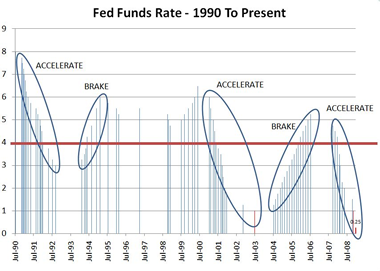
Go back to 1999-2000 and see what the Fed did. They are following the same pattern for 2005-06. If it ain't broke, the Fed will fix it... and good!
August 29, 2006 The Federal Reserve always acts on old information... and is the only cause of U.S. recessions.
December 5, 2006 Last spring I wrote about what I saw to be a sharp downturn in the economy in the "rustbelt" states, particularly Michigan.
March 28, 2007
The Federal Reserve sees no need to cut interest rates in the light of adverse recent economic data, Ben Bernanke said on Wednesday.
The Fed chairman said ”to date, the incoming data have supported the view that the current stance of policy is likely to foster sustainable economic growth and a gradual ebbing in core inflation”.

July 21, 2007 My guess is that if there is an interest rate change, a cut is more likely than an increase. The key variables to be watching at this point are real estate prices and the inventory of unsold homes.
August 11, 2007 I suspect that within 6 months the Federal Reserve will be forced to lower interest rates before housing becomes a black hole.
September 11, 2007 It only means that the overall process has flaws guaranteeing it will be slow in responding to changes in the economy... and tend to over-react as a result.
September 18, 2007 I think a 4% rate is really what is needed to turn the economy back on the right course. The rate may not get there, but more cuts will be needed with employment rates down and foreclosure rates up.
October 25, 2007 How long will it be before I will be able to write: "The Federal Reserve lowered its lending rate to 4% in response to the collapse of the U.S. housing market and massive numbers of foreclosures that threaten the banking and mortgage sectors."
November 28, 2007 FED VICE CHAIRMAN DONALD KOHN
"Should the elevated turbulence persist, it would increase the possibility of further tightening in financial conditions for households and businesses," he said.

"Uncertainties about the economic outlook are unusually high right now," he said. "These uncertainties require flexible and pragmatic policymaking -- nimble is the adjective I used a few weeks ago."
http://www.reuters.com/

December 11, 2007 Somehow the Fed misses the obvious.
fed_rate_moves_425_small.gif
[Image from: CNNMoney.com]
December 13, 2007 [from The Christian Science Monitor]
"The odds of a recession are now above 50 percent," says Mark Zandi, chief economist at Moody's Economy.com. "We are right on the edge of a recession in part because of the Fed's reluctance to reduce interest rates more aggressively." [see my comments of September 11]
January 7, 2008 The real problem now is that consumers can't rescue the economy and manufacturing, which is already weakening, will continue to weaken. We've gutted the forces that could avoid a downturn. The question is not whether there will be a recession, but can it be dampened sufficiently so that it is very short.
January 11, 2008 This is death by a thousand cuts.
January 13, 2008 [N.Y. Times]
“The question is not whether we will have a recession, but how deep and prolonged it will be,” said David Rosenberg, the chief North American economist at Merrill Lynch. “Even if the Fed’s moves are going to work, it will not show up until the later part of 2008 or 2009.
January 17, 2008 A few days ago, Anna Schwartz, nonagenarian economist, implicated the Federal Reserve as the cause of the present lending crisis [from the Telegraph - UK]:
The high priestess of US monetarism - a revered figure at the Fed - says the central bank is itself the chief cause of the credit bubble, and now seems stunned as the consequences of its own actions engulf the financial system. "The new group at the Fed is not equal to the problem that faces it," she says, daring to utter a thought that fellow critics mostly utter sotto voce.
January 22, 2008 The cut has become infected and a limb is in danger. Ben Bernanke is panicking and the Fed has its emergency triage team cutting rates... this time by 3/4%. ...

What should the Federal Reserve do now? Step back... and don't be so anxious to raise rates at the first sign of economic improvement.
Individuals and businesses need stability in their financial cost structures so that they can plan effectively and keep their ships afloat. Wildly fluctuating rates... regardless of what the absolute levels are... create problems. Either too much spending or too much fear. It's just not that difficult to comprehend. Why has it been so difficult for the Fed?

About Me

My photo
Michigan, United States
Air Force (SAC) captain 1968-72. Retired after 35 years of business and logistical planning, including running a small business. Two sons with advanced degrees; one with a business and pre-law degree. Beautiful wife who has put up with me for 4 decades. Education: B.A. (Sociology major; minors in philosopy, English literature, and German) M.S. Operations Management (like a mixture of an MBA with logistical planning)