READ ABOUT DETROIT AND SOLUTIONS TO ITS PROBLEMS. CLICK HERE.

Saturday, August 25, 2007

Traded Away

SEARCH BLOG: FAIR TRADE and FREE TRADE

I was trying to explain this to my wife the other evening as we took a walk. She just didn't think it was fair at all. Neither did I, but it's hard to argue against a "free lunch," isn't it?

Pat Buchanan doesn't think so.
But now we have to call Pat a "protectionist."
The real question that must be asked is if it is so good for us to be on the receiving end of cheap goods, why are countries like China and Japan so willing to "subsidize" us?
..

Friday, August 24, 2007

Good Fences Make Good Neighbors

SEARCH BLOG: ILLEGAL IMMIGRATION

This story is making the rounds:

European Union Funds Separation Fence

(IsraelNN.com) Former Mossad agent Gad Shimron reports that while the European Union attacks Israel mercilessly for the partition fence it's building to protect Jewish lives, the EU itself funds and operates a similar fence designed only to protect itself from illegal immigrants.

The fence is located in a Spanish enclave in northwestern Africa, the coastal city of Ceuta just across the Straits of Gibraltar from Spain. Unknown to most of the world, when Spain handed over most of northern Morocco to the newly independent kingdom in 1956, Spain retained Ceuta and Melilla (about 250 kilometers further east) - thus that the European Union is present in Africa as well. Poverty-stricken Moroccans attempting to cross into Ceuta, from where they will then be able to work anywhere in Europe because of the EU's no-checkpoints policy, are stopped in their tracks by the eight-meter-high, double layer fence. Funding for the fence, some 60 million Euros, came from European Union coffers.


Frequent Spanish patrols, together with policemen who do not hesitate to beat potential infiltrators, render crossing the partition a nearly impossible mission - but the needy say they will continue to try. One of the many who are determined to immigrate to Europe said, "Whoever came all this difficult way and reaches the mountains of northern Morocco, opposite the fence of Ceuta, will not give up. You see the lights of Ceuta? As far as we're concerned, that's the Promised Land. The people here are in despair and will do anything to pass over that fence, enter Spain, and from there continue northward and blend in with the other millions of immigrants in Europe."

The EU continues to oppose Israel's fence, constructed to protect against murderous terrorists and suicide bombs - even as it plans to build another fence of its own around Spain's second enclave in northern Africa, the Moroccan town of Melilla. "It appears," concludes Gad Shimron in Maariv today, "that from a European point of view, the ethical aspects of a separation fence are sometimes a matter of geography."
Do as I say; not as I do. Meanwhile, along the Mexican border....

..

Thursday, August 23, 2007

The World Must Be Cured

SEARCH BLOG: ISLAMISTS

... of the sickness that did this. Hillary? Nancy? Harry? Obama?

..

Another Open Letter to Alan Mulally

SEARCH BLOG: MULALLY

Ford Motor Company continues to struggle in the U.S., although operations elsewhere are doing much better. Your efforts to improve the efficiency at Ford seems to be making headway and, more importantly, if the historical culture of protecting one's turf is being eliminated, then you may expect more lasting positive results.

Most employees want to be part of a winning "team," but in the past the "team players" got T-shirts and recognition plaques... and possibly increases equivalent to the cost of living. The real winners were those who could optimize their positions... the manipulators... even at the cost of those around them.
But it is going to take more than just "team work." It is going to take dedication to having the most competitive and desirable products. For example, you were responsible for renaming the Five Hundred as the Taurus. That's a nice effort at leveraging a great name. But the new Taurus is closer in pedigree to the Crown Victoria than the old Taurus. So, while it may bring some people back to the showrooms [always a good thing], they may take some convincing that they are really looking at a Taurus-type car. Perhaps your "teams" are going to fix that in the next iteration.

One area that Ford historically has been behind competition is its car drivetrains. It's not that Ford can't produce a great engine or transmission, but it choses to offer fairly bland, and surprisingly lower fuel-efficient, powertrains than competitors. The new V-6 engine is an improvement that is long overdue. But don't stop there. Rather than "spinning wheels" on a lot of low-probability technologies such as hydrogen or ethanol that require substantial infrastructure changes, Ford should rapidly expand technologies that have a proven track record in Europe... specifically diesel and turbo-diesel engines.
Two years ago, Mercedes offered a diesel in their sedans for only $1,000 more than their gasoline engines. BMW is moving heavily into turbo-diesels. Audi has a strong diesel offering.
Obviously, these offerings are at the higher end, but there is nothing that says they have to be... as I'm sure you know since Ford offers a turbo-diesel Focus in Europe.

Will people pay for the diesel engine premium? Let's say that I will be standing in line for that Taurus with a turbo-diesel engine... and it doesn't even have to be the hybrid model.

..
European Backlash - Step 6

SEARCH BLOG: BACKLASH

Germans are once again in the middle of religious disputes. Centuries ago, it was Catholics against Protestants. Then it was Nazism against Judaism. Now it appears to be a general antipathy toward Muslims in the form of protests against building mosques.

In Cologne [Köln],

Cardinal Joachim Meisner, spiritual leader of the city's Roman Catholics and a close friend of Pope Benedict XVI, has said the proposed mosque leaves him with an "uneasy feeling."
Mosques are more than houses of worship:

"Muslims have come out ... and have become visible," says Claus Leggewie, a political scientist at Germany's University of Giessen who wrote a study on the evolution of the mosque landscape in Germany. "By building expensive, representative mosques, they're sending a message: we want to take part in the symbolic landscape of Germany. We are here and we'll stay here."

Major mosque projects from Cologne, Germany, to Amsterdam to Seville, Spain, have met with fierce opposition and fears that they will serve as breeding grounds for terrorists. Family members of two of the suspects in the Glasgow, Scotland, car bombings this month said the men had been radicalized by Tablighi Jamaat, an Islamic revivalist group with plans for an 18-acre complex near London's 2012 Olympic stadium that would house Europe's largest mosque.

It's beginning to get difficult to discern if it is religion causing cultural problems or cultural differences creating a sharp, negative focus on Islam... or both.
But the concern about mosques is one more aspect of the growing tension in Europe with Muslim immigrants.
..

Wednesday, August 22, 2007

New York Always Has To Be Different

SEARCH BLOG: GLOBAL WARMING

(CBS) NEW YORK A day after tying the record for the coldest high temperature during the month of August ever in New York City, temperatures were expected only to warm up slightly, before finally climbing back to normal by the end of the week.

The city along with the rest of the tri-state region is feeling the chilly effect of a cold front sweeping through the region, accompanied by cool rain showers.

Tuesday's high temperature in Central Park was just 59 degrees. The normal high for Tuesday was 82 degrees. The normal low was 67.

Forecasters were calling for temperatures to rise to about 66 for the high on Wednesday.

[source]

The Canadian Clipper that came through here late Saturday finally made it there. And even the Urban Heat Island effect wasn't enough to keep the temperatures up.

..

Tomorrow: Not So Variable Temperatures

SEARCH BLOG: GLOBAL WARMING

On February 27, I proposed there were only two ways for general warming to occur that made sense:

  1. more high temperature extremes
    >
  2. few, if any, new high temperature extremes, but milder low temperatures
    >
The global warming orthodoxy insisted that we should expect option #1.

It was apparent to me that option #1 was simply not happening... at least in the U.S. [and probably Canada, too].

So, now it appears that the strategy is to say that option #2 is, indeed, what is happening. We won't have a lot of high temperature
extremes, but it will just stay warmer longer.

Via
Benny Peiser [email]

Global and Planetary Change, May 2007, 57(1-2):1-15
http://tinyurl.com/yok3gm

Changes in variability and persistence of climate in Switzerland: Exploring 20th century observations and 21st century simulations

Martin Beniston a, and Stéphane Goyette a
A Chair for Climate Research, University of Geneva, Switzerland

Conclusions

This investigation, carried out for a low (Basel) and a high (Saentis) elevation site in Switzerland, has shown that contrary to what is commonly hypothesized climate variability does not necessarily increase as climate warms. Indeed, it has been shown that the variance of temperature has actually decreased in Switzerland since the 1960s and 1970s at a time when mean temperatures have risen considerably. Nevertheless, these findings are consistent with the temperature analysis carried out by Michaels et al. (1998) where their results also do not support the hypothesis that temperatures have become more variable as global temperatures have increased during the 20th century. The principal reason for this reduction in variability is related to the strong increase in the persistence of certain weather patterns at the expense of other types. A simple weather classification scheme has been designed to highlight this point, based on combinations of warm, cold, moist or dry regimes; according to this classification, winter regimes (cold and moist) associated with perturbed synoptic systems have been sharply reduced in the last decades of the 20th century, while warm and dry summer regimes have become the most persistent since the 1970s. In other words, synoptic weather patterns that are associated with high variability are today less frequent than those patterns associated with high persistence, i.e., low variability. Closer investigation of the behavior of surface pressure fields has highlighted the fact that positive pressure anomalies have increased since the 1970s, and that these are well correlated with the exceedances of temperature at both the low and high elevations.
So, what does this mean for the Al Gore orthodoxy? Maybe a little wiggle room as the net of scientific evidence shows that their predictions of catastrophe are politically, not scientifically, based. They can still claim warming has occurred.
Well, some warming has been observed since the cold side oscillation of the flat trend began in the 1960s... but so what? Is that supposed to be a bad thing?


Source


..

Tuesday, August 21, 2007

Spam Comments

Because spammers like to leave comments that clutter blogs, I have turned on comment moderation.

That means your comment won't appear until I have had a chance to review it for being possible spam.

I don't care if you disagree with my posts, but this is not the place for junk mail. I'll post all legitimate comments.
..

Federal Reserve Update - 2

SEARCH BLOG: FEDERAL RESERVE

On August 13, I wrote:

The Fed Will Act
... if the DJIA reaches 12,000.

That will be approaching a 15% "correction" from the high point [and the wheels will be squeaking too loudly to ignore].

That marks the point where the DJIA is 4% below the beginning of the year. Right now it is still up 3% for the year and just 8% down from the high, so the Fed will just be watching things.

By then, of course, the rest of the country's housing market will look like Michigan's... DOA. New construction will be shut down, foreclosures will be at record levels, and overall economic growth will be less than 2%.
On August 17, I wrote:
As I said on August 13 and today, the Fed is getting nervous, but it is not quite ready to lower interest rates that affect housing or other consumer purchases. Right now it is hoping a bandaid will fix things... it won't.
Today...
Federal Reserve Bank of Richmond President Jeffrey Lacker said the impact of ``financial turbulence'' on the broader economy will determine decisions on interest rates.

``Financial market volatility, in and of itself, doesn't require a change in the target federal funds rate,'' Lacker said at a luncheon of the Risk Management Association of Charlotte.

``Interest-rate policy needs to be guided by the outlook for real spending and inflation,'' and markets can change that assessment if they induce changes in growth or prices.
12,000 on the DJIA might indicate a signal of "financial turbulence." So also might a continued diminishing of the housing market and corresponding increase in foreclosures.
Right now the DJIA is treading water over 900 points off its recent high.
..

Selected Bloggers

SEARCH BLOG: DIVERSITY

If you haven't availed yourself of the blog links on the right sidebar, I suggest you try them. You will find a rather eclectic mixture of politics, economics, science, and philosophy.

I don't always agree with the positions in these individual blogs, but I value their singular trait: challenging to the reader.
They represent my kind of "diversity"... not-afraid-to-offend diversity.
If you have to say something with which everyone agrees, you haven't said anything of great interest... even if you are "politically correct."
Meanwhile, I have to get ready for golf [late to bed, early to rise, etc.]

...

Monday, August 20, 2007

It's Just Weather

SEARCH BLOG: WEATHER

A couple of days ago I commented that we were having the first hint of autumn around here with a Canadian Clipper that zipped through.

I knew it seemed a bit cool around here... especially with the talk of heat waves in the south... but I didn't realize that we came within 2° F of the all-time recorded low... for that date... for our area.

On average, the nation was pretty much "average."


..

No Carbon Left Behind Act

SEARCH BLOG: GLOBAL WARMING and CLIMATE CHANGE

From Benny Peiser email:

Latvia has the lowest per capita greenhouse gas emissions in the EU. But, despite being the EU's third poorest country, the European Commission's rulings mean that it must purchase emission quotas from richer and more polluting EU members that have done little to meet their Kyoto commitments. This unbalanced approach is jeopardising the economic development of Latvia and other vulnerable new member states, while old members enjoy a free ride.
--Valdis Dombrovskis, The Guardian, 20 August 2007
From The Heritage Foundation:
Although the federal law gives states the freedom to set standards and create tests, it is highly prescriptive about how AYP [adequate yearly progress] is determined, and these requirements are not always compatible with preexisting state systems. As a result, schools rated highly on the state system can fail to make AYP according to the NCLB. Differences in how each system treats subgroups or standards governing the percentage of students that must be tested cause discrepancies in the ratings. In 2003 an "excellent" rated school in Colorado did not make AYP while others with unsatisfactory ratings cleared the AYP bar. Florida saw three out of four of its "A" rated schools underperforming, according to the NCLB.

No Child Left Behind: Where Do We Go From Here?
Notice any similarities [hint: politics]?

..

Sunday, August 19, 2007

Can't Debate Them? Sue Them!

SEARCH BLOG: GLOBAL WARMING and LITIGATION

My wife, who is an avid blog reader, pointed out this one from Flopping Aces which quotes the National Review Online:

Tobacco road [Chris Horner]

A little birdie recently chirped about some usual-suspect state attorneys general preparing a litigation strategy document for/with environmental pressure groups, providing a roadmap for cooperatively replicating the tobacco litigation of a decade ago in the "global warming" context, substituting that projected catastrophe for cancer and "big energy" for tobacco companies.

The point of such exercise would not be to litigate the matter to conclusion — ever more challenging what with forced corrections of the temperature record, recent exposure of the woeful reliability of our own world's most reliable surface measuring network, and of course no global warming in a decade (or, we now know, since 1900 for that matter) — but to extract massive settlements from the energy industry to further fund the trial lawyers, greens and the greens' pet projects. Just imagine the anti-energy campaign that this model would yield! And at no cost, really, except to anyone who uses energy and/or invests in these sleepy "granny stocks". Oh, and the economy.

Given that at least two of the seven requests for information under state freedom of information laws have been received electronically, I am comfortable revealing that a version of the following inquiry has been sent to activist state AGs in California, New York, New Jersey, Connecticut, Vermont, Washington and Massachusetts.

We'll see how what we know squares with what is produced, and go from there, though I have little doubt that some stonewalling will make this a more energy-intensive effort than it should be; but as the tobacco AGs learned, there's usually one party who coughs up the documents at which point the games must come to an end.
Is that what is meant by "the debate is over?"
You have to remember that in law and politics, "proof" means something entirely different from science.


Apparently there is a lot of fog in California and a few other states, too.

..

Saturday, August 18, 2007

Hint of Autumn

SEARCH BLOG: AUTUMN

Sure, it is the middle of August... but you can feel it coming. A brisk night and cool morning... temperatures in the 40s. It's just a summer cool front sweeping in from Canada at 20 mph so the weather will be at September high-low averages.

But it's a hint that Labor Day is close and the growing season is ending... and autumn is just around the corner. That means cider and doughnuts and football and brightly colored leaves... and no more of that damned air-conditioning!
Yes, I'm getting ahead of myself, but I really love autumn.


..

Friday, August 17, 2007

Federal Reserve Update

SEARCH BLOG: FEDERAL RESERVE

From CNN
:

NEW YORK (CNNMoney.com) -- The Federal Reserve, reacting to concerns about the subprime lending crisis and the volatility in the financial markets that have resulted from it, announced Friday that it is cutting its so-called discount rate temporarily by a half percentage point, to 5.75 percent.

The discount rate is the rate the Federal Reserve banks across the country charge qualified lenders - mainly banks - for temporary loans. It is largely symbolic.

The central bank did not change its more closely watched federal funds rate, which affects rates that consumers pay on various types of loans. That rate remains at 5.25 percent.

The Fed last met Aug. 7 and decided to leave both the federal funds and discount rates unchanged. But since then, stocks have plunged further due to fears that some financial institutions and hedge funds were in serious trouble because of the mortgage meltdown.

As I said on August 13 and today, the Fed is getting nervous, but it is not quite ready to lower interest rates that affect housing or other consumer purchases. Right now it is hoping a bandaid will fix things... it won't.

..

The Fed Will Act

SEARCH BLOG: FEDERAL RESERVE

... if the DJIA reaches 12,000.

That will be approaching a 15% "correction" from the high point [and the wheels will be squeaking too loudly to ignore].

That marks the point where the DJIA is 4% below the beginning of the year. Right now it is still up 3% for the year and just 8% down from the high, so the Fed will just be watching things.
By then, of course, the rest of the country's housing market will look like Michigan's... DOA. New construction will be shut down, foreclosures will be at record levels, and overall economic growth will be less than 2%.
Then even the banking system will recognize that it has more to lose from the stallout than mild inflation. Big Ben will have to stop being "Johnny One Note."
Just to jog your memory, here are a few related posts and DJIA:
Back on December 18 last year I wrote:
It is difficult to get of measure of what the economic big picture is right now. The Christmas season is not over so no real numbers are available for comparison with other years. We know that housing and autos are quite weak. Stable oil prices have been good news as is the Federal Reserve's less aggressive attitude.
I think we are getting a measure of what the economic big picture is right now.

..

Thursday, August 16, 2007

The Oceans Are The Problem

SEARCH BLOG: GLOBAL WARMING

From Dr. John Ray's blog.

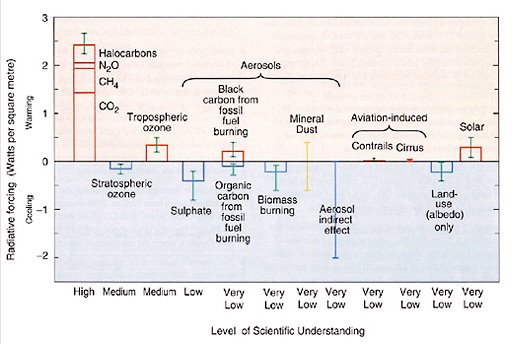
Most shocking of all is their prediction for the year 2100 to be slightly cooler than present day, despite the assumption of a doubling of atmospheric CO2 levels. Eye-popping indeed. Is carbon-dioxide really so ineffective at warming? A new study by Belgium's Royal Meteorological Institute seems to think so. Its conclusion is that, while CO2 does have some effect, that "it can never play the decisive role attributed to it" in global warming, and that its effects have been grossly overstated.
Oh, those Belgians are just a bunch of deniers.

And if that wasn't enough... check this out in New Scientist.

..

Losing Perspective

SEARCH BLOG: ECONOMY and PERSPECTIVE

It's been a rough 5 days on Wall Street with the DJIA down about 6% and a lot of people getting very worried about their investments.


The whole last month has been a big slide down of over 7%.


The last three months could leave your head spinning with the roller coaster ride if you look too closely.


So maybe we need to step back a bit to add some perspective.... How about a year?


Or maybe 5 years?


This reminds me of some other charts. Of course you need to step back for real perspective.

And then someone might come along and change the data, too.

..

Wednesday, August 15, 2007

Cooler In The Outlying Areas

SEARCH BLOG: URBAN HEAT ISLAND

Most of us who live in metropolitan areas have heard weather forecasts that go something like this:

Tonight, variable cloudiness with low temperatures in the mid-60s and, in the outlying areas, the mid-50s.
Don't you find it amazing how the founders of all of our large metropolitan areas were able to locate the exact spots that stayed 5-10 degrees warmer at night than the "outlying areas?"
There must have been some natural CO2 vents in those spots.
..

New Anti-Iranian Initiative

SEARCH BLOG: IRAN and CHERY

The Chinese company, Chery, will start selling automobiles in Iran.

Based on this video, I have to believe it is a CIA plot to try to get rid of high-ranking government officials... or perhaps it is just Iran's effort at population control.


..

Can"t Find It?

Use the SEARCH BLOG feature at the upper left. For example, try "Global Warming".

You can also use the "LABELS" below or at the end of each post to find related posts.

Blog Archive

Cost of Gasoline - Enter Your Zipcode or Click on Map

CO2 Cap and Trade

There is always an easy solution to every human problem—neat, plausible, and wrong.
Henry Louis Mencken (1880–1956)
“The Divine Afflatus,” A Mencken Chrestomathy, chapter 25, p. 443 (1949)
... and one could add "not all human problems really are."
It was beautiful and simple, as truly great swindles are.
- O. Henry
... The Government is on course for an embarrassing showdown with the European Union, business groups and environmental charities after refusing to guarantee that billions of pounds of revenue it stands to earn from carbon-permit trading will be spent on combating climate change.
The Independent (UK)

Tracking Interest Rates

Tracking Interest Rates

FEDERAL RESERVE & HOUSING

SEARCH BLOG: FEDERAL RESERVE for full versions... or use the Blog Archive pulldown menu.

February 3, 2006
Go back to 1999-2000 and see what the Fed did. They are following the same pattern for 2005-06. If it ain't broke, the Fed will fix it... and good!
August 29, 2006 The Federal Reserve always acts on old information... and is the only cause of U.S. recessions.
December 5, 2006 Last spring I wrote about what I saw to be a sharp downturn in the economy in the "rustbelt" states, particularly Michigan.
March 28, 2007
The Federal Reserve sees no need to cut interest rates in the light of adverse recent economic data, Ben Bernanke said on Wednesday.
The Fed chairman said ”to date, the incoming data have supported the view that the current stance of policy is likely to foster sustainable economic growth and a gradual ebbing in core inflation”.

July 21, 2007 My guess is that if there is an interest rate change, a cut is more likely than an increase. The key variables to be watching at this point are real estate prices and the inventory of unsold homes.
August 11, 2007 I suspect that within 6 months the Federal Reserve will be forced to lower interest rates before housing becomes a black hole.
September 11, 2007 It only means that the overall process has flaws guaranteeing it will be slow in responding to changes in the economy... and tend to over-react as a result.
September 18, 2007 I think a 4% rate is really what is needed to turn the economy back on the right course. The rate may not get there, but more cuts will be needed with employment rates down and foreclosure rates up.
October 25, 2007 How long will it be before I will be able to write: "The Federal Reserve lowered its lending rate to 4% in response to the collapse of the U.S. housing market and massive numbers of foreclosures that threaten the banking and mortgage sectors."
November 28, 2007 FED VICE CHAIRMAN DONALD KOHN
"Should the elevated turbulence persist, it would increase the possibility of further tightening in financial conditions for households and businesses," he said.

"Uncertainties about the economic outlook are unusually high right now," he said. "These uncertainties require flexible and pragmatic policymaking -- nimble is the adjective I used a few weeks ago."
http://www.reuters.com/

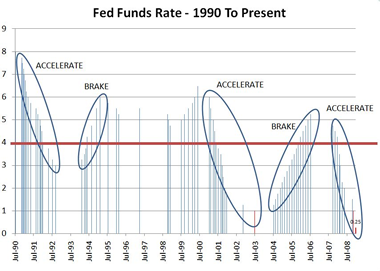
December 11, 2007 Somehow the Fed misses the obvious.
fed_rate_moves_425_small.gif
[Image from: CNNMoney.com]
December 13, 2007 [from The Christian Science Monitor]
"The odds of a recession are now above 50 percent," says Mark Zandi, chief economist at Moody's Economy.com. "We are right on the edge of a recession in part because of the Fed's reluctance to reduce interest rates more aggressively." [see my comments of September 11]
January 7, 2008 The real problem now is that consumers can't rescue the economy and manufacturing, which is already weakening, will continue to weaken. We've gutted the forces that could avoid a downturn. The question is not whether there will be a recession, but can it be dampened sufficiently so that it is very short.
January 11, 2008 This is death by a thousand cuts.
January 13, 2008 [N.Y. Times]
“The question is not whether we will have a recession, but how deep and prolonged it will be,” said David Rosenberg, the chief North American economist at Merrill Lynch. “Even if the Fed’s moves are going to work, it will not show up until the later part of 2008 or 2009.
January 17, 2008 A few days ago, Anna Schwartz, nonagenarian economist, implicated the Federal Reserve as the cause of the present lending crisis [from the Telegraph - UK]:
The high priestess of US monetarism - a revered figure at the Fed - says the central bank is itself the chief cause of the credit bubble, and now seems stunned as the consequences of its own actions engulf the financial system. "The new group at the Fed is not equal to the problem that faces it," she says, daring to utter a thought that fellow critics mostly utter sotto voce.
January 22, 2008 The cut has become infected and a limb is in danger. Ben Bernanke is panicking and the Fed has its emergency triage team cutting rates... this time by 3/4%. ...

What should the Federal Reserve do now? Step back... and don't be so anxious to raise rates at the first sign of economic improvement.
Individuals and businesses need stability in their financial cost structures so that they can plan effectively and keep their ships afloat. Wildly fluctuating rates... regardless of what the absolute levels are... create problems. Either too much spending or too much fear. It's just not that difficult to comprehend. Why has it been so difficult for the Fed?

About Me

My photo
Michigan, United States
Air Force (SAC) captain 1968-72. Retired after 35 years of business and logistical planning, including running a small business. Two sons with advanced degrees; one with a business and pre-law degree. Beautiful wife who has put up with me for 4 decades. Education: B.A. (Sociology major; minors in philosopy, English literature, and German) M.S. Operations Management (like a mixture of an MBA with logistical planning)