READ ABOUT DETROIT AND SOLUTIONS TO ITS PROBLEMS. CLICK HERE.

Thursday, March 31, 2005

Economics 101: Territorial Imperative and Sub-Optimization

Back last October, I wrote some thoughts about "territorial imperative" and "sub-optimization" including:

One of my sons was a contract worker at a large corporation and found that the bureaucracy seemed to exist to protect its territory and often did so by sub-optimizing the performance of the rest of the organization.

Since then, he has formed his own company and now faces similar hurdles in dealing with clients. One area within the client company wants his services to improve their performance. Another area sees him as an intruder into their "domain" and tries to create barriers to prevent him from having access to critical information to complete the project.

This is why corporations get more difficult to manage as they get larger... and why size does not necessarily mean "economies of scale".

Tuesday, March 29, 2005

Excessive Litigation - Supreme Court Weighs in on File-Sharing

Age old question: is enough, enough? or is too much enough? or is enough too much?

When it comes to file sharing, the answer seems to be "maybe."

Is it "sharing" or "piracy" or ??? Stealing used to be pretty obvious when everything was tangible. Take the gold; you're a thief. Take the cattle; you're a thief. Transfer some electrons; you're ???

The internet has enabled 6 billion connections and all of the possible permutations and combinations thereof. When I make something available on the internet, I cannot know for certain how it will be used by the 6 billion possible users.

If I put my own creation on the internet, I do so with the expectation that it is now out of my control; Pandora's box is open. If I put someone else's copyrighted material on the internet; it seems as if I do the same thing. The issue is: will preventing the latter also prevent the former? Do I stop innovative technology's improper use and proper use?

Where's Solomon when you need him?

Monday, March 28, 2005

Excessive Spending - Multinationals and the Dollar

Trade deficit - new twist. Reuters reports that:

Economists surprised by the failure of the dollar's three-year slide to narrow the U.S. trade deficit are increasingly focusing on the growing presence of multinationals in global commerce.
...

Research by the McKinsey Global Institute suggests roughly one-third of the U.S. current account deficit results from trade with U.S.-owned subsidiaries abroad.

This is a major reason why the dollar's broad-based slide on global foreign exchanges over more than three years hasn't narrowed the U.S. trade deficit, as conventional economic theory suggests it should.

The dollar has lost around a third of its nominal value against a basket of its major counterparts since January 2002, which should have made U.S. exports nominally cheaper and imports more expensive.

Yet U.S. consumers' voracious appetite to consume has seen the trade deficit balloon to new record after record.
...

"In our view, significant dollar depreciation is required simply to prevent further deterioration in the current account deficit," wrote Deutsche Bank's New York-based currency startegy team in a recent research note.

Now we feel better.

Friday, March 25, 2005

Excessive Spending - Taxes and Shelters

From The Detroit News: IRS collects $3.2 billion in tax shelter crackdown

By Jim Abrams / Associated Press

WASHINGTON -- The IRS has collected more than $3.2 billion, mainly from wealthy people, in its most ambitious effort ever to crack down on improper tax shelters, the agency said Thursday.

From my March 7 post.
I think that a straight 18% tax rate on GROSS INCOME... forget all of the deductions... with a deduction for the first $20,000 (amount can be worked out). That really amounts to a graduated tax up to a couple hundred thousand and a flat tax afterward. A simple, fair approach to taxes that should be close to revenue-neutral. After all, there's a lot of nonsense that goes on with the very rich to avoid taxes. Let's just clean it up and make it simple.
Adjustment Amount Gross
Income
Gross
Minus
Adjustment
Taxes Effective Tax Rate
20,000 20,000 - - 0.0%

25,000 5,000 900 3.6%

30,000 10,000 1,800 6.0%

35,000 15,000 2,700 7.7%

40,000 20,000 3,600 9.0%

45,000 25,000 4,500 10.0%

50,000 30,000 5,400 10.8%

75,000 55,000 9,900 13.2%

100,000 80,000 14,400 14.4%

150,000 130,000 23,400 15.6%

200,000 180,000 32,400 16.2%

250,000 230,000 41,400 16.6%

300,000 280,000 50,400 16.8%

1,000,000 980,000 176,400 17.6%

5,000,000 4,980,000 896,400 17.9%

8,000,000 7,980,000 1,436,400 18.0%

Thursday, March 24, 2005

Numb3rs - 2

Again... apologies to the TV show.

Michigan continues to struggle in the booming economy. The latest jobless (unemployment rate) numbers show the state at 7.5%.

So... that's good according to the Free Press article today.

Bruce Weaver, with the state Department of Labor and Economic Growth, said a lot of February's higher rate was due to a net increase of 22,000 job seekers returning to the market. Economists say that as an economy emerges from a weak jobs market into a stronger one, more people look for work and temporarily drive up the unemployment rate.
"It's darkest before the dawn" kind of thinking.

Well, let's hope so. Michigan appears to be an aberration... an economic model left over from the halcyon days of industrial USA... while the rest of the country appears to be doing fine selling intellectual property of some sort.

Meanwhile... I'm including this table from the U.S. Census Bureau showing 2004 trade... U.S. Exports versus U.S. Imports... numb3rs....

Total Trade (Goods)

    Rank Country Exports (Year-to-Date) Imports (Year-to-Date) Total, All Trade Percent of Total Trade
    --- Total, All Countries 819.0 1,471.0 2,289.6 100.0%
    --- Total, Top 15 Countries 614.2 1,107.1 1,721.3 75.2%
    1 Canada
    190.2 255.9

    446.1

    19.5%
    2 Mexico 110.8 155.8

    266.6

    11.6%
    3 China 34.7 196.7 231.4 10.1%
    4 Japan 54.4 129.6 184.0 8.0%
    5 Federal Republic of Germany 31.4 77.2 108.6 4.7%
    6 United Kingdom 36.0 46.4 82.4 3.6%
    7 Korea, South 26.3 46.2 72.5 3.2%
    8 Taiwan 21.7 34.6 56.3 2.5%
    9 France
    21.2 31.8 53.1 2.3%
    10 Malaysia 10.9 28.2 39.1 1.7%
    11 Italy 10.7 28.1 38.8 1.7%
    12 Netherlands 24.3 12.6 36.9 1.6%
    13 Ireland 8.2 27.4 35.6 1.6%
    14 Brazil 13.9 21.2 35.0 1.5%
    15 Singapore 19.6 15.3 34.9 1.5%

Wednesday, March 23, 2005

Excessive Spending - What goes around

I've gotten a number of emails about my post of March 18. My position was that certain types of trade are not necessarily beneficial to the U.S.... but the debate seemed to get sidetracked around Canadians mowing lawns versus countries 8,000 miles away.

One gentleman, Roland Patrick, suggested that there was no trade problem and that could be explained by a simple example: we buy from wine and cheese from France, they buy electronic products from Japan, and Japan buys apples and Jack Daniels from us... and we all get along fine and prosper.

My position is that it isn't quite working that way. The current account deficit of $0.6 trillion... or $600 billion... or $600,000 million... means that the product we seem to trade best to the world is currency... not manufactured goods or services or intellectual property. The government prints them and we spend them. And the world continues to accumulate them. Then what?

  1. they buy U.S. government backed notes and convert currency into U.S. debt which becomes a tax burden... or we simply increase our national debt to an even larger, staggering amount to continue spending more than we earn.
  2. they don't like U.S. government backed notes (maybe getting too risky), but find that U.S. land is a great bargain so they buy land and property... which is okay because now they are taxpayers... while driving up the cost of property so that U.S. citizens have a harder time owning property (talk to New Yorkers)... renting is good.
  3. they don't like the either U.S. government backed notes (too much national debt?) and they don't find the U.S. a great place to start a business (labor costs too high), so they try to exchange their dollars for Euros... driving down the value of the dollar... making U.S. products more attractive versus some imports... but still not competitive with the cheap-labor producers... and making heavily imported items such as oil more expensive resulting in higher inflation, higher interest rates by the Fed, and greater costs to businesses which must be covered by raising prices... keeping the U.S. products non-competitve... and U.S. citizens relatively worse off (fewer high paying jobs and increasing cost of goods... remember all of those U.S. industries that have gone under or are struggling to compete with the cheap labor countries).
Okay, the sky isn't falling... yet. The negative current account is still only 5% of the GNP. But the dollar has fallen quite a bit in the past 2 years. Oil has risen (and, yes, a lot of that has to do with China who is now becoming our chief competitor by undercutting domestic producers by refusing to let their currency float) and is spurring inflation (despite government insistence that it isn't) and is sure to affect the vast travel and tourist business segments negatively. And unemployment still remains way too high in traditional manufacturing areas... but is not too bad in the fast food sector with so many more available workers.

Oh, it's all supposed to work out. GM will be rich because of what they make in China. Maybe. But GM is not doing all that well financially despite dreams of glory in the Chinese marketplace. And then there is the Chery... go ahead and Google that one.

Tuesday, March 22, 2005

Excessive Spending - Cranking up the interest

Another 1/4%. Okay, put into perspective that is not a big deal. Something like $2.50 per $1,000. Even on $100,000 that's only $250 (simple interest). At today's gas prices, that's just a few tank fulls.

So, why all of the interest in interest rates? Right now, interest rates are still very low from an historical perspective. Given the booming economy, there is no reason why the market should be too concerned. Well, "booming" may be an overstatement. We have sort of made up lost ground over the past 3 years, but in some areas there is more bust than boom. So, another 1/4% is another small cut and another small amount of economic bloodshed. Trivial by itself, but...

  • Oil over $55 per barrel; gasoline around $2.15-2.20 per gallon across the U.S.... and climbing
  • Unemployment rate at 5.4% nationally... about the same for the last 6 months... well, it's not worse
  • Airlines continue to be in financial trouble
  • GM getting rid of 8,000 (more) white-collar workers
  • and the Fed warns about the return of inflation... ooops.
Is the Fed ever going to stop taking chances tinkering with the economy. That might have been a great baseball infield at one time, but adding cost to the cost of doing business in an effort to keep prices down has always been a little counter-intuitive. It worked so well in 2000 if you like to bring economic growth to a complete halt.

Monday, March 21, 2005

Environmental Extremism - Get the shorts on


Michigan glaciers retreat on the first day of Spring

Sunday, March 20, 2005

Excessive Litigation - BusinessWeek

The March 14 issue of BusinessWeek magazine is an interesting study concerning excessive litigation. Good reading for the non-lawyer.

What is clear when the U.S. system is compared with Europe is that the term "excessive litigation" could be replaced by "excessive penalties". I've said it before that I felt the tort system itself was a legitimate process that has simply been abused. It's time to take the abuse out while maintaining the process.

Of course, one must remember that the bias of these articles belongs to BusinessWeek. Nevertheless, there is fire behind this smoke.

Saturday, March 19, 2005

Feeding tube removed from brain-damaged woman - CNN

Terri Schiavo's Feeding Tube Removed Fox News

Schiavo's Feeding Tube Removed at Judge's Order New York Times

Schiavo's feeding tube removed Christian Science Monitor

Doctors removed Terri Schiavo's feeding tube despite a last-minute push by Republicans on Capitol Hill to keep the brain-damaged woman alive. It is expected to take one to two weeks for her to die, provided no one intercedes. 6:02 p.m. - Wall Street Journal

A lot of opinions about this one. Okay, here are mine.
  1. The woman was brain damaged, but no one knows for certain how much, if any, awareness she has of her surroundings. Given the uncertainty, one can clearly argue for continued care.
  2. The arguement was made that she is unable to care for herself. So are babies. So are quadraplegics. Score one for continued care.
  3. Her husband wanted to stop further care; her parents wanted to continue. As long as any relative was willing to accept responsibility for her care, care should continue.
  4. She might never recover. What about those who are terminally ill for certain? Not a valid point.
  5. It costs a lot to care for her and there is probably no likelihood that she will ever know the difference. Ah, the moral and ethical measure of society. The real deal breaker in the world of business.
  6. Stop feeding her and let her slip into a coma and die. What's the difference between that and a needle full of air into a vein... except that it's slower?
When the going gets tough... run away.

Friday, March 18, 2005

Excessive Spending - Buffett Wrong?

Dr. Don Boudreaux, who contributes to "Cafe Hayek", wrote on March 16:

But having re-read the part of Buffett’s letter dealing with the trade deficit (more accurately, the current-account deficit), I still believe that I’m right and he’s wrong. If my paying my Virginia neighbor $10 to mow my lawn creates neither debt nor other economic problems, how would my paying a Canadian $10US to mow my lawn create debt or other economic problems? What conceivable economic difference can the latitude or longitude of the seller’s residence make?

But is there even a whiff of relevant economic difference between this transaction when it takes place between two Americans and this transaction when it takes place between an American and a Canadian?

Perhaps there is a difference – a difference seen by Warren Buffett, David Ignatius, Paul Craig Roberts, Pat Buchanan, Lou Dobbs, and others, but missed by me. Please – and I’m not being facetious – if you detect an economically relevant difference between these two transactions, write to me and enlighten me.

But until I’m shown such a difference, or discover the difference on my own, I cannot but conclude that Buffett’s concerns about the trade deficit are misplaced.

Well, how about this:

The difference between paying a neighbor... or even a Canadian who happens to live close by for a service... and buying goods from a country 8,000 miles away is that... unless the equation is somewhat balanced by that country buying goods or services from the U.S.... there will ultimately be a negative economic impact as the U.S. economy loses it's ability to generate wealth internally.
    • The Canadian across the river is likely to use his newfound income to purchase goods or services from the area. The economy of the area is infused with income and spending that enriches the area.
    • The purchase of goods from an country 8,000 miles away that does not reciprocate, brings goods into the country while moving the wealth generated from production out of the country. Many of those who would normally infuse the economy by spending their income within the country and keeping the economic engine running, move to the sideline or, worse, become a drain on the economy (collect "benefits"). The economy of the country 8,000 miles away grows and prospers, but bad things tend to happen to the U.S. economy such as:
      • devaluation of the dollar
      • increased cost for goods (inflation)
      • higher unemployment
      • lower tax revenues
What about the lower cost of goods that are imported versus produced locally? Yeah, that is a benefit for awhile. But as the current-account deficit continues to grow to a significant portion of the GNP, the bad things start to show up.

$1 spent on imported goods enriches the exporting nation and the importing company. It may also enrich the retailer. But the negative side is that the U.S. supplier of raw materials loses, the U.S. manufacturer loses, the U.S. manufacturing employee loses, and maybe even the U.S. distributor. $1 at retail multiplies throughout the economy more when production is within the U.S. than when it is elsewhere. Ultimately... say at 5-10% of GNP... the current-account deficit begins to erode the purchasing power of the country as higher paying jobs are replaced with lower paying ones and the value of the dollar drops globally. In simple words: wealth moves elsewhere.

Oh, I know that there is faith that the lost jobs will be replaced by higher-paying, higher-skilled jobs... isn't happening. Faith isn't good enough. One need only look around to see the real dynamics in play.

Some topics I'd like to see at Cafe Hayek:
  • The advantages of protecting the home base while invading other economies (I can sell to you, but you can't sell to me)
  • Undermining the economy of your competitors by undercutting their means of production
  • "Win-lose" economics as a path to power (why use military force when you can drain the resouces of your enemy)
... but that's unlikely. After all, that would require a belief that there are non-economic agendas associated with economic policy.
Wednesday, March 16, 2005

Numb3rs

My apologies to the popular new TV show. I'm really referring to how strangely numbers reflect reality.

A recent study by the Insurance Institute for Highway Safety came up with an interesting comparison: the driver's death rate for a Mercury Grand Marquis is about 57% higher than a Ford Crown Victoria. You auto buffs will immediately say, "that's b...s...!" Well, no, that's statistics. Virtually identical cars have wildly different risk rates for death. Must be the grilles... they're different.

Actually, the study doesn't really tell anyone how safe any vehicle is... it simply reports the death rates for the drivers (per million registered years... that's a neat metric). The problem is, the statistics infer that one vehicle is safer than another when countless other variables may come into play. Such as? Such as the driver demographics. Hot rodders and nearly blind old folks can turn perfectly acceptable and safe vehicles into death traps. But public perception is that one vehicle is less safe than the other... even if they are identical.

Kind of like reporting that murders increased by 100% in one town versus 1% in another. The first town is obviously the most dangerous... went from 1 to 2 murders... whereas the second town has crime under control... went from 1,000 to 1,010. Sometimes you just have to get behind the numb3ers.

Tuesday, March 15, 2005

Ethnic Divisiveness - "24"

Fox News was soliciting comments about whether the Fox network show "24" was unfairly portraying Muslims as terrorists. There is a lot of sensitivity about hurting the feelings of various "ethnic groups" so this particular question wasn't too surprising.

But let's be a little rational here. What particular religious/ethnic group is presently comprising those who are routinely using homicide bombers and other means of violence against unarmed, non-combatant civilians; i.e., who comprise those called "terrorists"? Asked and answered... many times.

Nevertheless, I believe the question about "24" should be answered, to wit:

"24" is an equal opportunity inflamer. Sure, Muslims get picked on. So do defense contractors. How about black women? 2 years in a row there are conniving black, females who try to undermine the noble "CTU" and place the nation at risk. Then there are CTU supervisors who have their own agendas and problems... mid-level government officials... who keep getting in the way of progress only to be shunted aside when the going really gets rough....Yup, an equal opportunity inflamer.
"24" is nothing more than a sign of the times. During WWII, it was the "Japs" and "Krauts". Fair? Ask those who were attacked. It's not rational to paint a nation or a religion with one brush... but it is understandable. Especially when there is so little said by members of the religion/ethnic group against those violent actions.

But it's just temporary... there will be another villainous group to take the place of the current villains.

Sunday, March 13, 2005

Ethnic Divisiveness - I'm Special

WEST BLOOMFIELD TOWNSHIP -- An Orthodox Jewish academy knocked out of the Michigan high school basketball playoffs in the first round is continuing with a lawsuit against the tournament organizer, claiming that scheduling games on its Sabbath is discriminatory. (see article)

Anti-discrimination this; anti-defamation that... I've made a choice to live a certain way, so all of you must adjust the way you live to accommodate me... I'm special. Also see this.

There is a difference between discrimination and not making special accommodations.


Urban Myth - A Farmer's Market?

Headline: Urban farming may well hold the key to the future of Detroit (see article written by Nolan Finley)

I've posted many articles about the wasteland called Detroit. But I have to admit that farming has never been one of the potential solutions to the mass exodus of citizens.

It may not be as strange as it seems. Until just recently, there was a tract of land owned by Ford Motor Company in Dearborn adjacent to Hubbard Ave. that was farmed. But that was not what made Dearborn a viable and vital community. A few of the things that Dearborn has that Detroit doesn't have include:

  • a government focus on meeting the needs of the community
  • a strong business presence and a good environment for businesses... both large and small
  • an infusion of new cultures without intimidation of the old
... to name a few.

Mr. Finley, this is what farming won't fix:
Detroit needs a complete restructuring including:
  • resizing
  • rezoning
  • rehabilitation
  • reclamation
There is no logical, structured, sequenced plan to do any of this. There are only haphazard, half-hearted efforts to "find something" to fix a truly broken city. Farming will only work if a large portion of the city is leveled. Hmmm... that might not be a bad idea, after all. Except the city taxes will drive any farmer out of business in a year.

Waiting for Michigan Warming

Saturday, March 12, 2005

Excessive Spending - Update

WASHINGTON, March 11 (Reuters) - The U.S. trade gap widened to a near-record $58.3 billion in January as the seemingly insatiable appetite of U.S. consumers pushed imports to an all-time high, a government report showed on Friday. (see article)

WASHINGTON, March 11 (Reuters) - The United States is concerned about rising imports of clothing from China and will consider imposing restrictions if there is evidence the U.S. market is being disrupted, U.S. officials said on Friday. (see article)

WASHINGTON (Reuters) - The United States posted a record $113.94 billion budget deficit in February, above most Wall Street forecasts, as higher government receipts were not enough to cover a spending increase. (see article)

What can one say? (see article) Again.

Friday, March 11, 2005

Education Failure - 60 Kids or an Ex-Con?

$586,000

That's what the Detroit Free Press reports was spent by the Detroit Public Schools to hire the ex-convict brother of a school official for a public relations campaign that had dubious success.

That money is the equivalent to the revenue Detroit receives from ALL SOURCES to educate 60 students for a year.

60 kids... ex-convict brother of school official... hmmm. Rehabilitation is fine, but.... Well, the kids wouldn't have paid attention in class anyway, so what's the difference? Ya, sure.

This is just another symptom of the corruption and malaise that permeates Detroit. Any questions about why people are leaving?

Recent article about the Detroit malaise.

Wednesday, March 09, 2005

Environmental Extremism - NFL "Tackles" Pollution?

Okay, it's a good idea anyway.

That being said, the Detroit Free Press article about the NFL planting trees in Detroit to offset pollution caused by the Superbowl is stretching credulity.

Let's get the obvious out of the way (tip of the hat to Mandy Carlson)... most of the trees (all?) will be absolutely dormant... doing nothing... zilch, zip, nada... while all of the pollution from the extra 3,000 people in Detroit to see the Superbowl is going on.

So I guess we can consider the new trees as a long-term payback for the extra CO2 from the buses and cars... well, the cars anyway... that will be idling to find parking spaces that are not a mile away from the stadium.

God, I love political correctness... even if it only makes sense by accident.

Tuesday, March 08, 2005

Excessive Litigation - Stupidity

My son, the safety engineer, occasionally lets slip some interesting accounts of stupidity leading to lawsuits.

I happen to run across this article entitled "THE BASIC LAWS OF HUMAN STUPIDITY", which should be required reading for... well... the not-so-stupid... since it won't do any good for the stupid.

My sons have heard me say often enough that "stupidity has its own rewards." Unfortunately, the consequences of stupidity go beyond the stupid person. Perhaps there should be a stupidity test as part of all legal proceedings.

Monday, March 07, 2005

Excessive Spending - Death & Taxes

I spent the weekend working on taxes for 2004. After 40 years of paying them, I should be pretty good at preparing them. But there's always something new to be considered and some revised form that keeps me busy for an extra hour or two. But, ultimately, I get through the stack of forms. This weekend was dedicated just to the small business I own. It's just a flyspeck on the Federal radar... if even that. But I still get to consider all of the forms that larger businesses use. Then I get to pass the information on to my personal returns and spend another weekend working on that.

I'll owe a little this year because I took out some money from savings and I guess not enough was withheld. Not a problem. I spoke with my son who was doing the same thing in Chicago. Two incomes, renting an apartment... big time payers. Still, we do our best to follow the forms and pay what is owed.

It's tough that we all really need to be accountants to do this... or hire one. I can pretty much do it on my own with an occasional question to my brother or friend who are accountants... though I hate to bother them. Just follow what was done last year and look for changes in the instructions. I guess I would not be too upset if income taxes were replaced by a federal sales tax. Spend more, pay more. The problem with that is that it seems to be a regressive tax. A guy who makes a billion a year is not going to spend 100% of his income, but a guy making $100,000 will get a lot closer to 100%. And the guy making $10,000 spends it all. So that probably won't fly.

I think that a straight 18% tax rate on GROSS INCOME... forget all of the deductions... with a deduction for the first $20,000 (amount can be worked out). That really amounts to a graduated tax up to a couple hundred thousand and a flat tax afterward. A simple, fair approach to taxes that should be close to revenue-neutral. After all, there's a lot of nonsense that goes on with the very rich to avoid taxes. Let's just clean it up and make it simple.

And then I got to thinking about the budget deficit....

Saturday, March 05, 2005

Cold or Cancer?

Detroit's abandoned housing problem just won't go away. Of course, the housing problem is a symptom... like a cough is to lung cancer.

Now city and county officials are worried that "they need to kick-start efforts or risk embarrassment when the world's spotlight is on Detroit, which will happen even before the NFL championship game" according to The Detroit News. That's like saying Detroit needs to get stronger cough medicine. Sure, it will help... but it doesn't address the underlying problems.

Go back and read these.

Detroit's mayor is a caricature of what ails Detroit:
  • Large, but no real substance
  • Talks a great game, but can't deliver
  • Sense of community extends as far as his family (and their automotive needs)
Unfortunately, he is a living representation of what the city has been for a quarter of a century and more. Randomly demolishing a few houses is not a plan for the future. It is a photo-op for a newspaper story.

Tuesday, March 01, 2005

Justice Is Served - Anyone Else?

Last week, I attended the sentencing of an old friend in a Milwaukee court. He had embezzled (stolen) a serious amount of money over a long time. You'd never know it by his home, clothes or car. He probably never spent any of it on himself. The judge commented that people like him often have personalities that drive them to be generous givers in order to validate their self-image. Perhaps that's true. Regardless, he was sentenced to jail time for his crime. That's the way things run.

During the sentencing proceedings, I did make the point to another man who was there to speak on my friend's behalf that sometimes justice is served by putting a person in jail for a crime... but no one else. In my friend's case, he had lost his job of 30 years, his wife of 35 years, and basically all of his possessions. He was nearly penniless and abandoned. That's serious punishment, but the law does demand more. He had found a new, lower paying job and his new employer told the court that he trusted my friend despite what happened and felt that everyone deserved a second chance. He suggested to the court that a work-release arrangement might be in the best interest of all.

But the judge finally concluded that my friend must serve jail time. The judge did not rush to judgment. He considered all of the ramifications and concluded he had to order jail time for my friend. His sentence was not as harsh as it might have been. It was, no doubt, a very fair and compassionate sentence in light of the crime. Justice is served... the press can send out a message to deter other potential embezzlers. And now...

  • my friend loses his job and a chance to rebuild a shattered life
  • his new employer loses a person whose talents and knowledge could have greatly enhanced his business
  • the victims of his embezzlement lose a significant opportunity to obtain their money back
  • the state loses a significant amount of money to incarcerate him
There was no silver lining in that cloud.

Thursday, February 17, 2005

Ethnic Divisiveness - Unintended Consequences

Headline: Metro Detroit sprawl separates blacks, jobs

  • Slavery
  • Civil War
  • Jim Crow
  • Black Activism
  • Race Riots
  • White Flight
  • Racial Card Politics
  • Decay
The old saw "two wrongs don't make a right" really applies here. Actually a lot more wrongs than two.

Detroit is caught in an outward spiral... a reverse black hole sort of effect... nothing in seems to want to stay.

Eventually, however, the process will reverse... almost naturally. It has to. The city is too strategically located to be abandoned entirely. But it has not yet reached its nadir. Detroit's present population is about 900,000. When it reaches about 750,000, there will be imminent threat of collapse. The state will be forced to step in. At that point, there will be significant opportunities to remake Detroit into a model city.
  • Reclamation of large, blighted tracts for development
    • buy-out of remaining residents
    • tear-down of existing properties
    • rezoning to achieve mix of residential, business and public areas
    • bring in high-end developers... gated communities...
  • Tax reformation
    • hiatus on property taxes for residents and businesses moving into the city
    • overall reduction of taxes residents and businesses must pay in the city
    • privatization of city services such as garbage disposal
A more radical approach would be to adopt a Toronto-style form of regional government and land-use, but that would be very difficult. It would, however, integrate the area of Detroit within a larger, more stable government framework. It would eliminate the fundamental differences in taxation and services and let the core area of Detroit take advantage of its inherent geographic advantage. It is probably unworkable because:
  • Black Detroiters would have to relinquish significant political power
  • White suburbanites would have to relinquish insulation and isolation from the problems of Detroit
  • Taxes would increase overall
  • Racial issues would have to be addressed
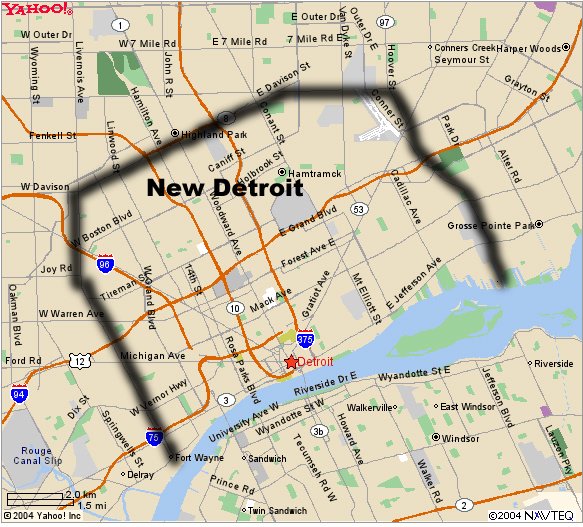
Another radical approach would be to reduce Detroit to a 5 mile radius from the foot of Woodward Ave and then create several new cities along the outer ring or let existing cities annex adjacent areas. This would create a more manageable central area that could focus on high-end businesses and more affluent residents. The outer areas would be more traditional smaller cities that could focus on small business and the needs of its residents.


Regardless of the solution... waiting... creating a metropolitan area government... reducing the geography of Detroit... the present situation seems untenable. It is not about "unregulated employment growth" that the Brookings Institution cites. It is the unintended consequences of wrong decisions over many, many decades. Eventually, this area must bite the bullet... or continue to see them flying.

Tuesday, February 15, 2005

Addendum

Uncertainties

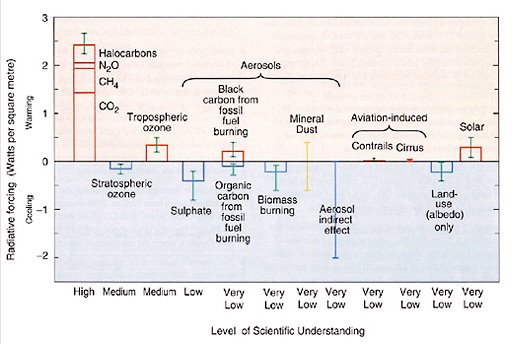
It's good to know that the earth's temperature has risen from the extremely cold late 19th century by 1 degree C. All kinds of record lows during that period.

There really are a lot of agendas out there... including the EPA's. One needs to be very careful about which bandwagon one joins. Point: one factor has changed slightly in a very complex equation that is not fully understood... one factor that may or may not be a long-term issue.

Environmental Extremism (sigh)

Note to Anonymous from yesterday's post: 200 years seems like a long time, but go back to this for a long perspective.

Some relatively warm years recently have created a geological micro-focusing on a very... very... short time period where a change in climate appears... appears... to be occurring. Rapid change in climate is not without precedent... and has had nothing to do with man's involvement. Nevertheless, the result is that there is a focus on atmospheric carbon dioxide as a "cause" of "climate change." It's a popular concept for those who would like to see the elimination of large cars and trucks... and a return to what??? but who... conveniently... oppose new nuclear power generating plants that are the only viable means of reducing the use of oil and coal for producing electricity... and having enough electricity available to convert from an oil-based to a hydrogen-based economy. And who... conveniently... support a treaty that does nothing to affect the most rapidly growth contributors of all pollution... China and India.

So my "needling" about Environmental Extremism does have a "point"... those that shout the loudest rarely have a viable alternative... and many of their alternatives (such as wind turbines) are vigorously opposed by other "environmentalists" who see them as dangerous to birds or ugly or have some other reason.

People rally easily to "noble" sounding causes without really thinking through alternatives and implications... and with the weapon of short-sightedness. It reminds me of the guy who "voted for the ice age coming before he voted against it" (for those of you old enough to remember the winters and cold summers of the 1950s... snow in July in Wisconsin... something I saw more than once... came during a time that there was a lot of talk about a new ice age... something that happens when a few years of unusual weather comes along).

One other thought... those who use "average global temperatures" are truly kidding themselves into believing that it is possible to rely on readings from 100 years ago for comparisons with data obtained by today's technology.

Here is a site that is worth looking at to get further insight to what I have written about:
http://www.techcentralstation.com/climatechange.html

Sunday, February 13, 2005

Back From The Future

While speculating about the future can be "fun", there is a serious component to it... present decisions affect future abilities. Simply responding to present issues does not necessarily prepare us for what is likely to occur.
Confusing?

We get our information from so many different perspectives that seeing the larger picture is difficult. GM (and other automobile manufactureres) are constantly trying to take advantage of potential opportunities without making disastrous decisions. Headlines oversimplify out of necessity... grab the reader without taking up space.

So let's summarize where the headlines are going:
  • GM is facing great competition from Toyota for leadership in world automotive sales and profits
  • GM's products are aging, it has huge cost burdens, and some of its operations are creating distractions and inefficiencies
  • China appears to be a major market opportunity and is presently yielding growth and profit for both GM and Toyota
  • But there is an underlying problem in dealing with China that may override the benefits presently being realized including outright piracy of GM designs and manufacturing techniques by Chinese firms that will bring GMs growth in China to a grinding halt
  • And there is a possibility that GMs foray into China may be creating its next competitor in the U.S. ... the Chevy Chery
Unlike Toyota, GM does not enjoy a market protected from non-U.S. manufacturers. The U.S. government encourages "free trade" which is loosely translated into "bring in the cheap goods" regardless of consequences. That includes ignoring issues of outright unfair trade practices by Asian countries... practices that are illegal in the U.S. It's a Faustian deal.

Before the future arrives, it is time to address what makes GM not tick... tock, tick, tock....

Saturday, February 12, 2005

2020 Conclusion

15 years... not that far into the future. How will things be the same; how will things be different?

The same: the U.S. will still be the most formidable economic and military power in the world.

Different:

  • U.S. will face greater challenges in:
    • Education
      • Growing minorities population with less tendency toward high school/college graduation or PhDs.
      • Need to provide alternative to academic-oriented education
    • Economy
      • Continued pressure on manufacturing from both China and India
      • Real possibility of a currency crisis stemming from trade deficits
      • Trade focus may begin to shift to the "Americas" and away from Europe and Asia
      • High level of illegal immigration of primarily poor, undereducated Hispanics plus an aging White population will create enormous strains on social programs that will require significant changes in the programs or increases in taxes
    • International relations
      • Gradual reduction of military efforts regarding Middle East/Islamic issues in favor of increasing European Union/Russian responsibility as those areas become increasingly sensitive to the Muslim Influx
      • Recognition of China as both an antagonisic military and economic competitor may force U.S. to consider creating stronger ties with India... despite economic competition... because India will be seen as having interests similar to the U.S. regarding China and Islamic activism
      • Recognition of economic opportunities "south of the border" in Latin and South America leading to greater cooperation and trade in those areas

  • European Union faces new directions
    • Turkey's efforts to join the EU have an upside and downside
      • A large, growing market and educated population can be a major contributor to the EU
      • The "Muslim Influx" into northern Europe is a potential source of social upheaval that could set back the EU indefinitely
    • Other eastern European nations may press for membership which might cause both political and economic issues for the region
    • Relationship with Russia must be addressed

  • Asia faces growing pains
    • China is a major question mark
      • Will it become a "legitimate" business environment or continue as a place for pirates and opportunists
      • Will it seek to use its growing military power to coerce the rest of Asia
      • Will it seek to expand its influence more into the western hemisphere, including Latin and South America
    • India may become an economic superpower or collapse from internal and external pressure
      • China and India could become mutual markets for each other
      • India could become bogged down in escalating conflicts with Muslim countries and Muslim minorities within India
      • AIDS could become a sociological disaster among the hundreds of millions in poverty
    • Central and Western Asia will continue to be a source of Islamic issues for the rest of Asia and Europe

  • South America may become a major market and supplier to the world if social and political issues can be addressed

  • Africa will remain a backwater despite significant markets and resources due to political instability and AIDS
Nothing is set in stone... but the indication are all there for those interested enough to look.

Friday, February 11, 2005

2020 Preparations - Step 3: Population Impact - 2

Yesterday I reviewed population facts. Today let's look at the implications:

  • China and India will have a combined population approaching 3 billion by 2020 making that part of the world the highest density marketplace.
    • There will be extremes of income - destitute to immensely wealthy
    • There will be a rapidly growing consumer base
    • There will be great demand for the world's resources
    • There will be intense global competition for a piece of both countries' expanding markets
    • There are significant risks of an AIDS pandemic among the poor
  • Europe may have significant social problems with the great Muslim influx as well as significant strains on many countries' social programs
    • Europe will benefit from relatively cheap Muslim labor
    • Europe will be distracted by social unrest
  • The U.S. will continue to have an increasing Hispanic population
    • There will be growing pressure to "Quebecize"... create a side-by-side society rather than an integrated one
    • There will be pressures on social support programs as a lower percentage of the population seeks college educations... or even graduates from high school
    • The economy will remain strong due to population growth, but manufacturing will be a smaller percentage of the total economy and more focus on the service sector
    • There is a great likelihood that the U.S. will begin to look more to Latin and South American markets for reciprocal trade (my conclusion) as the Hispanic population increases
It is not unreasonable to accept the possibility of an "Americas" focus emerging as the situation becomes more chaotic in Europe and Asia.

I believe the political and population dynamics will lead to the following:
  • The U.S. will become increasingly disenchanted with involvement in Muslim-initiated issues which will dominate the European and Russian areas and will force Europe and Russia to have greater roles in addressing Islamic activism
  • The U.S. citizens, businesses, and politicians will become increasingly disenchanted with lopsided trade balances and unethical practices by China and curtail efforts to be a major part of China's markets
  • The U.S. will increasingly see India as the key player in its Asian trade efforts and promote Indian development to offset both the Muslim and Chinese influences.
  • The U.S. will see Latin and South America as "natural" trading partners and increase efforts to build greater ties politically and economically.
FYI...
APPROXIMATE MILES FROM CHICAGO
Mexico City
1700
Rio de Janeiro
5300
Caracas
2500
Buenos Aires
5600
Paris
4100
Beijing
6600
Munich
4500
Hong Kong
7800
Moscow
5000
Bombay
8100

Thursday, February 10, 2005

2020 Preparations - Step 3: Population Impact

One of the dynamics affecting international affairs over the next 15 years as we progress toward 2020 will be changing populations.

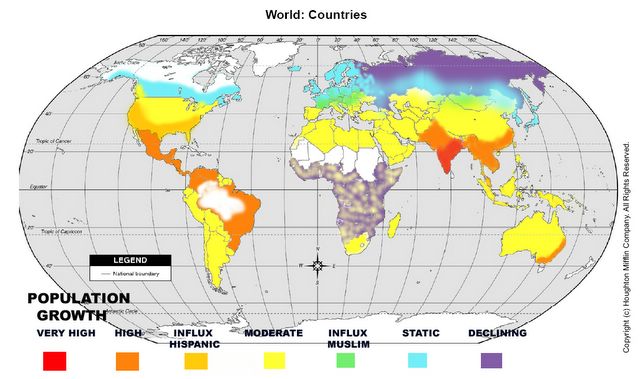
  • China and India approaching 1.5 billion people each; India with no discernible population control; China with an aging population
  • Europe with a static indigenous population and an influx of Muslim immigrants
  • A broad swath of moderate to high growth through the Mediterranean and West/Central/SE Asia
  • Japan aging and static population
  • Moderate to high growth in South and Central America
  • High growth in Mexico with an Hispanic influx into southern tier U.S.
  • Russia and sub-Saharan Africa with the possibility of decline populations because of disease and political instability
The map below is based on my interpretation of the CIA paper on 2020, but I think it tells the picture: the U.S., Europe, and Japan... current economic leaders... will be faced with different, but important population challenges. The U.S. and Europe may face serious cultural conflicts between the older and newer populations.

India's growth may continue unabated due to its young population and increasing national wealth. China's one-child policy will eventually create an aging, static population unless the policy is repealed.


For more on China's aging population, see this morning's Detroit Free Press.

Wednesday, February 09, 2005

2020 Preparations - Step 2: Economic Challenges 2

Yesterday was one example of how we are creating our own economic competition in China. On Saturday's post, I spoke of adapting to the new "rules of engagement" by not trying to match low wages, but by education... matching wits.

The U.S. is China's biggest external customer. It is time they stop "disrespecting" us... it is time that we assert ourselves while we can. What does China want and need?

  • Our technology
  • Our markets
  • Our knowledge base... including access to our universities
So you may ask yourself: "Does the U.S. have any leverage in dealing with an unethical, unprincipled China. Go back and read the bullet points again.

Our businesses tell themselves that they "need" Chinese labor. Not totally true. They can take advantage of cheap Chinese labor under ethical rules of engagement. Otherwise, the payment is far too high. India is a better alternative if cheap labor is the only price of doing business that drives U.S. corporations to seek outsourced manufacturing. India does have the British rule of law. Indians generally speak English and Indians have shown themselves to be reasonably reliable in business dealings.

China may be a tempting market, but its government is a major negative because it does not protect the intellectual rights of other nations doing business within its borders. Quite simply, we do not need China or its markets at the price presently being paid.

Here's a thought: allow U.S. companies whose products have been pirated to sue in U.S. courts and prove their cases. While it may not stop what is going on in China, it could be used in the court of world opinion against Chinese practices and... if the Chinese should ever want to export any of those products or components of the products to the U.S., they could be fined substantially or all products confiscated and destroyed.

Or... simply cancel China's "most favored nation" status. No, that might be too appropriate for our politicians to consider... especially many whose constituents have their hands in this cookie jar because of the access to China's huge markets. Perhaps when enough big businesses are burned, attitudes will change. After all, what good is access when all that mean is the U.S. will teach China all it knows so that China can undermine the U.S.? ... us.

Tuesday, February 08, 2005

2020 Preparations - Step 2: Economic Challenges

According to GM China, the similarities between its Spark minicar and Chinese Chery Automobile Corp.'s QQ model are more than just mere coincidence. In fact, if you examine the automobiles, they are virtually identical.
*****
"Chinese officials were demanding more advanced technology than seemed appropriate or necessary to Chrysler," concluded the Commerce report.

Chrysler was at that time the maker of the U.S. Army M-1 tank.

Chrysler officials quickly realized the advanced assembly and manufacturing technology demanded by the Chinese was far more applicable to making armored vehicles such as the U.S. Army M-1 tank than vans for soccer moms.

*****
Audi, the German car maker, also had a sweet deal with China to manufacture its very popular 5000 sedan during the 1990s. However, once the terms of the deal expired, Audi was hustled out of China.

Suddenly, the same Beijing car maker began producing the "Red Flag" sedan. The Red Flag was identical to the Audi 5000 right down to the last nut and bolt - with the single exception of a plastic red-flag hood ornament.

*****
The U.S. companies that so heartily supported open trade with China are now beginning to regret the deals they made with Beijing. Tyrants don't have to play fair or by the rules. GM, Chrysler and others are learning as they pay the financial penalty of a fools bargain.

Perhaps it is time to examine how we "partner" with our competitors.

"Outsourcing" is a two-edged sword when it comes to China. We get cheaper goods because of low-cost labor. They get our designs and technology.

So is "outsourcing" really cheaper or are we just borrowing from our future? It's hard to put an entry on a spreadsheet under the heading of "pirated knowledge".


Monday, February 07, 2005

2020 Preparations - Step 1: Education (Continuing?)

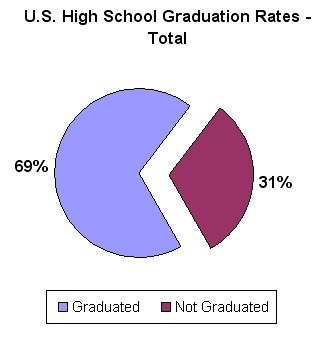
Yesterday, one of the leverage points I suggested was alternative education paths to the traditional high school/college path. It's not a new idea... just one that was abandoned by most school districts. The charts below depict the education failure rates for those school districts. I point the finger at the districts because they have not responded to the real crisis in American education... almost 1/3 of our children do not receive an education that prepares them for adult life.

Rather than being prepared for well-paying trades or crafts, we allow our children to simply walk away from the educational system. That's education failure in a nutshell. And, if present statistics remain unchanged by ethnic groups, the growth of our minority populations will heighten the problem.

Click on the graphs below to see the data details.


Sunday, February 06, 2005

2020 Preparations - Step 1: Education (continued)

Yesterday, I proposed tax incentives for U.S. citizens seeking PhDs. It's really not so much that they would be incentives as investments by the government in our nation's future.

  • PhDs would have far greater earnings potential returning those initial tax breaks back to the government in later years
  • PhDs would have a far greater potential for developing revolutionary ideas that could be translated into U.S. business competitive advantages... more production... more employement
Working backward from the top, it is evident from enrollment data that the U.S. colleges are enjoying a brisk business. A large part of our population certainly recognizes the advantages of a college degree or and advanced degree. However, by the time a student reaches the age of 24 or 25, the pool of those considering PhDs drops off considerably. It's like never-ending medical school. So, the smoother the process and the greater support to get to the top, the more will get there.

Nearly everyone recognizes the problems facing high schools and elementary schools:
  • reduced funding
  • segments of the community without a bias toward education
  • few alternatives for gaining non-academic skills; bias against those who seek alternative educations
    • not everyone is suited tempermentally or intellectually for college
    • the community and businesses need people who are both skilled and disciplined to do other work; e.g. tool makers, carpenters, electricians
We presume that to be economically successful, one must go to college. We ignore those who can be contributers in other ways and let them stumble along until they do or do not find a place in the productive community.

Consequently, it seems to me that the two greatest leverage points for improving U.S. education and U.S. competitiveness lie in :
  • Focusing on increasing the number of PhDs among U.S. citizens
  • Focusing on high school education that provides a good alternative for those not interested in pursuing a college education, but would do well in skilled trades or crafts
Got better ideas?

Saturday, February 05, 2005

2020 Preparations - Step 1: Education

The rest of the world isn't going to turn back the clock so that the U.S. can continue to be unchallenged militarily, economically and intellectually.

It seems to me that the U.S. must begin to adapt to the new rules of engagement. It should be obvious that it is not in our best interest to try to match the ridiculously low wages driving manufacturing out of this country. That would be self-defeating. But we can make it harder for other nations to compete with us intellectually.

I sent the following letter last September and it is one possibility:

Rep. John Boehner, Chairman
Committee on Education and the Workforce
U. S. House of Representatives
2181 Rayburn House Office Building
Washington, D.C. 20515

Subject:Expanding America’s Intellectual Resource

Increasingly, the ranks of our universities PhD programs are being populated with students from other nations. While diversity of opinion, experience, and skills are valuable, I believe that such diversity already exists within the tens of millions of American-born potential PhDs. The fact that a company such as Microsoft feels compelled to seek Chinese PhDs for their research staff while, at the same time, U.S. universities’ PhD programs are so heavily populated with foreign students sends a message to me that our system of education is failing to focus on American intellectual resources: U.S. citizen students.

The point of my concern is this: the U.S. is losing manufacturing and technology jobs to lower cost labor suppliers, and the argument is that this is not serious because these jobs will be replaced by better paying ones based on the U.S. becoming the wellspring of new ideas. There is no guarantee that the foreign PhD students will stay here when booming economies in their native lands offer them the chance to become part of the elite there. I would argue that without support for creating the home-grown expertise, the U.S. eventually may be relegated to just another country that had a glorious past.

I propose a simple incentive to create a more favorable environment for students: allow students who are U.S. citizens at the time they enter a PhD program and who work in the U.S. for five years immediately after receiving their PhDs a tax break. This tax break would be very simple: average the last five years of income prior to receiving the PhD and then average that with the income received over the next five years. For example, if the average income during the last five years of the PhD program was $20,000 and the income over each of the five years following was $100,000 (for simplicity), then the taxable income before any other adjustments would be $120,000/2 or $60,000. At a 25% tax rate, that would be an annual incentive of $10,000 ($100,000 minus $60,000 times 0.25). Over five years, that would be a savings of $50,000 which could be used to offset some of the costs of pursuing a PhD.

This incentive could well be the difference between a U.S. student deciding to pursue a PhD or deciding that the burden of pursuing one is too great.

Unfortunately, Rep. Boehner was too busy to respond or acknowledge receipt of the letter.

If you wish you can also contact Rep. Boehner at:

1011 Longworth H.O.B.
Washington, DC 20515
(202) 225-6205

Or you can simply copy the letter above and send it to Rep. Boehner with your signature.

Friday, February 04, 2005

2020 - What could go wrong?

Everything.

The CIA paper to which I have been referring does recognize that political and economic forecasting is much less reliable than weather forecasting. Things can go wrong:

  • War between China and Taiwan - probably very short and disastrous politically for China
  • War between India and Pakistan - likelihood of nuclear weapons being used and other nations being involved
  • Collapse of sub-Saharan Africa - disease and unstable governments are a dangerous combination
  • Creation of an Islamic pseudo-empire - radical Islamists acting outside of traditional governments and national boundaries gain power through terror... Islamic Mafia.
  • Widespread availability of nuclear weapons - any country might become an nuclear power through covert means... making the world a far more unstable place.
The world is changing and the U.S. will have to adapt... but continue to lead. What are some of the options?

We'll look at that....

Meanwhile, as predicted by global warming models...

Glaciers in Michigan are forecasted to retreat at an accelerated pace. After only two weeks, glaciers are beginning to show signs of melting. Animal life may return to this desolated area.

Thursday, February 03, 2005

Economics - Trade deficit

Follow-up to my February 1 post. Although I have not combined the trade deficit with the budget deficit into some total number, I have stated that I believed they are both indicators of economic structural weaknesses that this nation will be forced to face. Back on November 6, I started writing about excessive spending as part of my post-election focuses and said:

Perhaps it is unfair to lump the national debt and trade deficits together as "borrowing", but the trade deficit does one thing that leaves me just a little paranoid... especially at 1/2 trillion dollars per year... and that is the issue of control. Somewhere in the equation of getting goods for cash is the part that says Cash = Control. Cash becomes the power to influence, the power to compete, and the power to control.
Don Beaudroux at Cafe Hayek (named after Friedrich Hayek) wrote:
In his book Exporting America, Lou Dobbs writes

Our trade deficits and budget deficits are soaring, together amounting to a trillion dollars a year [p. 30].

The ‘trade deficit’ is a deficit in the current-account. When America has a trade deficit, nothing more ominous is happening than the fact that Americans are importing more goods and services (in value terms) than Americans are exporting. Foreigners earning dollars by selling goods and services to Americans are investing some of their dollars in dollar-denominated assets – mostly stocks, bonds, real-estate, and cash.

So why does Dobbs think that this sum is meaningful? Answer: he mistakenly equates the current-account deficit with debt. It’s not debt.
All well and good... the definition is clarified. The question is not in the definition, but the significance of the trade deficit. Of that, there is much dispute... as Yoda might say.

The Cato Institute agreed with Dr. Boudreaux... or at least did in 1998. By 2004, others were not so sure, as reported in the New York Times.

Not only are many U.S. economists concerned about the trade deficit, there are a growing number of voices elsewhere in the world expressing concern. For example, John Quiggin, a Federation Fellow in Economics and Political Science at the University of Queensland, wrote in The Economists' Voice
Currently the United States imports about half as much again as it exports. Without radical changes in the U.S. economy, or specific policy initiatives on energy, a large deficit on oil imports can be taken as a given. There are important classes of consumer goods for which domestic production has ceased. If balance is to be reached in a decade, there has to be a major turnaround in the pattern of trade in some other sector. But what? At the moment, there is no sector in which the United States is currently running a significant surplus (there is a small surplus on services, but even here, the trend is flat or negative). Even with the recent depreciation of the U.S. dollar, and widely-noted productivity growth, there are no signs that U.S. producers are gaining market share in any part of the traded goods sector.

Any significant reduction in the imbalance on goods and services therefore appears likely to require very large changes in market prices or U.S. income levels, such as:
• A (further) larger devaluation of the U.S. dollar.
• Large reductions in U.S. wages relative to those overseas.
• Large increases in U.S. productivity relative to foreign productivity (the relevant concept here is multi-factor productivity, taking account of both capital and labor inputs).
• Large reductions in U.S. consumption relative to foreign consumption.

Unfortunately, no one of these alone would be enough to get the trade deficit in balance or surplus without a crisis.

...
It is inevitable that the U.S. trade account will return to balance, and likely that most of this adjustment will take place within the next ten years. The only question for policy is whether the adjustment will be relatively smooth, like the process which resolved the first U.S. trade deficit blowout in the 1980s, or sharp and costly, as in the case of the many countries that experienced financial crises in the 1990s.
What, me worry?

Wednesday, February 02, 2005

2020 - Beyond nations

There have been alliances for millennia. Nations sign treaties for mutual benefit or simply to spell out how they will behave with each other. A phenomenon was reborn in the late 20th century: virtual nations or empires.

So far, the impact of these empires without geography is minimal. The most important has been Muslim terrorist organizations such as Al Qaida. They use the technology of the internet to hold together individuals dispersed around the world. They are held together by an idea rather than physical borders.

Now, I say this phenomenon was "reborn" because quasi-governments have been around for a long time. Most religious faiths were not confined to national territories for very long. What is new is the means to "govern" these virtual nations or empires. Instant communication allows for unprecedented control and action. Virtual armies and banks are now available for use anywhere. This is the "reborn" version of the Knights Templar.

This "virtual empire" capability can allow groups to rise and spread quickly causing difficulties for real-world nations. If you are attacked, where do you retaliate? If you capture members of the virtual empire, you are faced with similar members in another location who can quickly take the place of the others.

Globalization... changing demographics... virtual empires... a different world in 2020.

Tuesday, February 01, 2005

Economics - Who's yo daddy?

"...the 2004 U.S. trade deficit, will exceed $600 billion. That led the dollar to reach a new low against the euro in 2004."

Now you know.

More on 2020 to come.

Can"t Find It?

Use the SEARCH BLOG feature at the upper left. For example, try "Global Warming".

You can also use the "LABELS" below or at the end of each post to find related posts.

Blog Archive

Cost of Gasoline - Enter Your Zipcode or Click on Map

CO2 Cap and Trade

There is always an easy solution to every human problem—neat, plausible, and wrong.
Henry Louis Mencken (1880–1956)
“The Divine Afflatus,” A Mencken Chrestomathy, chapter 25, p. 443 (1949)
... and one could add "not all human problems really are."
It was beautiful and simple, as truly great swindles are.
- O. Henry
... The Government is on course for an embarrassing showdown with the European Union, business groups and environmental charities after refusing to guarantee that billions of pounds of revenue it stands to earn from carbon-permit trading will be spent on combating climate change.
The Independent (UK)

Tracking Interest Rates

Tracking Interest Rates

FEDERAL RESERVE & HOUSING

SEARCH BLOG: FEDERAL RESERVE for full versions... or use the Blog Archive pulldown menu.

February 3, 2006
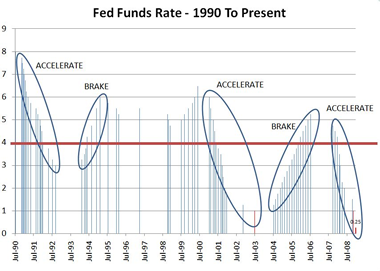
Go back to 1999-2000 and see what the Fed did. They are following the same pattern for 2005-06. If it ain't broke, the Fed will fix it... and good!
August 29, 2006 The Federal Reserve always acts on old information... and is the only cause of U.S. recessions.
December 5, 2006 Last spring I wrote about what I saw to be a sharp downturn in the economy in the "rustbelt" states, particularly Michigan.
March 28, 2007
The Federal Reserve sees no need to cut interest rates in the light of adverse recent economic data, Ben Bernanke said on Wednesday.
The Fed chairman said ”to date, the incoming data have supported the view that the current stance of policy is likely to foster sustainable economic growth and a gradual ebbing in core inflation”.

July 21, 2007 My guess is that if there is an interest rate change, a cut is more likely than an increase. The key variables to be watching at this point are real estate prices and the inventory of unsold homes.
August 11, 2007 I suspect that within 6 months the Federal Reserve will be forced to lower interest rates before housing becomes a black hole.
September 11, 2007 It only means that the overall process has flaws guaranteeing it will be slow in responding to changes in the economy... and tend to over-react as a result.
September 18, 2007 I think a 4% rate is really what is needed to turn the economy back on the right course. The rate may not get there, but more cuts will be needed with employment rates down and foreclosure rates up.
October 25, 2007 How long will it be before I will be able to write: "The Federal Reserve lowered its lending rate to 4% in response to the collapse of the U.S. housing market and massive numbers of foreclosures that threaten the banking and mortgage sectors."
November 28, 2007 FED VICE CHAIRMAN DONALD KOHN
"Should the elevated turbulence persist, it would increase the possibility of further tightening in financial conditions for households and businesses," he said.

"Uncertainties about the economic outlook are unusually high right now," he said. "These uncertainties require flexible and pragmatic policymaking -- nimble is the adjective I used a few weeks ago."
http://www.reuters.com/

December 11, 2007 Somehow the Fed misses the obvious.
fed_rate_moves_425_small.gif
[Image from: CNNMoney.com]
December 13, 2007 [from The Christian Science Monitor]
"The odds of a recession are now above 50 percent," says Mark Zandi, chief economist at Moody's Economy.com. "We are right on the edge of a recession in part because of the Fed's reluctance to reduce interest rates more aggressively." [see my comments of September 11]
January 7, 2008 The real problem now is that consumers can't rescue the economy and manufacturing, which is already weakening, will continue to weaken. We've gutted the forces that could avoid a downturn. The question is not whether there will be a recession, but can it be dampened sufficiently so that it is very short.
January 11, 2008 This is death by a thousand cuts.
January 13, 2008 [N.Y. Times]
“The question is not whether we will have a recession, but how deep and prolonged it will be,” said David Rosenberg, the chief North American economist at Merrill Lynch. “Even if the Fed’s moves are going to work, it will not show up until the later part of 2008 or 2009.
January 17, 2008 A few days ago, Anna Schwartz, nonagenarian economist, implicated the Federal Reserve as the cause of the present lending crisis [from the Telegraph - UK]:
The high priestess of US monetarism - a revered figure at the Fed - says the central bank is itself the chief cause of the credit bubble, and now seems stunned as the consequences of its own actions engulf the financial system. "The new group at the Fed is not equal to the problem that faces it," she says, daring to utter a thought that fellow critics mostly utter sotto voce.
January 22, 2008 The cut has become infected and a limb is in danger. Ben Bernanke is panicking and the Fed has its emergency triage team cutting rates... this time by 3/4%. ...

What should the Federal Reserve do now? Step back... and don't be so anxious to raise rates at the first sign of economic improvement.
Individuals and businesses need stability in their financial cost structures so that they can plan effectively and keep their ships afloat. Wildly fluctuating rates... regardless of what the absolute levels are... create problems. Either too much spending or too much fear. It's just not that difficult to comprehend. Why has it been so difficult for the Fed?

About Me

My photo
Michigan, United States
Air Force (SAC) captain 1968-72. Retired after 35 years of business and logistical planning, including running a small business. Two sons with advanced degrees; one with a business and pre-law degree. Beautiful wife who has put up with me for 4 decades. Education: B.A. (Sociology major; minors in philosopy, English literature, and German) M.S. Operations Management (like a mixture of an MBA with logistical planning)