READ ABOUT DETROIT AND SOLUTIONS TO ITS PROBLEMS. CLICK HERE.

Thursday, November 18, 2004

Politics: Free Will

This is not about a whale.

Philosophers have debated whether man has "free will" for centuries... millennia. We will not cover all of the possibilities here... there is just too much speculation.

Let's go to a more practical level... one of choices. If free will means freedom to choose, then we all have it... assuming that there isn't some grand "puppet master" who is fooling us into thinking that what choose is really what we choose.

But choice alone isn't really enough. We can choose to live forever or float unaided from mountain tops... but the reality of our condition makes those choices meaningless... or at least the limits the effectiveness of our choices.

Let's go back to yesterday's post. When the young marine shot the wounded Iraqi insurgent who had suddenly moved when the marines in the room presumed the men on the floor were all dead... how much free will did he have? Of course, he could have chosen not to shoot... or could he?

What choices were "free will" choices for this young marine? Well, apparently, he chose to join the marines without coercion. So let's mark up one for free will. Perhaps he was given a choice of specialties within the marines, so let's mark up one for limited free will... he couldn't choose anything... only those specialties for which he was "qualified" (e.g., he didn't qualify for aviator).

From that point on, we was assigned to his unit and to his duty station. He was assigned to combat duty in Iraq. He was ordered into combat duty in Falluja. He was ordered into house-to-house combat with his buddies. He was trained to protect himself and his buddies... and to kill any enemy that threatened him or his buddies. He was made aware of the tactics used by the enemy... which included suicide bombing and booby-trapping dead bodies.

So, when the young marine entered the room where he shot the Iraqi insurgent/terrorist, his only choice was to shoot the man who suddenly moved among the dead bodies or put his life and the life of his buddies in jeopardy.

Therefore, the question is: did this young marine have a choice based on free will... or did he have no real choice at all? My guess is those who have never been faced with such a situation will say, "We always have a choice."

Do we?

Wednesday, November 17, 2004

Politics: What was Queensbury thinking?

The Queensbury Rules. You know... civilized fighting.

The U.S. Miltary Queensbury Rules.

Islamist Extremist Queensbury Rules.

The wounded enemy combatant who was killed by a Marine has raised an uproar over whether he violated the "rules of war".

  • The marine had been wounded in the face the previous day and returned to combat
  • Other marines had been killed by "booby-trapped" bodies that were detonated as the marines checked them
  • The wounded Iraqi appeared to be feigning death and when he moved the soldier reacted
Given an enemy that has shown no regard for any human life and who has no regard for any "rules of war"... and the fact that the marines have been faced with the most life-threatening combat environment... why it only seems "fair" that he face severe punishment for his actions.

After all, you, as an 18 or 20-year old, would have handled the situation much differently... like hell.

Tuesday, November 16, 2004

Education Failure: Halo-2

Wow, all of the talk... all of the excitement... it's here!

Halo-2, of course.

Hold on a minute! What about Halo-1???
No, no, no... just Halo.
Is this about angels? Another religious story?
Hardly!
What then.
It's all about a mind-numbing video game that has one objective: kill the enemy before you are killed.

And it goes on, and on, and on....

I got my first taste while visiting my son at college last week. One of his roommates was playing on this large screen TV. It seemed like forever... blam, blam, blam, blam, blam... damn, got killed... blam, blam, blam, blam.

I presumed this was in lieu of getting drunk or partying, so possibly it was probably a good thing.

I remember how fascinating it was to play those first crude video games on those really slow computers. You got caught up trying to win.

Now these games are getting scarily real... 3D perspectives, surround sound, multiple live players, gigabytes of possibilities. It's all entertainment. So why do I get troubled by it? The kids eventually walk away from it and focus on something else.

It's just that I think about the time invested (a lot) and the return on the investment (not much). College goes by quickly and, for most of us, it is a one-time chance. It seems... sad... to waste time on Halo-2 or the like.

But the kids get it... when they become seniors.

Monday, November 15, 2004

Politics: Same Planet... Different World

Yesterday, I posted a link to a story about a girl who was "married" off at the age of nine by her family to a middle-aged ex-Taliban pervert who abused her mercilessly... yet he was supported and defended by the Islamic-fundamentalist "Supreme Court".

In the U.S., he would have been sent to prison and introduced to some very large, mean, gentlemen who would have "instructed" him on the error of his ways.

--------------------------

This planet is home to different worlds... different realities... than most of us in America can accept as rational... yet their existence and continuation confront our senses and sensibilities daily:

  • In Iraq and Palestine, the territorial imperative is in full play.
  • In India, Brazil, Europe, Africa and elsewhere, slavery ... labor and sexual... continues unabated.
  • Dictators rule their countries more wickedly than foreign occupiers and threaten the world with nuclear insanity.
The list seems endless... and may well be. Meanwhile, we concern ourselves with whether or not the President has a "mandate" or not.

Perhaps it is time for us to remember that our world is really not that bad... given the other worlds we might live in.


Sunday, November 14, 2004

Politics: Tradition !!!

From The Fiddler on the Roof...

TEVYE & PAPAS

Who, day and night, must scramble for a living,
Feed a wife and children, say his daily prayers?
And who has the right, as master of the house,
To have the final word at home?

The Papa, the Papa! Tradition.
TSEITEL
Matchmaker, matchmaker, plan me no plans.
I'm in no rush. maybe I've learned
Playing with matches a girl can get burned.
So bring me no ring, groom me no groom,
Find me no find, catch me no catch.
Unless he's a matchless match!

MOTHERS AND FATHERS
May the Lord protect and defend you.
May the Lord preserve you from pain.
Favor them, Oh Lord, with happiness and peace.
Oh, hear our Sabbath prayer. Amen.
So many of us enjoyed the story of the fiddler on the roof and how love and tradition enriched the poor Jewish family.

Isn't tradition wonderful?!!!

MAYBE NOT! CLICK HERE

Saturday, November 13, 2004

General Knowledge: U.S. Warns Suriname... China Faces Uprising In Guyana

Geography was one of those courses that we used to have as part of the grade school curriculum. Today, we seem to have gotten away from the study of geography. Television and the Internet have transported us to "places of interest".

Oh, sure, we have this world map in our minds when we read about the war in Iraq, or China and India becoming economic powerhouses, the French fighting in the Ivory Coast. But we don't really concern ourselves with the way geography impacts our perception of the world.

The U.S. is a big place... all 48 states... plus Alaska and Hawaii. Oops, a little geographic displacement of our political reality.

How often does South America come up in the news? Strangely, South America (population 1/3 billion) is more isolated from the North American world view than Australia (population 20 million). How many people do you know that have talked about or actually gone to Australia versus, say, Argentina? Or even Guyana? Do you know where Guyana is? South America has been called the "Hollow Continent" because of its vast, unpopulated interior. It is a continent of such extremely diverse cultural backgrounds and extreme geography that it is little more than "islands" of human development sharing a landmass.

Geography... the Andes Mountains and the great Amazon basin... combined with too much language and cultural diversity... and a really, really bad legacy the Spanish left... has prevented South America from political and economic growth. Geography... South America and Africa are geographic "twins" in the sense that both have a vast interior barrier to human migration or commerce (and may have been parts of one continent). But, whereas Africa's interior barrier... the Sahara... separates the northern edge from the vast central and southern portion, South America is, indeed, like a hollow ball of human settlement... development and growth must come along the edges.

If the Appalachian Mountains had been more like the Rockies, the U.S. might not have become the U.S. But they aren't and we are.

Interestingly, the geography of South America, while keeping it an economic and political backwater, provides a certain "protection" for its inhabitants. Despite the 1/3 billion people in South America...the rest of the world is mostly not interested in that continent... except for some exports... oil, cocaine, food, lumber. There's not much in the way of warfare... and what there is cannot be considered too significant. There is plenty of food and room to grow without a lot of interference. It is the same situation that allowed unique plants and animals to thrive for millions of years while the rest of the world underwent massive ecological and evolutionary changes.

Perhaps South America, because of its geographic and political isolation, may someday become the last bastion for mankind... but for now it is an interesting curiosity for the rest of the world.

And, no, the headline is not true.

Want to get some interesting facts about the world? Try this link.

"Anonymous" writes

Here's one way to deal reduce the number of medical malpractice without any legislation at all....

http://www.boston.com/news/nation/articles/2004/11/12/apology_a_tool_to_avoid_malpractice_suits/

My response:

In a world where "I'm sorry for your loss" or "I'm sorry things didn't work out as well as we hoped" is then treated as an admission of wrong-doing, it is difficult to say those words.

But, yes, an apology for causing harm is a desirable approach... but it should be one that does not lead to worse consequences for the person making the apology than withholding the apology would do.

Friday, November 12, 2004

Life or death at the extremes

Sometimes you read or hear things that just don't ring true... you do a double-take and then laugh and then shake your head.

Take the trial of Coral Watts who has gone on the record as killing over a dozen women. He is about to be released by the State of Texas because he was granted immunity for the killings in return for showing where the bodies were and consequently was sent to jail only for burglary... where he was a "model" prisoner and is about to get out early for "good behavior".

The Detroit News columnist, Laura Berman, wrote that:

Judge Kuhn has ruled that Watts' confessions could be allowed as evidence, although the jury could not consider them to be proof that he's a "bad man".... [I think that's the part where you do a double-take and laugh... unless you are a juror]

One witness. Lost files. Musty recollections. No DNA. A scheme of random kills. That evidence, and all those suffering faces -- living and dead -- haunting you in the courtroom. In 2F, the law requires a fair trial, proof beyond a reasonable doubt.

And you, the juror, will have to decide if you care.

It's one of those situations... double-take, laugh, shake your head. Life doesn't always make sense on the extremes. This is a case where everyone knows a man is a serial killer... he admitted it. But the law that is supposed to protect the innocent from self-incrimination is turned upside down to allow a self-admitted killer to be protected from the law.

It really all boiled down to the requirement to prove this guy's guilt. Michigan couldn't do it before he went to Texas and neither could Texas when he killed women there... so Texas struck a deal to get him off the streets... 60 years for burglary. But the guy was smart. Once the deal was struck, he was immune from prosecution for murder. He became the model prisoner and ... imagine that ... the system that failed to prove he was guilty of the crimes he committed has now been played again ... time off for "good behavior".

Irony of all ironies.

Michigan is trying to convict him for the one murder the prosecutors think they can tie him to here, but the evidence is sketchy. Sure the jurors know about his confessions in Texas... but that is irrelevant to the law... in Michigan.

So Laura Berman asks the question that is probably on the mind of all the jurors...
If the law is this screwed up... should I care what the law says or just do what is right?
I think Coral Watts is about to play the law for the third time. I wouldn't be surprised if he is released... nor surprised if he has a bad accident shortly thereafter... and no one will care.

Life doesn't always make sense at the extremes... but it might.

Thursday, November 11, 2004

Politics: Harold Ford, Jr.

I had a brief conversation with my sister-in-law who is... well... right of center politically... but pretty well centered regarding people.

After some post-mortem discussion about the election, we drifted into the area of who did we like among the politicians. Amazingly (to me), we both agreed that we were impressed with Harold Ford, Jr., a young congressman from Tennessee. I thought about that for awhile after our conversation had ended. I really didn't know much about him except that he was from a fairly liberal, Democrat district and more or less "inherited" the position from his father.

But every time I have listened to him speak, I have never gotten the impression that he had a "liberal" Democrat agenda ala Ted Kennedy or Michael Dukakis or that ilk. There is something that separates Harold Ford, Jr. from many of the other politicians.

He certainly has had a stellar education... attending St. Albans Prep School in Washington, D.C., the University of Pennsylvania majoring in history, and then the University of Michigan Law School. There is a fairly good article about him at this link.

I think that what is appealing about Harold Ford, Jr. is:

  • his independence from a strict party line approach... he has an independent streak in him
  • his willingness to listen and discuss issues rather than simply drive a stake in the ground and not budge from that position.
He seems to represent a more reasonable... reasoning... approach to politics than most of us witnessed in the presidential election... from either party.

He is young, so time will either bear witness to this observation or refute it... but he seems to have a bright future. He seems to have taken to heart the phrase: "To whom much is given, much shall be required...." That's a slight paraphasing of Luke 12:48 and a statement used by President John F. Kennedy.

If Harold Ford, Jr. has taken that to heart, there may be a day when you will have a chance to give him your vote.

Wednesday, November 10, 2004

Excessive Litigation

The last of the five major concerns to be covered from "My Mandates" is excessive litigation.

The law is the fundamental strength of this country. In theory, it doesn't matter if you are an auto mechanic from Peoria or a corporate executive in Philadelphia... the laws are blind to personal circumstance. Of course, the ability to pay for legal counsel differs among our population... but the law is, technically, neutral.

Why then the great concern about excessive litigation? The U.S. government has had formal hearings to discuss the impact of perceived excessive litigation. Everything from fishing to education to medical malpractice to nearly anything and everything.

Nevertheless, "nothing is ever as simple as it first seems." Professor Deborah L. Rhode is the Ernest W. McFarland Professor of Law and Director of the Stanford Center on Ethics at Stanford University.

The real problems with the litigation system, Rhode suggested, involve its expense, inefficiency and the inconsistency of results. Few victims file successful claims, those with the most serious injuries receive too little and, all too often, lawyers are overcompensated. Citing class action cases, where class members’ injuries are often minimal yet settlements are expedient, Rhode noted that, “the real parties in interest are the lawyers.”
Roughly translated, that means "it's not the lawsuits, it's the suits filled with lawyers."

In Henry VI, Shakespeare wrote, "The first thing we do, let's kill all the lawyers." As pointed out by many,
The accolade is spoken by Dick the Butcher, a follower of anarchist Jack Cade, whom Shakespeare depicts as "the head of an army of rabble and a demagogue pandering to the ignorant," who sought to overthrow the government. Shakespeare's acknowledgment that the first thing any potential tyrant must do to eliminate freedom is to "kill all the lawyers" is, indeed, a classic and well-deserved compliment to our distinguished profession.
Is excessive litigation a problem? It appears the answer is both "yes" and "no". It is not a problem in the sense that legitimate litigation redresses wrongs. What appears to be excessive is the incentive to sue on the part of some lawyers. Contingency fees have become the center of focus for those who believe that certain lawyers thrive on filing individual and class-action suits designed to exploit the propensity of some juries to award "damages" for unsubstantiated "injuries". Vice-presidential candidate John Edwards was often accused of that very strategy during the course of the recent election campaign.

Yet, the American Bar Association vigorously defends continginency fees and argues that it is a needed and noble practice where the lawyer assumes the expense risk for a client who is unable to afford the cost of litigation... in return for a share of the award, if any... and limiting or eliminating such fees would actually do more harm than good.

The ABA doesn't represent the thinking of all legal experts;
Jeffrey O'Connell cowrote an article in the March 15 National Law Journal arguing for a proposal that would limit excessive contingency fees, saying "The proposal would create an incentive for settlement offers that would net claimants what they would receive under the current system, or even more, while saving defense litigation costs. Some critics charge that the proposed rule will create situations that benefit everyone except the lawyers. Just so: The reform is designed to benefit injured parties and American consumers."
The strength of our nation is that we are a nation of laws. The weakness that many perceive is that we are not a nation of ethical behavior... which is, perhaps, why we perceive that legal behavior is not always the most desirable behavior.

Our nation needs lawyers and courts to protect its citizens from the unethical behavior of other citizens, corporations, and the government itself. What may be needed is enforcement of laws that protect other citizens, corporations and the government itself from unethical behavior (not necssarily as defined by the ABA) of some of its citizens... which may include lawyers who target certain industries or professions, not because of inferior products or services, but because they can and because it rewards them well.
Side note: I have one son who is an engineering consultant for a firm that evaluates products involved in lawsuits to determine if injury is caused by faulty product design, insufficient instructions for use, or poor warning labels... or faulty product users. I have another son who plans to become a lawyer. They are both highly ethical people. Our society needs both for its protection.


Tuesday, November 09, 2004

Education Failure: No Child Left Behind - Part 2

A survey by the Washington Post seems to say that most Black and Latino children do care, but simply respond to teachers differently than Whites or Asians.... They don't like to be told what to do... they want to be gently encouraged to learn???

The problem is that other studies show just the opposite.

There is a change occurring in the attitude toward education that is of fairly recent origin. Instead of valuing educational achievement, African Americans, especially a younger generation of African American adults, increasingly see education as a dead end pursuit, irrelevant to their life chances and daily concerns. This rejection of educational achievement has been documented in studies of black learners (Fordham & Ogbu, 1986; Ogbu, 1988, 2003; Solomon, 1992). This research has focused primarily on high school youth.
That's stereotyping! Yes, but even some of those who are stereotyped recognize that attitude toward education is a critical component of educational success.

Yet, even top experts are just not sure why gaps in educational achievement exist... only that they do... and something must be done about it.

Perhaps it is time to take a new look at school districts that are "failing" the no child left behind concept. Perhaps it is time to address the root cause of failure... the reason more fundamental than money that leads to really bad statistics. Perhaps it is time to address the way the "education system" responds to people who just don't care or who have no faith in education to make their lives better.

I know
... it is their right to be irresponsible
... it is their right to chose poorly
... it is their right to reject the education ethic
... it is their right to pursue sex and a flashy exterior instead of substance
... it is their right to bring children into this world while they are children themselves.
... it is their right to neglect their responsibility for their children's educational advancement
... go back to the top of this list for the next generation.

But then, I guess it is my right to not be too concerned about their future... except that it is likely that they will end up being a burden... one way or another... to all of us.

Perhaps it is time for the rest of us to question those "rights". Perhaps it is time to address the problems differently rather than simply seeing more money as the solution... money is only part of the solution. Perhaps it is time for:
  • having pay for performance for administrators... rather than pay for failure
  • limiting the percentage of funding for administration versus instruction and facility expenses
  • integrating social services into the school process
  • involving universities and businesses in the education process... not just "advising" school administration or providing cash donations
  • developing a "peace corp" program approach for failing districts
  • "nagging" parents into becoming involved... including visits by social services and the "benevolent association of police officers"
  • creating "boot camp schools" for students who are disruptive or just won't try
  • involving newspapers and broadcasting media in creative ways
Pick one... pick all... pick something.

The law that allows children to leave school before they are 18 or receive a high school diploma is archaic and irresponsible. The graduation rate should be 100% from either high school, trade school or reform school. Cruising the streets should not be an option.

But what about children who come from abusive families or families that cannot afford to support them through high school? Handle those as exceptions. Get social services involved. The world is not perfect, but the present situation in Detroit and similar school districts is so far from perfect that it is time to start chipping away at the 56% who fail to graduate... for one reason or another.

Monday, November 08, 2004

Education Failure: No Child Left Behind - Part 1

The fourth of my "mandates" is education.

It is so easy to blame the schools for children failing to become students. Oh, we automatically classify every child who attends a school as a "student", but that's stretching reality a bit.

A rather horrible statistic was published in the last few days: 44% of Detroit, Michigan children graduate from high school (some official argue that the number should be in the low 50% range). That versus 85% statewide (check out the graphs).

That must be related to money. Well... no. Livonia, Michigan received $8,142 per pupil; Wayne County (average) receives $9,140; Detroit receives $9,861 (2002 Michigan Department of Education). Yet Livonia graduates over 87% of their children. The argument is that Detroit doesn't get to spend its money on education... it administers it to other costs... so the children don't receive as much as they should. Okay... and Detroit has a school board voted in by Detroit residents... so the problem must be with Livonia... the Livonia parents are involved and willing to spend time and money supporting their children and the schools... totally uncool.

But let's get beyond money, because the graduation rate is not directly correlated to money spent on the school system... as much as those who keep asking for more want us to believe.

Detroit is an example of what ails education in large cities:

  • Large sums of money... local, state, and federal... are poured into an enormous bureaucracy that is top-heavy with political appointees and very well paid administrators.
  • Unions have a stranglehold on both the school maintenance and education processes.
  • The districts are so large that logistics become the central issue rather than education.
  • There is little or no communication between the top administrators of the school district and the parents... not assigning fault here because communication requires effort from both parties and too may people with offspring are not inclined to be parents.
But what may be the biggest issue facing school districts like Detroit is the dysfunctional sub-culture... a dysfunctional attitude toward education of both the parents and the children who are served by that district.
"You can't assign all the blame to the schools. It's that these kids don't see education paying off. They don't see it worthwhile to stick around, obviously," said David Plank (click on EPC Staff Members), codirector of the Education Policy Center at Michigan State University.
That's worth repeating... They don't see it worthwhile to stick around.... I suggest you read my October 19 posting if you have not already done so.

Tomorrow... what can we do?

Sunday, November 07, 2004

Environmental Extremism: The French Are Correct

Arrghh! The French???

First let's narrow the subject a bit... I want to address the issue of environmental extremism and the impact on our economy and the environment.

On October 23, I wrote about fear and how it prevents us from making rational decisions. I pointed out that the fear of another Chernobyl disaster is used to convince people that nuclear power is not a viable alternative to generate electricity. And I also pointed out that the very same environmental "protectors" find excuses to avoid having large-scale wind turbines installed near them (too unsightly?).

The French now supply nearly 80% of their electricity needs from nuclear power. Omighad! Those dumb French... don't they know that they will destroy Europe with radiation poisoning or fallout from the meltdown? Well, actually, they don't know that at all. In fact, they know the exact opposite... that modern technology and design makes nuclear power virtually the safest source of energy.

For those who think that nuclear power plants are inherently dangerous, I would like to point out that the U.S. or France has never used Chernobyl-based designs. Modern nuclear plant designs are inherently safe.

Well, what about the waste? The environmentalists want us to believe that burial of wastes in hundreds... thousands... of feet of rock leaves us in danger. Sorry, that's simply not true (147 page pdf file from the Nuclear Regulatory Commission - Risk Insights Baseline Report - April, 2004). Now there are those who say that the Yucca Mountain nuclear burial site cannot guarantee, absolutely, 100%, that no radiation will escape into the biosphere. That's correct. There are no absolute guarantees of anything. The question is: does the very minimal risk of a minimal amount of radiation in the atmosphere sometime in the next 10,000 years outweigh the risks of continuing to burn fossil fuels at an increasing rate over the next century?

Besides, future alternatives (my speculation) may well include disposal by rocket directly to the sun where it will be incinerated... absorbed, if you will by the large nuclear furnace of the sun.

BUT WHY NUCLEAR POWER???

  1. Nuclear power is safe, reliable and readily available
  2. Nuclear power can free us from dependency on oil or other polluting sources of energy
  3. Nuclear power is a viable technology for growth, whereas wind and solar power are too conditional... the right weather conditions are needed for them to be effective... and they require a storage medium... batteries... to make sure that the power does not constantly spike and then fade.
But the biggest reason for nuclear power is that it would enable alternative fuel technologies... such as hydrogen powered vehicles... to make sense. If you read the link on my November 4 posting regarding Environmental Extremism, you understand that hydrogen is a storage medium for energy, not an energy source. Nuclear energy... fossil-free energy... makes perfect sense and is perfectly capable of allowing us to create fossil-free fuel.

Nuclear energy provides a clean, reliable source of electricity needed to convert chemically combined hydrogen... such as di-hydrogen monoxide... water... into hydrogen gas which could be our fuel of the future.

So, organizations like Greenpeace are doing a significant disservice to our environment by opposing the expansion of nuclear energy and, ultimately, the replacement of fossil fuels by clean, environmental-friendly sources of power. Their basic argument is that while there isn't any official information about nuclear contamination, it is everywhere and there are massive cover-ups by government and industry so that we don't learn that we are being poisoned and getting cancer... nonsense... from these nuclear facilities... fear, fear, fear.

Oh, one other minor benefit. Nuclear power could utimately break the economic dependency of the U.S. on OPEC... not a bad side-effect.

The stupid, effete French are correct... and we should follow their lead.

Saturday, November 06, 2004

"Mozza" asks:

If there is irrationality in the world, that doesn't mean that we have to be irrational to deal with it. Who do you trust as a psychiatrist? A doctor or a maniac?
Your statement is without context... responding to "irrationality" depends on the nature of that irrationality. The harmless irrationality of one who converses with animals is quite different from the irrationality of one who seeks to destroy others because he believes it is the way of "truth" or the will of his diety (peace being when all who do not share his belief system are dead).

So, Mozza, your question is only valid if the irrational one is "treatable". The irrationality of the zealot, the defender of "truth", the one who believes innocents who do not share his beliefs must die... that is not treatable with psychiatry. That is treatable by sending the irrational one to meet the source of his "truth". If you think otherwise, state your "rational cure".

Excessive Spending: Spending... Too Much?

Another domestic issue I raised after the election was Excessive Spending.

I recently wrote the following to an economist at George Mason University:

It is obvious... or should be... that the U.S. has been the economic engine of the world. What is less obvious is the relationship of borrowing to economic health. At an individual level, borrowing can provide both opportunity and risk. It all depends on the ability of the individual to leverage the borrowed money to make even more money: that's growth. That's a win-win for the lender and the borrower. If not, it is a lose-lose.

What begins to get clouded in my mind is the relationship of borrowing and economic health at a national or international level. The nature of borrowing is less defined to me. The national debt is pretty easy for most of us to understand... the government is spending more than it is receiving through taxes, so it borrows money (bonds, notes) to cover the shortfall. Our faith is that somehow the government will find a way to pay the interest on the bonds and still have enough left to handle the business of government. Some of us get concerned when
the debt level seems a bit excessive.... $7,429,582,471,118.88 http://www.publicdebt.treas.gov/opd/opdpenny.htm

That's about $25,000 for every person in the U.S. I guess that's manageable, but I hope it doesn't come due soon.

The other statistic that we all hear about, but have difficulty with the implications is the Trade Deficit
http://www.census.gov/foreign-trade/statistics/historical/goods.pdf

A net annual negative of $0.5 trillion and growing just does not seem to be healthy borrowing to me. I think that others share some of my concern.

It appears that we are presently borrowing heavily to sustain a consumer-based economy with artificially low prices. Many corporations and individuals are benefitting from this at present, but perhaps not as much as we might like to believe.

The questions is: who pays the piper... and when? How?
Technically speaking a trade deficit is not borrowing. Money is exchanged for goods. And in the past, there has been an inverse correlation of the trade deficit to unemployment... mainly because as unemployment rose, demand fell and imports fell. Perhaps my concerns are unfounded, but during this last recession, as unemployment rates increased... so did the trade deficit.

Now, quite honestly, I do not have the breakdown of how much of the deficit was related to oil and how much to other imports. What concerns me is that in exchange for U.S. cash, we are consuming increasing amounts of foreign products, employment is only slowly rising and the economy is not exactly steaming ahead.

But more than that is the issue of what is happening with that cash. A large amount goes into "safe haven" securities... foreigner are purchasing U.S. government bonds. Some of it is used by the producers of imported products to become even more competitive against domestic producers. Some of it is used to establish manufacturing or distribution footholds within the U.S. ... something that helps employment and the economy.

Perhaps it is unfair to lump the national debt and trade deficits together as "borrowing", but the trade deficit does one thing that leaves me just a little paranoid... especially at 1/2 trillion dollars per year... and that is the issue of control. Somewhere in the equation of getting goods for cash is the part that says Cash = Control. Cash becomes the power to influence, the power to compete, and the power to control.

So maybe it isn't totally unreasonable to think that great debt and exchanging goods for control might not be a great long-term strategy. It hasn't hurt so far... but we now have a total national debt of $25,000 per person and an annual trade deficit of about $1,700 per person... every man, woman and child.

Somewhere, it seems, there must be a piper.

Friday, November 05, 2004

Ethnic Divisiveness: Ethnically Challenged

Yesterday, I listed some domestic issues needing significant attention.

First was ethnic divisiveness. There have been some dramactic changes in the U.S. population pattern... especially with the significant increase in the Hispanic population. The Census Bureau prepared a presentation that is most enlightening regarding the statistics about the Hispanic population. Most disturbing are two elements:

  • Significantly fewer are becoming U.S. citizens (before 1970 nearly 75 percent; between 1990-2000 less than 7 percent... a tenfold decline)
  • Significantly fewer have high school educations than the rest of the U.S. population
The overall Hispanic population is concentrated in metropolitan areas with nearly half in central cities.

This pattern is repeated with other ethnic groups such as Arabs.

Now, one might argue that such concentration is normal; immigrants cluster in order to provide social and economic support. That's true. And it is also true that immigrants maintained such social and economic ties for many decades.

What is different
now is that there are pressures to accomodate the "uniqueness" of these groups... especially in the area of language and culture. Local and state governments have been burdened with bi-lingual demands especially in the area of education.

Cultural issues also impact government administration and community relations.

Rather than immigrants attempting to adopt the historic U.S. culture, they are attempting to force the U.S. to officially recognize their homeland cultures in law and policy. This trend can only lead to further fragmentation and divisiveness between the various "cultural" groups... and further fragment the U.S. politically.

There is a fine line between diversity and divisiveness. It is not always apparent when the line has been crossed. The U.S. has always welcomed all people and it is a strength of our nation. Immigrants have always accepted their responsibility to improve themselves and become part of the greater blending. We all benefit from the cultural richness added to the "American stew" when it is not forced upon the rest of us and when we are not forced to provide special support or accomodations for the newcomers.

This should always remain the "land of opportunity" for those who wish to live here. We only ask that they join us... not just co-exist... no matter how many or how long they have been here.

The alternative is political fragmentation, increased pandering to special interests, and cultural animosity.

Thursday, November 04, 2004

My Mandates

Yesterday, I covered what I believe to be the greatest threat to world peace: radical Islamists.

Today, I simply want to list some domestic issues that are long term concerns.

  • Ethnic Divisiveness - the positive spin is "diversity", but the U.S. is not "absorbing" ethnic populations as in the past. Rather ethnic groups are seeking to carve out local and national political power based on being "unique"... unique goals, unique needs. This ethnic "diversity" becomes ethnic divisiveness as one "unique" group attempts to gain advantage over other "unique" groups. National goals and needs are secondary to these groups.

  • Education - schools are blamed for the poor performance of students and their parents' lack of interest or involvement. The role of dysfunctional sub-cultures is not being addressed. Universities do not accept an obligation... moral, social, ethical... to help address the root causes of poor performance in elementary and high schools. Universities find it easier to seek government funded programs as the solution to poorly prepared individuals or non-competitve groups than provide guidance and expertise,

  • Excessive Litigation - law is the underpinning of our land, but lawsuits are undermining our society. Real grievences are lost in the blizzard of "snow jobs"... lawsuits with little or no merit enabled by technicalities and sustained by an attitude of "paying back the big guys". The societal costs for insurance, medical care, products and personal protection are outrageously affected by the litigious purveyors.

  • Environmental Extremism - most forms of extremism are dangerous, costly, and generally ill-advised. But environmental extremism is most often counter-productive. By using fear as the primary weapon, legimate concerns about protecting the environment create convoluted actions and responses to the restrictions imposed. False science, such as the "hydrogen energy" efforts divert us from real, responsible approaches to protecting the environment while providing for the needs and growth of society [hint: hydrogen is a "storage medium" for energy... but to create hydrogen gas, large amounts of energy in the form of electricity... from oil, coal, nuclear material... must be expended].

  • Excessive Spending - as a society, we are "borrowing addicts". We spend personally and societally as if there is always going to be "some way" to "balance the books". Our present inability to balance the books leaves us collectively as a nation and individually in financial peril. Most of us are aware of the "budget deficit" and believe "something" should be done about it. Fewer of us are bothered by the overwhelming imbalance of trade... our trade deficit... that continues to grow. We are a debtor nation increasingly in debt to nations that are becoming our chief economic competitors... a dangerous situation.

We have just endured a year of political mayhem. I suspect that most of us are drained of much of our political energy... not because we have lost interest, but because we have been faced with choices that are too polarized. Most of us feel comfortable in more "centered" positions than our politicians and special interest groups take. Consequently, when we make a political choice, we end up feeling that it is a great compromise from the choice we really want... especially when it comes to the issues that affect our everyday lives and jobs.

That's why I don't feel I've given any politician a mandate... even if I have given my vote. My "mandates" are different from the choices I was given for my vote. Polarization makes for great talk shows... not necessarily great choices.

Wednesday, November 03, 2004

Politics: Islam - A Threat to World Peace

The presidential election appears to be over so we can focus on the issue that should be of greatest long-term concern.

Islam claims to be a religion of peace.

The problem with Islam appears to be Muslims.

Muslims are concentrated in North and Central Africa, the Middle East, Central Asia, and the Asian-Pacific Islands. Most of the world's present trouble spots are related to Muslim interaction with non-Muslims. In fact, it is almost impossible to read a major newspaper without finding at least one story related to Muslim violence... somewhere in the world other than Iraq.

There is a basic, underlying tenet of Islam that the duty of Muslims is to "bring" Islam to the non-believers. Unfortunately, bringing Islam becomes force when convincing doesn't work.

Certainly, this is NOT the way of life among MOST who call themselves Muslims. But there is a growing segment among Muslims who believe in "Islam by any means".

This is not rocket science or brain surgery.

Radical Islamists are a threat to world peace. Pick your place... America... Russia... China... India... Africa... the Philippines... Malaysia... and on and on. Radical Islamists are the world's new Communists... the Islamic Manifesto is the product of these extremists. And there can only be one end if they are not stopped soon: world war.

Think about it. The U.S. and Europe to the west; Russia to the north; India and China to the East... all in conflict with Islam... Muslims. Tolerance is about to end. Mark my word on this... unless Radical Islamists are contained and eliminated, there will be a major war involving the Islamic World and the rest of the world within 20 years. The trend is there. The Radical Islamists are arming themselves for the battle. They delude themselves with the belief that what they do is for the "glory of Allah". It is the Millennium's new Dark Age.

And we delude ourselves into thinking we have a "failed policy" in Iraq because these Radical Islamists resist our efforts at democracy. Of course they resist. They have no intention of sharing this world with any of us. We must resist our idealistic leaders who ask, "Can't we all just get along?" and those who chastise those of us who would dare say anything negative about Islam as "legitimate" religion.

I encourage you to click on the links in today's message as well as the following to get further insight into an unpleasant, but important subject:
It is not a time to become paranoid about Muslims; it is a time to become resolute in our OPPOSITION TO Radical Islamists.


Tuesday, November 02, 2004

Politics: Showtime

Have you thought things through?

Have you examined information with a critical eye?

Have you separated assertion from fact?

Have you learned the lessons of history?

Have you made up your mind?

Vote.

Monday, November 01, 2004

Politics: Which Way?

It's down to the wire.

There is only one focus for tomorrow: the election for President of the United States.

This has been a brutal campaign. George Bush is like a lightning rod attracting strong support or great animosity. John Kerry is more like a bowl of jello, attracting neither great support or great animosity... as judged by polls that show likely voters for Kerry are almost split between those voting for him and those voting against Bush... passions seem to slide off Kerry.

Why is this?

Let's look at Kerry first.

He has never been a person of outward passion. Even when he tries to be aroused, he leaves the impression of one who is about to put himself to sleep with his own voice. He certainly does have passion, however. His record of forty years is clearly one of animosity toward things military. He is a product of his Vietnam experience. He is also a product of those who believe it is the manifest destiny of the U.S. to leave the manifest destiny of others alone.

John Kerry is an idealist. He wants the world to be civil and reasonable and rational and kind. Therefore, he is prone to side with those who would use discussion rather than violence... who would provide aid and support rather than those who would leave it to the forces of the marketplace... who would place personal freedom above religious or moral outrage.

But he is also a man of contradiction and complexity. While disparaging the wealthy and powerful, he has become one. While arguing those with greater wealth and income should be taxed more, he is not. While stating that he would be a strong, militant leader against those who threaten us, he has voted to deny necessary resources to those who he would enlist in that effort. He has intellectual rather than personal idealism.
George Bush is not complex to understand.
He is religious and believes that there is a distinct line where individual freedom must not move past moral obligation. He tends to view the world in absolutes more than shades of grey. He supports a process of opportunity more than a process of support for individuals. He is unabashedly "America first" and will ignore world opinion if he feels he is morally right and acting in the best interests of the U.S. He is more comfortable with the entrepreneurial process than the social safety net process (although his Medicare prescription program is a decided departure from that comfort zone).

Consequently, George Bush is seen as reckless and a threat to individual and world freedom by those who do not share his religious or nationalistic views. They see him as the world bully rather than a defender of freedom and an espouser of liberty. They see corporate entanglements behind his domestic and international economic policies which leads them to see him as the enemy of the "common man".
The personal contrasts are stark. The political positions are distinct.

Where do I stand? As much as I would like to believe that it is possible to approach the present world situation in a civil, reasonable, rational and kind way, I am inclined to accept that there are forces against whom we must fight and eliminate... forces that are basically malevolent. Unfortunately, this is an overriding issue.

In an ideal world, I would choose to be civil and reasonable and rational and kind to all... despite any differences of opinion or goals. But in a world where flying airplanes into buildings is seen by some as magnifying the "glory of Allah", I recognize that a segment of the world has strong elements of the irrational.

Consequently, I will support our current president despite misgivings about other policies.

Can"t Find It?

Use the SEARCH BLOG feature at the upper left. For example, try "Global Warming".

You can also use the "LABELS" below or at the end of each post to find related posts.

Blog Archive

Cost of Gasoline - Enter Your Zipcode or Click on Map

CO2 Cap and Trade

There is always an easy solution to every human problem—neat, plausible, and wrong.
Henry Louis Mencken (1880–1956)
“The Divine Afflatus,” A Mencken Chrestomathy, chapter 25, p. 443 (1949)
... and one could add "not all human problems really are."
It was beautiful and simple, as truly great swindles are.
- O. Henry
... The Government is on course for an embarrassing showdown with the European Union, business groups and environmental charities after refusing to guarantee that billions of pounds of revenue it stands to earn from carbon-permit trading will be spent on combating climate change.
The Independent (UK)

Tracking Interest Rates

Tracking Interest Rates

FEDERAL RESERVE & HOUSING

SEARCH BLOG: FEDERAL RESERVE for full versions... or use the Blog Archive pulldown menu.

February 3, 2006
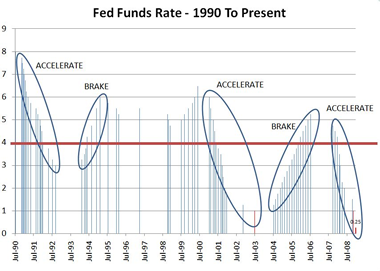
Go back to 1999-2000 and see what the Fed did. They are following the same pattern for 2005-06. If it ain't broke, the Fed will fix it... and good!
August 29, 2006 The Federal Reserve always acts on old information... and is the only cause of U.S. recessions.
December 5, 2006 Last spring I wrote about what I saw to be a sharp downturn in the economy in the "rustbelt" states, particularly Michigan.
March 28, 2007
The Federal Reserve sees no need to cut interest rates in the light of adverse recent economic data, Ben Bernanke said on Wednesday.
The Fed chairman said ”to date, the incoming data have supported the view that the current stance of policy is likely to foster sustainable economic growth and a gradual ebbing in core inflation”.

July 21, 2007 My guess is that if there is an interest rate change, a cut is more likely than an increase. The key variables to be watching at this point are real estate prices and the inventory of unsold homes.
August 11, 2007 I suspect that within 6 months the Federal Reserve will be forced to lower interest rates before housing becomes a black hole.
September 11, 2007 It only means that the overall process has flaws guaranteeing it will be slow in responding to changes in the economy... and tend to over-react as a result.
September 18, 2007 I think a 4% rate is really what is needed to turn the economy back on the right course. The rate may not get there, but more cuts will be needed with employment rates down and foreclosure rates up.
October 25, 2007 How long will it be before I will be able to write: "The Federal Reserve lowered its lending rate to 4% in response to the collapse of the U.S. housing market and massive numbers of foreclosures that threaten the banking and mortgage sectors."
November 28, 2007 FED VICE CHAIRMAN DONALD KOHN
"Should the elevated turbulence persist, it would increase the possibility of further tightening in financial conditions for households and businesses," he said.

"Uncertainties about the economic outlook are unusually high right now," he said. "These uncertainties require flexible and pragmatic policymaking -- nimble is the adjective I used a few weeks ago."
http://www.reuters.com/

December 11, 2007 Somehow the Fed misses the obvious.
fed_rate_moves_425_small.gif
[Image from: CNNMoney.com]
December 13, 2007 [from The Christian Science Monitor]
"The odds of a recession are now above 50 percent," says Mark Zandi, chief economist at Moody's Economy.com. "We are right on the edge of a recession in part because of the Fed's reluctance to reduce interest rates more aggressively." [see my comments of September 11]
January 7, 2008 The real problem now is that consumers can't rescue the economy and manufacturing, which is already weakening, will continue to weaken. We've gutted the forces that could avoid a downturn. The question is not whether there will be a recession, but can it be dampened sufficiently so that it is very short.
January 11, 2008 This is death by a thousand cuts.
January 13, 2008 [N.Y. Times]
“The question is not whether we will have a recession, but how deep and prolonged it will be,” said David Rosenberg, the chief North American economist at Merrill Lynch. “Even if the Fed’s moves are going to work, it will not show up until the later part of 2008 or 2009.”
January 17, 2008 A few days ago, Anna Schwartz, nonagenarian economist, implicated the Federal Reserve as the cause of the present lending crisis [from the Telegraph - UK]:
The high priestess of US monetarism - a revered figure at the Fed - says the central bank is itself the chief cause of the credit bubble, and now seems stunned as the consequences of its own actions engulf the financial system. "The new group at the Fed is not equal to the problem that faces it," she says, daring to utter a thought that fellow critics mostly utter sotto voce.
January 22, 2008 The cut has become infected and a limb is in danger. Ben Bernanke is panicking and the Fed has its emergency triage team cutting rates... this time by 3/4%. ...

What should the Federal Reserve do now? Step back... and don't be so anxious to raise rates at the first sign of economic improvement.
Individuals and businesses need stability in their financial cost structures so that they can plan effectively and keep their ships afloat. Wildly fluctuating rates... regardless of what the absolute levels are... create problems. Either too much spending or too much fear. It's just not that difficult to comprehend. Why has it been so difficult for the Fed?

About Me

My photo
Michigan, United States
Air Force (SAC) captain 1968-72. Retired after 35 years of business and logistical planning, including running a small business. Two sons with advanced degrees; one with a business and pre-law degree. Beautiful wife who has put up with me for 4 decades. Education: B.A. (Sociology major; minors in philosopy, English literature, and German) M.S. Operations Management (like a mixture of an MBA with logistical planning)