READ ABOUT DETROIT AND SOLUTIONS TO ITS PROBLEMS. CLICK HERE.
Showing posts sorted by relevance for query china. Sort by date Show all posts

Wednesday, September 12, 2007

Why China Subsidizes Us

SEARCH BLOG: CHINA

Along with the problems in the housing market, the latest employment statistics unnerved Wall Street on Friday. While the financial markets bounce around, the downward trend for housing and employment may continue and worsen for awhile.

Some will see an employment downturn as a result of shipping off jobs to China. Maybe; maybe not. But let's talk about trade with China and, perhaps, a Chinese hidden agenda.
Many claim that China is "subsidizing" the U.S. by selling goods to us that are far cheaper than we could produce domestically.
That may be from a purely economic perspective, but one must ask the basic question: why is China being so altruistic toward an ideological competitor?
Before we look at that, perhaps an historical perspective is helpful. This is a chart showing the major employment sectors in the U.S. over time:


[source]

The U.S. has moved from a producing [farming, manufacturing] to a consuming [services] employment economy.
One must recognize the impact of efficiency. While fewer people are employed in farming than ever before, technology has increased efficiency so dramatically that more food than ever is being produced by fewer people than ever. Likewise, manufacturing is dramatically more efficient than ever before. Simply put, fewer people are needed for manufacturing.
So the employment opportunities are focused on continued improvement of efficiency or raising the quality of life.

But that doesn't answer the question about why China is being so altruistic about "subsidizing" the U.S. with cheap goods.
First of all, China is struggling to get to the point the U.S. was in 1950-1960. An enormous portion of its 1.3 billion population is still in agriculture... "dirt poor" as it were. Increasing manufacturing is its next step to wealth. Even so, the absolute output of China's manufacturing is amazing considering where it was two decades ago.
Then is increasing the living standard of its people the reason that China is "subsidizing" the U.S.?
In order to believe that, one must believe that China has converted to a market economy from a centrally-controlled economy so that it can create opportunities for wealth for its population. Evidence indicates that may be the case... in some part. There are an increasing number of millionaires and billionaires in China.
Does that also mean that China's power elite have converted from a Marxist philosophy to a capitalist philosophy?
I'm not convinced that is the case. Capitalism and central government management of the economy are not necessarily compatible. But limited capitalism may be a tool to be employed by a power elite... especially when the labor used to power the limited capitalism is powerless to demand anything. Some might argue that China's policies might be closer to mercantilism. Regardless, rather than accumulating gold and silver, classic mercantilism, the Chinese are accumulating the world's currency... U.S. dollars. The nation is gaining wealth, but not necessarily the whole population.
What this means is that "China" is not subsidizing the U.S.. Rather it is the Chinese laborers who are subsidizing the U.S. in order to build U.S. dependency on Chinese manufacturing... in order to build wealth for the Chinese government.

But are not many Chinese citizens becoming very wealthy?
Yes, within the constrains of the government control. Party leaders also are becoming more economically powerful as the government itself raises vast amounts of U.S. currency reserves.
So, increasing wealth is the Chinese end game?
I think not. Wealth is a means to an end.
What might that end be?
Power and influence.
For example?
  • Money to buy influence among U.S. politicians
  • Money to buy influence among U.S. corporations
  • Money to obtain technology for military upgrading
  • Money to create modern military products using the technology obtained by influencing U.S. politicians and corporations
  • Money to expand its upgraded military
  • Money to provide weapons "aid" to potential allies willing to act as proxies against the U.S. and, possibly, Russia so that China becomes the dominate military influence in Asia and Africa.
I believe that the Chinese government's goal is to be the dominant nation in the world by the end of the 21st century... economically and militarily... so that it will have priority access to the rest of the world's resources.
China's government is not "communist" in that it is not a "people's government." It is a feudal government of powerful elite, wealthy families that maintain the facade of a "people's government." It's strategy is to dole out just enough of the increasing wealth to placate its population without ceding any power.
So why is China "subsidizing" the U.S.?
Perhaps they are taking some pages out of the book from this man.
Wealth is but a means to an end. The U.S. might want to ask, "The end of what?"


[click on picture to enlarge]

I know, I'm just another one of those conspiracy nuts.

..

Wednesday, March 17, 2010

China: It's Not About Economics

SEARCH BLOG: ECONOMY and POLITICS

Recently, I attended a meeting at the Westland AMVETS where Jack McHugh of the Mackinac Center for Public Policy was giving a presentation. Jack and I had not met before then although we communicated occasionally by email. I have great respect for Jack's work and opinions, but we have have one slight difference in our viewpoints: China. Jack even acknowledged that in a friendly, off-hand remark at the meeting.

Jack and I both believe in the benefits of free trade. Where we differ with regard to China is my opinion that trade with China is highly manipulated by China to the detriment of U.S. manufacturers and is done so because China's interests are strategic first and economic second.

Jack rightly points out that manufacturing has been a declining segment of the U.S. economy for decades as it regards employment. It is a function of production efficiency that fewer workers are required to produce more goods. Besides, no one wants to be a production worker... do they? In my mind, that is not the point entirely. Trading with China is unlike trade with Germany or India or Brazil.

China has a far-reaching goal in which trade is simply a tool to be used in any way that gains a strategic advantage.
The series of posts dealing with this strategic goal is summarized here, but this is the key graphic:

[click on picture to enlarge]

A few days ago, the British online paper Telegraph wrote:

U.S. President Obama shakes hands with Chinese ambassador to the  U.S. Zhou as U.S. ambassador to China Huntsman looks on during a tour of  the Great Wall of China in Badaling
US President Barack Obama shakes hands with Chinese ambassador to America Zhou Wenzhong on the Great Wall of China Photo: Reuters

China has succumbed to hubris. It has mistaken the soft diplomacy of Barack Obama for weakness, mistaken the US credit crisis for decline, and mistaken its own mercantilist bubble for ascendancy. There are echoes of Anglo-German spats before the First World War, when Wilhelmine Berlin so badly misjudged the strategic balance of power and over-played its hand.

Read full story....

China views trade as the hammer for its long-term strategic goals... and the U.S. is just another nail to be pounded. While others like Jack and the Telegraph view trade with China as primarily economic in nature, I continue to view it as a strategic struggle for power with the economic aspect as the "red herring."

Will China ultimately fail in its efforts because the "economics" of what they are doing are against them? I'm not holding my breath.

ADDENDUM:
Jack's email response:

Good stuff.

I don't disagree that with China, "the economic is the geopolitical," but I certainly wouldn't characterize the economic competition as a "red herring," and here's why: It would be just as fair to say that with China "the geopolitical is the economic." IOW, one is not the second fiddle to the other; rather they are two faces of a single holistic entity, The Middle Kingdom.

In China's view it is only right and proper that the largest country with the oldest civilization - whose people are bloody smart and endowed with a Confucian work ethic that makes everyone else including us look like slackers - should become the preeminent world economic power. Naturally, with that position comes strategic geo-political concerns, just was the case with Britain in the 19th C, and the U.S. in the 20th. Like the U.S. in the 20th C, China doesn't have imperialistic territorial aspirations beyond its periphery, but that doesn't mean it has no interest in mucking around in distant places in furtherance of its interests.

As I said in an earlier exchange, in the 20th C China was stupid and poor, but it was unrealistic to think they would stay that way forever.

The Middle Kingdom is a tough, worthy competitor in both the economic and the geo-political realm. No they don't "play fair" according to conventional western conventions. In their pursuit of economic and geopolitical preeminence they aren't inhibited by the kind of moralistic considerations that often enliven foreign policy debates in this country. One might think of them as an Asian "France" in this regard.

We can't take our marbles and go home when they behave in ways we don't like. If we raise restrictive trade barriers, that will make us poorer and less capable of competing. If we whine and beg, "Can't we all just get along," that will be correctly interpreted as weakness and opportunity.

So what can we do? Get in the game, economically and geo-politically. Sharpen up our game on both fronts. How? Cato Institute and the Mackinac Center have the domestic economic agenda for that. Organizations like the Center for Strategic and International Studies have the program on the geo-political front.

I suspect that Bruce Hall and I have no fundamental disagreements on this part.

Jack McHugh

2012 IS GETTING CLOSER

..

Sunday, July 11, 2010

China May Not Subsidize Us Much Longer

SEARCH BLOG:CHINA

As China becomes an economic giant, the world must consider the cause it is abetting.  This story from The New York Times provides a strong hint:

“This illustrates the extreme importance with which China views its access to natural resources, especially things like steel and oil,” said Joshua Rosenzweig, a Hong Kong-based official with the Dui Hua Foundation, a San Francisco group that monitors human-rights issues in China. “These are things China sees as vital to its economic growth, which in turn is vital to maintaining stability. It’s clear that resource issues are seen as national security issues.” [read more]
The government and corporations of the United States tend to view China as a growing resource and market for the United States.  There is some economic truth to that.  General Motors, a huge corporation with the government as majority owner, has just sold more vehicles in China than the United States.  That's good for General Motors and the United States government.  Is it necessarily good for the United States?

Many economists viewed the relationship of cheap imports and a potential huge market for selling our products as a win-win.  China was "subsidizing" us.  But were they?  Or does China have an agenda that is not necessarily a long-term win for the United States?  As basic and advanced engineering and production has moved from the United States to China, the core of the United States economy... its manufacturing... has be replaced by the so-called "service industry."  For those who were not around in the 1960s and 1970s, service industries were based on the wealth created by manufacturing and before that, agriculture.  Not exactly parasitic; not exactly symbiotic.

Things have changed.  Manufacturing has shriveled.  Manufacturing jobs have evaporated.  The service industry has followed because that which was being serviced is disappearing.  Now the hope is for service sectors such as health care to become the growth engine for our economy?  But who pays for this growth?  Insurance companies? Someone has to pay the premiums.  The government?  Someone has to pay the taxes... or lend the government money.  That seems to leave China... to subsidize us.  But how long will China want to "subsidize" us... or need us for their growth?

In 2007, I wrote this post [and several follow-up posts... see label CHINA] and published this image [click for larger view].

Nearly three years later, the impetus toward these goals is intensifying and becoming apparent to many more around the world.

China has become an immensely important resource and market for the United States corporations and Federal government.  U.S. consumers have benefited from cheaper goods, which is fortunate because more Americans have had to siphon funds from whatever assets they have in the absence of their formerly good paying jobs. The question is whether we can afford the next stage in China's development... the stage when the U.S. becomes an also-ran.  But the real question is whether or not the U.S. will have any say in its long-term economic future.  Our present policies and practices will determine that.

2012 IS GETTING CLOSER

..

Friday, July 24, 2009

Now We Know Why China Subsidizes Us

SEARCH BLOG: CHINA

As the U.S. continues its long economic recession and plans further self-flagellation with economy-busting CO2 regulation legislation, China and India blithely continue on their roads to prosperity.

Two years ago, I wrote a post titled "Why China Subsidizes Us" [please re-read] in response to economists who chuckled loudly that China was getting a bad deal while we were enjoying economic prosperity on their backs. The tide has rolled out.

Now the U.S. is moving toward socialism as China and India embrace their particular brands of capitalism/mercantilism. We move toward state handouts; they move toward unit efficiencies and production. We move toward binding regulations; they move toward innovation and expansion.

The Financial Times reports this:

China to deploy foreign reserves
By Jamil Anderlini in Beijing
Published: July 21 2009 19:09 | Last updated: July 21 2009 19:09

Beijing will use its foreign exchange reserves, the largest in the world, to support and accelerate overseas expansion and acquisitions by Chinese companies, Wen Jiabao, the country’s premier, said in comments published on Tuesday.
“We should hasten the implementation of our ‘going out’ strategy and combine the utilisation of foreign exchange reserves with the ‘going out’ of our enterprises,” he told Chinese diplomats late on Monday.
Mr Wen said Beijing also wanted Chinese companies to increase its share of global exports.
The “going out” strategy is a slogan for encouraging investment and acquisitions abroad, particularly by big state-owned industrial groups such as PetroChina, Chinalco, China Telecom and Bank of China.
Qu Hongbin, chief China economist at HSBC, said: “This is the first time we have heard an official articulation of this policy ... to directly support corporations to buy offshore assets.”
China’s outbound non-financial direct investment rose to $40.7bn last year from just $143m in 2002.
Mr Wen did not elaborate on how much of the $2,132bn of reserves would be channelled to Chinese enterprises but Mr Qu said this was part of a strategy to reduce its reliance on the US dollar as a reserve currency.
“This is reserve diversification in a broader sense. Instead of accumulating foreign exchange reserves and short-term financial assets, the government wants the nation to accumulate more long-term corporate real assets.”
State-owned groups, particularly in the oil and natural resources sectors, have stepped up their hunt for overseas companies and assets on sale because of the global crisis.
China Investment Corp, the $200bn sovereign wealth fund, has been buying stakes in overseas resources companies and has taken a 1.1 per cent stake in Diageo, the British distiller.
In an interview published in state-controlled media, the chairman of China Development Bank said Chinese outbound investment would accelerate but should focus on resource-rich developing economies.
“Everyone is saying we should go to the western markets to scoop up [underpriced assets],” said Chen Yuan. “I think we should not go to America’s Wall Street, but should look more to places with natural and energy resources.”
Wealth is but a means to an end. The U.S. might want to ask, "The end of what?"

..

Monday, November 19, 2007

US-China Economic and Security Review Commission Report

SEARCH BLOG: CHINA

Recently, I posted twice about China's strategy for the 21st century:

Here is further perspective. Excerpts below:

  • While speaking of subsidies and violations of free market
    principles, it is worth noting here that China is continuing
    to manipulate the value of its currency in order to gain an
    unfair export advantage. Meanwhile, China has not
    fulfilled its many promises to protect the intellectual
    property of foreign business software and entertainment
    companies from rampant piracy, just to cite two industries
    important to the U.S. economy. Nor has China reduced the
    many subsidies provided to exporting industries in China.
    As of this year, both of these issues are subjects of formal
    complaints before the World Trade Organization, a
    development that the Commission has advocated in the
    past.

  • The Commission also found that the pace of military
    modernization in China has exceeded official U.S.
    estimates. China’s defense industry is producing new
    generations of weapon systems with impressive speed and
    quality, in part because China has developed the capacity to
    integrate commercial technologies into military systems. In
    addition, industrial espionage has given Chinese companies
    an added source of new technologies.

  • The Commission found that the PLA is increasing its
    emphasis on asymmetric or disruptive warfare techniques,
    such as cyber and anti-satellite warfare. We note the
    increase in the number of computer hacking attacks
    targeting government offices in the United States and
    Europe. Also, the Chinese missile test that destroyed a
    satellite this year and laser attacks by China on U.S.
    satellites in 2006. Both of these technological efforts seem
    directed squarely at U.S. military capabilities, which rely
    on satellites and computers far more than do those of other
    nations.
Questions?

..

Tuesday, July 24, 2012

China's Active Expansionism

SEARCH BLOG: CHINA

Back in 2007, I created this graphic to explain China's long-term expansionist goal which was based on the strategy of accumulating wealth by undercutting the world's manufacturers with cheap labor to become the world's manufacturing center.  That strategy has worked superbly.

[click image to enlarge]

The latest tactic China is employing is to claim territory and vast tracts of ocean by establishing "cities".

As reported in The Telegraph:
China declares new city to assert control over South China Sea
China founded a new city yesterday more than 200 miles from the mainland, in a bid to cement control over 800,000 squares miles of the South China Sea.
Sansha is based on Yongxing Dao, or Woody Island, a petite heart-shaped island barely a mile long. It is shorter than its airport runway, which is left jutting out to sea.
China's 657th city, as classified by the country's State Council, has a floating population of a few hundred fishermen, a post office, library, bank, supermarket, and hospital and not much else. A casino is planned to drum up tourism.
But it will have a full 45 government officials to run the city, its own mayor, and a Communist party secretary, Fu Zhuang, who has spent his entire career in the People's Liberation Army, rising to become the deputy chief of the Air Defence Office of Hainan province.
It will also have a military garrison, responsible for "national defence mobilisation ... and carrying out military missions".
From here, China expects to administer almost the entire South China Sea, including both the Paracel and Spratly island chains.
While the Islamic march into Europe and America has garnered most of the attention in the West, China has steadily and stealthily worked toward expanding its own empire. 

2012 IS HERE

..

Wednesday, February 09, 2005

2020 Preparations - Step 2: Economic Challenges 2

Yesterday was one example of how we are creating our own economic competition in China. On Saturday's post, I spoke of adapting to the new "rules of engagement" by not trying to match low wages, but by education... matching wits.

The U.S. is China's biggest external customer. It is time they stop "disrespecting" us... it is time that we assert ourselves while we can. What does China want and need?

  • Our technology
  • Our markets
  • Our knowledge base... including access to our universities
So you may ask yourself: "Does the U.S. have any leverage in dealing with an unethical, unprincipled China. Go back and read the bullet points again.

Our businesses tell themselves that they "need" Chinese labor. Not totally true. They can take advantage of cheap Chinese labor under ethical rules of engagement. Otherwise, the payment is far too high. India is a better alternative if cheap labor is the only price of doing business that drives U.S. corporations to seek outsourced manufacturing. India does have the British rule of law. Indians generally speak English and Indians have shown themselves to be reasonably reliable in business dealings.

China may be a tempting market, but its government is a major negative because it does not protect the intellectual rights of other nations doing business within its borders. Quite simply, we do not need China or its markets at the price presently being paid.

Here's a thought: allow U.S. companies whose products have been pirated to sue in U.S. courts and prove their cases. While it may not stop what is going on in China, it could be used in the court of world opinion against Chinese practices and... if the Chinese should ever want to export any of those products or components of the products to the U.S., they could be fined substantially or all products confiscated and destroyed.

Or... simply cancel China's "most favored nation" status. No, that might be too appropriate for our politicians to consider... especially many whose constituents have their hands in this cookie jar because of the access to China's huge markets. Perhaps when enough big businesses are burned, attitudes will change. After all, what good is access when all that mean is the U.S. will teach China all it knows so that China can undermine the U.S.? ... us.

Saturday, January 29, 2005

2020 - Changing Geo-Politcal Landscape

The National Intelligence Council's paper looked at possible futures regarding poitical power.

"A combination of sustained high economic growth, expanding military capabilities, active promotion of high technologies, and large populations will be at the root of the expected rapid rise in economic and political power for both [China and India]."
As pointed out in yesterday's post, the U.S. is contributing to the economic rise of our own competition:
  • U.S.-based multinational corporations are focusing more manufacturing as well as reseach and development activities in China and India driving a significant portion of those countries' advances
  • U.S. focus on advanced education in hard sciences has declined in the past two decades
  • U.S. government has not seen any need for a "Manhattan-style project" for advances in the frontier sciences... leaving the gates wide open for other countries to move into leadership positions
The rise of economic power is concommitant with the rise of political and military power:
"China’s desire to gain “great power” status on the world stage will be reflected in its greater economic leverage over countries in the region and elsewhere as well as its steps to strengthen its military. East Asian states are adapting to the advent of a more powerful China by forging closer economic and political ties with Beijing, potentially accommodating themselves to its preferences, particularly on sensitive issues like Taiwan.
  • Japan, Taiwan, and various Southeast Asian nations, however, also may try to appeal to each other and the United States to counterbalance China’s growing influence. China will continue to strengthen its military through developing and acquiring modern weapons, including advanced fighter aircraft, sophisticated submarines, and increasing numbers of ballistic missiles. China will overtake Russia and others as the second largest defense spender after the United States over the next two decades and will be, by any measure, a first-rate military power."
It is not a certainty that India and China will become economic superpowers, but it is likely. And with that likelihood comes the likelihood that the U.S. will have to adapt to a different role in the world... still important, but not the driving force.

There are some flies in the ointment for the U.S., China, and India:

U.S.
  • Increase in poor Hispanic population resulting in an overall less-educated population and greater ethnic fragmentation
  • Increase in the gap between the haves and have-nots... the poor will be less supported because the productive population will be a relatively smaller percentage of the total population
  • Tendency toward looking inward versus the rest of the world... some loss of military and political confidence/relative strength... more focus on exclusively American issues... much less effort to be the world's "policeman".
China
  • Dramatically aging population because of the "one child" policy
  • Potential political unrest as larger "middle class" emerges with higher level of overall education for the total population
India
  • Regional political unrest with neighboring Muslim countries
  • Significant gap between the haves and have-nots that could cause social upheaval
A big potential fly in the ointment for both India and China is the spread of AIDS which is growing rapidly in both countries. Unless an effective vaccine is found soon, there may be widespread social impact as the large poorer segments of those populations become infected. India now leads the world in HIV/AIDS cases with about 5,000,000 adults or nearly 1% of the adult population... less percentage-wise than other countries (particularly in Africa)... but most absolute number.

Saturday, September 22, 2007

We Apologize Because You Poisoned Us

SEARCH BLOG: CHINA

Recently, I posted some thoughts about the "relationship" between China and the U.S.

It appears that China's influence is now so great that U.S. companies, using China as a supplier, feel their very existence is threatened, if the exposure of Chinese misconduct in the U.S. press, "offends" the Chinese; to wit:
Mattel apologizes to China

Mattel Inc. tried to save face Friday with Chinese officials, taking the blame for the recent recalls of millions of Chinese-made toys as it strives to mend a strained relationship with the nation that makes most of its toys and fattens its profit.

The world's largest toy maker sent a top executive to personally apologize to China's product safety chief, Li Changjang, as reporters and company lawyers looked on.

"Mattel takes full responsibility for these recalls and apologizes personally to you, the Chinese people, and all of our customers who received the toys," Thomas A. Debrowski, Mattel's executive vice president for worldwide operations, told Li.

The unusual move reflects how invested El Segundo-based Mattel has become in China.

"Mattel certainly must have been facing some pressure to do that, because you can't imagine why they would be trying to push this story along any further," said Eric Johnson, a professor of operations management at Tuck School of Business at Dartmouth College.

Peter Navarro, a business professor at the University of California, Irvine, and the author of "The Coming China Wars," also suggested Mattel was trying to avoid punitive measures.

"Mattel is worried that the Chinese government is going to make it difficult for them to produce, put their costs up and hurt their stock price," Navarro said.

Mattel did not immediately respond to a call seeking further comment. Mattel ordered three high-profile recalls this summer.

Such are the benefits of dealing with an unethical economic and political competitor. But, hey, China is subsidizing us. Yeah, just like al Qaeda is just offering low-cost demolition services.

..
Sunday, April 26, 2009

The Automotive Future

SEARCH BLOG: CHINA and AUTOMOBILES

Chinese manufacturers have a history of copying products from Japan and the West. Here in the U.S., we would call that theft, but in China that is considered respectful emulation. So, while I don't support specious environmental taxes on domestic or imported goods [see yesterday's post], it seems the better part of wisdom to know from whom you are buying those goods.

How about these examples? Chinese manufacturers' information from here.

Chery Automobile
Chery Automobile
Chery Automobile Chery Automobile Co.,Ltd. was founded in 1997 in Wuhu City, P.R.China. Despite its humble beginning, Chery has achieved many unlikely breakthroughs and become the fastest growing independent automaker in China. Chery is committed to developing world-class automobiles via cooperation with top engineering firms such as Lotus Engineering of the U.K, and Mitsubishi Automotive Engineering of Japan, and leading auto designing firms such as Bertone and Pininfarina of Italy. In its relentless pursuit of quality, Chery adopts DURR Paint Systems in its paint shop in 2004. In 2005, as a groundbreaking event for Chinese automotive industry, Chery starts producing China¡¯s first high-performance Euro IV engines in cooperation with AVL List of Austria. In addition, in J.D.Power 2004 China Initial Quality Study, Chery QQ finishes NO.1 in compact car segment. With an ambition to become a global player, Chery has so far launched its products in 29 countries. For the time being, Chery is developing a new line-up of products aiming at auto markets in the U.S and EU. In 2005, a strategic partnership is formed between Chery and Vesionary Vehicles of the USA for launching Chery products in North America in 2007. more info on Chery Automobile...

That's the CHEVY - Toyota....

BYD Auto
byd auto
BYD Auto
BYD Company Ltd. owns more than 40,000 staff members all over the world with its market value over HKD 15 Billion. BYD AUTO has adhered to the international development road and devoted itself to researching, developing and manufacturing the Fuel vehicle-vehicle and Hybrids-vehicle. Inheriting the car manufacturing elite from the former Tsinchuan Auto Co., LTD, which had a history of several decades, and melting the first-class technology of BYD IT and electronic equipments manufacturing, BYD AUTO has become a world-class auto manufacturing company. more info on BYD Auto...

That's the BMW Auto...

Lifan
Lifan group Autos
Lifan Autos and Motorcycles
After 12 years' efforts, Lifan Group rapidly grown up and developed to be a state level large-scaled individually-run enterprise centering on science and technology development, engine & motorcycle manufacture and sales(including export) and incorporating automobile manufacture, soccer industry, financial securities, culture/media Chongqing Lifan Industry (Group) Co., Ltd is the biggest individually-run motorcycle manufacturer in China. Lifan's products are widely sold to over 100 countries covering South-East Asia, West Asia, Europe, Africa, South America. Lifan is new in the Auto industry but may be a very big player in the race of Chinese Auto manufacturers going international. more info on Lifan Car...

That's the Buick...

Qingling Motors
Qingling motors
Qingling Motors
Qingling Motors (Group) Co., Ltd. is one of 15 leading automobile manufacturers in China, and is also a large scale automobile group taking Qingling Motors Co., Ltd. as its backbone, 10 important subsidiaries as its cores and more than 200 suppliers as its support. Qingling is engaged in the manufacture of N and T series light commercial trucks, F series heavy commercial trucks and UC series MPVs with the newest technology from ISUZU.

That's Isuzu... maybe we can give them a pass because of an apparent connection to Isuzu... maybe.


Soon we will be importing all sorts of low-priced automotive products from China that seem to be just like the brands we were used to. Economists and government officials will talk about the "China miracle" and wonder why we can't do what they do.

..

Thursday, August 12, 2010

Chinese Mercantilism

SEARCH BLOG: CHINA and ECONOMY

Despite some who feel that concerns about China's economic policies and military goals are unfounded, there are some well-informed people who express concern.  Recently, Peter Morici, professor at the Smith School of Business, University of Maryland School, and former chief economist at the U.S. International Trade Commission, had this to say:

In the second quarter overall, imports grew so much more rapidly than exports that the growing trade gap subtracted 2.8 percent from growth.
But for the increase in the trade gap, GDP would have grown 5.2 percent instead of 2.4 percent. At that pace, unemployment would fall by 2013 to less than 5 percent, the level accomplished the two years prior to the Great Recession. ...
China recognizes Obama isn't likely to counter Chinese mercantilism with strong, effective actions; hence, it offers token gestures and cultivates political support among U.S. businesses like General Motors profiting from investments in China. [full story]
That's a "twofer" for China: U.S. weakens economically and becomes more in debt to China while China becomes more economically and militarily powerful.  Sure, China has its problems, but

Related:

2012 IS GETTING CLOSER

..

Friday, September 17, 2010

Modern Pirates - Verse 2

SEARCH BLOG: CHINA

Call it piracy; call it extortion; call it free trade; call it voluntary; I call it unethical and corrupt and another example of why having anything to do with China is suicide... sorry Foxconn.

From The New York Times via Jason Gillman:

BEIJING—China's government is considering plans that could force foreign auto makers to hand over cutting-edge electric-vehicle technology to Chinese companies in exchange for access to the nation's huge market, international auto executives say.

China's Ministry of Industry and Information Technology is preparing a 10-year plan aimed at turning China into "the world's leader" in developing and producing battery-powered cars and hybrids, according to executives at four foreign car companies who are familiar with the ministry's proposal.

The draft suggests that the government could compel foreign auto makers that want to produce electric vehicles in China to share critical technologies by requiring the companies to enter joint ventures in which they are limited to a minority stake, the executives say.

China's Ministry of Industry and Information Technology is preparing a 10-year plan aimed at turning China into "the world's leader" in developing and producing battery-powered cars and hybrids, according to executives at four foreign car companies who are familiar with the ministry's proposal.

The draft suggests that the government could compel foreign auto makers that want to produce electric vehicles in China to share critical technologies by requiring the companies to enter joint ventures in which they are limited to a minority stake, the executives say. [full story]
Trade reciprocity; not unethical "free trade."  There will be a backlash soon.

2012 IS GETTING CLOSER

..

Sunday, November 04, 2012

China Replacing The U.S. - Part 2

SEARCH BLOG: CHINA.

As the U.S. economy continues to run at stall speed under the mounting legislation and regulation of the Obama administration, China is doing exactly what was predicted here just 5-years ago.

FRIDAY, OCTOBER 19, 2007

China Replacing The U.S.

SEARCH BLOG: CHINA
On September 12, I wrote about the issue of "why is China subsidizing the U.S.":
I believe that the Chinese government's goal is to be the dominant nation in the world by the end of the 21st century... economically and militarily... so that it will have priority access to the rest of the world's resources.
Oh yes it is. h/t Mike McIntyre.

Asian economies turn to yuan

A "renminbi bloc" has been formed in East Asia, as nations in the region abandon the US dollar and peg their currency to the Chinese yuan — a major signal of China's successful bid to internationalize its currency, a research report has said. 
The Peterson Institute for International Economics, or PIIE, said in its latest research that China has moved closer to its long-term goal for the renminbi to become a global reserve currency. 
Since the global financial crisis, the report said, more and more nations, especially emerging economies, see the yuan as the main reference currency when setting their exchange rate. 
And now seven out of 10 economies in the region — including South Korea, Indonesia,Malaysia, Singapore and Thailand — track the renminbi more closely than they do the US dollar. Only three economies in the group — Hong Kong, Vietnam, and Mongolia — still have currencies following the dollar more closely than the renminbi, said the report, posted on the institute's website. 
The South Korean won, for example, has appreciated in sync with the renminbi against the dollar since mid-2010. 
China has long vowed to raise its currency's global sway, along with the rise of its economy,which became the world's second-biggest last year. 
The goal has seen significant development in recent years as the country promotes renminbi-denominated cross-border trade and gradually loosens control over its capital accounts. [full article here]
[click image for larger view]

2012 IS HERE

..

Monday, May 21, 2012

China's ‘Economic Espionage’

SEARCH BLOG: CHINA

From FT via IBN:

China linked to ‘economic espionage’ 
Washington: China is the world’s biggest supporter of “economic espionage”, the Pentagon says in its annual report on the Chinese military which also claimed that Beijing’s defence budget is much higher than official numbers. 
Friday’s report said China would continue to be an “aggressive and capable” collector of sensitive US technological information, including that owned by defence-related companies, and represented a “growing and persistent threat to US national security”. 
“Chinese actors are the world’s most active and persistent perpetrators of economic espionage,” the report said.
Over the years, the subject of China's military and expansionist policy has appeared in this blog many times [see label "China"].  The one persistent graphic is this which first appeared in 2007:

[click image for larger view]

China has since gone on to establish itself as a "trading partner" with Iran and many African nations... and been a continual source of computer espionage against both U.S. government and U.S. business.

Rep. Mike Rogers who heads up the House Intelligence Committee sent this out last month:
House to Consider Bipartisan Cyber Security BillNext week the House of Representatives will consider my bipartisan cyber security legislation.  The Cyber Intelligence Sharing and Protection Act (H.R. 3523), which has over 100 bipartisan cosponsors, allows the private sector to defend its own networks on a voluntary basis.  This bill is designed to protect American innovation and the jobs that come with it from foreign cyber attacks. 
Every day, countries like China and Russia launch countless cyber attacks against U.S. businesses, military targets, and critical infrastructure.  These attacks have increased at an alarming pace over the past few years.  Top intelligence officials estimate over $400 billion in economic output is lost every year due to cyber espionage.  These losses are a direct threat to jobs in Michigan and across the country.  My legislation is a simple solution that would allow the government and private sector to share cyber threat information in order to defend our networks.  It also includes strong privacy and civil liberty protections.  
CLICK HERE to read the text of the bill and additional background.  CLICK HERE
 to read more about this issue in Congressional Quarterly.  CLICK HERE
 for more information in U.S. News & World Report.

2012 IS HERE

..

Friday, April 06, 2012

China's Other Face

SEARCH BLOG: CHINA

NO MATTER how often China has emphasised the idea of a peaceful rise, the pace and nature of its military modernisation inevitably cause alarm. As America and the big European powers reduce their defence spending, China looks likely to maintain the past decade’s increases of about 12% a year. Even though its defence budget is less than a quarter the size of America’s today, China’s generals are ambitious. The country is on course to become the world’s largest military spender in just 20 years or so (see article). [SOURCE]
As much as many would like to believe that China is just a nice, cheap source of labor and a piggy bank for the U.S. government, there is the side that few are willing to talk about.

[CLICK ON IMAGE TO ENLARGE]

Can it really becoming apparent just now?
WEDNESDAY, SEPTEMBER 12, 2007 
Why China Subsidizes Us

Meanwhile, as U.S. manufacturing declines and China becomes the source of components for the U.S. military, guess what happens?

2012 IS HERE

..

Saturday, October 28, 2006

How Economists Think

From Cafe Hayek:

Bruce, if all of us are better off by trading with China, where are the victims? Are you saying that at some time in the future, China is going to say "Okay, we now know how to make your products without you. Now go away and we will continue to sell into the US."? If they're going to steal IP, they don't really need anybody's help. Reverse-engineering is a fairly well-developed art. And if it's legal for China to sell something into the US, then it's legal for Iowa to sell it into New York. Are you going to suggest that New York needs to put up protectionist barriers against Iowa?

Posted by: Russell Nelson | Oct 28, 2006 1:59:24 AM

My response:

Russell,

I don't believe I ever made the case that we are all better off dealing with China... others have stated that as their belief.

My position is clear: China represents an economic threat to the U.S. because it is a wholly unethical trader.

If I steal something that you make and then sell it back to you for less than you can make it, does that make it a bargain for you? If you believe so, then we should do a lot of business. I can make you very pleased with those new economics.

The fact that China provides cheap labor in the short run does not offset the economic harm done to businesses that have their products and processes usurped by China. It does not make up for the costs of research and development that are lost as a result of counterfeiters not only destroying the market opportunities in China of those whose products or processes were taken, but also undermining those companies in the U.S. by becoming "competitors" as they sell their knock-offs in the U.S. You might actually read some of the examples I cited earlier rather than giving totally hypothetical examples of how we benefit by being undermined.

What you've basically said is that since the Chinese are going to steal from us, we might as well buy from them to make up for it. Wow, that is really obtuse! Just because a corrupt government in China looks the other way doesn't mean that we should. Or is all fair in economics and war?

I lose your analogy to Iowa and New York completely. Are the Iowa farmers ripping off the research and development and processes and products of the New York businessmen?

Posted by: Bruce Hall | Oct 28, 2006 10:46:14 AM

Thursday, October 15, 2009

Why China Subsidized Us

SEARCH BLOG: CHINA

A little over two years ago, while the U.S. economists still held the illusion that our economy was strong, I posted: Why China Subsidizes Us.

Wealth is but a means to an end. The U.S. might want to ask, "The end of what?"


[click on picture to enlarge]

Subsequently, I posted China Replacing The U.S. and Now We Know Why China Subsidizes Us.

Fortune magazine's October 26, 2009 issue has a couple of articles titled "It's China's World. (We just live in it)" and "China Buys the World." Right now the online version doesn't have the full story which includes a very extensive chart of China's worldwide activities [a steroid version of the chart above], so you may want to consider buying it. But you can get the earlier edition by reading the links above.
..

Friday, October 27, 2006

How China Competes

I have written about how China uses currency manipulation to create a "low-cost labor" image around the world. But there is a more insideous side of China's economic policy: theft.

For those who argue it is simply "free trade" and "good economics" to source in China, perhaps they might want to read the following:

China's national industrial policy facilitates forced technology transfer to Chinese industries. One new mechanism is the so-called CCC safety certification. Every electronic component or piece of equipment to be sold in China must be submitted to the Chinese government body overseeing the CCC certification. The process requires the foreign manufacturer to give Chinese officials full access to engineering drawings and schematics and to provide a complete finished product for evaluation. In addition, the applicant companies must pay for Chinese officials to visit and inspect their factories outside of China.
I'm not sure if those economists are ignoring this issue because it is inconvenient to fit it into their "free trade" philosophy or because they view it as unimportant. Either way, this is an example of how China steals jobs, business, and profits from the world... especially the U.S.

Sunday, November 19, 2006

China in 2025

SEARCH BLOG: CHINA

I have written several times that what we get on the cheap now we will pay for later. These from the BBC:

Meanwhile, despite government protests that all is well in the U.S., foreclosures are accelerating, housing sales and prices are plummeting, and manufacturing areas like Michigan are shutting down.

Oh, an then there is the long-term health of the dollar... what's China to do with $2 trillion... cash?

I hope our children and grandchildren will think we are as smart as some of us do about creating our greatest economic competitor... China.

..

Tuesday, November 20, 2007

Examining The Presidential Candidates

SEARCH BLOG: POLITICS and CHINA

Yesterday, I wrote about the U.S.-China Economic and Security Review Commission Report and mentioned a couple of earlier posts about the interplay between the U.S. and China.

Then, I spent an hour on the phone with Bill, a gentlemen down South, who has been active in politics behind the scenes. As might be expected, the discussion wandered around considerably, but always came back to politics and the economy.

This was not one of those "It's the economy, stupid," discussions. Rather it was about economic direction and policy and whether there was anyone among the candidates who really had a grasp on the long-term implications facing the U.S.
I'll spare you many of the side routes, although those were interesting, too. One of those revolved around the concept that the Secretary of the Treasury was responsible for the U.S. economy.

The Secretary of the Treasury is the principal economic advisor to the President and plays a critical role in policy-making by bringing an economic and government financial policy perspective to issues facing the government. The Secretary is responsible for formulating and recommending domestic and international financial, economic, and tax policy, participating in the formulation of broad fiscal policies that have general significance for the economy, and managing the public debt. The Secretary oversees the activities of the Department in carrying out its major law enforcement responsibilities; in serving as the financial agent for the United States Government; and in manufacturing coins and currency.
[source]

The Secretary of Commerce does have a say in things, too. Bill, wanted the candidates to be able to say who their choices for Secretary of the Treasury would be as a litmus test for their understanding of what should be done regarding our economic future.
I believe that what should be done was what should have been done when W.J. Clinton was president, but got sidetrack with his propensity to cozy up to the Chinese in matters trade, technology, and his own political treasury. Bush apparently was too preoccupied with matters Middle East to recognize the economic 5th column by politicians who loved the copious campaign financing and U.S. businesses who believed that they had found a cheap way out of their need to be competitive.

So they were all too happy to enjoy the "free lunch" that China was offering. And Libertarian economists were all too happy to say that China was "subsidizing" us and that we should be happy about it. [I've never bought into the concept that the Chinese were just being altruistic toward us.]
Well, the dollar is crashing and China is wreaking havoc with the resource markets and suddenly the Fed says we have to worry about inflation. The U.S. is discovering there is a bill for the "free lunch."

Back to selecting a president.... While all of the headlines are about terror and war, the real concern should be where the U.S. is headed over the next 20 years, economically. The Democrats talk jobs, but they really mean more government spending. The Republicans talk about containing terror, but they really mean more government spending.
But neither party really seems interested in examining the underlying economic dynamics affecting the U.S. There is a presumption that we can shift costs elsewhere and reap benefits here. But the world is beginning to say that maybe the dollar isn't a good bet for the international currency. Think not? Look at the dollar vs. the Euro and the cost of oil in U.S. dollars.
Here's my take [it took me awhile]:
  • Clinton - as low on the integrity scale as possible to get... but politically astute and ruthless. Would accomplish many things; question is whether much would be good for this country. Most feared by taxpayers and business; would exacerbate present financial strains on the U.S.
  • Obama - simply not ready for prime time... his one unique qualification being his racial background.
  • Edwards - the second coming of George McGovern; a lightweight in every sense.
  • Guiliani - tough, but has a tendency to surround himself with those of questionable morals. Would accomplish many things; question is whether much would be good for this country. Most feared by al Qaeda, Iran, et al.
  • McCain - tough, responsible, ethical, and honorable; but has his age and health are significant questions. Most likely to fight than negotiate with those in Washington, but would not be reckless in his approach with our adversaries... wouldn't be timid either.
  • Thompson - who knows?
  • Romney - smart, articulate, effective, but is Mormon... and the "Mormon issues" are already circulating. Would probably be most effective on economic issues, but is an unknown regarding terrorism and military issues.
Bill seems to think that Mitt Romney is the best choice for President because he has a focus on things business and economic and would play a better hand for the U.S. Possibly.... I'm not sure if there can be a fundamental shift in Washington politics until it become painfully obvious that the U.S. is just another country out there when it comes to economics... when the U.S. sneezes, the rest of the world hands it a tissue.
The idea that we can simply produce ideas and fortunes will come our way is as fragile as the goodwill of countries like China to honor our intellectual property... not very likely.
It is more likely that the U.S. will gradually lose influence in Europe and Asia and even Australia while China becomes the predominant power in that part of the world. What's 100 years to the Chinese? Meanwhile, we can barely see an horizon 100 months out... and we lose interest in 100 weeks.
So, is Romney the best choice to lead this nation? I'm not sure Moses could lead this nation where it should be going... even with direction from on high. I'm pretty damn sure Hillary can't and wouldn't... and shouldn't.
Besides, carbon credits are the future... just like plastics used to be.

..

Can"t Find It?

Use the SEARCH BLOG feature at the upper left. For example, try "Global Warming".

You can also use the "LABELS" below or at the end of each post to find related posts.

Blog Archive

Cost of Gasoline - Enter Your Zipcode or Click on Map

CO2 Cap and Trade

There is always an easy solution to every human problem—neat, plausible, and wrong.
Henry Louis Mencken (1880–1956)
“The Divine Afflatus,” A Mencken Chrestomathy, chapter 25, p. 443 (1949)
... and one could add "not all human problems really are."
It was beautiful and simple, as truly great swindles are.
- O. Henry
... The Government is on course for an embarrassing showdown with the European Union, business groups and environmental charities after refusing to guarantee that billions of pounds of revenue it stands to earn from carbon-permit trading will be spent on combating climate change.
The Independent (UK)

Tracking Interest Rates

Tracking Interest Rates

FEDERAL RESERVE & HOUSING

SEARCH BLOG: FEDERAL RESERVE for full versions... or use the Blog Archive pulldown menu.

February 3, 2006
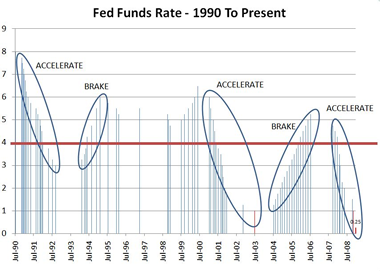
Go back to 1999-2000 and see what the Fed did. They are following the same pattern for 2005-06. If it ain't broke, the Fed will fix it... and good!
August 29, 2006 The Federal Reserve always acts on old information... and is the only cause of U.S. recessions.
December 5, 2006 Last spring I wrote about what I saw to be a sharp downturn in the economy in the "rustbelt" states, particularly Michigan.
March 28, 2007
The Federal Reserve sees no need to cut interest rates in the light of adverse recent economic data, Ben Bernanke said on Wednesday.
The Fed chairman said ”to date, the incoming data have supported the view that the current stance of policy is likely to foster sustainable economic growth and a gradual ebbing in core inflation”.

July 21, 2007 My guess is that if there is an interest rate change, a cut is more likely than an increase. The key variables to be watching at this point are real estate prices and the inventory of unsold homes.
August 11, 2007 I suspect that within 6 months the Federal Reserve will be forced to lower interest rates before housing becomes a black hole.
September 11, 2007 It only means that the overall process has flaws guaranteeing it will be slow in responding to changes in the economy... and tend to over-react as a result.
September 18, 2007 I think a 4% rate is really what is needed to turn the economy back on the right course. The rate may not get there, but more cuts will be needed with employment rates down and foreclosure rates up.
October 25, 2007 How long will it be before I will be able to write: "The Federal Reserve lowered its lending rate to 4% in response to the collapse of the U.S. housing market and massive numbers of foreclosures that threaten the banking and mortgage sectors."
November 28, 2007 FED VICE CHAIRMAN DONALD KOHN
"Should the elevated turbulence persist, it would increase the possibility of further tightening in financial conditions for households and businesses," he said.

"Uncertainties about the economic outlook are unusually high right now," he said. "These uncertainties require flexible and pragmatic policymaking -- nimble is the adjective I used a few weeks ago."
http://www.reuters.com/

December 11, 2007 Somehow the Fed misses the obvious.
fed_rate_moves_425_small.gif
[Image from: CNNMoney.com]
December 13, 2007 [from The Christian Science Monitor]
"The odds of a recession are now above 50 percent," says Mark Zandi, chief economist at Moody's Economy.com. "We are right on the edge of a recession in part because of the Fed's reluctance to reduce interest rates more aggressively." [see my comments of September 11]
January 7, 2008 The real problem now is that consumers can't rescue the economy and manufacturing, which is already weakening, will continue to weaken. We've gutted the forces that could avoid a downturn. The question is not whether there will be a recession, but can it be dampened sufficiently so that it is very short.
January 11, 2008 This is death by a thousand cuts.
January 13, 2008 [N.Y. Times]
“The question is not whether we will have a recession, but how deep and prolonged it will be,” said David Rosenberg, the chief North American economist at Merrill Lynch. “Even if the Fed’s moves are going to work, it will not show up until the later part of 2008 or 2009.”
January 17, 2008 A few days ago, Anna Schwartz, nonagenarian economist, implicated the Federal Reserve as the cause of the present lending crisis [from the Telegraph - UK]:
The high priestess of US monetarism - a revered figure at the Fed - says the central bank is itself the chief cause of the credit bubble, and now seems stunned as the consequences of its own actions engulf the financial system. "The new group at the Fed is not equal to the problem that faces it," she says, daring to utter a thought that fellow critics mostly utter sotto voce.
January 22, 2008 The cut has become infected and a limb is in danger. Ben Bernanke is panicking and the Fed has its emergency triage team cutting rates... this time by 3/4%. ...

What should the Federal Reserve do now? Step back... and don't be so anxious to raise rates at the first sign of economic improvement.
Individuals and businesses need stability in their financial cost structures so that they can plan effectively and keep their ships afloat. Wildly fluctuating rates... regardless of what the absolute levels are... create problems. Either too much spending or too much fear. It's just not that difficult to comprehend. Why has it been so difficult for the Fed?

About Me

My photo
Michigan, United States
Air Force (SAC) captain 1968-72. Retired after 35 years of business and logistical planning, including running a small business. Two sons with advanced degrees; one with a business and pre-law degree. Beautiful wife who has put up with me for 4 decades. Education: B.A. (Sociology major; minors in philosopy, English literature, and German) M.S. Operations Management (like a mixture of an MBA with logistical planning)